
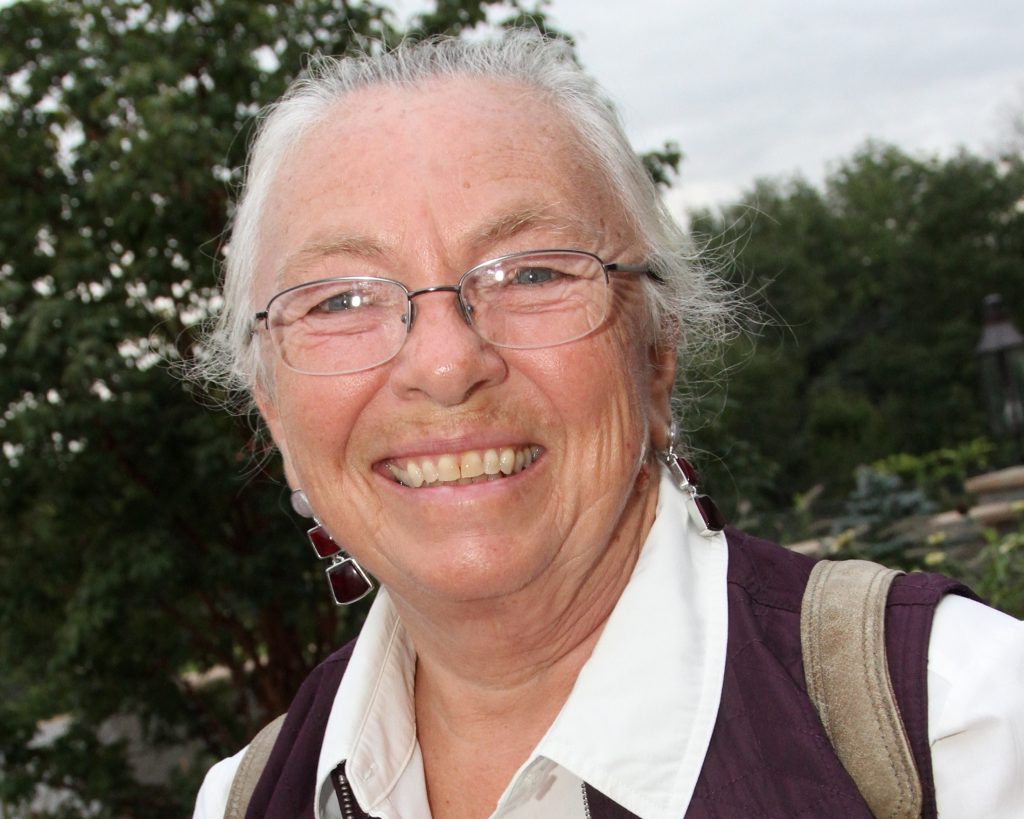
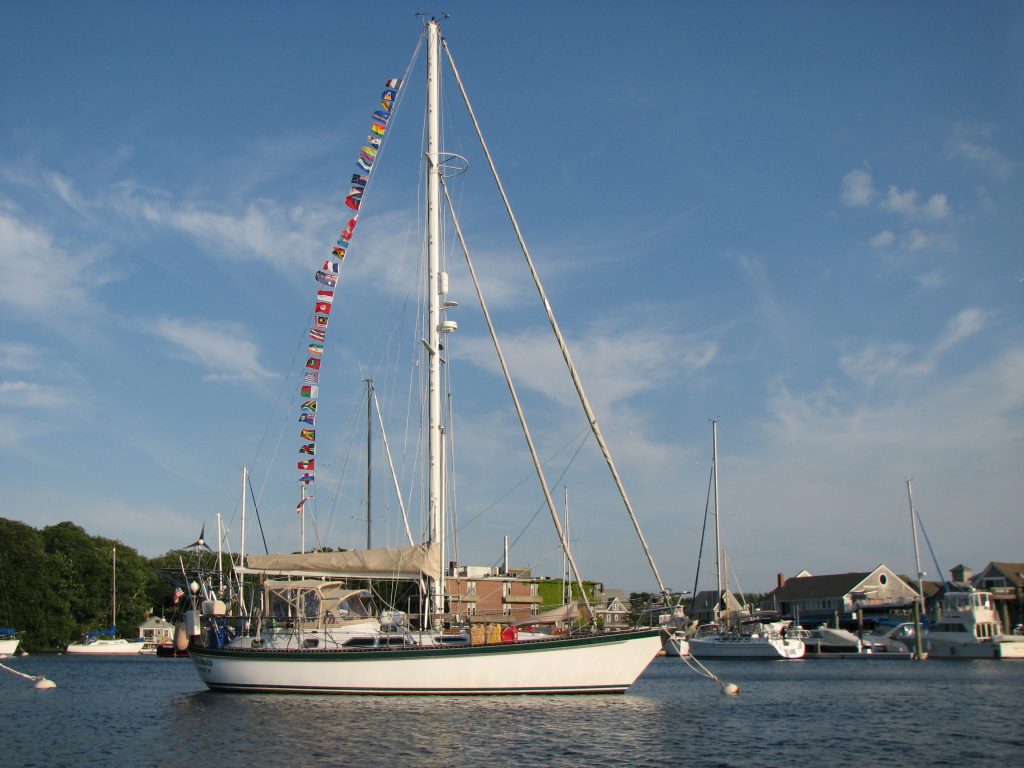
After almost 6 years of traveling, we sailed into Woods Hole on Cape Cod. We continued living aboard for the next five years and I wrote about that, adding ‘and Beyond’ to the title of the blog. Then shortly before Mark’s death in 2016, we sold our beloved Windbird and my travel logs became land logs. At this point, I had written a daily account for each and every day for 11 years. I fully intended to end the blog at that point, but when I wrote that news in a log, I got many responses saying that I really needed to keep posting. At the same time, I realized that I couldn’t stop writing. Summarizing each day had become a permanent part of my life and I will probably continue writing until I can no longer. These postings reflect the ordinary, and sometimes the extraordinary, days in my life and I would like to invite you to join me on my journey.
Day 241, Year 5 Day Trip to Nosy Ankarea
Day 241, Year 5 Day Trip to Nosy Ankarea
Date: Thursday, June 24, 2010
Weather: Another Gorgeous Day, Winds 15 From Land, Then from Sea
Location: Maribe Bay, Nosy Mitsio, NW Madagascar
Bolatara! I really have no idea how to spell this, but it is the equivalent in Malagasy (pronounced MAL-a-gash) of ‘Bonjour’ in French. And it was a good day. Ed and Lynne came over in their dinghy at 7:30 am. We attached their dinghy to Windbird, pulled up the anchor, and motored Windbird the four miles out to little but high Nosy Ankarea. We arrived by 8:45 am, took Constance’s dinghy to shore, and walked the beach at low tide. It is always fun to see what kind of shells wash up in different places Here it seems that small cowries, cones, and nerites (little dome-shaped shells with ‘teeth’ at the opening on the underside). We also found some heavy shells that I can only describe as ‘bumpily.” My find of the day was a Textile Cone. My two front pockets were so heavy with rocks and shells that I was sure my pants were going to fall down before we completed our walk. But I made it just fine and am enjoying looking at my haul of smooth black rocks and shells from the beach. When we came to the bigger black rocks at the end of the beach, we had another delightful surprise. There were lots of small baobab trees in bloom and some VERY large baobabs as well. One of the big trees was about thirty feet in circumference and had a large hole in it so that you could see that it was hollow inside. After investigating the baobabs, large and small, we walked on a trail that led back in the general direction we had come from. We immediately saw that this end of the beach, in the forest just off the beach, was the location of a resort at some time in the past. We could see the foundation posts of beach huts and further back in the forest we found two buildings which at some time in the past had three bathrooms each-with running water for showers and a toilets. So the huts on the beach were probably built like the traditional huts here since there is no sign of them left except for the foundation posts and the bathhouses were constructed of brick, concrete, and tile and were quite modern and durable. There was a lovely Morning Glory Bush with delicate pink morning glory flowers, a Coral Hibiscus with a red, fringy flower with a long stamen hanging down several inches with stigmas at the end that looked like a little bottle brush. There were a couple of Frangipani trees in bloom with white flowers with yellow centers and the required Bougainvillea with dark red blossoms. There were mango trees, papaya trees, and banana trees. You could see that this resort was its own little paradise at some time. We kept following a path and then made our own path until we reached a boggy area. We saw a dead crab that gave us some idea of what the live critters who live here look like and we saw a beautiful butterfly, maybe a dragonfly, with clear wings that were tinged with a bright, bright red. There was an orange butterfly and a white one with red and black spots. So we chased butterflies for a bit and than took the path back out onto the beach. It was a lovely explore.
We fought the incoming tide to get the dinghy off the beach and went back to Windbird to have lunch and then motor back to Maribe Bay. We are at anchor not far from where we have been the past two nights, but in the morning we will up anchor again (weather permitting) and head around the south side of Nosy Mitsio to an island called Tsara Banjina. It is about twelve miles from here, so we should arrive early in the day. The water there is supposed to be crystal clear and the snorkeling very good. Our plan is to spend only one night there and head for Nosy Sakatia near Nosy Be on Saturday. We know there is internet there and we are trying to reach there in time to talk to Justin, Jo, and Ziggy before they head to England (on Monday) and to ‘talk’ to Jonah on his first birthday. If all this works out, we will then check-in on Monday in Hell-ville. Constance is not leaving with us tomorrow, but they hope to join us in Hell-ville for the check-in process. I hope the name of the town doesn’t indicate the type of check-in process we might have!
 |
| 100624 Day 241 Nosy Mitsio, Madagascar–Day Trip to Nosy Ankarea |
Day 240, Year 5 Walk About on Nosy Mitsio
Day 240, Year 5 Walk About on Nosy Mitsio
Date: Wednesday, June 23, 2010
Weather: Gorgeous Day, Winds 5-10 SE to SW to S
Location: Maribe Bay, Nosy Mitsio, NW Madagascar
It was up early this morning so I could get a laundry on the line and Mark could try to fix our pressure water pump before heading to shore. We had made arrangements for Constance to pick us up in their dinghy as it looked like low tide and their dinghy is much easier to carry up the beach. We were delayed when Constance realized their dinghy fuel tank was stone dry (hopefully fuel was not siphoned from it during the night) and while we were waiting the man who greeted us when we arrived yesterday returned. He speaks no English, but he understood that we were going to land to go for a walk. Now I know to call it a promenade, but I learned that as the day progressed. Anyway, Zachary (Zac-har-EE) met us on shore and became our guide for a three and a half hour walk about the island. What looked like a couple of little huts near the beach turned out to be a village of about forty people. We met Zachary’s mother and father who were 73 and 88 respectively. We know Zachary’s mother was born in 1937 as she showed us her Malagasy identification card, but the father didn’t really look 88-but maybe. The mother was sick and needed an injection that had been prescribed for her. Lynn gave her the shot as they didn’t know how and there is not medical personnel on the island.
We met mothers with tiny babies, lots of smiling children, goats, chickens, and zebu. There was a little store, what looked like tables where tourists could be served food, and an outdoor dancing area with sound equipment in a small hut. We assume all of this is to serve the tourists who come and stay at some huts to the left of the village as you look at the island. We walked across the island from north to south, up and over a small hill, and visited more villages on the windward side of the island. There was very little beach on that side of the island and many of the little huts were right on the water. The huts were small but I could just imagine how wonderful the sound of the lapping waves would be during the night. Huts are constructed of poles (small branches from trees) and then the sides and roof are covered with palm fronds. The fronds from the palms here are small and rounded, not long like coconut palms, so they are arranged in fan shapes in the walls. Everywhere we went women were winnowing a grain that looked something like barley, but we could never understand what they do with the grain. They have bananas here, but plantain seemed to be the food of the day. When we went as far as we could go, we stopped at a hut and were offered some of the plantain and coconut crème staple. Even with the coconut crème, it was not sweet and actually was very filling and had a pleasant taste.
As I write this log, Mark is outside negotiating for spiny lobster. It is dark but we can see that that the lobsters are good sized. But we had to ask Ed and Lynne to come over in their dinghy to help with the negotiation. Four lobsters ended up costing us $5US and a t-shirt. Not bad. But with absolutely no comprehension of French, we do not understand anything. It is very frustrating. We did learn to say goodbye in Malagasy today and that is ‘veloma’ pronounced ve-low-mah. We were taught to say Bon Jour in Malagasy, but neither of us can remember that one. We’ll have to add that tomorrow.
 |
| 100623 Day 240 Nosy Mitsio, Madagascar–Island Tour |
Day 239, Year 5 Andranoaombi Bay to Nosy Mitsio
Day 239, Year 5 Andranoaombi Bay to Nosy Mitsio
Date: Tuesday, June 22, 2010
Weather: Gorgeous Day, Winds SE 20-25 ’til 1 pm, then SW 5-10
Latitude: 12 degrees 54.498 minutes S
Longitude: 048 degrees 34.713 minutes E
Location: Maribe Bay, Nosy Mitsio, NW Madagascar
Today was all about rainbows and seaweed, eggs, bananas, crab, and a new location. Yesterday we traveled 46 miles from Ampanasia Bay to Andranoaombi Bay. This brought us from the tippy top of Madagascar down around the first major cape. Today we traveled 31 miles from Andranoaoambi Bay down to Nosy Mitsio. Remember that in Madagascar, ‘nosy’ means island. So we are anchored in v-shaped Maribe Bay on the northern side of Nosy Mitsio. Immediately upon entering the bay, the dugout canoes came paddling our way. And there were two sailboats in the bay and one anchored off an island just a couple of miles north of the inner bay. But before I go into more detail about where we are, I’ll go back and explain what today was all about.
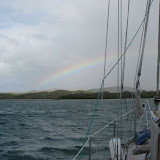
We left Andranoaombi Bay just before 9 am, but already the crabs that we trustingly ‘paid for’ with a t-shirt were delivered and they were beautiful. A huge papaya was also brought out to us. We traded a pair of Mark’s shorts and an old t-shirt for this. Then we ate fried eggs, over easy, for the first time since leaving Thailand in January. We had traded a t-shirt for thirteen eggs yesterday from Chief Jean-Pierre and the eggs turned out to be a great trade. Two of the four eggs we had this morning were so fresh I think they were taken right out from under the hen. The other two were a little older, but not bad. We then ate bananas for the first time since arriving in Chagos. After not visiting a store for two and a half months and a fresh food market for more than three months, getting any fresh food of any sort is a real treat. We were still boiling the crabs as we left the anchorage this morning and had just gotten those out of the pot when we exited the bay and hit the waves and wind. We were sailing into 20 to 25 knots of wind and doing the hobby horse thing. As we passed Nosy Antolo, a little island just out Andranoaombi Bay, I looked around to see if there were any whales. Friends who were there in September last year stayed for a week watching mother humpbacks and their babies swim all around them. We saw no signs this morning as I think they have just not arrived from Antarctica quite yet. The whales come here in July to have their babies and then head back south in October. So we will revisit this area in a couple of months. As we hobby horsed south Windbird made rainbows every time she hit a wave. The water would spray and the little rainbow would form. It was just beautiful. While watching the rainbows we were making, I noticed that there was a huge amount of seaweed in the water. It is the first seaweed we have seen in a very long time–certainly the first we have seen in the Indian Ocean. So I’m wondering if the reason the whales come here to raise their young has anything to do with the seaweed. This is another question for my scientist daughter. When I get an answer, I’ll let you know.
When we approached Maribe Bay, one of the sailboats at anchor called us to give us anchoring information. It was Single Malt, a boat from Switzerland that was in the Maldives with us and again in Peros Banhos in Chagos. We were then approached by an older man with what was probably his son in a dugout wanting to know if we spoke French. I told him no French only English, but somehow we managed to order two kilo of spiny lobsters for tomorrow. We haven’t had those since the Vanua Balavu in the Lau Group in Fiji. I have no idea what the gentleman will want in trade, but I’m sure we can come up with something. Then another dugout came offering oranges and giving us the same story they had already given Constance about needing food for a baby whose mother doesn’t have enough breast milk. This story was all told with sign language, but quite understandable. It is probably just a line to get more for their trade, but I gave them dried milk powder anyway. Then they wanted rum, cigarettes, and who knows what else. But we just smiled and said no and they just smiled and left. I’m sure we’ll see those two guys again tomorrow
Tonight we enjoyed the crabs we got in Andranoaombi Bay as on appetizer at happy hour with Ed and :Lynne.
Tomorrow will be a day of exploring on the island. The next day we will visit an island out in the entrance to the bay to do some snorkeling and exploring, and then on Friday we might head just south of here to Tsara Banjina. This is an island where the Lonely Planet recommends that you “drop your swanky anchor.” It is tiny island with a very nice resort, crystal clear water, and great snorkeling. Sounds like a winner to me. And after a stop there we will head to Nosy Sakatia and then on to Nosy Be to check into Madagascar and go to the super market. I’ve never been so anxious to go shopping in my life.
 |
| 100622 Day 239 Nosy Mitsio, Madagascar–Passage from Andranoaombi Bay |
Day 238, Year 5 Moving On
Day 238, Year 5 Moving On
Date: Monday, June 21, 2010
Weather: Sunny Day; Winds Variable 5 to 30
Latitude: 12 degrees 26.991 minutes S
Longitude: 048 degrees 46.201 minutes E
Location: Andranoaombi Bay, NW Madagascar
It was a good day for Windbird and we’re hoping it was a good day for our daughter-in-law Jo as it was her birthday. Happy Birthday, Jo! We are with you in spirit and hope you enjoy the little gift we sent from India. We have another birthday coming up later in the week. Our youngest grandbaby, Jonah, will be one year-old on Saturday. And sometime yesterday or today was summer solstice for you and winter equinox for us. Or does it work that way? Anyway, it is a week of celebrations. But for sure the stars were aligned today and allowed us to finally get out of Ampanasia Bay. Constance almost didn’t make it. They went aground right after raising the anchor. They put up their mainsail and were able to sail off the soft mud, but it made for a bit of early morning drama. Constance had hoped to put their headsail back on early this morning before the winds came up, but that didn’t happen either. We had winds all night which we hadn’t had for days and it stayed windy until almost noon today. So we sailed away with mainsails and staysails. This was fine as the winds were 22 to 30 knots and we flew for the first four and a half hours. We had gone 30 miles by 11 am, but then the winds started clocking and instead of SE winds that we have had since leaving Chagos all of sudden the winds were from the NW . . . and then the W . . . and finally from the SW. The last twenty miles of the trip we had to motor sail as the winds were so fluky. But we made it and it felt good to put down an anchor in a new place.
Andranoaombi Bay is a deep bay running north-south. There are tiny villages around the bay, only three of which we can see, but we are told there are five. As soon as we arrived, the outriggers started arriving. Jean-Pierre and his son, probably eight years old, brought limes and eggs. Two other men came with bananas. And a man came in a third canoe promising (we think) crabs tomorrow. We traded hats and t-shirts and fishing hooks, gave them bottles of water, and gave Jean-Pierre’s son writing books and colored pencils. We are not very good at the trading thing. We give away much more than we get in return, but it feels good to do this. Besides, we have too many t-shirts onboard that haven’t been worn in more than four years, so this is a great way to clean house and get much needed supplies in return. It is a win-win situation, albeit a bit frustrating that we can’t understand a word of what is being said. The people we met today spoke a mix of Malagasy and French, and we speak not a word of either, so trading is quite interesting. We’re not sure if we will move on tomorrow or spend another day here. I guess it will depend on where the wind blows us.
 |
| 100621 Day 238 Andranoaombi Bay, Madagascar |
Day 237, Year 5 Father’s Day River Trip
Day 237, Year 5 Father’s Day River Trip
Date: Sunday, June 20, 2010
Weather: Mostly Sunny AM, Overcast PM; Winds SE 18-22 Knots
Location: Ampanasia Bay, NW Madagascar
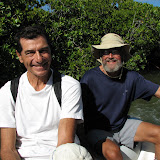
Happy Father’s Day to all of the fathers we know. Ed and Lynne graciously let us use their SAT phone to call our son-in-law Jed and son Justin to wish them a happy day. We got through to Jed, but not to Justin. So Justin, if you are reading this, we hope you had a wonderful day. Heather and Jed were getting ready to take off on a bicycle ride with Jonah and Sam, so we caught them just in time. Sam talked to Granddad and told him he missed him and Jonah waved at the phone, so Mark is a happy father/grandfather. My present to Mark was to hang individual tiny photos of Heather, Jed, Justin, and Jo on the wall by his side of the bed. Now every morning when he gets up, the first thing he will see is photos of his kids. His other present was a reprieve from work for a trip up the river. At first the river was about 100 feet wide, but by the time we got as far as we could go, it was less than 10 feet wide. We saw birds–a bee eater, a black egret, and a fish hawk-and we really enjoyed the quiet without incessant winds blowing. We saw zebu (Madagascar cows) along the way and lots of jumping fish. When we got as far as we could go, we got out and explored. We were surprised to find coconut palms, lots of zebu and a man tending the cows. We were even more surprised to find fenced stockades for the cows, and a fenced off garden area where banana trees and tall grasses grew. By the time we left, there were three men tending the cattle along with a little white dog. We got waves from the men, but no one approached us. We saw more young baobab trees, some in bloom, and lots of jumping fish. There was one little bird that looks like an iridescent bright blue flash that kept crossing our path, but it was impossible to photograph. All in all it was just a nice quiet reprieve from being on the boat for so many days. Later in the day, Mark, Ed, and I went to shore to burn garbage and explore a bit more. I ran into a flock of Sicklebilled Vangas, a black and white bird with a long curved bill. I also found another flowering baobab. The baobabs we are seeing here have white flowers with a yellow center and sometimes a red tinge to the edges of the white flowers. So it was a good day of exploration.
Ed and Lynne came over for dinner and we finally celebrated our arrival here with a little champagne. Ed hopes to get up at 5:30 in the morning and try to raise a headsail before the winds start blowing, so we will get up and be there to help. We will then pull up anchor and head south, maybe 20 miles to an island or maybe 50 miles to another bay. It will all depend on how the sail raising goes and what the winds are like. But one way or another, we should be leaving Ampanasia Bay tomorrow.
 |
| 100620 Day 237 Ampanasia Bay, Madagascar–Father's Day River Trip |
Day 236, Year 5 Finally . . . An Explore on Land
Day 236, Year 5 Finally . . . An Explore on Land
Date: Saturday, June 19, 2010
Weather: Mostly Sunny AM, Overcast PM; Winds SSE 20-28 Knots
Location: Ampanasia Bay, NW Madagascar
No let up in the wind except at night. In fact, last night was very quiet and peaceful until just about 8 am and then the winds returned with a vengeance. And according to Graham on the South African Maritime Mobile Net there will not be the let up early in the week as previously forecast. He says we should have what we have now for the next five days. So we are going ahead with repairs in the wind and do plan to try and leave on Monday. Constance now has a secure headstay but the roller furler has a problem. But with this wind, we won’t need headsails anyway. Our smaller staysails should work just fine. To stem the leak, the plan is to plug the scupper drain with a plug using the Life Caulk early tomorrow morning and then we will all head up the river to see what we can see.
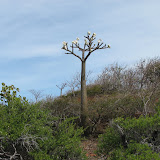
After finishing the job of securing the headstay on Constance, we all got in our dinghy and headed out for a little explore on land. Through the binoculars we can see a beach area to the southwest and this morning I saw a number of cows there. I can also see the tops of some very large baobabs in that area, so we decided to land the dinghy on that beach, walk on land a bit, and then dinghy around to the beach with the baobab in bloom. I still don’t know for sure that the tree in bloom is a baobab, but I did read in the Lonely Planet that baobabs do not bloom until they are over 100 years old. Many of the baobabs in Madagascar are over a 1,000 years old, and since the one on the beach is no more than fifteen feet tall, it is a youngster. And since everything about its shape tells me it is a baobab, I will call it that for now.
We picked up Ed and Lynne and off we went. As we got closer to the dark-colored beach we could see that it is covered in what looks dark paving stones. Not exactly the best landing spot for a dinghy, but we pulled the dinghy on the beach and enjoyed standing on ground for the first time in twenty days. Our last walk on land was on May 30 when we walked on the reef flat from Ile Mapou to Ile De La Passe. So today’s walk was a true pleasure. To the left of the barren beach area there were mangroves and two other trees that are very salt-water resistant as they grow right below the tide line. Maybe they are mangroves as well, but they did not have the gnarly, knotty trunks and roots of the mangroves. As we walked up the little hill from the beach area we were met by hundreds of small Wild Tamarind trees. These are also called Mimosa, Acacia, and Cow Tamarind. The reason for the last name is that the leaves and seed pods of these trees can be used as an extremely high protein fodder for cows and goats, both of which graze here. However, if horses, donkeys, and pigs eat the fodder, they lose their hair. Since there are none of those here, we have no problem. The Wild Tamarind have thorns all over their trunks and branches as do most of the other trees that we saw today. So I guess this is how the ‘spiny bush’ gets its name. We found a fishing hut over the hill on the beach at another little bay and it had a dugout canoe sitting beside it. The hut was built of small branches and covered with thatching for the roof and the walls. It sits right on the tide line and inside was a floor and even a trash can. So obviously someone comes here and uses it. We found a number of other interesting trees, all with seed pods or fruit that we have never seen before. The nightshade plant here looks like the one that grows in the eastern US, but the one here has thorns on the leaves and has beautiful, bright yellow fruits that look like cherry tomatoes. I’m assuming this plant is poisonous as I believe all members of the nightshade family are, but again, I’m going on memory. We had to fight the wind to get the dinghy off the shore and then got soaking wet as we motored into the wind to get around a point and to the bay with the baobab tree in bloom. One thing about this wind, you don’t stay wet too long. We scrambled up the gravel beach and found that the blooming baobab is about fifteen feet high. We took lots of photos and then as we started looking around we found more little baobabs. These were knee high to waist high and had no branches. They actually looked more like a straight cactus. Evidently baobabs are some of the slowest growing trees on earth, so the ones that came up to our knees were probably no more than ten years old. We found another one about ten feet tall and it had branches at the top but no blossoms. So we assume it was just not old enough yet. We gather from what we have seen that baobabs grow straight up for a number of years before branching out at the top. None that we have seen have leaves, so we are yet to learn about that.
It is 5:15 pm here and the sun is getting ready to set. It sets at 5:30 pm and rises again at 6:00 am. The temperature is 77 degrees F which feels very cool to us. We don’t have to use fans anymore (Who would with this wind?) and when the sun goes down, we feel chilly. I guess that’s what happens when you are used to temps in the 80’s, but we are not complaining. This is a wonderful temperature. We even have to sleep with a sheet over us these days.
 |
| 100619 Day 236 Ampanasia Bay, Madagascar–First Time on Land |
Day 235, Year 5 Windier Than Yesterday
Day 235, Year 5 Windier Than Yesterday
Date: Friday, June 18, 2010
Weather: Mostly Sunny with a Few Light Showers; Winds SE 20-30 Knots
Location: Ampanasia Bay, NW Madagascar
Some things never change. It is still windy. In fact, it was as windy today as when we arrived. So we sit and wait. Ed did go up his mast early this morning before it got too windy, and he did get the headstay reattached. But he is not done with the job and it was just too windy to go back up today. He also did not get to go in the water and plug the drain that is leaking. He’ll go up the mast first thing in the morning and we’ll see where the day goes from there. Mark wanted to do some epoxy work on deck today, but it was too windy for that as well. It was a good day for inside work. Mark worked on the VHF radio trying to get the DSC (digital selective calling) option working, but he was not successful. We can’t use this until we get back to the Caribbean, but since there was nothing else to do he played around with this. He did a few other odd jobs and I baked bread and a cake, did laundry, and worked on those Chagos photos. Like I already said, some things never change. Wind or not, we plan to go back to the part of the bay where we saw the baobab tree (or whatever kind of tree it is) in bloom so that I can take more photos. We’ll also explore on land a bit. Then on Sunday morning we’ll explore the river as a special Father’s Day trip. If everything goes as planned, we’ll be out of here on Monday morning-wind or no wind.
 |
| 100618 Day 235 Ampanasia Bay, Madagascar–Rainbows |
Day 234, Year 5 Still No Break in the Weather
Day 234, Year 5 Still No Break in the Weather
Date: Thursday, June 17, 2010
Weather: Sunny, Winds SE 18-25 Knots
Location: Ampanasia Bay, NW Madagascar
You can’t have it all. Yesterday it was overcast and rainy but the winds were down a bit. Today the sun shone brightly all day but the winds were back up to 18 to 25 knots with no let up all day. We were getting white caps on the bay once again but as the sun fell lower in the sky the winds stayed closer to 18 than to 25 and the number of white caps were greatly reduced. Mark and I took advantage of that and headed out in the dinghy to explore the shoreline. Mangroves line the shore. There are breaks in the wall of mangroves here and there and in one of those breaks we found a pebbly beach with two dugout canoes on shore. We saw three cows but were not close enough to see if they had the fantastic horns of the Malagasy zebu (just another word for cow). And we also found a beautiful tree in bloom. I have no way to identify it as I have absolutely no resources outlining Malagasy flora. I thought this tree was a baobab based on the bottle shape of the trunk, and it might be, but on close inspection of the photos, I see the trunk and branches all have spiny thorns and I didn’t know baobabs were thorny. The tree had no leaves but the blossoms looked like little bouquets. I have to go back and beach the dinghy so I can inspect this a little closer. There are a few others scattered here and there, but none so close to the shore. In this stark environment, a tree in blossom is such a beautiful thing. So on the list for tomorrow is a return to the area where that tree is located for a little land exploration.
Now back to the progress being made on repairs. Mark completed the caulking job on the deck chain plates and I continued cleaning the stainless. It was so windy that one of my rags blew away and the container of stainless polish went flying and landed upside down on the deck making a nice little mess. So I finished the bow pulpit area and quit on that job for the day. I washed the cockpit seat cushions and made pizza for dinner. In the late afternoon Mark went up the mast to inspect the rigging one more time and found a problem we had not seen before. The lower stay on the starboard side has one wire sticking out where it connects to the mast. This same stay had this same problem when we reached New Zealand in 2006 and we had it replaced. Now we will have to replace it again and we have no idea why this same stay keeps having the same problem. Since we cannot replace this until we get to South Africa, we will use some Amsteel line made from Dyneema and fashion another lower so if the wire one goes, the rope one will be in place. Dyneema is a very strong line, actually almost twice as strong as the wire rigging, so we think we should be fine. And even if both lowers broke, it should not affect the stability of the mast. At least that’s the theory.
Constance is still battling the slow leak. They had to take out the contents of yet one more cabinet to dry it out. So their boat is just full of stuff that should be in the cabinets but cannot go back until the leak is completely stopped. Putting the Life Caulk on the outside yesterday slowed things down, but now Ed needs to actually plug the underwater drain that is cracked. He will push a wooden peg in the hole sealing it with the Life Caulk. I don’t know what we would have done without the tubes of this stuff. When Lynne flew back to the states to see her mother in March, we contacted my sister-in-law Sue and her husband Brad in Boynton Beach where Lynne’s mother lives. We had Brad and Sue go to West Marine and buy three tubes of this caulk along with some other stuff and take it to Lynne so she could bring it back to us. We were going to use it to redo the caulking in our teak deck, but that didn’t get done, thankfully, and now we have it to help seal off the leaks in Constance and our leaky chain plates. What a stroke of luck that we happened to have the caulk. I now call it Life Saver instead of Life Caulk. So thank you Brad and Sue for shopping for us.
The South African Maritime Mobile Net tells us that we will get a bit of a break in the winds on Sunday, Monday, and Tuesday. So if Constance is ready to go, we will plan to head south. Windbird is down to the last two tomatoes from India, the last two eggs from the Maldives, and the last case of beer. We haven’t seen a fresh green vegetable in a couple of months, so it is time for a stop with a store. That would be Nosy Be which is more than a hundred miles from here. But by this time next week, we should be there. Super Marche (the name of the grocery store there) here we come!
 |
| 100617 Day 234 Ampanasia Bay, Madagascar–Tour of the Bay |
Day 233, Year 5 More Boat Repairs and MoreYucky Weather
Day 233, Year 5 More Boat Repairs and MoreYucky Weather
Date: Wednesday, June 16, 2010
Weather: Overcast with Rain Squalls, Winds SE 15-20 Knots
Location: Ampanasia Bay, NW Madagascar
Evidently our information that it rarely rains in June in northwest Madagascar is just wrong. It rained off and on all night and off and on all day. And as we go into another evening, it doesn’t look like that pattern is going to change. So we have still not been to shore and I’m getting a little stir crazy. But I’m not really interested in walking through the bush in the rain, so we will wait. We did launch the dinghy today but used it only to go back and forth to Constance. Being stuck on the boat means that we are getting lots of work done. I keep plugging away at those Chagos photos and Mark keeps ticking things off the boat repair list. The inner forestay is back up but it was too wet to put caulk under the port side chain plate covers. So that is tomorrow’s job. Ed and Lynne were up early and Ed was up his mast by 7 am. What he found was good news. Their head stay is not broken. The attachment to the mast is, but that can be replaced without taking the whole rig down. He does need calmer weather to unwind the head sail and take it down and that might have to wait until we are further south. I don’t think the wind ever stops blowing up here. Ed then went in the water and used some Life Caulk that Lynne had brought back for us when she went home from India in March. We didn’t know it until a couple of days ago when we read the tube, but it can be applied underwater. So Ed found the ten-inch hairline crack in the hull, sanded the area, and applied the Life Caulk. That has not stopped the weepage on the inside, so more exploration will take place tomorrow. But progress is being made.
We saw more signs of life in the bay today. Two men in a homemade boat went rowing past Windbird on their way to the south side of the bay. I was surprised that they didn’t stop but I have heard other cruiser say that there are fishermen in this bay that do not come to sailboats to trade. The other sign of life we saw today was a huge flock of beautiful white birds that swooped and danced past Windbird at sunset. I’m going to take that as an omen of good weather to come!
Day 232, Year 5 Working on the Rigging
Day 232, Year 5 Working on the Rigging
Date: Tuesday, June 15, 2010
Weather: Partly Sunny with Rain Squalls, Winds SE 15-20 Knots
Location: Ampanasia Bay, NW Madagascar
The weather is not cooperating. The winds were a little less today than yesterday, but it is still very windy. Because we have mast steps all the way to the top of the mast, it was safe enough for Mark to go up the mast and investigate the problem with our inner forestay. It was impossible to tell from below what the real problem was but as soon as Mark went up he could see that the stay was definitely broken. This is the oldest stay on the boat, replaced in 2001, and it is worrisome that it broke. We certainly don’t want the headstay to break. It was replaced in 2003, so hopefully it will be fine until we get home. Mark brought the inner forestay with roller furler and sail attached down to the deck and was lucky enough to find the right Sta-Loc fittings to correct the problem. Getting it back up in these winds will be a little trickier, but Mark has asked Ed to come over and help us with this tomorrow. If it goes back up and everything is just right, then we will once again be a cutter rig and all of the things broken on the trip from Chagos to here will be fixed. Maybe then Mark can relax. He has been working like a madman doing one repair after another. Staying with the rigging theme, we are also re-caulking the deck chain plates. Mark also unscrewed all of the nice little wooden plates that cover the massive chain plate fittings in the cabinetry of the main cabin. The chain plates hold all of your rigging in place and our chain plate deck cover plates were leaking a bit which caused some surface rust on the bolts below. So we cleaned and cleaned and got rid of every spec of rust, sprayed some magic corrosion inhibitor on the plates and then covered them once again. This is the first time I have really seen the chain plates and I was truly impressed with the size and number of bolts that hold down our rigging. This boat is really built like a tank and I like that!
We saw signs of life onshore today. A lone man was working on a sandbar attached to shore at low tide. I took photos and zoomed in and could see that he had arrived in a dugout outrigger canoe. We didn’t see him come or go, but there must be a village somewhere near. As more and more of the repairs are completed, and if the winds do not get stronger again, I am really hoping to make it to shore soon. Constance still has much more work to do and they might be able to take the time to go with us, but I’m going to try and convince them that they need a little break. Hopefully I’ll have something land-based to report tomorrow.
 |
| 100615 Day 232 Ampanasia Bay, Madagascar–Boat Work |