by Judy Handley | Aug 24, 2010 | Madagascar, Sailing Logs Year 5 |
Day 302, Year 5 Mahavanga to Baramahamay Bay
Date: Tuesday, August 24, 2010
Weather: Most Cloudy with No Wind
Latitude: 13 42.797 S
Longitude: 047 54.002 E
Location: Baramahamay Bay, NW Madagascar
Just when we think we are getting the hang of sailing with the morning SE breeze from land and the afternoon NW wind from the sea, we get a day like today with no wind and absolutely glassy seas. So we didn’t do much sailing, but we did have a nice calm trip from Mahavanga northwards. After a bit of a rocky and rolly night, the calm trip was most welcome. We arrived in Baramahamay Bay mid-afternoon and were delighted to see that Peter and Carla of Odulphus are here. They came over for Happy Hour tonight and we caught up with our separate adventures of the past couple of weeks. Peter has a new plan for the trip from here to South Africa that would require us to leave this area a little sooner than planned and travel further south down the Madagascar coast. So we have much to think about. But they have actually discovered a tiny local restaurant on shore and we are going there for lunch tomorrow. Peter told the story of going there and ordering chicken for lunch. Preparation takes about an hour, so he and Carla went for a walk. When they returned they were told that the chicken escaped and that he would have to order something else. Too funny!
We got an email from our son-in-law Jed this morning that gave us a bit of a scare. He responded to yesterday’s log where I stated that there is no threat of ciguatera in Madagascar. Evidently that is not true. Here’s what we received from Jed:
University of Florida From http://edis.ifas.ufl.edu/in742
(University of Florida Institute of Food and Agricultural Services)
In the Indian Ocean, ciguatera commonly occurs in Reunión, Madagascar, Mauritius and the Seychelles and has also been reported from Sri Lanka, the Maldives and the Comoro and Chagos Archipelagoes.
I have the remaining barracuda filets nicely frozen against the cold plate in our refrigerator and they will stay there until we can research this further. Even though we no longer have a freezer, we do have the luxury of freezing small portions against the evaporator plate of the refrigerator. If our barracuda was carrying the toxin we should have felt the results within eight hours after eating it. Since we didn’t, there is probably not an issue, but there is no sense in taking a chance. You can suffer for months after experiencing ciguatera poisoning and it is not something you want to take a chance with. We just want to check in with the locals we know back in the Nosy Be area and see what they know about this. But once again we are very thankful for Jed’s quick research.
We have decided to stay here tomorrow and go into the village on the north side of the bay. We didn’t visit there before and this is where Peter and Carla tell us there is a restaurant. We will meet them there for lunch. Hope they can catch the chickens tomorrow!
by Judy Handley | Aug 23, 2010 | Madagascar, Sailing Logs Year 5 |
Day 301, Year 5 Forgot to Mention the Barracuda
Date: Monday, August 23, 2010
Weather: Clear Day; Land-Sea Breeze 10-15 Knots
Latitude: 14 21.101 S
Longitude: 047 42.468 E
Location: Mahavanga Coastal Village, NW Madagascar
In yesterday’s log I totally forgot to mention the ‘humongo’ barracuda Mark caught yesterday. It wasn’t the fish of choice, but actually it tasted very good. This one was three feet long (92 centimeters). This kind of barracuda can grow to be 140 centimeters, so our guy still had some growing to do, but I don’t want to see a bigger one. These guys have fangs. Yikes! Barracuda in the Atlantic is rarely eaten because they can carry the dreaded ciguatera toxins, but this is not the case in the Pacific or the Indian Ocean. We marinated part of the barracuda in a tablespoon of chili powder, a tablespoon of kosher salt, and a third of a cup of lime juice. After two hours, we removed it and put it on the grill. We flaked the fish and used it to make barracuda tacos. We added finely chopped cabbage and salsa and had a delicious meal.
Today was a delightful day. We waited until 8:30 am to leave Nosy Lava and headed to Nosy Saba with 15 knots of wind from the SE. This gave us a nice downwind ten mile sail. Just before we arrived at Nosy Saba the land breeze gave way to the sea breeze from the NNW. This was perfect for the anchorage at Nosy Saba. Our first order of business was to go snorkeling. We got in the water and drifted with the current for a bit. We saw some nice fish and some coral, but the visibility was not great. We then went back to the shallow waters closer to the beach and to the north of the anchorage and the snorkeling there was much better. We snorkeled over white sand and green grass patches between the scattered coral. There was an unbelievable variety of small fish here, many of which we had never seen before. We saw some beautiful angel fish, lots of raccoon butterflyfish, and a yellow, white, and black fish that is new to us. So as always, we enjoyed being in the water. We then went back to Windbird and got dressed for a hike on the island.
We hiked uphill through golden grasses and when we got to the top we were surprised to find a ‘rest area’ with artwork. There were four tall concrete columns with fancy white stone rectangular bases built around three of them. The fourth stood apart with nothing around it. On one side of each of the columns there was a sculpted outline of horned zebu. There was also a small rectangular stone base with carved drawings on top. And around the area there were stone benches. It felt strange to find something like this on an island where there is nothing but one resort. As we were contemplating this, a young couple walked from the resort side of the island and arrived at this little Nosy Saba Stonehenge. Elisa and Fabio are from Italy and have spent the last month enjoying their honeymoon in Madagascar. We learned that they had arrived at the resort by plane in the morning. Staying at the Nosy Saba Island Resort for a few days is the end of their Madagascar experience. We wanted to know all about them and they wanted to know all about us, so we jabbered away. Elisa told us that if we had the time we should stay and eat dinner at the resort as it is the best good she has had in Madagascar. Then Elisa and Fabio headed to the beach where we had left our dinghy and we headed across the island to the resort. From the water, Nosy Saba is beautiful with white sand beaches interspersed with rock formations and surrounded by surreal blue water of many shades. Inland, however, it is dry with few trees and golden grasses. We walked down the wide road cut by large machinery that led to the resort. It is different from any place we have seen in Madagascar. Instead of bungalows built to look like the native huts, these bungalows are made of concrete, painted orange, with pointed thatched roofs and glass windows with one-way glass. The resort looked much more African than others I have seen in Madagascar. We were met by a young man who spoke some English and he explained that the resort opened two years ago. There are sixty-five locals who live on the island and work in the resort and there is nothing else on the island. The resort has built a huge number of buildings that house a machine shop, a wood working shop, and storage sheds for machinery.
We walked back across the island and found Elisa and Fabio on the beach where Fabio had re-anchored our dinghy for us. We had not expected to be so long and had not brought it far enough up on the beach for the incoming tide. But all was well. We exchanged email addresses and then we took off for Windbird so we could cross to the mainland before dark. We are anchored just off a village on the shore which appears to be the only thing for miles. There is a hillside above the village that is the light, light green of new grass. I’ll have to look at the photos to try and figure out what is growing here because we will not be going ashore. Tomorrow we head for Honey River at an early hour as it is a long sailing day.
by Judy Handley | Aug 22, 2010 | Madagascar, Sailing Logs Year 5 |
Day 300, Year 5 Back North to Nosy Lava
Date: Sunday, August 22, 2010
Weather: Overcast, Clear, Overcast; Land-Sea Breeze 20 Knots
Latitude: 14 32.608 S
Longitude: 047 37.199 E
Location: Nosy Lava, NW Madagascar
Up at 5:45 am, anchor up by 6:25 am, and arrival in Nosy Lava by 1:30 pm. It was a quick forty mile sail and we did get to sail. We had twenty knot winds and calm seas, so it was a great run. It is ten miles from here to the beautiful little island of Nosy Saba that was too rough for us on the way down, so we are going to give it another go in the morning. If it doesn’t work, we will anchor over by the mainland for the night and head for Honey River on Tuesday morning.
We had great conversations with both of our kids last night. Heather, Sam, and Jonah were sick all of last week when they were visiting with Jed’s family in Maine. That was a bummer, but they still had a wonderful time relaxing in the Maine woods. Heather’s blog site has to be ready by Friday as that is when the funders will see it for the first time, so she is working furiously. Justin is missing Jo and Ziggy soooooo much but trying to make the best of a not so great situation. We called last night as we won’t have cell service again until we get back to the Nosy Be area. Ed and Lynne did have a successful overnight and are back in the Hell-ville area. We will get there day by day and then get ready for a foray to north again. We have a month left in Madagascar before we have to check out and I know the time is going to fly by.
by Judy Handley | Aug 21, 2010 | Madagascar, Sailing Logs Year 5 |
Day 299, Year 5 Last Day in Moramba Bay
Date: Saturday, August 21, 2010
Weather: Cloudy Then Clearing; Land-Sea Breeze 10 Knots
Location: Moramba Bay, NW Madagascar
Today is Mark’s sister Mary Ellen’s birthday so Happy Birthday to ME. I won’t tell her age, but she is a year younger than Mark. We tried to call but there was no one home, so ME, we hope you have a wonderful day. We certainly had another wonderful day of lemur watching and have reluctantly decided to leave here tomorrow morning. We could stay here forever, but we know it is time to move on. I can only pull myself away because I know we get to return on our way to South Africa.
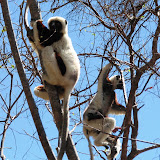
On first glance, this is not a particularly pretty bay. It is large and all of land surrounding it is low. It is not until we get in the dinghy and get closer to shore that we begin to see the beauty of the little button mushroom-shaped islets and the limestone cliffs where majestic baobab trees grow. We have explored most of the beaches on the northern side of the inner bay and have found lemurs living on most of them. We have given the beaches our own names, the Beach of the Talking Baobabs, Baobab Beach, Momma Lemur Beach, and Giant Baobab Beach. Today we visited Baobab Beach but didn’t see the juvenile lemurs that we saw there yesterday. I went there to gather some of the dried seed pods that look something like a milkweed pods except they are flat when they dry and the inside has a rumpled texture in a beautiful shade of tan. From Baobab Beach, we backtracked to Momma Lemur Beach. As we approached we could the lemurs hanging in a tree on the beach. There were five of them. We shut off the motor and rowed in so we wouldn’t scare them, but as we set foot on the beach, we heard a raucous noise like none we have heard here before. We looked at each other and wondered if the wild boars could make noises like this. But we knew that couldn’t be. And since we know there are no lions or tigers or bears, we finally figured out that it was the lemurs. We heard one group on the hill to our left first and then the group of five that we saw on the beach making this loud raucous noise. As we approached them, however, they settled down and we were able to watch and photograph as they leaped and played and ate the leaves of one of the trees. But we also saw a behavior today that we have not seen before. Every so often the lemurs would throw their heads back. It looked like they would throw themselves backwards, but they would recover, play a bit, and then throw their heads back again. Something was definitely different today, but we are not sure what. Again, we didn’t know it until we got home and looked at the photos, but one of the five was carrying a baby on her tummy today. We got some good video with some wonderful bird sounds in the background. The tiny glistening sunbirds were flying all around us as we watched the lemurs. It was really fantastic. We decided to walk up the hill that we usually come down from the homestay beach just to see if we could spot the other lemurs we had heard. We didn’t find them, but on the way down, on the same path we have walked the last few days, we saw what looked like a few bright red leaves. We went closer and saw the most fantastic red blossoms on a tiny little tree. They looked like orchids, but were definitely blossoms on the branches of the tree. What a special treat.
Our next stop was the only beach we had not visited previously. We headed in and immediately saw a baobab with psychedelic bark. We have passed by this beach every day but the colors of the bark were not visible until we got on the shore. The bark had swirls and curls in shades of brown, orange, and tan. It was quite remarkable. From this beach we were able to walk to the homestay beach with mangroves on the waterside.
As I write this log, I begin to think that maybe we should stay one more day. This is the kind of place where you feel like you could stay forever. The sounds of the vasa parrots reverberating off the limestone cliffs, the sounds of the dry seedpods rattling in the wind, the songs of the sunbirds, the delightful movements of the Coquerel’s Safika lemurs, the flight of the butterflies as big as birds, and the amazing size and shapes of the ancient baobab trees and other plants of the dry lands all combine to make this a very special place. But it is a harsh land. There is no banana, no papaya, no coconut palm, and therefore, not many people. That is why the wildlife is so prolific here. May it stay like this forever.
by Judy Handley | Aug 20, 2010 | Madagascar, Sailing Logs Year 5 |
Day 298, Year 5 South Side of Moramba Bay
Date: Friday, August 20, 2010
Weather: Sunny AM, Wind SE 10; Partly Sunny PM, Wind NE 15
Location: Moramba Bay, NW Madagascar
There was very little wind during the night and then as the sun rose above the horizon, the breeze started blowing from the land. It was a gentle ten knots and good enough for Ed and Lynne to feel they should pull up anchor and start their trip back to Nosy Be. They are doing an overnight which should get them back to Nosy Be by tomorrow evening.
We stayed on Windbird during the morning and at noon when the land breeze died down and just as the sea breeze from the northeast started blowing, we got in the dinghy and headed all the way across this wide bay to the south shore. We picked a point about two-thirds of the way from where we are to the point of land as far as we can see to the south and landed the dinghy on a beach there. The tide was still coming up and we didn’t want to stray too far from the dinghy until the tide was receding so we took off on a path leading away from the beach and promised not to walk too far before returning. The paths were obviously zebu paths and they led us to a barren area that looks like it must fill with water in the wet season and then on to tsingy cliffs. The path kept going and we wanted to go with it, but we returned to the beach to check on the dinghy. We surely wouldn’t want to lose it, and we weren’t sure we could count on the tide table being correct here. But actually it was right on. We now felt confident enough to leave the dinghy and go for a longer walk. The beach we were on was very long and the high tide line was a treasure trove of small cowrie shells and olive shells, all with different designs. Mark found one large cowrie that I love, so walking the long beach was a delight for me. At the end of the beach there was a limestone wall so we turned inland following the cliff. Immediately Mark turned around and whispered, “Maki.” The lemurs were leaping across the path in front of us and into the trees on the limestone cliff. We stopped and took photos and enjoyed their antics and then continued following the path. Actually it was more like a dirt road. We walked past a fenced area and through a wet area that brought us back out onto another beach. We walked and shelled this beach and went inland to the trail near the end of the beach. This time the trail took us uphill. We know there is a very fancy looking building on the end of the point, but as we continued to walk in that direction we could see that we were still only half-way there. We wanted to get there just to see what it is, but it was getting later in the afternoon so we turned around for the trek back to the dinghy. We saw numerous birds on the way back, more lemurs, but only one lone zebu calf. When we got back to the dinghy we could see that the sea breeze had kicked up a bit of surf. The ride back to Windbird was a little lumpy but it was dry.
We haven’t made a decision as to what we will do tomorrow-leave or stay. But unless the weather changes drastically, I think we will stay one more day. I don’t think I can leave here without visiting the momma and baby lemurs one more time and going back to the Giant Baobab beach to see the rowdy lemurs that leap through the trees there. So my vote is one more lemur hit tomorrow and then we will be on our way back north.
by Judy Handley | Aug 19, 2010 | Madagascar, Sailing Logs Year 5 |
Day 297, Year 5 Hooked on Lemurs
Date: Thursday, August 19, 2010
Weather: Sunny AM, Wind SE 20+; Overcast in PM, Wind NNE 5-10
Location: Moramba Bay, NW Madagascar
Big ones, tiny ones, middle-sized ones . . . no matter the size, we are definitely hooked on lemurs. This morning was just too windy to go out exploring, so I baked bread, but for the first time since we have been here, the wind died down just after noon and we actually got a gentle afternoon sea breeze from the northeast. This made going out in the dinghy much more fun and it allowed us to go further than we have before. We went past the beaches we have visited and finally found a small village. We have seen a few local canoes and wondered where they came from. Now we know. We then worked our way back stopping at the next beach back from the village for an explore. As we neared the shore, we saw some white spots in a tree on the beach. By the time we beached the dinghy, the lemurs started bounding down out of the tree. One bounded on to the beach and disappeared, and then the others leaped through the trees and out of sight. We didn’t see them again, but it is nice to know that they are there. Next time we’ll row in so as not to scare them with the sound of the dinghy motor. We explored this beach and found a talking baobab. This one had gashes on the trunk that looked like eyes and a mouth with arms (branches) and looked just like it was speaking to us. I saw more of the green pods that we have been seeing and realized today that they look a little like large milkweed pods. These were drying and splitting open, and inside there was the same kind of fluff you find attached to the seeds in milkweed. But when these pods dry, they flatten out and make quite a lovely decoration. On this same beach we also saw the big bird called a coucal and a slightly smaller blue bird with a very long tail called a crested coua. I pulled another of my “tromping through the vines to photograph a bird” trick and fell flat on my face. The vines here are everywhere and are just like little trip wires.
The next stop was on the beach where Mark and I saw the giant butterfly a couple of days ago. We call this one Baobab Beach because it also has a lovely assortment of baobabs. I no sooner started walking up the beach when a much smaller swallowtail than we saw before came flying directly at me and looked like it was going to land on my finger. I was ahead of Ed and Lynne and tried to call to them to look, but they only saw the butterfly flying away. We walked down what looked like a bit of a sand path. Mark and Ed walked ahead with Lynne and I behind them. I saw a spot of white in a tree so Lynne and I walked that way and found three little lemurs. We’ll call them juveniles but we have no idea if they are two months old or a year old. We just know that they are not nearly as big as the adults. These three little guys put on a show that delighted us. They do more climbing than the adults we have seen, but they can still leap a fair distance from tree to tree.
Our last stop was at what we are now calling Momma Lemur Beach. We just had to see if we could get another glimpse of those babies. We saw leaves swaying and knew the lemurs were jumping. Mark headed up the hill but Ed, Lynne, and I stayed on the low ground. We could see the lemurs from a distance, but it was hard to get photos through the trees. I found a mother with a baby and kept my eye on her. Eventually I heard Mark call down that he didn’t have his camera. It was in the backpack on my back. So I went to the path that goes up the hill and then cut across to him. He had been sitting in the same spot for at least twenty minutes with an unbelievably close view of the mother with the oldest baby. By the time I reached him, she bounded away and the mother with the tiny baby was still in her perch and not moving. As we watched we realized that this mother looks young and her baby can’t be very old. There’s nothing fluffy white about it yet. It is still in the grayish-white stage. We just can’t believe how many lemurs we are getting to watch and getting to see the babies is such a treat.
We were able to fly back to the boats as the wind had virtually died in the part of the bay we were exploring. When we got back to where we could see the boats, we realized that we had a gentle sea breeze blowing in from the west. That is the first we have in days. The southeasterly winds have just been so strong that we have not been getting the normal land breeze-sea breeze winds each day. We listened to the weather this evening and it looks as if we will have light breezes for the next couple of days. If so, tomorrow we will do some exploring across the bay to on the south shore. That has just not been possible with the strong winds. We will then decide whether to head north and motor if there are light winds or stay here a few more days. We would love to get back north to Nosy Saba when the winds are light so we could enjoy the snorkeling there, so we’ll have to weigh that against the cost of motoring.