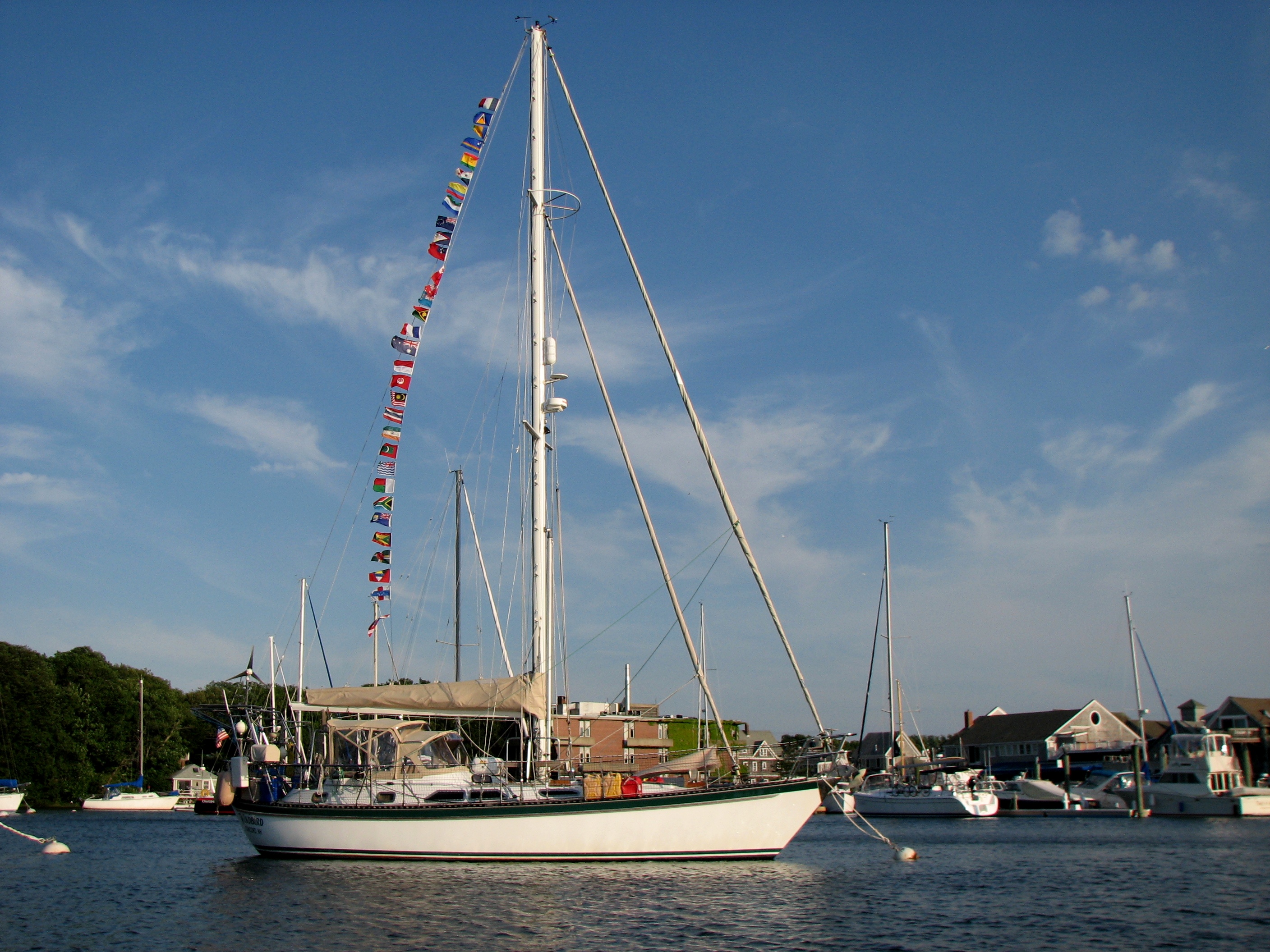
by Judy Handley | Aug 18, 2010 | Madagascar, Sailing Logs Year 5 |
Day 296, Year 5 Babies and Baobabs
Date: Wednesday, August 18, 2010
Weather: Another Beautiful Day; Wind SE 15+
Location: Moramba Bay, NW Madagascar
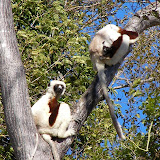
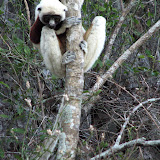
Baby lemurs are just too cute, so the hope today was to get to watch the mother and baby that we photographed yesterday, not even knowing at the time that we were seeing a baby. This morning the wind was blowing like crazy again, so we took the dinghy to the closest shore hoping to not get soaked again. The closest beach happens to be the one with the homestay and a path over the hill to the lemur beach. Just like yesterday morning and unlike yesterday afternoon, the lemurs were in the trees waiting for us. Unfortunately, they were higher in the trees and there were all sorts of vines hanging in the line of sight. So we climbed through brush and vines and every manner of prickly forest vegetation to get a better look. Finally we spotted the mother and baby. The baby was riding on mama’s back as she made her leap from one tree to another, so we tromped further into the dense vegetation. We managed to get a couple of photos of mother and baby and one short video. This baby lemur already has a fluffy white coat and was quite curious. She or he would look down to where we were and then look back at mamma. Then the baby decided it was time for a mid-morning snack and crawled around to the mother’s front and tucked in to nurse. We could still see one little leg and the scrawny little tail sticking out. Lynne and Ed had gone back to the beach by this time, but Mark and I persisted and found another mother and baby. This baby was obviously younger and we think it is the one we saw yesterday. We feel so fortunate that these Coquerel’s Safika lemurs allow us to hang around with them and just watch. Today we stood under the trees watching them for at least half an hour. They did move from tree to tree when we moved in closer, but they didn’t try to get completely away from us.
Ed had gone for a walk while we were lemur watching and found a bamboo forest. All of the garden fencing we have seen is made of bamboo poles and we had been wondering where it came from. Now we know. We walked back to the homestay and found that they wind had calmed a bit, so we got in the dinghy and headed to the beach where we spotted our first lemurs upon arrival here. We didn’t see any lemurs hanging out near the huge baobab where we have seen them before, so we took off on a path into the woods just to explore. We came out in a flat field of dried grass and beautiful baobabs all around. I call it the Valley of the Baobabs. These giants really dolook like someone pulled them out of the ground and stuck them back in with their roots in the air. I read one description that said it has been described as ‘A Caliban of a tree, a grizzled distorted old goblin with a girth of a giant, the hide of a rhinoceros, twiggy fingers clutching at empty air.’ Walking among them is a definite Tolkien-esque experience. Mark and I got back to the beach before Ed and Lynne and I saw some huge birds flying through the trees over by the big baobab. On second look, I realized I was not seeing giant birds, but I was watching lemurs leaping from tree to tree. Then one of them bounded down on the beach right in front of the giant baobab, made another leap, and then went into the trees. They are not as graceful on the ground as they are in the trees, but it was exciting to see this one bound across the sand. We found him in a tamarind tree, but we never did find the other two who flew through the trees with him. We measured the girth of the giant baobab and found that is about twenty-five feet around. The first baobab we saw on Nosy Ankarea up north was over thirty feet around, but both are big. I then wanted to walk into the woods behind this giant to see two other monsters that we had seen from the dinghy yesterday. Mark came with me reluctantly as it was once again a prickly experience. When we got to the trees, I was very surprised to find that they were not as tall as I had thought. They were definitely bottle-shaped and a little less than twenty feet around. Because of all the vines and brush I couldn’t get far enough away to get a photo, but I do have one taken from the dinghy. The bottle-shaped tree has my vote as prettiest baobab and the giant where the lemurs hang out is the most majestic.
by Judy Handley | Aug 17, 2010 | Madagascar, Sailing Logs Year 5 |
Day 295, Year 5 A Magical Place
Date: Tuesday, August 17, 2010
Weather: Beautiful Day; Wind SE 20 am, 10 pm
Location: Moramba Bay, NW Madagascar
A baby lemur, a swallowtail butterfly as big as both of my hands, a Hoopoe bird, a critically endangered Madagascar fish eagle, and baobab trees of every size and shape imaginable . . . these were today’s finds here in Moramba Bay. After a wet dinghy ride in very windy conditions, we landed on a beach to start exploring shortly after 8 am. We had chosen this beach for landing yesterday and we had hoped to stop along the way to take photos of some amazing looking baobabs. The light just wasn’t right yesterday afternoon when we went that way and it was too wild and wet this morning to do much with cameras, but we did get a few photos. As we approached our landing spot we saw zebu wandering about in a flat area behind the beach. We wanted to try and find a path to walk to the next beach, so Ed and Lynne walked along the beach and Ed went over a cliff while Mark and I followed the path where we had seen zebu. Maybe we were hallucinating as we never saw another zebu or even evidence that they had been there. But we did find a fenced garden area with not much growing in it at the moment, a watering hole, and what looks like a home-stay with four or five tents scattered about. We walked around the bottom edge of the fenced area and found a path that would lead us over the hill to the next beach. Ed and Lynne joined us as Ed’s high path was a little too steep. We walked up a hill and down the other side. As we stood on the beach looking at what appeared to be wild boar tracks, Lynne spotted three lemurs in a tree on the hill we had just climbed down. As we walked that way, we all started taking photos just in case this group would not let us get as close as our other two friends we visited yesterday and the evening we arrived. As we got closer, one large lemur took off and leaped high in a tree further up the hill. We didn’t see that one again, but we did get photos of the other two-one very large and one that looked like a juvenile. When we got home and looked at the photos we saw that the one looked so large because she had a baby on her stomach with its little human-like hands wrapped around her back. So very precious!. After watching the lemurs for quite a while, we walked back over the hill to the garden and home-stay. Here we saw beautiful domesticated turkeys and I also did some Hoopoe chasing. This bird is found throughout Europe and Asia and most of Africa, but it was the first time I have seen it, so I went chasing to get a photo. At first I thought it was a small chicken as it was pecking at the ground as if looking for insects. But then I noticed that it had a beautiful crest on its head and I remembered seeing a photo of it in the Lonely Planet. This bird is ginger-colored with white and black stripes on its wings. As luck would have it, the bird was hanging around the bases of trees where there was very little light, so getting a good photo was almost impossible. And when it would fly low to the ground it was hard to see as the black and white stripes just faded into the surroundings.
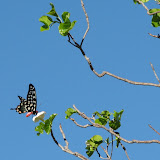
We headed back to the Windbird and Constance and found that the wind had picked up considerably and we all got soaking wet on the way back. But it had been a successful morning so the salt-water drenching wasn’t such a big price to pay. When we got back and looked at our photos and discovered that we had seen a mother Coquerel’s Safika lemur with her baby, Mark and I just had to return to see if we could see it again. But our afternoon foray came up with zero lemurs. What we did see, however, made up for it. We saw Atrophaneura anterior, Madagascar’s largest butterfly. While we were watching it flit from flower to flower on a small tree (looked something like a dogwood) we could not decide if we thought it was a bird or a butterfly. It was just way too big to be a butterfly, as big as both of my hands, so that made us think it must be some strange bird. Mark called it a “bird-a-fly.” When we got home we looked in the Bradt Madagascar Wildlife book we have and found that what we had seen was actually a type of swallowtail butterfly whose closest relatives live in southeast Asia. The head and abdomen of this butterfly was bright red and the wings were black with white polka dots edged in red. Quite striking. We saw this on what we are calling Baobab Beach. It was a long beach with so many baobabs. When we left here, we headed back to the place where we had seen our first lemurs. On the way, we saw a majestic Madagascar fish eagle that looks similar to an American bald eagle sitting in the top of leafless tree. We stopped the dinghy and just sat and watched, taking photo after photo. It startled us so when it flew away that we didn’t really get good photos of it in flight, but it was such a pleasure to have this chance to watch one of these endangered creatures up close. We then returned to the beach where we saw lemurs yesterday and the evening before, but again there were no lemurs to be found. I did walk a bit inland and found blossoming bush with a beautiful sunbird. I then walked back to the huge baobab where we had seen the lemurs yesterday, gave it a big hug, and called it a day.
Tomorrow morning Ed and Lynne will head out with us again in search of more wildlife. The shores of this bay and its little islets just seem to be teaming with life. To us it seems like a magical place.
by Judy Handley | Aug 16, 2010 | Madagascar, Sailing Logs Year 5 |
Day 294, Year 5 Windbird in Wonderland
Date: Monday, August 16, 2010
Weather: Beautiful Day; Wind 10-15 Knots SE
Location: Moramba Bay, NW Madagascar
Moramba Bay has the feel of a wonderland. The little limestone mushroom-shaped islets that look like they sit on a pedestal in the water are interesting. But then put a few baobab trees of top and the interest grows. There are six different kinds of baobab trees here. Some have trunks shaped like bottles. Others start as one trunk and then develop into two that twine around each other. Others have a broad base and get smaller as they rise up. And others just rise straight up majestically. But all of them have twisting, finger-like branches only at the top that spread out like an umbrella. When you look at these trees, you somehow get the feeling that they could come alive and start moving. Eerie . . . but beautiful in a strange way. So this afternoon we picked up Ed and Lynne and wound our way through the wonderland of baobab-topped islets. We went back to the area where we saw the lemurs yesterday, but this time we beached the dinghy and walked around to the rocky outcrop where we saw them yesterday. The first thing we saw was a very large baobab tree with a few mangroves on the beach below it. Lynne started walking toward the tree while Ed and I were taking photos of it. Then we saw a couple of spots of white and realized that our lemur friends were there waiting for us. We seem to be able to get very close to these lemurs without scaring them away, but voices immediately scare them and they leap through the tangle of branches. Today one of the pair leaped to a higher branch when we got close but the other one was munching on a long green-bean shaped mangrove seed pod and would not be disturbed. So we were able to get better photos then yesterday when we were taking the pictures from a bouncing dinghy. We must have spent twenty minutes or more just standing there watching the lemurs. We finally pulled ourselves away to explore the other areas around the beach. We saw a flock of black and white Pied Crows, a couple of Vasa Parrots, herons and egrets flying overhead, and one soaring fish eagle. We then got back in the dinghy and went deeper into the bay. We delighted in looking at all of the different baobabs. We saw several beautiful beaches and decided to come back and land at one of them in the morning so we could do a land explore. Lemurs, tsingy, baobabs, mushroom shaped islands. What a wonderland!
by Judy Handley | Aug 15, 2010 | Madagascar, Sailing Logs Year 5 |
Day 293, Year 5 Moramba Bay
Date: Sunday, August 15, 2010
Weather: Beautiful Day; Wind 15-20 Knots SE
Latitude: 14 53.895 S
Longitude: 047 19.719 E
Location: Moramba Bay, NW Madagascar
The winds blew us quickly from Nosy Lava to Moramba Bay. We delayed our 6:15 am start due to strong winds, but just before 7 am we decided to go for it. The winds were coming from the SSE and we were going SW so we were tight to the wind, but made great time. There were a few bumpy times but for the most part it was a great sail. We have left the mountains behind and are in dry, dry country. Much of the coast we sailed along is being cultivated. From a distance it looks like bushy little trees being grown in rows. All I could think is that it might be wine country, but I have nothing to substantiate that. Moramba Bay is big and as we got deeper into it we started seeing the mushroom-shaped limestone islets. These little rocky islets are undercut deeply and growing on top of them are baobabs and other trees and plants characteristic of this dry region. We anchored, I pre-cooked dinner, and then we took off in the dinghy for any explore among the limestone islets. Our hope was to get to shore and possibly spot our first Coquerel’s Sifakas (Coo-kell’s Sah-feeks). This is a type of lemur (part of the Indri family) that I have been so anxious to see. We motored among the islets, stopped to take photos of different kinds of baobab trees and just as we were about to try to land the dinghy, I saw some spots of white on a rocky outcrop. I asked Mark to go in that direction and it was soon apparent that the white spots were beautiful lemurs. These guys are about four feet long, but two feet of that is tail. There are fuzzy white with dark maroon patches on the front of their thighs and on their arms. The little faces are black with yellow eyes. They didn’t back off as we motored closer and then we stopped the motor and just sat and watched them. They have powerful legs and can take huge leaps from branch to branch. You can be sure we will go back to this same spot tomorrow morning and see if we can get ashore to get good photos. The water was bit choppy late this afternoon and that made picture taking from the dinghy a bit challenging. These guys are beautiful and graceful and I hope to see more and more of them in the next few days. We just couldn’t believe how lucky we were to see them on the first try. We also saw Madagascar Sacred Ibis with their long curved beaks roosting in the tops of trees with Greater Vasa Parrots and Dimorphic Egrets. The parrots are small and grey but the egrets are white or black and quite beautiful. We also saw caves in the sides of some of the islets. Our introduction was nothing less than spectacular, so we hope to have a repeat performance in the morning.
by Judy Handley | Aug 14, 2010 | Madagascar, Sailing Logs Year 5 |
Day 292, Year 5 Not Where We Meant To Be
Date: Saturday, August 14, 2010
Weather: Beautiful Day; Wind 10-12 Knots SE then W
Latitude: 14 32.599 S
Longitude: 047 37.195 E
Location: Nosy Lava, NW Madagascar
We had hoped to be anchored at Nosy Saba tonight, but after a mid-day stop there we decided that it was just too chancy to spend the night. It is a beautiful anchorage and we will return, but we’ll plan to spend the night in a close-by anchorage on the mainland and go to Nosy Saba for the day only. That is unless the winds are more favorable than they were today. We moved on but not before jumping in the water for a quick snorkel. The anchorage was just beautiful due to the colors in the water-sparkling turquoise, milky turquoise, emerald, sky blue–there was every color of blue you can imagine. The beach looked inviting and we tried to swim ashore, but there was coral between us and shore and we were afraid of being slammed down on top of it due to the low, low tide. So we gave up and returned to Windbird. Ed and Lynne had decided not to stop and to go on to Nosy Lava. So we followed. Our stop of an hour at Nosy Saba was just the right amount of time to let the wind switch from onshore to offshore which gave us a great sail to within a mile of the anchorage on Nosy Lava.
As we have moved south, the islands and mainland have gotten much drier looking. There are spots of green, but the predominant colors are shades of harvest gold and burnt orange. And we are starting to see interesting rock formations. The anchorage here at Nosy Lava is calm and reflects these changes to a drier area. It is striking the way the desert can be striking, but not beautiful like palm-fringed white sand beach islands. In 1993 this was the location of Madagascar’s maximum security prison. One night some of the inmates escaped, swam out to a boat anchored here, killed the occupants and tried to escape in the boat. Since then, cruisers have not stopped here. The prison had such a terrible reputation that a few years ago, they simply shut it down. We have heard from other cruisers who stopped here this year that three of the inmates were left behind and still live on the island, but they are friendly and will even give you a tour of the old prison. We’ll not push our luck that far, but we did go ashore for a walk and to burn garbage. We did this just below the high tide line so this evening’s high tide will wash away the ashes.
Early in the morning we will head for Moramba Bay. It seems to be everyone’s favorite Madagascar anchorage, so we want to spend time there enjoying the beauty. One of the draws of Moramba Bay is that the Coquerel Safika lemurs live there. These lemurs are white with maroon thigh, arm, and cheek patches and leap through the trees and on land in huge bounds. They are not acclimated to humans, so they won’t be jumping on our shoulders, but just a glimpse of them in the wild will make me a happy cruiser.
by Judy Handley | Aug 13, 2010 | Madagascar, Sailing Logs Year 5 |
Day 291, Year 5 Friday the 13th
Date: Friday, August 13, 2010
Weather: Weather Almost Back to Normal
Latitude: 14 06.015 S
Longitude: 047 54.275 E
Location: Paradise Hole near Berangomaina Point, NW Madagascar
I heard from my sister-in-law Conda this morning and she reported that my niece’s surgery went well and that the doctors don’t feel that the cancer had gotten into the lymph nodes. They won’t know this for sure until the test results are returned, but the news early this morning was so good to hear.
We did stay put today and we have had only one little Friday the 13th scare. As noon approached and low tide neared, we found that we were much closer to the reef in the head of the bay than we thought. So both Constance and Windbird upped anchor and moved far enough from the reef to be comfortable. Well, you are never really comfortable when there is reef around, but at least now we have some breathing space. The winds were still coming from due south and then west of south this morning instead of from the southeast, so that plus the fact that it was Friday the 13th helped make the decision to stay put. Mark worked on our auto pilot controller/display unit which he really thinks he might have fixed. We have been using the hand held for months now, but tomorrow we will try the real thing. I did some of my favorite things-worked on photos and did more laundry and took advantage of the extra time to try and figure out how to merge photos of each of our grandchildren into one so I can see them on my desktop each time I turn on my computer. I haven’t figured it out yet, but I sure enjoyed looking at the photos of the three of them while working on the project. We put our dinghy in the water and went over to talk to Lynne and Ed and pick up some fish that he caught yesterday. He caught a Wahoo and wanted to share his bounty, but we were just too spent last night when we got here to launch the dinghy and go get it. And I know it will still taste great tonight.
We plan to leave here early in the morning and travel about 22 miles to Nosy Saba. It is supposed to be a beautiful island but the anchorage is exposed. We’ll see what the wind is like once we arrive and decide whether we can stay the night or whether we will have to go the three miles to the mainland for the night. We’re sure hoping we don’t get winds on the nose like we had yesterday. That is very unusual here, so we’re hoping for ‘normal’ tomorrow.