
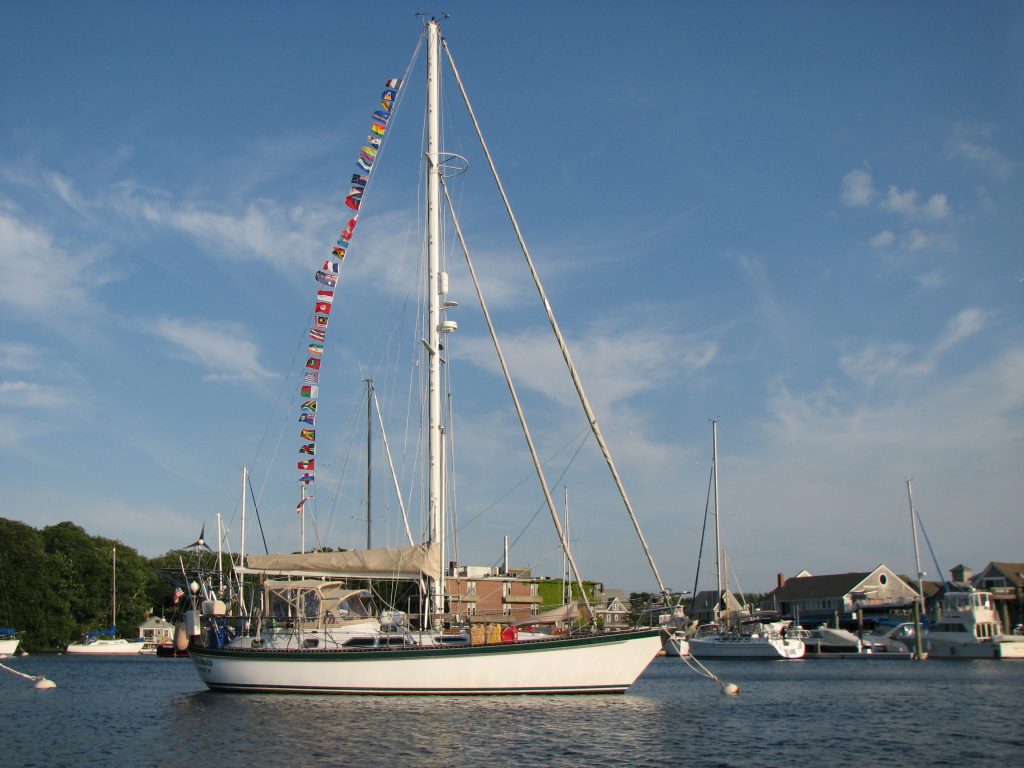
After almost 6 years of traveling, we sailed into Woods Hole on Cape Cod. We continued living aboard for the next five years and I wrote about that, adding ‘and Beyond’ to the title of the blog. Then shortly before Mark’s death in 2016, we sold our beloved Windbird and my travel logs became land logs. At this point, I had written a daily account for each and every day for 11 years. I fully intended to end the blog at that point, but when I wrote that news in a log, I got many responses saying that I really needed to keep posting. At the same time, I realized that I couldn’t stop writing. Summarizing each day had become a permanent part of my life and I will probably continue writing until I can no longer. These postings reflect the ordinary, and sometimes the extraordinary, days in my life and I would like to invite you to join me on my journey.
Day 237, Year 1: Another Change of Plans—Now Headed to Moorea
Day 237, Year 1: Another Change of Plans—Now Headed to Moorea
Date: Sunday, June 11, 2006
Weather: Another Windy Day, NE 30 Knots (plus or minus 10), Lumpy Seas
Latitude: 16 degrees 34 minutes
Longitude: 148 degrees 32 minutes
Location: Tuamotus to Tahiti (Moorea) Transit, Day 2
Estimated Time of Arrival: Noon Monday, ~100 Miles To Go
We continue to “fly” to the Society Islands. This group of mostly high volcanic islands is the western most archipelago in French Polynesia. The Societies are divided into the Windward Islands (les iles du Vent) and the Leeward Islands (les iles Sous le Vent). The Windwards include Tahiti and Moorea which are the most populous, and Tetiaroa (privately owned by the Marlon Brando estate), Maiao, and Mehetia. Of these, we will be visiting only Tahiti and Moorea. The Leewards include Huihine, Raiatea and Tahaa (which share the same lagoon), Bora Bora, Maupiti and a few atolls further west. Of these we will be visiting Huihine, Raiatea-Tahaa, and Bora Bora.
The wind out here has been crazy. We are getting a pretty steady 30 knots, plus or minus 10. We are getting a northerly component to the wind that is always possible, but was not predicted. Evidently this year it is hard to predict any weather! If things continue to go well, we will arrive in the morning, probably just before noon. We have changed our minds once again and are not going straight to Papeete, Tahiti. The island of Moorea is just 10 miles from Tahiti and we have decided to go there to decompress before entering the big city world of Papeete.
The skies have cleared and we are hoping for a night without squalls. Last night was incredible with the light of moon dancing on the top of the white capped swells. As the sun came up this morning, the moon went down. I love that symmetry. It makes a world of turmoil come into balance for me.
 |
| 060612 Day 237 – Day 238 Tuamotus to Moorea |
Day 236, Year 1: Believe It or Not—Headed to Tahiti
Day 236, Year 1: Believe It or Not—Headed to Tahiti
Date: Saturday, June 10, 2006
Weather: Another Windy Day, NNE 25 to 30, Lumpy Seas
Latitude: 14 degrees 59 minutes
Longitude: 146 degrees 47 minutes
Location: Tuamotus to Tahiti Transit, Day 1
Estimated Time of Arrival: Monday Morning
Here’s sailing drama at its best. The sun just set in the west and although it is cloudy above, it was a beautiful sunset. The full moon is rising to the east. It is beautiful, but we are not where we are supposed to be. And the winds are just not behaving properly. Our daughter Heather gets the last laugh this time. In yesterday’s log I was rubbing it in a bit when I said that by this time today I would snorkeling in a beautiful blue lagoon in the Tuamotus while she was sitting at home on Cape Cod watching the rain.. Wrong. We made it to Ahe at sunrise and, along with Stillpoint, the boat we have been traveling in company with from the Marquesas, we started through the pass at about 0700. Our computer information and book charts told us to wait until 1100, but someone in the lagoon told us on the net yesterday that the local tide chart stated that slack water would be between 0600 and 0800. Wrong again. Stillpoint went in front and about halfway through, we saw them turn around. We got on the radio to see what the problem might be and they reported that they had overheated the motor to a point that it stopped running. Yikes! They raised a sail and came out with the rushing tide. It was far from slack and the 20 plus knots of wind right on the nose as we were entering didn’t help things. We turned around as well and spent an hour listening to the morning net and deciding what to do next.
Here was our situation. We felt confident that we could motor into the pass, but we didn’t want to leave Ed and Candice out there with the possibility of no motor. We had just finished a very windy four-day passage from the Tuamotus and we really wanted to see the atolls. But the weather was not cooperating. The report on the net this morning was for 25 to 30 knot winds in the Tuamotus for the next two days coming from the NNE. Winds and atolls don’t mix well. The winds blow more water into the lagoons over the coral reef which causes the calm clear water to be not calm and not clear. And there is really nothing to stop the wind since all of the land is low, so many boats have drug anchor over the years and been blown onto the reef. Not something we are interested in. The weather report for Tahiti was also for 25 to 30 knot winds with rough seas. More of what we have just been through, but it is only two days. So what to do?
We opted for what seemed like the safer choice – head for Tahiti. We know we can withstand the projected winds and seas. It might not be comfortable, but we will be there by Monday. We will miss not getting to experience the atolls here, but we have lots of fantastic snorkeling still ahead. We were going to get to spend very little time in Tahiti, but now we will get to explore that part of the world more completely. We will first land in Papeete which is big city, but since we will have an extra week, we might get to explore the southern part of the Tahiti known as Tahiti Iti. Or we might just find a nice anchorage in the harbor in Papeete and enjoy urban life for a week. That is still to be determined.
The weather is not doing what it is supposed to be doing right now, but that is to be expected. The winds are out of the NE, but not the NNE, and only blowing 18 to 20, not 25 to 30. The seas have calmed considerably and after about four sail changes this afternoon, we are having a great downwind sail now. Who knows what the night will bring, but right now sitting here in the cockpit with a still glowing sky in the west and a full moon guiding us to Tahiti, AND calm seas seems fantastic. Plus we are moving ahead at about five to six knots with just the headsail up. I’d love to have these conditions all the way to Tahiti. Probably won’t happen, but I can dream.
Day 235, Year 1: Lumpy, Bumpy Ride
Day 235, Year 1: Lumpy, Bumpy Ride
Date: Friday, June 9, 2006
Weather: Squalls Mixed with Sunshine, Moderate to Strong Tradewinds
Latitude: 13 degrees 51 minutes
Longitude: 145 degrees 37 minutes
Location: Marquesas to Tuamotus Transit, Day 4
Miles to Go: 55
We are having a lumpy, bumpy ride out here, but we are both fine. I remember reading “Winnie the Pooh and the Blustery Day” over and over to our children and I think Pooh would agree that this passage has been blustery. We have periods of sunshine with puffy white clouds and then all of a sudden one of those clouds starts to darken, the winds increase, and we get a mix of high winds and rain for a short period. Things just begin to settle down, and it happens again-squall after squall after squall. Our daughter Heather wrote her version of a “Captain’s Rambling” to us yesterday, but she admitted it was more “ranting” than “rambling” about the weather back home. Here’s part of what she had to say: “I’ve decided that Cape Cod is on its own very special tectonic plate that moves around the globe randomly. For a couple of winters, when Buzzards Bay froze shore to shore, I was convinced we were in the Artic Circle. Now I believe we’re in Bangladesh during monsoon season. It has been raining for weeks, with the exception of Memorial Day weekend. I actually had to wade to and from my car today as the entrance to the parking lot was flooded 4+ inches deep and the “puddle” had no edges. It just connected a marsh to a stream. Rivers around New England are at or above flood stage, and we’re due to get 4 inches of rain tomorrow … 4 inches in one day! Not to mention gusts to 40 knots and thunderstorms.” Well, I hope we don’t get 4 inches out here today, but we will probably have 40 knots. And I feel more like I am in the North Atlantic instead of the South Pacific. We have the warm weather, but not the steady trades. Today we were getting winds north of east again. But I don’t think I’ll get any sympathy from anyone from the Northeast. Hopefully we will be safely tucked into the atoll of Ahe by mid-morning tomorrow and snorkeling in the clear, warm waters by tomorrow afternoon. Sorry, Heather!
The Marquesas Experience
June 9, 2006
I promised to write a summary of what we learned and experienced while in the Marquesas. This is probably more for us than for anyone reading this, but if you are interested in history, you might want to read on. When we left the Galapagos, we knew that we would not be visiting the same kinds of islands with the variety and great numbers of wildlife in the South Pacific. We thought our experiences would revolve around learning about different cultures. As it turns out, the people living in the Marquesas today could be transplanted anywhere in small town USA and things would not be very different. But there is a beauty to their islands and traces of a very different life not so long ago. Male body tattooing seems to be the only leftover from the days when fierce, cannibalistic tribes populated the Marquesas. However, the culture of those days is retained through annual festivals and celebrations. The dancing is beautiful and we have loved watching the outrigger races in the anchorages. We will see the culmination of this in Tahiti and Bora Bora as the islanders travel there for the ultimate festival the end of June.
Of the five archipelagoes in French Polynesia, the Marquesas is the farthest from any continent. Peru in South America is due east some 6,000 kilometers or 3,600miles. Baja California is to the northeast and is 4,800 kilometers or 2,880 miles away. The island of Tahiti is 1,400 kilometers or 840 miles from the Marquesas and Hawaii is 3,850 kilometers or 2,310 miles. When you are in the Marquesas, you are very much removed from contact with the outside world. Or at least that was true until radio, television, and the internet arrived. Our impression from what we saw is that almost every family, even those in remote villages a far trek from the nearest town, have a satellite dish and television. On the little island of Fatu Hiva, the television sets were almost all flat screen digital-very new. Also, it seems that every family has an almost brand new 4-wheel drive vehicle. Part of this prosperity is due to the export of the fruit of the Noni plant which grows like a weed here. Noni and copra production (copra is dried coconut meat from which coconut oil is extracted) seen to be the basis for island economy. We did not see any instances of the poverty and squalor we saw in parts of the Windward Islands in the Caribbean. Every yard was neat and clean and there were potted tropical plants everywhere. We’re still not sure why they are potted and not planted in the ground but think it might be for watering purposes during the dry season. The French government subsidizes these islands and the price tag must be huge. All of the road work equipment we saw was brand new, all of the government offices are in brand new buildings, and most homes are a standard prefab that must be shipped in. There are still the markings of what one would associate with rural America about 50 years ago in both the small villages and the largest towns. There are the ever-present chickens. They are everywhere-proud roosters and lots of mamas and baby chicks. Goats and horses are tethered in yards and fields and in some towns we came across the “town cows” and “town pigs”. Sometimes pigs are kept in side yards, but when that is the case the pens are very clean with absolutely no smell. In some towns we found pens with large numbers of pigs being kept on the edge of town-still very clean pens, but obviously grouped for convenience and then shared amongst the town’s people. In Hanavave, Fatu Hiva, we found one “town cow” and in Taiohae, Nuka Hiva, we found about four cows and one bull tethered on a town green. Otherwise, these little towns look like little towns anywhere.
The defining feature of the Marquesas is the flora, not the fauna. Plants are everywhere and they are bigger and more beautiful than any we have ever seen. Sometimes we would see plants that we saw in the Caribbean and marvel at how much larger they are here. In the Caribbean a ginger plant might have one blossom, while here one plant might have 50 or 60 blossoms. The smell of flowers is in the air and fruit literally drips from the trees. Our one great discovery was pampelmouse. That’s the French word for grapefruit, but other than the fact that it is round and yellowish-green, the pampelmouse is very different from its relative, the grapefruit. These things are huge-at least twice the size of normal grapefruit, but not quite as big as soccer ball. You cut them in wedges and enjoy. They are so juicy and sweet, in a grapefruity sort of way. Papaya grows everywhere and citrons or lemons litter the ground. We only have three pampelmouse left and hope that these things grow in Tahiti. We have become addicted.
The people in the Marquesas are very friendly. They speak a mixture of French and Marquesan with a little English thrown in for good measure. We found that we could speak English and use hand gestures and usually get our ideas across. Young children often greet you with, “Hello. How are you?” Others say, “Bon jour.” And still others use the Marquesan greeting, “Kaoha.” Music has an island flair, but has been modernized. The electronic keyboard is always used along with the traditional ukulele. Traditional drums are used only for traditional dances. The music coming from homes sounds like US country-western music being sung in French and Polynesian. Teenagers wear Bob Marley shirts but we didn’t hear the music.
Where did these island people in “the land of men” come from? And when did they come to the Marquesas? A man named Robert Suggs is accepted as one the most accurate historians concerning the settlement of the Marquesas. Based on the findings of Lapita pottery from southeast China, it appears that “the men”, as the Marquesans called themselves, sailed from Samoa to the Marquesas around 500 BC. These people sailed from southeast China to Samoa some 1500 years prior to that. There is evidence that in an El Nino year, the westerly winds blow from Samoa straight to the Marquesas. It is believed that this is how “the men” reached the Marquesas in their double-hulled outrigger canoes. If the seas were anything like they have been for us, I sure wouldn’t have wanted to do this transit in a canoe! Evidently these same people then sailed from the Marquesas to Hawaii, to Easter Island to the south, and to the Tuamotu atolls.
In the Marquesas, we found Fata Hiva to be a beautiful little harbor to sail into after the long crossing from the Galapagos. Hanavave was a delightful village and the scenery was spectacular. Our next stop, Tahuata, had nice beaches, but not much else. Atuona on Hiva Oa was the most “city-like” place we visited, even though Taiohae on Nuka Hiva is the administrative center. Hiva Oa was nice, but not our favorite. Our car trek to Puamau was interesting and gave us a real feel for the ruggedness of travel here, but when we left there and went to Ua Pou, we found our favorite island in the Marquesas. It is beautiful, the people are friendly, and it is easy to reprovision there. We enjoyed the traditional dancing and music at the Mother’s Day celebration there. When we left Ua Pou, we went to Nuka Hiva. We first visited Daniel’s Bay and walked to the Vaipo waterfall-spectacular. We then went to Taiohae. This town was nice, but a bit of a disappointment as the administrative center. We didn’t feel it had as much to offer as Hakahau in Ua Pou. Lastly, we visited the small village of Taipivai in Comptroller Bay. If Ua Pou was our favorite island, Taipivai was our favorite village. We enjoyed walking through the village and finding the archaeological site there.
You can’t visit the Marquesas without commenting on the beautiful Catholic churches. The wood sculptures are magnificent. Each church is so very different, but the cathedral in Taiohae was beautiful. We tried to capture some of the beauty in our photographs that will be posted to the web once we reach Tahiti around the 21st of June.
We visited me’aes (may’ah-ays), the huge rectangular platforms that were the sacred place of priests, chiefs, and warriors. We saw many paepaes (pay-pays), the stone sleeping foundations consisting of two-levels of rectangular stone platforms. And we saw tohuas, the ceremonial plazas that were the sites of feasts, stilt races, and dances. Stone-carved tikis adorned these places. Again, we tried to capture the essence in photographs to share with you.
Our heads are still spinning from all of the experiences we had in the Marquesas. It was a beautiful group of islands with lots of history. Tomorrow we will be in the Tuamotus-a completely different place. There will be no volcanic mountains, waterfalls, and very few plants other than coconut trees. But the water will be shallow and clear and the diving and snorkeling should be great. Stay tuned.
Day 234, Year 1: The Game of Sailing
Day 234, Year 1: The Game of Sailing
Date: Thursday (Thor’s-day), June 8, 2006
Weather: Sunny Morning, Squally Afternoon, Strong Tradewinds
Latitude: 12 degrees 26 minutes
Longitude: 144 degrees 02 minutes
Location: Marquesas to Tuamotus Transit, Day 3
Miles to Go: 182
Sailing is an interesting mode of travel. You are totally dependent on the wind to get you where you need to go, but when it is very windy, you spend all of your time trying to find ways to slow down. When there is no wind, you spend all of your time trying to find ways to go faster. Earlier today the winds settled in at a steady 28 to 30 knots. By late afternoon we have variable winds 18 to 25 knots. The seas are much calmer than yesterday, but the threat of squalls with higher gusts keeps us on the conservative side in terms of amount of sail out. We are actually moving slower than we would if we had less wind. If we move faster, we will arrive in the Tuamotus during the night, and that is not a good idea. So we will continue to find ways to slow down. That’s the game of sailing.
Mark is reading a really fascinating little book, “The Year 1000: What Life Was Like At The Turn of the First Millenium”, by Robert Lacey and Danny Danzinger. It gives the background for many of our English words. As we are struggling with Spanish, French, and the various Polynesian languages, we realize that we know so little about our own language. Here’s a little trivia for you concerning the names of the days of the week.
Sun-day for the Sun
Moon-day for the Moon
Tiw’s-day (Tiw, Norse god of war)
Woden’s-day (Woden, Alfred’s father of the gods and of the royal House of Wessex)
Thor’s-day (Thunor, Norse god of thunder)
Frig’s-day (Frig, Norse god of growing things and fertility)
Saturn’s-day (from the Roman god Saturn)
Today was a baking day aboard Windbird-bread, brownies, and Shepard’s Pie for dinner. It was also a shower day which in turn means a clothes washing day. So Thor’s-day was a very busy one. The afternoon squalls also kept us busy adjusting course and changing sails. Before and after the squalls there is very little wind for a period, and then we have 25 to 30 knot winds for a period. Finally we even back out at an average of 22 to 24, but the variability keeps you on your toes.
We have now traveled about 318 miles from the Marquesas. I had really hoped to write my Marquesas summary and include it in today’s log, but once again, that is just not going to happen. Unless the weather goes absolutely crazy, I’ll definitely have this done by tomorrow. We will arrive in the Tuamotus on Saturday morning, and by that time the Marquesas will be a distant memory. Best capture the essence before it is too late.
Day 233, Year 1: Ugly Weather on Day 2 of Passage to Tuamotus
Day 233, Year 1: Ugly Weather on Day 2 of Passage to Tuamotus
Date and Time: Wednesday, June 7, 2006
Weather: Sunny, Strong Tradewinds; Occasional Squalls with Gusting Winds
Air Temperature: 84 degrees F
Water Temperature: 81 degrees F
Latitude: degrees minutes
Longitude: degrees minutes
Location: Marquesas to Tuamotus Transit, Day 2
What a difference a day makes . . just 24 hours. Yesterday at this time we were having a lovely sail. But as night set in, the rain squalls increased and so did the wind. This morning we were sailing under a double-reefed main and a double-reefed staysail, with no headsail flying. We had 22 to 30 knot winds, which is twice the 10 to 15 predicted, and we have the seas that come with that kind of wind. During the night we had gusts to 40 knots during one squall, but usually the gusts are around 35. It is rougher than we had planned, but I guess this is what goes with that Windbird wind “cell” I talked about in yesterday’s log. Windbird does fine in these conditions. It just makes it difficult to move around and do anything except read. I had planned to bake bread and brownies today, but remembering the burn I got the last time I tried that in seas like this, I opted for answering e-mails and reading. This afternoon we had periods when conditions seemed to be moderating. Winds were down to the low 20’s with occasional gusts into the upper 20’s. Right now we are in the midst of another squall!
Our friends Ed and Candice on Stillpoint aren’t faring quite as well. Their aluminum boat was built as a racer and doesn’t have the heavy displacement we have. We can keep our reefed main up for stability, but they had to lower all sails except for just a tiny triangle of headsail. They are moving as fast as us, but it is not as comfortable. And they have an aft cockpit that gets swamped with water in these waves. We have a center cockpit which is much higher and drier, plus we have plastic side curtains to help deflect the water. I sometimes feel like Windbird is the Sherman tank of sailboats, and I like that feeling in these conditions!
We are no longer in sight of other boats, but we can still talk with them on the VHF radio. I think Stillpoint is about seven miles behind us and once in a while we catch a glimpse of them. The catamaran Shiraz taking a different route and is off to the east of us. They are averaging about 7.5 knots, whereas we are averaging about 6 knots, so they will be passing us soon if they have not already. Ed of Stillpoint and Mark talked this morning about the possibility of by-passing the Tuamotus if it stays this windy. The Tuamotus were once known as the Dangerous Archipelago. They are easier to navigate with today’s electronic gear, but when the winds are strong and the seas are sloppy, they can still be a challenge. Each of the atolls is just a fringing coral reef that once surrounded a volcano. The volcanoes collapsed leaving deep craters that are now the lagoons. The fringing reefs support motus or small islets and have a few spots where you can pass into the lagoons, but you always have to be very careful. Just a few weeks ago, one of the boats in the Blue Water Rally washed up on a coral reef on the atoll of Rangiroa. The boat was the Gypsie Moth IV. This boat is the one that a syndicate in England just poured thousands of dollars into to it to rebuild it to its original condition when it was sailed around the world by Sir Francis Chichester. We hear that the boat has now been shipped to New Zealand for extensive repairs. Since we don’t have that kind of financial backing, we certainly don’t want to take any chances. So we may by-pass the Tuamotus and go straight to Tahiti. It is just too early to make that determination.
I said in yesterday’s log that I would be writing a summary of our experiences in the Marquesas to include in today’s log and that Mark would be completing another Captain’s Ramblings. Well, I didn’t get the summary of our Marquesas visit done. We had one squall after another during the night and had to be at the helm constant ready to change course to run with the wind when the gusts exceeded 30 knots. The squalls continued into the morning, so we did a lot of sailing, but no writing. However, this afternoon while I was catching up on sleep I missed last night, Mark finish his fifth edition of Captain’s Ramblings and it is attached. Perhaps tomorrow I will get the Marquesas summary done.
Captain’s Ramblings–Communications
6/6/06
Some of you have written asking for details on the technology we have on board and what we value most. A sailboat equipped for cruising is a very complex environment. We have all the utilities that any city would have: electricity generation, sewage treatment and disposal, waste collection and disposal, water making, and communications. And then there are the systems of propulsion: sails and rigging, and for most of us, a diesel engine. A cruiser should be able to do basic maintenance on all of these systems, though in fact most of us are learning as we go and we depend heavily on each other to fill in the voids in our knowledge. I have never been particularly mechanical so my learning curve has been steep. I’ll start with communications since in many ways the innovations in voice and e-mail communications have made this trip so much more enjoyable, safer, and has enabled us to maintain this cruising log you are reading.
Of course, we have the requisite VHF transceiver. In every anchorage this is our link to the other cruisers around us. It is our telephone (a party line where everyone listens in). Every time we pull into an anchorage as we are motoring around looking for a good spot to drop anchor, we call over to a nearby boat to find out what channel everyone is monitoring in this anchorage. It is usually channel 68 or 69 or sometimes 72 or the standard everywhere: channel 16. We use the VHF to organize social gatherings, to find out where to buy (fill this in with whatever has recently broken on your boat), where the market is, what the store hours are, where to land your dinghy, etc., etc. Sometimes at sea we will use the VHF to maintain contact with boats within sight of us. And we monitor VHF channel 16 at all times at sea. If a ship comes within view and we can’t tell its intended course, we will call them on channel 16 to find out their intentions and to let them know we are here.
The next piece of communications gear is the ham/SSB radio. We both got our general class Ham licenses before we left. Though there are cruisers out here without a licensed ham on board, we believe that at least one person should have their license. There are many nets that are for “Hams-only” and our email service (Winlink) is a service of hams operating throughout the world to give us free access to the internet. Of course, it is a very slow e-mail system so we cannot browse the internet nor can we send or receive very large emails such as those with photos attached. That is why our photos are posted separately on the web site. We send them using a g-mail e-mail account when we have access to high speed internet. Most places seem to have internet access these days and you can usually (but not always) find an internet café. There was only one place in all of the Marquesas with an internet café, but everywhere else we have been able to get online.
Our Ham/SSB radio is an ICOM 706. It was on the boat when we bought it and we are happy with it. There are many brands and models available but from our experience and the stories we have heard from other cruisers ICOM is the preferred brand. ICOM makes several models suitable for cruisers. Most are SSB radios that will need to be modified to transmit on ham frequencies. Some, like ours, are ham radios that need to be modified for the marine SSB frequencies. The ICOM 700 and 710 are tried and true models. ICOM has come out with a new model (the 802) that is already set up for both ham and marine SSB. However, we know of only two installations of this model and both are having trouble with them. I would suggest that you get your radio and ham license well in advance of leaving so you can use it and find out its weaknesses before it is critical (We got our licences, but we didn’t “practice” and we wish we had!). We bought a Pactor II Modem with the Pactor III software upgrade. This modem is the connection between our computer and the radio. Using it and some free downloadable software (Airmail) we are able to compose and send emails with a minimum of knowledge of radio wave propagation. It is all pretty well automated. The software also has a catalog of weather information you can order just by clicking the box next to the items you want. The next time we log on it will automatically send an e-mail requesting the weather information we want. Then a few hours later we log on again to receive e-mail and get e-mails with the weather information either in the body of the e-mail or as an attachment. Weather faxes can also be received using this software. As I mentioned above, we use a Ham-based e-mail service called Winlink that is free. Some cruisers use a commercial service called Sailmail for about $200 a year. Sailmail has the advantage that you can conduct business on it (Ham radio is for non-commercial use only). However, Sailmail has strict time limitations on how much use you can make of it each day. This has made it difficult for some cruisers to fully utilize the weather information available as some of those files are very large and take some time to download. We have a Sailmail account but only use it for doing business, such as ordering parts, etc. E-mail is as critical to us here as it ever was in our work lives. It is how we keep in touch with family and friends, how we receive critical weather information, and how we post our logs. We couldn’t do without it.
Of course, the Ham/SSB radio is also good for voice communications. We use it primarily to log into cruising nets on a daily basis. When we log in we give essential data about the boat, its crew, our position, course and destination. If we don’t respond during roll call for several days fellow cruisers will become concerned and start trying to find us. It is the best safety net we have out here, and it is a good way to keep up with the travels of friends. We would rate our Ham/SSB radio with its modem and computer as one of the most essential items to have on board – so much so that we have a spare computer in case our primary one goes down, which it did a couple months ago. Some cruisers carry a spare radio. We don’t, but it wouldn’t be a bad idea.
Our computer also does double duty in that it serves as the way we store and make backups of our digital photos, of which we have thousands. We do not usually use the computer for navigation, though we have used C-Map charts in the Galapagos and in the Marquesas as we have no good paper charts of the ports and anchorages in these islands. I do, however, have a great program for passage planning: Visual Passage Planner. It contains all the data from pilot charts (average wind, waves, etc.) and uses that information to plot the best route between two points. Of course, the pilot chart information is just historic data and cannot predict the weather we will actually experience, but it is a good place to start. Our computer also has tide prediction programs and a number of other helpful navigation programs most of which we use only rarely.
The last, but not the least important item for communications is our Iridium satellite phone. We can call any phone in the world from anywhere in the world. I have used it to order parts while we were at sea so they would be available when we reached port and to get advice when we had an engine starting problem. We occasionally use it to talk to our kids and other family members. And I have used it to consult with a doctor at WorldClinic when I had a foot infection (I could do another whole Captain’s Ramblings on preparing for health emergencies at sea – maybe later). But in the end, we do not use it often as it is expensive – about $1.09 per minute. We buy blocks of 500 minutes at a time to get the price down from the more than $4.00 per minute it would cost on a pay as you go plan. To us the satellite phone is primarily available for emergency purposes. In theory we could have made most of the calls we did using our radio and a Ham net for cruisers and doing a phone patch. But propagation of radio waves is not always what you want when you may need it most, so we have found the Satellite phone invaluable.
I should also mention a way we keep in touch when on land. If a community has a high speed internet connection we can use a program called Skype. It is available as a free download on the web. With a set of headphones and microphone (Be sure to get a good set as many have thin, easily breakable wires or earphones that fit uncomfortably in your ear.) attached to your computer you can call any other Skype user for free and if you deposit $10 with them you can call any phone for literally pennies. We have made many calls this way and still have about $8.00 credit in our account. This is something I would recommend for everyone – you don’t have to be a cruiser. And if you are a real computer geek you might add a camera to turn your computer into a video-phone. We first learned about this in the Caribbean where we saw European cruisers constantly talking to their computers. Once we asked what they were doing, we saw what a great thing Skype can be.
Using Skype brings up the subject of Wi-Fi. There are marinas and other shore-side businesses that have a Wi-Fi service. Sometimes this is free, sometimes you have to go in and register to get a password. Some had powerful external antennas so boats anchored in the harbor could use the service. Occasionally this was the way we got high speed internet access on Windbird in anchorage. We could have done so more often, however, if we had an external USB Wi-Fi antenna. Some of the signals are marginal and need the extra boost in strength provided by one of these antennas. However, not all external antennas are created equal and we have not yet been able to find one that we believe will work for us. Browsing the internet onboard your boat at anchor is terrific. One of the things we miss most out here is easy access to all the information on the internet. If we could be on the internet at sea we would be doing research on the next landfall. But technology is not at that point yet. At least it is not affordable for us. So we have to do any internet browsing while in port, and even then only in those ports that have high speed access. Having an external USB Wi-Fi antenna is high on our list of purchases as soon as we can find the right one.
In my next Captain’s Ramblings I will discuss propulsion and deal with some of the issues we have had along the way with our engine(s) and transmission(s).
Day 232, Year 1: On the Road Again
Day 232, Year 1: On the Road Again
Date: Tuesday, June 6, 2006
Weather: Sunny, Moderate Tradewinds; Occasional Squalls with Higher Winds
Latitude: 09 degrees 32 minutes
Longitude: 140 degrees 43 minutes
Air Temperature: 84 degrees F
Water Temperature: 81 degrees F
Location: Marquesas to Tuamotus Transit—Day 1
We are sailing along at five to six knots under a double-reefed main and full headsail. The winds are anywhere from 10 to 20, with an average of 15. We have occasional squalls with winds up to 30 knots, but the seas are fairly calm and we are having a great passage to this point.
I must be a vagabond at heart. Every time we pick up anchor for another passage, I hear Willie Nelson softly singing “On the Road Again”. I smile and feel that this is what I was born to do. I’ve learned to love these passages that I thought I would not enjoy. Passages give you time to reflect, away from the hustle and bustle of life an anchorage. There are always so many wonderful things to see and so many great people to get together with when you are at anchor . . . but it can be exhausting. A passage gives you the time to rest up and get ready to go at it again. I love it.
We had decided to leave today, wind or no wind, as we want to be in Tahiti by June 20. That will give us a couple of days to learn the “lay of the land” there before Mark’s sister Mary Ellen and her husband Lee arrive . . . and we can’t wait to see them! Since it is a three to four day trip from the Marquesas to the Tuamotus and another couple of days from the Tuamotus to Tahiti, we needed to leave no later than today to have some time in the Tuamotus. June 20th is only 14 days away. All of the weather reports were saying there would be no wind until at least Friday of this week, but that Windbird “wind cell” returned unexpectedly yesterday and has given us a great ride so far. We have now lost sight of Nuka Hiva and Ua Pou is barely visible. Our next land sighting will be the motu of Ahe in the Tuamotus.
We are sailing in the company of Stillpoint out of Bellingham, Washington, with Ed and Candice aboard. We both left Comptroller’s Bay early this morning. I checked in with the Coconut Net to let them know we were underway, and then we started getting calls from other boats. Renee and Steve aboard Shiraz where leaving Taiohae Bay this morning, as well as George and Barbara aboard Gdansk, and Carl and Minda aboard Carminda II. So we have lots of great company out here. We can see Stillpoint and Shiraz, but not Gdansk and Carminda at this point. We can see another boat about six miles ahead, but not sure who that might be.
As we leave the Marquesas Islands there are many things that I regret not being able to see, but there are SO many things that we did see and experience. When I close my eyes and think “Marquesas”, I think about coconut plantations, pamplemouse, breadfruit, noni, taro plants, friendly people, lush islands with high peaks, beautiful valleys with rushing streams, waterfalls, and the ancient rock structures and tikis that we have seen. There are beaches here, but they are not the white sand beaches that we saw in the San Blas in the Caribbean or in the Galapagos. The anchorages here are deep, so we have not had the turquoise water of the Caribbean or the Galapagos, and we have certainly not seen the birds and reptiles that were the hallmark of the Galapagos. There are brown boobies here and some sort of petrel, but it is rare to see more than a few birds at one time. My summary would be that the Marquesas is about history and subtle beauty, with a few punctuations of grandeur such as the anchorages in Fatu Hive and Ua Pou with those wonderfully beautiful volcanic plugs and spires. We will see more of this in the Society Islands of Moorea and Bora Bora, but what we have seen here has been beautiful.
As we leave I also think of the friendships made with other cruisers. It is wonderful to see Randy and Sherri of Procyon healthy and happy once again. We got to spend time with Doug and Sylvia on Windcastle, and we have made new friends like Ed and Candice on Stillpoint. Meeting Jonah of Araby last night was really neat. He is 28 years old and single-handing a boat with no motor. And he is so happy to be doing what he is doing. There are a number of single-handers out here, most of them very young, and most of them with motor problems. I wouldn’t want to be doing what they are doing, but they are a happy lot. There is one couple aboard a boat named Nymph that are very young and have a one-year old aboard. They ran out of water and fuel on the way here from the Galapagos, but thankfully Necessity and Checkmate, the same Norwegian boats that helped Procyon, went back to give this couple water and fuel. I guess everyone’s level of comfort if very different, and what one would say is irresponsible, another would say is just fine. The bottom line is that cruisers are a fantastic group of people who are always ready to help one another. Nationality plays no role out here. We are all of one world.
Tonight while I am on watch I will write a summary of our experiences in the Marquesas. That will be included in tomorrow’s log. Mark is also working on another Captain’s Ramblings about electronics onboard and other technical details. When we were able to download our e-mail from our judy.mark.handley@g-mail account in Nuka Hiva, we heard from many friends and some people who have sent comments to our website. We will try to include responses to those e-mails in our logs in the next couple of days. We love hearing from folks and value each and every message.
I’ve got to end this log so that I can send it at the magic hour of 06:06:06 on 06/06/06. Not sure of the significance, but it sounds important to me.
 |
| 060610 Day 232 – Day 236 Marquesas to Tuamotus |
Day 231, Year 1: The Tikis of Taipivai
Day 231, Year 1: The Tikis of Taipivai
Date: Monday, June 5, 2006
Weather: Beautiful Day with Wind Returning
Location: Hakahaa, Comptroller’s Bay, Nuka Hiva Island, Marquesas
This bay is a very peaceful place to be at anchor. It is not the most dramatic in terms of scenery, but it is still beautiful. Savoir Vivre sailed out early this morning, leaving just Procyon and us behind. But just after they left, Stillpoint came sailing in. We had been listening to the VHF and knew that Stillpoint was sailing with two other boats-both single-handers. Bamboo is a trimaran with Herbert as captain, and the other boat is Araby with Jonah as captain. On the way here, Jonah lost his dinghy and had to turn back to try and retrieve it. Bamboo went along to help. They made a successful retrieval and sailed into our little bay later in the morning.
At about 9:30 am, we picked up Randy and Sherri of Procycon and headed to the village of Taipivai. We first tried to dinghy up the little river to town, but we went aground in our dinghy and had to turn around. We went back out into the bay and came back to the area where we had landed our dinghy yesterday. We made a successful landing, and then our goal was to walk into the village, follow the road along the river, and find the very steep path to the tikis of Taipivai which are among the best known in the Marquesas Islands. Our only directions were to go past a vanilla plantation to a path that zig-zags up the hill. We had to ask for direction by just saying “tiki” and finally we found the right path. It was steep and muddy, but we made it to the site of Paeke which has several large tikis and a huge me’ae-ceremonial platform. The mud here is like red clay and it is really slick. We felt very good when we got back down to the road and no one had fallen. We also felt very good that we had actually found the archaeological site. Other cruisers who have been here in the past week were not so lucky and never found Paeke.
We returned to our boats and talked with Ed and Candice on Stillpoint. Mark and I invited everyone in the anchorage over to Windbird for sundowners and then proceeded to get Windbird ready for the four-day passage to the Tuamotus. The weather looks good and we feel it is time to move on. So early tomorrow morning, we will be underway.
We enjoyed our evening with Randy and Sherri of Procyon, Ed and Candice of Stillpoint, and Jonah of Araby. Stillpoint will leave with us in the morning for the Tuamotus. Procyon will return to Taiohae to get the contents of their freezer from the hotel that graciously kept their food while they were waiting for refrigeration parts to arrive. They will head to the Tutamotus on Friday or Saturday, but we probably won’t see them again until the fall in Tonga. Araby and Bamboo will head around to the north side of this island before heading to the Tuomotus. We all cross paths, but then we head out in different directions. Meeting other cruisers is almost like meeting strangers in the night. They come and go and then come again. We cherish our time with everyone but we also look forward to our four-day passage to the Tuomotus where we will see no one for the next four days or so.
It is a good life out here.
 |
| 060605 Day 231 Marquesas, Nuka Hiva–Tikis of Taipivai |
Day 230, Year 1: At Anchor in Hakahaa, Comptroller’s Bay, Nuka Hiva
Day 230, Year 1: At Anchor in Hakahaa, Comptroller’s Bay, Nuka Hiva
Date: Sunday, June 4, 2006
Weather: Rainy Day with Intermittent Sunshine
Location: Hakahaa, Comptroller’s Bay, Nuka Hiva Island, Marquesas
We continue to have rain squalls that come and go and leave sunny weather behind. We left Taoihae Bay this morning and headed east to Comptroller’s Bay. By the time we got here, Procyon had already arrived and joined Savoir Vivre who has been here for the past couple of days. It was wonderful to enter an anchorage with only two other boats, both boats with great people aboard. Jaimie and Lucy from Savoir Vivre came over right away to greet us and to invite us over for sundowners. They were also inviting Procyon, so it would be great to get together later in the day.
Mark and I headed into the beach around 3 pm and walked into the village of Taipivai.
Even though we had driven 42 kilometers to the village of Iipona on Hiva Oa, this village feels much more remote. After walking through the village, we returned to Windbird and then had cocktails on Savoir Livre and dinner aboard Procyon.
Tomorrow we will explore this area by foot and report on our findings. Life here continues to be good.
 |
| 060604 Day 230 Marquesas–Comptroller's Bay, Nuka Hiva |
Day 229, Year 1: Getting Ready for the Passage to the Tuamotus
Day 229, Year 1: Getting Ready for the Passage to the Tuamotus
Date: Saturday, June 3, 2006
Weather: Rainy Day with Intermittent Sunshine
Location: Taiohae Bay, Nuka Hiva Island, Marquesas
We won’t be leaving the Marquesas until Tuesday morning, but since this is a three-day weekend here, the last shopping had to be done today. We were up at 4:15 am and on the dock by 4:30 for the early Saturday morning market. We picked up Sylvie on Windcastle on our way in and we all arrived eager to learn about Saturday morning market. We were able to get fresh lettuce, green peppers, greenish tomatoes that we hope will ripen slowly, super long green beans, zucchini, cucumbers, Dakon radishes, cabbage, pineapple, bananas, and the most fantastic fresh tuna we have seen at a market on this trip so far. The local bakery also had the wonderful looking pastries-chocolate filled croissants, chocolate éclairs, fruit-filled pastries of all kinds. It was phenomenal and almost made getting up at 4:15 an okay thing. We visited with friends, returned Sylvie to Windcastle (with a little mishap where she fell in the water but was safely retrieved), and returned to the boat and packed away all of our goodies. We actually tried to go back to sleep, but that just didn’t happen. So Mark contacted Stillpoint and Procyon and went to the fuel dock with their jerry cans, as well as ours, to get fuel as we had prearranged. Mark made a second trip to get fuel for us and for Aqua Magic and Gdansk. We have a duty-free certificate since we have gone through an agent and we can sometimes help friends by getting duty-free fuel for them as well.
Once Mark finished with the fuel runs, it was time for us to head to town. We had hoped to go straight to the grocery store, but by the time we got here, it was closed until mid-afternoon. We walked around town with Candice and Ed, revisited the Catholic Church, and stopped to have a cold drink at a local restaurant. We saw Jaimie and Lucy from Savoir Livre who had walked and then caught a ride here from the Comptroller’s Bay to the East. It was great to see them. The time passed quickly and we went to the store to buy our supplies and returned to Windbird. We actually made another trip to the dock late in the day to rinse a laundry and take showers using the dock water.
Tonight we went to a local dinner with some music and dancing entertainment. It was so very different from what we saw last week in Ua Pou. It appears that the dancing style on each island is very different, but we did have a great time. Tomorrow we will head to the bay just east of here-Comptroller’s Bay. Windcastle, Stillpoint, and Procyon will be heading out with us so we should have great company as we explore our last Marquesan anchorage.
 |
| 060603 Day 229 Marquesas, Nuka Hiva–Provisioning, Traditional Dancing |
Day 228, Year 1: Exploring Taiohae Bay
Day 228, Year 1: Exploring Taiohae Bay
Date: Friday, June 2, 2006
Weather: Blue Skies and Sunshine—Still VERY Warm
Location: Taiohae Bay, Nuka Hiva Island, Marquesas
We no longer know the air or water temperature, but we know it is very, very warm. On passage we keep track of these things, but once on land, there are so many things to do and somehow checking thermometers is no longer on the radar screen.
Our day started early with me taking Mark over to Windcastle. They were making a run to the fuel dock, so Mark, as well as Bob from Figment and Steve from Oz went along as crew. Everyone took their fuel cans so they could be filled up at the same time. The fuel dock is very high and much easier to access by big boat than by dinghy, so this was a chance for all to get that precious $5.00 per gallon fuel. Since both Windcastle and Windbird needed to hire an agent to secure our bond for French Polynesia, we also get duty free fuel. That lowers the price by $2.00 per gallon, but it is still pretty expensive.
While Mark was getting fuel, I was working furiously to get as many of our pictures as possible organized and labeled and ready to send to the website. There are a couple of internet cafés here and I wanted to take advantage of this. I got the work done, but the connection at the café on the dock was so slow that I was only able to send pictures of the passage from the Galapagos, Fatu Hiva, and Hiva Oa. This is a holiday weekend here, Penecost, and the internet spot on the dock is closed until Tuesday. We’ll be long gone by then, but we are hoping the other internet access might be open in the morning so that I can send the other folders. If not, they will have to wait until Tahiti. I hope that is not the case, but we will just have to see what tomorrow brings.
While sending photos, we were also able to check our “land-based” e-mail account for the first time since we were in the Galapagos. Those of you who send comments to the web go through this e-mail account, so today was the first chance we have had to see what you have been saying. More than one person has asked if it would be possible for us to incorporate photos with our logs, but unfortunately that is just not possible. We send the logs daily from a very low speed HAM radio connection. We can only send pictures when we reach land and can get to a high speed access. I’ll have to talk to our son Justin who manages the site to see if there is anyway to post a few pictures with the logs when we do reach high speed access. If there is a way, we will try it. By the way, internet access out here is very, very slow, and very, very expensive. It cost $36.00 American to be online for the three and a half hours that it took to send a few folders of pictures. I sure hope Tahiti has a faster connection.
We spent what was left of the afternoon touring the town of Taiohae. There is a beautiful building close to the dock that houses art from Marquesan artisans. They have wonderful carvings and beautiful jewelry. The prices are not cheap, but the quality of the work is very good. After visiting here, we walked into town and checked out the grocery stores. We then headed for the Notre Dame Cathedral. This place is truly beautiful. The cathedral’s interior is well known for it’s wonderful wood carvings, especially the carvings of the Stations of the Cross which are the product of local artist Damien Haturau. We have seen his carvings in churches on all of the islands. He depicts biblical figures as Marquesan in a most beautiful way. For instance, in this Cathedral, he depicts Jesus in the Garden of Breadfruit instead of in the Garden of Olives. The Cathedral was built of stone and is magnificent, but the grounds were even more impressive. The landscaping is just spectacular.
Just after the Cathedral, we came to an area on the waterfront where many tikis were made for the Marquesas Islands Festival in 1989. There is a tohua which is a traditional structure with a thatched roof and many tikis that were carved for this event. It makes a lovely waterfront park that locals seem to enjoy.
We walked on to the far end of town where the College of Nuka Hiva was hosting a “bowls” or “pa-tonk” competition. There were hundreds of people all wearing white t-shirts with bright red Coca-Cola lettering-obviously the sponsor of the tournament. We know almost nothing about this game, but see kids here playing it everywhere. You basically roll/toss silver balls about half the size of a bowling ball on an area the size of a shuffleboard court. When I figure out the object of the game, I’ll let you know, but I will tell you that the people here play this with great intensity.
We did not make it to the museum owned by American art collector Rose Corset. If we decide to stay here until Sunday morning, we might be able to get to this. We had hoped to visit the 4:30 AM fresh fruit and vegetable market in the morning, make another quick trip to the Cathedral to see the carved Stations of the Cross, head back into town and make our purchases at the grocery store, AND THEN go back to the boat and head over to the fuel dock in our dinghy to get one more run of fuel before leaving this harbor and heading around to the north side of the island. All of that sounds very ambitious, and we hear that there is some sort of festival in town tomorrow night, so we might not really leave tomorrow. I guess we’ll cross that bridge when we come to it.
Whether we leave tomorrow morning or Sunday morning, we will then head to Anaho Bay on the north side of Nuka Hiva. And from there, we will leave for the Tuamotus on Tuesday. But that gives us three more wonderful days in these islands, and we promise to enjoy every moment that we are here.
|
| 060603 Day 229 Marquesas, Nuka Hiva–Provisioning, Traditional Dancing |