
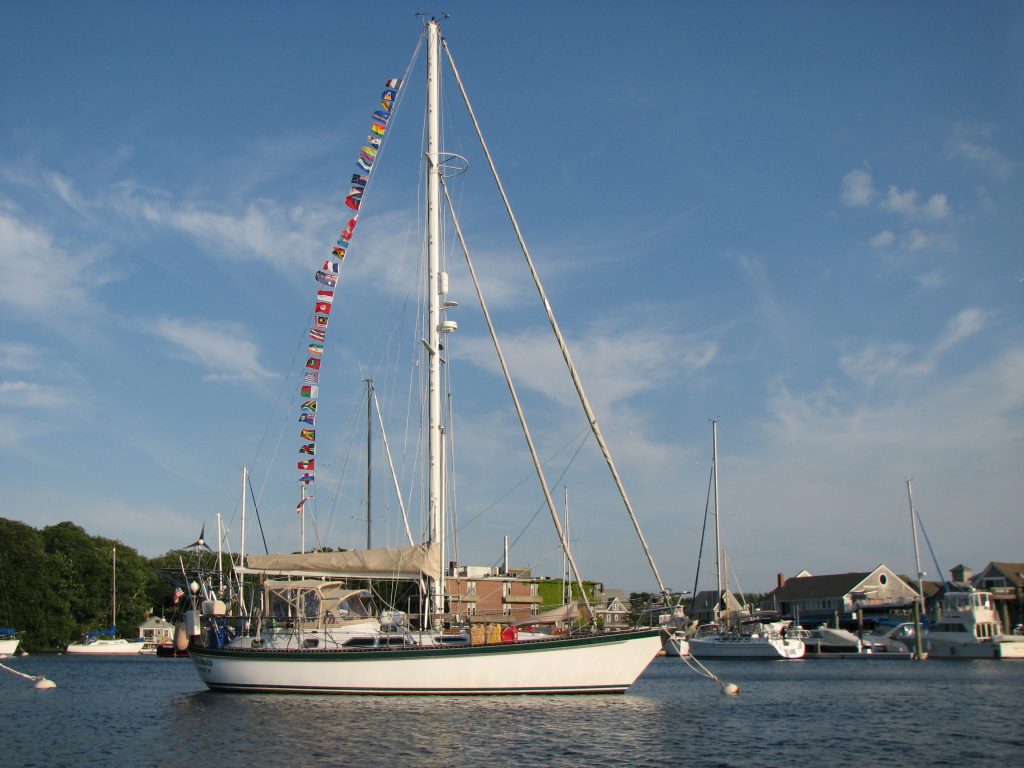
After almost 6 years of traveling, we sailed into Woods Hole on Cape Cod. We continued living aboard for the next five years and I wrote about that, adding ‘and Beyond’ to the title of the blog. Then shortly before Mark’s death in 2016, we sold our beloved Windbird and my travel logs became land logs. At this point, I had written a daily account for each and every day for 11 years. I fully intended to end the blog at that point, but when I wrote that news in a log, I got many responses saying that I really needed to keep posting. At the same time, I realized that I couldn’t stop writing. Summarizing each day had become a permanent part of my life and I will probably continue writing until I can no longer. These postings reflect the ordinary, and sometimes the extraordinary, days in my life and I would like to invite you to join me on my journey.
Day 36, Year 6 More Shopping
Day 36, Year 6 More Shopping
Date: Monday, November 29, 2010
Weather: Rain Overnight, Overcast Day, SW Winds
Location: Tuzi Gazi Marina, Richards Bay, South Africa
There’s not much to report today. We spent our morning putting away what we bought yesterday and then spent the afternoon shopping and putting more food stuffs away. We picked up the piece from our anchor windlass that we had hoped would be fixed, but not. And we picked up our alternator that we had hoped would be repaired, but not. So part of tomorrow morning will be spent on trying to find shops that can do the repairs we need. We are doing fine with the back-up alternator, but if something should happen to it we would not be able to produce power to send emails or keep the refrigerator and freezer going. So having a back-up is very important. So we will continue the search for someone who can get the parts to fix our alternator. The piece from our anchor windlass that we had hoped to get repaired is not quite as critical. The piece is called a gypsy and it provides the cogs that the anchor chain goes through when we raise and lower it. The current cogs on the gypsy are very worn and sometimes the anchor chains slips, but if we are super careful, we can probably make it back to the US with the current worn gypsy. So tomorrow morning, we will finish the last bits of food shopping and continue the search for places that can repair our broken bits. We will also do the last long-term food shopping, and when we return to Windbird and get those items stowed away, we will start looking for that window to head south.
Day 35, Year 6 Eating–Definitely Over-rated
Day 35, Year 6 Eating–Definitely Over-rated
Date: Sunday, November 28, 2010
Weather: Partly Sunny, Winds from the SW
Location: Tuzi Gazi Marina, Richards Bay, South Africa
Windbird is filling up with canned and bottled food for the up-coming Atlantic crossing. This time we are stocking up for only six months, but even that is quite a chore. Shopping is only half of the job, however. The real work begins when we get all of the bags hauled from the parking lot, down the dock, and onto Windbird. Putting everything away is the tough job. So after shopping all morning and packing things away all afternoon, we are still surrounded by dozens of cans and bottles that still need to find a home. I’ve decided that eating is definitely over-rated. There must be a better way to spend all this time and money!
We are now desperate to see all of the photos we took in Kruger, but we have not had one minute to even take a peek. We have, however, taken the time to have wonderful conversations with our children and grandchildren. We’ve talked to Justin, Jo, and Ziggy twice and we talked to Jed yesterday, and then the whole Goldstone crew-Jed, Heather, Sam, and Jonah–today. The internet connection here is fantastic so Skype video calls are once again a staple in our diet. Yesterday we got to watch Ziggy eat breakfast and today Sam and Jonah did a musical performance for us with Sam playing violin and Jonah dancing. We are making plans to all meet in St. Martin in the Caribbean in April. St. Martin was our first port-of-call after leaving the US, so it will be the closure of Windbird’s circumnavigation and a family reunion after more than a year-and-half without seeing each other. But first things first. For now we have to put all our energy into focusing on getting around the Cape of Good Hope safely. We’d love to be in Cape Town for Christmas, but at this point that looks like wishful thinking. We’ll be ready to leave here next week and then just watch that weather for a good window to head south.
Day 34, Year 6 Back to Reality
Day 34, Year 6 Back to Reality
Date: Saturday, November 27, 2010
Weather: Sunny, Windy Day and Humid
Location: Tuzi Gazi Marina, Richards Bay, South Africa
The problem with South Africa is that it is BIG. We still have over a thousand sea miles in some of the scariest waters in the world to travel before we reach Cape Town. And now that we have completed the touring in this area that we could afford, both time-wise and money-wise, it is time to start thinking about traveling south. Odulphus left while we were away and our neighbors Juan and Jane on Aldo left on the Thursday before we headed to Kruger. Most of the ARC Round the World Boats that arrived two weeks ago have already headed south, so now it is our turn. We have about of week of shopping and boat preparation to do and then we will start looking for that weather window.
The reality part of this is that we only have the rental car for three more days and we need to buy as many of the provisions we will need for the next six months before we return the car. So today Ed and Lynne had the car for the morning hours and we had it for the afternoon. Each day we will flip-flop the times, so we got back at 6 pm with LOADS of food and drink to carry from the car to the boat, and tomorrow morning we head out at 8 am to do the same thing all over again. This nice part is that we are only provisioning for the six months from now until we reach Florida in late May. When we left Thailand we were provisioning for ten months, and that was even harder. But because of the time crunch with the car, photo editing from our Kruger trip has been put on hold. We will be posting a few photos of the best of the best of the week-long trip with yesterday’s log, but the complete folders are a few days away from being posted. I thought I would have the complete logs from our days in Kruger posted by now, but maybe tomorrow. As always, so much to do, and so little time.
Day 33, Year 6 Home Again, Home Again
Day 33, Year 6 Home Again, Home Again
Date: Friday, November 26, 2010
Weather: Mostly Cloudy Early, PM Overcast, Intermittent Heavy Rain
Location: Tuzi Gazi Marina, Richards Bay, South Africa
Home from Kruger and the Blyde River Canyon . . . For the last six days we have been traveling in the northeastern part of South Africa, and it is a most spectacular little corner of the world. We traveled through parts of KwaZulu Natal province that we had not seen previously, drove through the tiny country of Swaziland, traveled for the better part of four days through the southern half of Kruger National Park (which shares an eastern border with Mozambique and the Limpopo Transfrontier Park and a northern border with the country of Zimbabwe), left Kruger and drove through a tiny corner of the South African province of Limpopo, drove into the clouds of Blyde River Canyon in the province of Mpumalanga, and then worked our way home through Mpumalanga and back into KwaZulu Natal. We saw some incredible scenery and spectacular wildlife. When you go to Kruger, you go to see the BIG 5-buffalo, elephant, leopard, lion, and rhino. But you also see cheetah, zebra, giraffe, wildebeest, warthog, hippo, and any number of majestic antelopes. We saw it all and the logs that I wrote for each day of the trip will be posted tomorrow. But if you don’t want to read all the details, you can just read this summary. However, you may want to look at the photos with each day.
Day 1–Big 5 minus 1
After driving two hours north of Richards Bay, we entered the small country of Swaziland. Four hours later we drove into the southeastern entrance to the Kruger National Park at Crocodile Bridge. We checked into our accommodation in the Crocodile Bridge Camp and were most delighted to find our rondavel (round hut with a conical roof) to be very nice. But we didn’t stick around long as we wanted to get out to see the wildlife. It is springtime here in South Africa and we saw evidence of that. We saw a baby zebra, a baby giraffe in a family grouping, and baby impala (a type of antelope) with their mothers. We saw rhino and elephant, got very close to buffalo, and in the last light of day, we saw lions in the distance. But they were so far away that you had to look through binoculars or super zoom in on photos to really tell what you were seeing. We felt like it hardly counted, but we did see lion on our first day, leaving leopard on our list of Most Wanted.
Day 2-Big 5 minus 1 plus 2
This day was all about seeing a mother cheetah with her three babies early in the morning, stumbling upon a pride of ten sleeping lions right beside the road, and seeing a baby hippo, as well as the big mommas and papas, at the end of the day. The adrenaline was running high, but the leopard still escaped us. We left Crocodile Bridge Camp at first light at 4:30 in the morning and by 8:30 am we had seen a herd of 20-30 elephants, three different kinds of antelope, two different groupings of dwarf mongoose, with the highlight being a beautiful mother cheetah crossing the road right in front of the car and then seeing her three bouncing little cubs coming behind her. They ran and climbed and put on a delightful show for us while the mother quietly disappeared into the bush. They quickly followed, but not before we were able to get great photos of the babies. Our goal for the day was to drive to the main road which bisects the park from north to south and then head south and west before heading back to the east to Skukuza Camp for the night. When we reached the main road and headed south, we literally stumbled upon a pride of lions. We saw a couple of cars stopped on our side of the road, so we pulled over to have a look. We were searching through the brush to see what we could see when we realized that lions were sleeping not even twelve feet away from us. If the other cars had not been stopped, we are not sure we would have seen them. They were just TOO obvious. There was a young male lion and a group of females in one body pile, three more in another body pile, and the dominant male sleeping a few yards away from the others. At first it looked like they were all dead. There was absolutely no movement. But then one would twitch, another would toss her head, and yet another would sit up for a second and then just absolutely and instantly collapse. It was so exciting to see these magnificent creatures up-close, but after a half an hour we saw that they were out for the count and we traveled on. After checking into our guest house for four at Skukuza Camp later in the day, we headed to a close-by hide looking out over Lake Panic. Here we saw hippos at a distance but one mother and baby very close to the hide. We also saw a mother egret trying to protect her baby from a monitor lizard (quite an interesting show) and many birds. At day’s end we returned to Skukuza and enjoyed the very nice accommodations in the guest house with Ed and Lynne.
Day 3-BIG FIVE and Much More
This day started at 5 am and by 5:30 we were watching a stately female leopard cross the road directly in front of us. This completed our search for the BIG FIVE, but there was more in store. As we headed back east toward Lower Sabie Camp we saw a big elephant destroying a tree by using his tusks to strip the bark. Before eating the bark, this guy actually managed to strip off the rough outer bark and eat only the tasty inner bark. This is when we realized that an elephant is actually just a self-contained pulp and paper mill. This was confirmed when we reached Lower Sabie Camp and found that they sell elephant dung writing paper in the shop. But we have to go back to the bark stripping elephant for just a minute. After stripping and eating most of the bark of the tree, the elephant moved to a nearby green-leaved bush to top off the bark main course with a little salad. We were constantly snapping photos, and when the elephant walked away from the bush I exclaimed, “This elephant has five legs.” You take it from there. This elephant was a HE and the fifth leg was not a leg! Now how do you top this? Well, the list of animals we saw for the remainder of the day is very long, but as we were hurrying back to Skukuza Camp at the end of the day, we had a big hippo cross the road right in front of us and then had another male elephant encounter. This big guy was walking down the paved road straight toward us, raising his truck high over his head every few steps. So we kept backing up and backing up, until finally we turned around to head in the opposite direction to try and find another way home. But we moved slowly and after this big guy had herded three different cars, us being one of those, he decided to head down to the river. So we did another u-turn and made it safely back to camp. Whew!
Day 4-Leo the Lion
We drove north on this day, out of bush country and into African savannah. We wanted to experience the open country and hoped to see herds of elephants and more lions. We did see a magnificent herd of elephants and just at the end of the day, we saw Leo the Lion. This male lion was cat-napping, head up, eyes closed, right beside the road. He looked just like the MGM lion. After taking tons of photos of him, sometimes eyes open, sometimes eyes closed, we realized that there was a second male lion back in the tall yellow grass. I got a photo of him yawning just before he collapsed in the grass for his nap. One minute we could see him, and the next he was sleeping in the grass and totally camouflaged. This reminded us to never take a walk in tall grass in Africa! These cats are unbelievable. They are up one minute and then down for the count the next. Leo did the same thing. It looked like he got tired of holding his head up and he just instantly fell over. We drove on down the road for a few kilometers and when we returned, he was still sleeping. While we watched, he started heaving his body and roaring and the other male was answering him, but he never got up. What a great way to end our last full day in Kruger.
Day 5-Out of Kruger, Into the Mountains
On our way out of Kruger we came upon a family of giraffe with the tiniest baby giraffe we had seen. And this just reminded us of how lucky we were to be visiting at this time of year. We saw baby antelope, baby hippo, baby zebra, baby giraffe, baby elephant, baby birds, baby buffalo, and baby cheetah. We left the park feeling very lucky to have seen all of the BIG 5 plus so many more animals with their babies. But we had to quickly switch from wildlife to landscape. We drove into the Drakensberg Mountains with absolutely breath-taking views. We had a bit of a battle with clouds in the afternoon as they settled on top of us obstructing some of the views, but we had already seen the most fantastic views and waterfalls and were content to descend to the little town of Graskop where we spent a lovely evening in the Graskop Hotel.
Today we spent eleven hours driving home. It should have taken only eight hours, but rain and road construction slowed us down. But it couldn’t dampen our spirits because we have seen and experienced so much beauty in the last few days.
 |
| 101126 Day 33 South Africa–Best of Kruger |
 |
| 101126b Day 33 South Africa–Kruger Faces |
 |
| 101126c Day 33 South Africa–Kruger Tails |
 |
| 101126 Day 33b South Africa–Graskop to Richards Bay |
Day 32, Year 6 Out of Kruger, Into the Mountains
Day 32, Year 6 Out of Kruger, Into the Mountains
Date: Thursday, November 25, 2010
Weather: Overcast, Foggy Mist in the Afternoon
Location: Graskop, Mapumalanga, South Africa
Happy Thanksgiving! We are eating at a Portuguese-Mozambican restaurant tonight, so no turkey for us. We are just going to have to wait until Christmas this year to have turkey, stuffing, and pumpkin pie. Ed and Lynne are eating at a different restaurant, so it is going to be a lonely Thanksgiving dinner. Holidays are hard for us out here without family and friends, but we are thinking of you and missing all of you so much. We’ll spend our evening talking about all the things we have to be thankful for, and that list is very long.
We left Satara Camp in Kruger at 6 am and drove for about two hours to get out of the park. We saw our last giraffe family with mama, papa, two teenagers, and the smallest giraffe baby we have seen. That was the highlight of our exit drive. We saw loads of impala mothers with babies, more than usual, and that was also special. But for the most part we drove through yellow-grass savannah country sprinkled with trees here and there and saw very little in the way of wildlife. We had hoped to see more lions, but that was not in the mix this morning. Seeing Leo and company last night would be a hard act to follow, and we are just grateful for all the wonderful sightings we did have in our three and half days in the park.
Upon exiting the park, we entered the Limpopo province for a short time and then drove into Mpumalanga province headed for the Blyde River Canyon. The Drakensberg Mountains run from the center of the country up to this area. The Blyde River Canyon is the third largest in the world and the largest green canyon. This area of the Drakensberg Mountains known as the Drakensberg Escarpment is home to some of South Africa’s most striking landscapes. At one time the whole area was untamed rainforest that provided a home for elephants, buffalo, and lions. But today when we climbed the mountain, we found huge gently sloping areas with commercial farming and towns, and closer to Graskop at the southern end, tree farms forever. Everything was so green and beautiful with the spectacular rock outcroppings surrounding the central flat lands We were going to stop to see Echo Cave on our way into the park, but when we got there and found out the shortest tour was 45 minutes, we decided to skip it. The clouds were looking ugly and we felt like we needed to get to some of the spectacular viewpoints while we could still see them. Our first stop was to see the Three Rondavels. A rondavel is a round African hut with a conical roof, or sometimes with a rounded beehive roof. At this overlook, we saw enormous rounds of rock with pointed and rounded grassy tops like the conical and beehive tops of rondavels. The Blyde River was rushing deep in the canyon and the Blyde River Dam has provided a meandering lake. The views of this were just spectacular. Our next stop was at Bourke’s Luck Potholes. These are cylindrical holes that have been carved into the rock by the whirlpools of water at the confluence of two rivers, the Blyde and the Treuer. Thomas Bourke, director of the Traansvaal Gold Mining Estate in the 1880’s, bought two farms in the present day area where the ‘potholes’ are found. Due to his presence in the area, the name stuck. We walked out to the confluence of the two rivers and found the deep cylindrical potholes in the bedrock of the river to be absolutely fascinating. This area is the start of the Blyde River Canyon. From here we drove to two different waterfalls, Berlin Falls and Lisbon Falls, and then on to a viewpoint called God’s Window. Unfortunately, God must have pulled down the blinds on his window today. The misty fog had rolled in and totally blocked any views. But luckily, we drove a short distance down the main road and found an overlook where we could see the Lowveld (low lands at the bottom of the mountain) just under a curtain of thick fog. Our next stop was to see the Pinnacle which looks like a rocky skyscraper. By this time it was late afternoon, so we headed to Graskop. This is a cute little town that gets loads of tourists and bikers who are doing high altitude training. We drove through town to see a natural rock bridge on the other side, but it was low and covered with grass-not much to look at. We then checked into the Graskop Hotel. It is not much to look at on the outside, but is a work of art on the inside. You have a choice of an art room or a garden room. We chose the garden room and we were delighted. Our room was decorated with art with antelope fur rugs on the floors. The French doors leading from our sitting room led out to a fabulous garden area with raised beds and sitting areas. The cost was the same as our accommodations in Kruger, which were nice, but this was REALLY nice. It was a lovely way to end our wildlife and sightseeing adventure in northern South Africa.
Note: Lance and Carla Gibson are the owners of Canimambo, the restaurant specializing in Portuguese and Mozambican food where we had dinner. We learned by reading the menu that in 2000 Lance was diagnosed with Dystonia. That made us think of Garrett Stuart, the son of good friends Linda and Michael Stuart, who also has Dystonia. Garrett will graduate from high school this year and loves to travel. I could just see him flying to South Africa to meet Lance and Carla. Lance and Carla were away on Holiday but their eighteen-year old son was running the restaurant and shared his father’s story with us.
 |
| 101125 Day 32a South Africa–Kruger Day 5 |
 |
| 101125 Day 32b South Africa–Blyde River Canyon to Graskop |
Day 31, Year 6 Kruger, Day 4-Leo the Lion
Day 31, Year 6 Kruger, Day 4-Leo the Lion
Date: Wednesday, November 24, 2010
Weather: Overcast and Drizzly
Location: Kruger National Park, South Africa
We drove north on this day, out of bush country and into African savannah. We promised to travel the main road north to Satara Camp where we would check-in for the night and then we would drive further north to Olifants Camp and back. We wanted to experience the open country and hoped to see herds of elephants and more lions. We did see a magnificent herd of elephants in the Olifant River and just at the end of the day, we saw Leo the Lion. So the plan was a success.
As we drove north from Skukuza we entered savannah country. The grass was more off-white than yellow. It swayed in the wind and was punctuated here and there by picturesque flat-topped African Umbrella Thorn trees, a type of Acacia (Acacia tortilis). In our first hour we saw elephants, mongoose, impalas, black and white lapwing birds, Vervet monkeys, baboons that filled the entire road in front of us, waterbuck with that characteristic white circle at their rear looking just like a target, zebra, giraffe, steenbok, rhino, a couple of warthogs, and many of the ever-present graceful impalas. We did take one loop road to see the southern-most baobab tree in Kruger and on the way we saw a small group of Southern Ground Hornbills. These are very large black birds with red skin on their throats and around their eyes. We saw some buffalo and herds of zebra and wildebeest hanging out together. We had an early lunch at Satara Camp, checked-in, and then headed further north to Olifants.
On the way, the grass became more sparse and countryside drier. The animals were more spread out, but we still saw lots of wildlife. We stopped on the Olifants River bridge and watched a magnificent herd of elephants pulling and eating the grass growing in the almost dry river bed. We visited Olifants Camp and then headed back south. Along the way we watched a yearling (not a baby) elephant nursing and found it fascinating the way the baby just flips his trunk up over his head so he can nurse. We also saw nyala, a type of antelope that we saw lots of in Hluhluwe but haven’t seen much of here. When we crossed the Olifants River bridge, the elephants were still there but this time it was the hippos in the water that were putting on the show. There was one big bull showing his authority over a mother and baby by opening that big mouth in front of them. I think he was all show, however, as he soon tired and went on his way. We got back to Satara Camp and picked up our keys (we could check in early but not get the keys), but didn’t go to the accommodations as we wanted to see the last bit of wildlife before coming in for the night. It was a good decision because our final drive of the day produced Leo the Lion.
This male lion that we named Leo was cat-napping, head up, eyes closed, right beside the road. He looked just like the MGM lion. After taking tons of photos of him, sometimes eyes open, sometimes eyes closed, we realized that there was a second male lion back in the tall grass. I got a photo of him yawning just before he collapsed in the grass for his nap. One minute we could see him, and the next he was sleeping in the grass and totally camouflaged. This reminded us to never take a walk in tall grass in Africa! These cats are unbelievable. They are up one minute and then down for the count the next. Leo did the same thing. It looked like he got tired of holding his head up and he just instantly fell over. We drove on down the road for a few kilometers and when we returned, he was still sleeping. While we watched, he started heaving his body and made grumbling sounds and the other male did the same in answer to him. But he never got up. We finally left Leo the Lazy Lion and headed back to camp. What a great way to end our last full day in Kruger.
 |
| 101124 Day 31 South Africa–Kruger Day 4 |
Day 30, Year 6 Kruger, Day 3-BIG 5 and Much More
Day 30, Year 6 Kruger, Day 3-BIG 5 and Much More
Date: Tuesday, November 23, 2010
Weather: Beautiful, Sunny Day
Location: Kruger National Park, South Africa
Today’s highlight was seeing a female leopard first thing in the morning. This rounded our sighting of the BIG 5-buffalo, elephant, leopard, lion, and rhino. We have been told that many people come to Kruger for years and never see a leopard, so we feel very, very lucky. We had planned our day to have the best chance of an early morning leopard sighting, but when we actually saw the leopard walking across the road in front of us, it was almost surreal. She was beautiful and majestic. After seeing the ten sleeping lions yesterday right beside the main road, we couldn’t believe we would be so lucky as to see a leopard on the main road right in front of us. It was just magic. And right behind the leopard came two spotted hyaenas down the road going right by the car and then ducking into the bush behind the leopard. But there is so much more to the Kruger experience than seeing the BIG 5 and we feel like we have been blessed with so many interesting sightings. After seeing the leopard, the adrenaline was running high once again. These cat sightings seem to do that to you. It took us about an hour of driving to settle down. We went back to the spot where we saw our sleeping lions yesterday, but they were gone. We did see some beautiful birds-long-legged crowned lapwings and various kinds of doves. There are Cape Turtle Doves that are gray with a black band on the back of the neck and black eyes and legs and the Red-eyed Doves that look identical but have reddish-orange eyes and legs. We also saw more steenbok which are a small antelope. Then we headed east toward the Lower Sabie River. On the way we watched an elephant strip all the bark off a tree, and then separate the tasty inner bark from the outer bark. It was fascinating, although tremendously destructive to the tree. We watched him strip and eat, strip and eat, and then he moved to a smaller scrub to eat the leaves. When he walked away from the scrub, I declared that this elephant had five legs. We looked more closely and saw that the fifth leg was-well, you can figure that one out. All that we could think was that he must have been super excited by his stripping of the tree. But none of us had ever seen such a sight and we decided we would have to add a five-legged elephant to our Kruger checklist, making it The Big 5 PLUS. Next we watched beautiful male kudus browsing. Kudus are a rather large antelope with vertical wide-spaced, thin white stripes on their sides. The males have magnificent spiraling horns which can be five feet long. When two males locks horns it can sometimes be the death of them both as there is no way they can get unlocked from each other. Not far away we saw female kudus browsing, but we did not see kudu babies. At one water hole we saw a hamerkop. This is a brown water bird with longest black legs and backward-pointing crest. As this bird walks along the crested head goes up and down and looks like the head of a hammer. I’m imagining this is how it got its name. As we neared Lower Sabie Camp we stopped at Sunset Dam and watched the wildlife in the lake formed by the dam. There we saw hippos in and out of the water, a sly crocodile surfacing just enough so that we could see his eyes, lots of weaver birds, and a family of Egyptian geese with momma, papa, and five babies.
We stopped for lunch in the café at Lower Sabie Camp that overlooks the Lower Sabie River. There we got our only look at a Saddle-billed Stork. This is a tall black and white bird with long black legs, a black head, and a long black bill banded with bright red. This bird is listed as Endangered in South Africa so we were pleased to get to see it. After lunch we drove a loop road near Lower Sabie camp and our first sighting was another magnificent bird called the Secretarybird. This is a large black and white bird with very long legs and an orange patch of skin around its eyes. It is easily identified by its striding gait through the grasses.
In the afternoon we made two stops where we could get out of the car. The first was on top of a hill overlooking Mlondozi Dam. We got out of the car here and watched Vervet monkeys and lizards skittering about under the thatch-roofed picnic area. The next stop was at the Nthandanyathi Hide. Here we saw hippos floating in the water and birds. A feisty Southern Yellow-billed Hornbill landed on a branch right above us and observed us while a beautiful little Crested Barbel sat on a branch next to the hornbill. On our way back to Lower Sabie we saw zebra, wildebeest, giraffe, warthog, various types of antelopes, lots of Leopard turtles crossing the road, and as the sun was starting to dip in the sky, a huge hippo walked across the road in front of us and then tried to hide himself behind some straggly bush to play hide and seek with us. No sooner had we ended that game when a big bull elephant came marching down the middle of the road right toward us, flapping his ears and repeatedly raising his trunk high over his head. We were not sure why he was doing this, but it looked threatening to us. So we stopped and then more cars arrived on the scene and stopped, but the elephant kept marching. So we all backed up, and then we backed up some more. The two other cars turned around and left and just about the time we were ready to do the same, the elephant finally left the road and headed down to the river. We were prepared for a full tilt charge, so we were much relieved. But there was never any doubt about who was in charge. A little further on we saw baboon couples sitting on the side of the road with the females picking parasites from the males coat. One couple had a tiny little one who was very curious and put on quite a show for us. Seeing all of these magnificent animals in their natural habitat, doing what they do naturally, is just such a special experience. It was another great day for us in Kruger National Park.
 |
| 101123 Day 30 South Africa–Kruger Day 3 |
Day 29, Year 6 Kruger, Day 2-Big 5 minus 1 plus 2
Day 29, Year 6 Kruger, Day 2-Big 5 minus 1 plus 2
Date: Monday, November 22, 2010
Weather: Beautiful, Sunny Day
Location: Kruger National Park, South Africa
Today we added cheetah and hippos to our list, but that leopard is still lurking somewhere out of our view. This day was all about seeing a mother cheetah with her three babies early in the morning, then stumbling upon a pride of ten sleeping lions right beside the road, and seeing a baby hippo at the end of the day, as well as the big mommas and papas. The adrenaline was running high after seeing the cheetahs and the lions and it took much of the rest of the day for us to settle down. We left Crocodile Bridge Camp at first light at 4:30 in the morning and by 8:30 am we had seen a herd of twenty to thirty elephants, three different kinds of antelope, two different groupings of dwarf mongoose, with the highlight being the beautiful mother cheetah crossing the road right in front of the car and then seeing her three bouncing little cubs coming behind her. They ran and climbed and put on a delightful show for us while the mother quietly disappeared into the bush. They quickly followed, but not before we were able to get great photos of the babies.
Our goal for the day was to leave Crocodile Bridge camp in southeast Kruger and drive diagonally all the way across the park to the western border, turn north, then back east to Skukuza Camp for the night. It meant a lot of driving, but it paid off in wildlife sightings. There is one main road that runs north south and divides the park into eastern and western sections. When we reached that main road we had to drive south in order to pick up the next gravel road that would take us to the western boundary. While driving south on the main road, we literally stumbled upon a pride of lions. We saw a couple of cars stopped on our side of the road, so we pulled over to have a look. We were searching through the brush to see what we could see in the distance when we realized that lions were sleeping not even twelve feet away from us. If the other cars had not been stopped, we are not sure we would have seen them. They were just TOO obvious. There was a young male lion and a group of females in one body pile, three more in another body pile, and the dominant male sleeping a few yards away from the others. At first it looked like they were all dead. There was absolutely no movement. But then one would twitch, another would toss her head, and yet another would sit up for a second and then just absolutely and instantly collapse. The dominant male rolled over onto his back at one point with his feet up in the air and instantly went back to sleep. We all got a chuckle out of that. It was so exciting to see these magnificent creatures up-close, but after a half an hour we saw that they were out for the count and we traveled on. We traveled west across the park in hopes of seeing roan and sable, two different antelopes that are hard to find but should have been in that area. We were not successful, but we did manage to have a nice lunch at the Pretoriuskop Camp on Kruger’s western boundary. From there we headed north and then east to Skukuza Camp. After checking into our guest house for four at Skukuza, we headed to a close-by hide looking out over Lake Panic. What a great place for wildlife sightings in the late afternoon. Here we saw hippos at a distance but one mother and baby floating in the reeds very close to the hide. We also saw a mother green-backed heron trying to protect her baby from a monitor lizard (quite an interesting show) and many birds. At day’s end we returned to Skukuza and enjoyed the very nice accommodations in the guest house with Ed and Lynne.
 |
| 101122 Day 29 South Africa–Kruger Day 2 |
Day 28, Year 6 Kruger, Day 1-Big 5 minus 1
Day 28, Year 6 Kruger, Day 1-Big 5 minus 1
Date: Sunday, November 21, 2010
Weather: Beautiful, Sunny Day
Location: Kruger National Park, South Africa
Progress has been made. We saw our first lions today, albeit at quite a distance. But Lynne and I were able to get photos to capture the moment. I didn’t really feel like I had ‘seen’ a lion as I could only see them through the binoculars and in super-zoomed photos. But we did see two lions, one clearly a female and the other not so clearly a young male. I say ‘not so clearly’ because in the photos he was either on this back with his feet in the air or his head was partially hidden by bushes. But the head of the second lion looked bigger and fuzzier, even though it was camouflaged. Now we just have to hunt down a leopard to complete our Big 5 experience. That is easier said than done, however, but we have three more days to give it a try.
We left Richards Bay at 6 am and crossed the border from KwaZulu Natal Province, South Africa into the tiny country of Swaziland about two hours later. We drove through huge sugar cane plantations, drove into Hlane Royal National Park to see what we could see, but we quickly learned that it is not a self-driving park. So we drove on. We drove out of Swaziland and into Mpumalanga, another South African province. After negotiating a road detour, we finally reached the Crocodile Bridge Gate leading into Kruger National Park around 1:30 pm. We checked into our bungalows (actually round rondavels with conical thatched roofs), ate lunch, and headed out to see as much game as possible in the few short hours left in the afternoon. Our first 45 minutes were not very productive, but around 4 pm things started to change. We saw loads of Impala and at two different sites we saw a mother Impala with her young fawn. Zebra and giraffe were also in abundance and we saw a beautiful giraffe family grouping with a baby giraffe, her mother and father, and an older sibling who delighted in chasing the baby. One zebra group we saw today was also in a playful mood. There was one baby sticking close to her mother, a few older zebras, and few yearlings that were enjoying chasing one another in circles. We saw elephants, wildebeest, vultures, beautiful birds of all sorts, and a few buffalo-one of which was right beside us on the road and posed for our photos. We got back to Crocodile Bridge Camp just before the gate closed, but in time to fill up with petrol. Tomorrow morning we head out at 4:30 am to see what wildlife we can see in the early, early morning hours.
 |
| 101121 Day 28 South Africa–Kruger Day 1 |
Day 27, Year 6 Zulu Song and Dance
Day 27, Year 6 Zulu Song and Dance
Date: Saturday, November 20, 2010
Weather: Beautiful Day, Winds NE 20
Location: Tuzi Gazi Marina, Richards Bay, South Africa
What a day! We spent the entire day at the Sports Complex in Richards Bay watching the 14th Annual Zulu Dance Competition. And it was fantastic. We had been told that the competitions get moving slowly in the morning, so we arrived at 11 am. Unfortunately, that was a little too late as we missed a couple of the categories. We arrived in time for the Isicathamiya. This is a singing competition where the men are dressed in suit and tie and white gloves. They sing a-cappella combining a bit of gospel with traditional African rhythm. Next we watched Ingoma Isizingili. Mixed groups of young men and women, and sometimes very young children performed the dance to the chanting of a large group of people behind them. The men dress in traditional animal skins and the women perform bare-chested wearing a skirt and sometimes an elaborate necklace of beads. This is one of the purest remnants of Zulu tradition. But the highlight was Indlamu which is sometimes referred to as the Zulu war dance. Actually it is a dance of warriors. In this dance the beat is kept with big drums. The dancers lift a foot high over their heads and then slam it down hard on the ground accentuating the drum beat. The dancers are dressed in animal hides with women dancers performing bare-chested. The final performance was a modern form of Ingoma called Ingoma Isishiyameni. Ingoma is another dance where feet are alternately kicked high in the air and then slammed down hard on the ground. The modern version reminded us of break dancing, which must have been derived from the African Isishyyameni. The costumes were quite creative and the dancers most enthusiastic. It wore us out just watching them! There was a lunch break and Anushka Makka, the Tourism Officer for the Uthungulu District Municipality here in Richards Bay, invited all of the yachties in attendance to a free luncheon. We were overwhelmed at the outreach of hospitality. All in all, it was a fantastic day.
And a fantastic day should be topped with a fantastic night, and so it was. We went to the barbecue that Pieter of Odulphus had arranged with Christie at the Upper Deck. It was the perfect ending to a perfect day. The Dutch-Pieter and Carla of Odulphus, Deana and Ed of Angelique, and Henny, a mainstay here in Tuzi Gazi-played accordion, harmonica, and guitar and got us all involved in a bit of singing. The Upper Deck supplied green salad, pasta salad, and bean salad, mashed potatoes and gray, and a tray of lamb, beef, and sausage for each person for only 55 rand ($8 US). And most of us could only eat one dinner between the two of us. The food was good but the camaraderie was the special part. Dominique and Dominique of KEA arrived from Mozambique while we were all standing around the braai (South African term for a grill) and once they were tied up, they came to join us. Getting together with other cruisers tonight reminded us of what a special group of people we travel with.
 |
| 101120 Day 27a South Africa–Zulu Dance Competition |
 |
| 101120 Day 27b South Africa–Upper Deck Braai |