
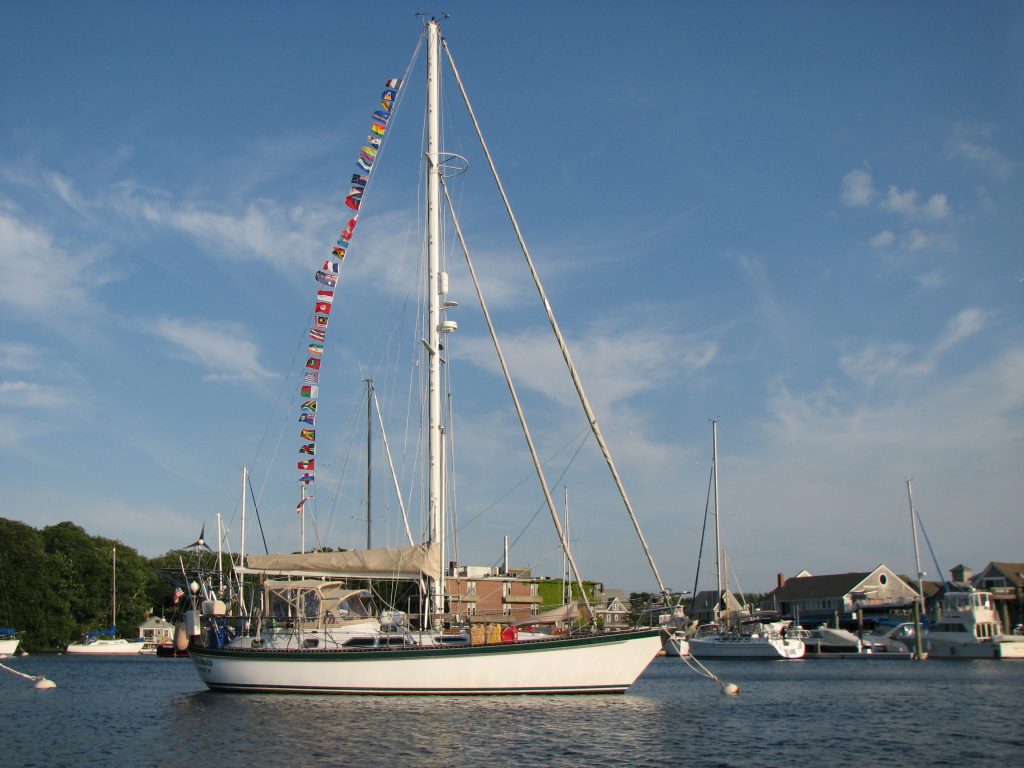
After almost 6 years of traveling, we sailed into Woods Hole on Cape Cod. We continued living aboard for the next five years and I wrote about that, adding ‘and Beyond’ to the title of the blog. Then shortly before Mark’s death in 2016, we sold our beloved Windbird and my travel logs became land logs. At this point, I had written a daily account for each and every day for 11 years. I fully intended to end the blog at that point, but when I wrote that news in a log, I got many responses saying that I really needed to keep posting. At the same time, I realized that I couldn’t stop writing. Summarizing each day had become a permanent part of my life and I will probably continue writing until I can no longer. These postings reflect the ordinary, and sometimes the extraordinary, days in my life and I would like to invite you to join me on my journey.
Day 116, Year 1: Cristobal, Panama
Day 116, Year 1: Cristobal, Panama
Date: Friday, February 10, 2006
Weather: Sunny and Very Warm
Latitude: 09 degrees 20 minutes
Longitude: 79 degrees 54 minutes
Location: Panama Canal Zone, San Cristobal, Panama (near Panama Canal Yacht Club)
Miles Traveled from San Blas to Cristobal: 88 miles
We had a great overnight passage from the San Blas to the Panama Canal Zone. We arrived safely at about 1000, so it took us a little less than 14 hours to make the trip. We sailed under double-reefed main and reefed head sail to slow ourselves down so that we would have good light to enter the Canal Zone. What we didn’t know is that we would have a good 1 knot current against us beginning in the wee hours of the morning, so we got in a little later than expected. As we headed into the Canal Zone, a school of Spotted Dolphins served as our welcoming committee. With so many boats coming in and out of here, those dolphins must be worn out at the end of each day.
We had some mail that needed to get to a post office about a week ago, so Mark headed into the Panama Canal Yacht Club as soon as we arrived. I stayed on the boat as we have read that it is unsafe to leave your boat without someone aboard here. After being here for the day, I think that leaving during the daytime is fine, but at night, you need someone to keep a look out. Mark was gone about 2 hours having successfully gotten the mail off, plus he returned with the lines required for Canal transit and tires that we need to use as fenders. He is a fast mover! We did not plan to do any of this until Monday, but when he got to the Yacht Club, he found that he could not walk to the Post Office. It is very close, but it is totally unsafe to walk anywhere here. So he got one of the many cabbies that hang out here to take him. This guy is even a faster mover than Mark-and that’s going some. He took Mark to the PO and then he asked him if we were already registered to go through the Canal. Mark explained that we had just arrived, but the guy said, “What are you waiting for? If you’ve got a copy of your boat documentation and a crew list with you, we’ll go straight to the Admeasurer’s Office and make an appointment to have the boat inspected.” Mark had the documents, so off they went. The Admeasurer will come tomorrow to check the boat to make sure it safe for a Canal passage. We will go to the CitiBank on Monday to pay the fees, and after 1800 on Monday evening, we call to get our passage date. The cabbie Mark randomly chose is an agent here and he swears he can make that call for us for $10.00 and get us through the Canal by the end of next week. That seems VERY optimistic, but he did a great job today of getting about 3 days work done in 2 hours. But I believe in magic, so we’ll see what Monday brings.
When Mark returned with the lines and half the tires, I asked why he didn’t bring all of the tires. It seems that a 72 year-old gentleman from Romania needed a ride back to his boat. Mark took him instead of the rest of the tires. The man is traveling solo around the world in a tiny, tiny sailboat-and he has no dinghy. A very brave soul. But since Mark had to go back in for the rest of the tires, I went with him. I’m glad I did as we finally met Patrick and Margaret aboard Aqua Magic from Portsmouth, England. We have talked with them on the radio many times and it was great to meet them. They have a transit date the end of February and think that our cabbie will not be able to get us through next week. We shall see.
We are headed into the Yacht Club for Happy Hour. We are hoping to find someone transiting in the next couple of days that we can go with as line handlers. And we need to find 4 strong people who are willing to handle lines for us. We have to have names for the Admeasurer tomorrow, so tonight’s Happy Hour will also be a time to connect with folks and find the people we need. Mark met a French couple earlier today that are on vacation in Panama, and they are willing to go with us, so we really only need 2 more people.
Since it is not safe to travel into town (Mark says it looks really scary-that it makes the worst inner-city in the US look like a walk in the park.), we’ll spend most of our time here on the boat and at the Yacht Club-certainly not fancy, just the bare necessities. We have to be on the boat all day tomorrow to wait for the Admeasurer, so it will be a forced day of little movement. I think we need that!
 |
| 060210 Day 116 Arrival in Cristobal, Panama |
Day 115, Year 1: Enroute from the San Blas Islands to Cristobal, Panama
Day 115, Year 1: Enroute from the San Blas Islands to Cristobal, Panama
Date: Thursday, February 9, 2006
Weather: Beautiful Day
Location: Overnight Passage from San Blas to Cristobal, Panama
As the sun was beginning to sink below the horizon, we were leaving our anchorage at Acuakargana and Waisaladup islands in the San Blas. We are now headed west into the sunset and should arrive in the Panama Canal area by mid-morning. I find myself leaving the San Blas with a bit of sadness, and at the same time, a great deal of joy. We were only here 4 days, but these islands offer so much and we really connected. I keep thinking of Ernesto Perez’s oldest son, Ian. He is a very bright and thoughtful thirteen year-old. When we said good-bye yesterday, he hugged and kissed me and it was very special. As with teenagers everywhere, he had a CD player attached to his ear most of the time. I asked him what kind of music he listens to and he said the Rolling Stones, Red, Red, White, and U Quatro. I’ve never heard of the last two, but we did have the Rolling Stones in common. I wonder if I will see Ian again someday. Maybe. He has a copy of San Blas cruising guide that has Kuna words translated into English and Spanish. He has added his own column in French. I tried to explain to him that if he could print out his 4-column language guide, he could sell it to all sailors visiting his island. I would have given anything to have a copy of what he had, but there are certainly no copy machines on Sugtupu. There is one computer, however, but I’m not sure there is a printer. Maybe someday I will come back and have the time to help him print his language guide. For now, as I leave here, I have happy thoughts of the people we met and am a little sad that we didn’t have more time to spend with them.
We spent our day at Disney World today. We headed over to Waisaladup mid-morning to explore and to snorkel. The island is narrow and you can see the ocean surf across the island. The part of the island where we beached the dinghy looked like a coconut tree park. The area under the trees was cleared so that you walked on sand from tree to tree. As we walked further down the island, there was more vegetation under the trees, and it was beautiful in a different way. We rounded the tip of the island and watched the waves of the Atlantic as they crashed on the reef and then headed back to where we had left the dinghy and went snorkeling. We were over sand at first and then weaved in and out of the coral reef that follows the shore of the island. The fish were not as big, and there wasn’t quite the variety that we saw in Bonaire, but the coral was beautiful and colorful. There were so many different kinds of coral, and the soft corals swayed with the ocean surge. I found myself swaying with the coral and truly spellbound by all of the colors. I thought that if Disney were going to build a fake coral reef for children to snorkel in, it would look just like this. Neon green coral, purple coral, yellow coral, red fish, blue fish, yellow fish . . . it was beautiful. We went back to Windbird to have lunch and then headed back for one more walk and one more snorkel before leaving. On our walk we watched the pelicans fly overhead and land on the water close by. In the water, the sunlight was just right and the colors were even brighter than in the morning. We saw some fish that were new to us, and some old favorites. We watch a spotted ray for a long time and swam with schools of neon blue chromis and blue tangs. We chose this anchorage because the guide said it was good for snorkeling, and indeed it was. It was a very good choice for our last snorkel in the Atlantic. The next time we put on our snorkel gear, we will probably be in the Pacific Ocean.
We are moving along under a moon that has only a few days until it will be full. There’s not a lot of wind tonight, so we might be motoring to Cristobal. Right now we are motor sailing and listening to Jimmy Buffet. I’ll check in tomorrow to let you know how things go.
 |
| 060209 Day 115 West Holandes Cays, San Blas |
Day 114, Year 1: Sugtupu to Acuadup to Western Holandes Cays, San Blas, Panama
Day 114, Year 1: Sugtupu to Acuadup to Western Holandes Cays, San Blas, Panama
Date: Wednesday, February 8, 2006
Air Temperature: 82 degrees F
Water Temperature: 81 degrees F
Latitude: N 09 degrees 36 minutes
Longitude: W 78 degrees 47 minutes
Location: West Holandes Cays, San Blas, Panama
Another phenomenal day. The sun is setting and we are now in West Holandes Cays in the San Blas. We are anchored behind a reef and looking right out into the Caribbean Basin. To our left is an island with coconut palms white sand beaches-Acuakargana–and to our right is another island with coconut palms, lots of pelicans, and white sand beaches–Waisaladup. As we anchored here, schools of very small silver fish flittered out of the water and back in again-over and over. Not sure what they were, but the glittery effect was beautiful. There was also either one lone dolphin or a small whale that continued to surface and then dive in front of us. While that was happening, flocks of pelicans swooped playfully along the beach on Waisaladup. I can hear the surf pounding on the reef in front of me and birds calling in the palm trees on shore. All of this comes at the end of day where we started on Carti Sugtupu, dinghied 2 miles to Acuadup and back, and then sailed here. It has been an amazing day filled with experiencing new and wonderful things.
Early in the day, Ernesto (our guide from Sugtupu) and his 3 sons came to go with us to a neighboring island. It was a 2 mile dinghy ride to Acuadup. Ernesto’s oldest son, Ian, was to be our guide and he piloted the dinghy through the choppy waters. Acuadup is a traditional Kuna island. It was very different from Sugtupu in that there was open green space between the huts instead of small walkways with packed earth.. I said to Ernesto that his island was the town and this one was the country. He agreed. There were coconut palms, banana trees, breadfruit trees, calabash gourd trees, and lime trees everywhere. Once in a while, a little color was added by large hibiscus flowering buses. As we walked, every hut had Kuna women trying to sell me their molas. They had them displayed on the grass, on the sand, hanging on poles, everywhere. I did buy as many molas as I could afford, but finally had to keep saying, “No more money for molas”. The Kuna women speak no English, but they have no trouble saying “ten dollars”. I think they understood that I was saying that I had no more money, but I am sure they didn’t believe me. Buying molas could become an obsession, so I was glad I had brought a limited amount of money.
On one part of the island, the people were relatives of Ernesto, so we could go into the huts and see how the people live. Every hut has many hammocks, one for everyone that sleeps there. For the most part, living rooms and kitchens are outside, and only sitting areas and sleeping areas are inside. On this island, parakeets and monkeys had been brought from the mainland as pets, and there were many wild pigs in pens. It was a very special experience to visit this traditional Kuna village. There were very few men on the island as all were out either fishing, getting water from the river on the mainland, or working their garden plots on the mainland. The women are tenacious sales people, and the children run about happily. But by 1100, it was time to head back to Sugtupu. We had promised to stop by the airport on the mainland on the way so that Rudy could see it, so that was our first stop. There were no people there, so we had the runway to ourselves We looked around and decided that it was time to head for the mainland. We headed out into the choppy seas and by the time we reached Sugtupu, we were all soaked. We went directly to Ernesto’s house as he had asked us if we could please take a picture of his whole family and print it for him before we left. A few more extended family members than we expected also wanted their pictures taken, but we finally broke away and headed back to Windbird with just Ernesto and Ian. We printed some pictures for them and then they untied their ulu and paddled away. It was with mixed emotions that we said goodbye. We felt very lucky to have gotten to know a Kuna family so quickly, but at the same time, the constant pushing of Kuna molas and other artifacts was wearing thin. We pulled up the anchor at about 1400 and headed north to our present anchorage.
We are now about a half mile from one of the major passes back out into the Interior Basin of the Caribbean. We will spend tomorrow walking on the islands and snorkeling, and then in the early evening we will head out for the Panama Canal. We will arrive on Friday mid-day, and immediately start the process for getting registered to go through the Canal. Once we are given a date, we will figure out whether we will stay in Colon to await transit, or whether we will explore others parts of Panama while waiting.
So I will check in with a log before leaving here, and then check in again once we are in Colon on Friday. Colon is not a city that is safe to walk around in, so we are really hoping our stay there will not be the reported 4 weeks. That could be a very long 28 days.
 |
| 060208 Day 114a Ernesto Perez Family Pictures |
 |
| 060208 Day 114b Acuatupu, San Blas |
Day 113, Year 1: Carti Sugtupu, San Blas, Panama
Day 113, Year 1: Carti Sugtupu, San Blas, Panama
Date: Tuesday, February 7, 2006
Air Temperature: 82 degrees F
Water Temperature: 81 degrees F
Latitude: N 09 degrees 33 minutes
Longitude: W 78 degrees 56 minutes
Location: Carti Sugtupu, San Blas, Panama
This was quite some day, so this log will be a long one. If you just want to know if we are fine and enjoying the San Blas, you can stop here. We are. If you want the details, read on. I hope you enjoy reading about our wonderful day with the Kuna Indians on Carti Sugtupu.
When we got up this morning, we still weren’t sure which island we were going to travel to today, so we spent more time reading the Panama Guide and trying to decide. Did we want an uninhabited island or an island with a village? If we wanted an island with a village, did we want totally traditional (no schools or churches) or one with a school? Did we want to go to an island close to the mainland, or one further out? As we read, we discovered that one island, Sugtupu in the Carti Group, has a post office. We desperately need to mail something overnight to the US dealing with our boat documentation, so even though I had read that this island has been spoiled by the number of cruise boats that visit it, we decided on Sugtupu. We knew if that didn’t work out, we could move about a half mile to another very traditional island with only 4 families living on it. So we left Porvenir around 0930 headed about 3 miles south to Sugtupu which is very close to the mainland in the south of the Gulfo de San Blas. As we left Porvenir, I was at the wheel and had to cut in front of a boat whose crew was pulling up the chain anchor rode by hand. The boat turned out to the Gipsy Moth IV from Great Britain. This boat was sailed around the world by one of the most famous cruising couples of all time, Eric and Susan Hiscock. Eric wrote the first book that Mark ever read on world cruising: Cruising Under Sail. It was a real rush to be right next to this boat carrying so much history.
We had a latitude and longitude reading for an anchor destination of Sugtupu, and as we neared the island, a man and his son came paddling up to us in an ulu (traditional dug out canoe). The father, Ernesto, was dressed in jeans shorts and a t-shirt and spoke very good English. He talked with Mark, who was on the foredeck ready to set the anchor, and before I knew it, he was onboard helping us to navigate between two reef areas. His 11 year-old son, Rudy, stayed behind in the ulu and kept up with us as we headed in to anchor. What I didn’t realize at the time was that there was another 7 year-old son, Kevin, in a second ulu. He couldn’t keep up with us and after anchoring, Ernesto and Mark had to rescue him with our dinghy. Ernesto is a 42-year old Kuna entrepreneur. He speaks Kuna, Spanish, English, French, and a little German. His business card lists him as a local excursion tour guide. Basically, he does serve as a tour guide of Sugtupu and of the cemetery and jungle on the mainland for people who sail into the island as we did today or for those who come in on the “adventure-oriented” cruise ships. Ernesto, Rudy, and Kevin spent some time on the boat with us and we learned that we had come on a good day for visiting. There were no cruise ships anywhere near the San Blas and at 1300, two families were hosting puberty celebrations for their 11 year-old daughters. We could visit the island and see the celebration.
Shortly after 1300, we dinghied over to the island and were met by Ernesto. We started our island tour at the southeast end of the island where the medical center and school are located. The school and medical center are poured concrete and the school is being renovated for the February visit by the President of Panama, and the children are on holiday until March, so we saw only an empty building. This whole island is not as large as a city block in New York City, but 1,000 Kuna Indians live here according to Ernesto. There are 2 dirt-packed avenues that run the length of the island, with narrow walkways that run perpendicular to the avenues between the huts. Each room in a hut is about 12 feet square and some families have only one room while others have 2 or 3. No hardwood is needed in the main construction of the huts. The walls are made of what I assumed are sugar cane poles lashed together vertically. The roof is layer after layer of palm fronds. There is a wooden door, but no windows, so the insides are very dark. Hammocks are everywhere as this is what the Kunas sleep in. There are stores that sell cold drinks and a few essentials, but certainly nothing fancy. We went to the congreso building and met one of the two men who are second in command under the chief or sahila. They are referred to as the deputy sahilas (pronounced like silo). The congreso looked just like all of the huts, just larger. Four hammocks hung in the center of the room and only the chief and his deputies can use these, while everyone else sits on the hard benches that form a square around the hammocks. More benches fill the room, all facing the center. Ernesto explained that all decisions for the village are made here. Woman can attend and sit and watch, but they cannot speak. Men make all of the decisions in this otherwise matriarchal society. Next we visited what Ernesto called the “bar” or party hut where the celebration was taking place. Traditionally this is the hut where chicha is made. Chicha is a mild alcoholic drink made form fermented sugar cane juice, but today the chicha hut was being used for the puberty rite celebration and the alcoholic drink for this day is rum. Here we met the village chief and the second of his deputies. We also met the man in charge of the “bar”. These men all wear long pants, dress shirts, and formal dress hats. Each time we met an important person, we were directed by Ernesto to give them a dollar, or five in the case of the chief, as part of getting their approval for our island visit and to pay our respects to their position. A bit of a strange system, but it works. You are also expected to pay a dollar to get permission to take pictures of any adult Kuna women. You can photograph children, but pictures of the women or special ceremonies come at a price.
We went to Ernesto’s complex of huts and met his oldest son, Ian, and his 5 year-old daughter Nayelin. He showed us molas that his wife had for sale and we sat inside and then moved our chairs outside to enjoy the breeze. A couple of men came by in an ula with lobsters for us. They had 3 for $3.00 and threw in a small one as a gift. Ernesto’s complex is on the north side of the island on the water, so there was a wonderful breeze at all times. I had seen his wife in room next to the one where we were sitting. She was in a hammock, but did not come out to meet us. A little later, one of the boys came out with Wilfran, the 7-month old. He was a very cute and very happy baby and the 3 boys seemed to be very much a part of taking care of him. It was time to move on and we visited Ernesto’s mother-in-law’s complex, visited the Kuna museum on the island, and then went back to see how the celebration was proceeding. Everyone was still passing the rum bottle around and drinking shots. All of the women were on one side of the large hut and all of the men on the other, with a group of about 6 men sitting between. They were wearing green dress shirts, long pants, and black dress hats. Eventually, a couple of them put on pelican bone necklaces and danced. If we had stayed on into the evening, everyone would be dancing, but around 1700, we decided it was time to go back to Windbird for the evening.
The chief is coming out to Windbird at 0800 in the morning to visit with us and then Ernesto’s 2 oldest sons will go with us in our dinghy to another island closer to shore. We might get to explore a small river near there that goes into the rain forest. We will do that and then move to the north to some uninhabited islands for tomorrow night.
We feel overwhelmed being immersed into this culture so foreign to our own so quickly and at the same time feel so lucky to have met Ernesto which gave us the chance to really get to know the island of Sugtupu.
 |
| 060207 Day 113a Caribbean, San Blas–Carti Sugtupu Arrival |
 |
| 060207 Day 113b Caribbean, San Blas–Traditional Kuna Dance Video |
Day 112, Year 1: In the Land of Comarca de San Blas or Kuna Yala (indigenous)
Day 112, Year 1: In the Land of Comarca de San Blas or Kuna Yala (indigenous)
Date: Monday, February 6, 2006
Air Temperature: 82 degrees F
Water Temperature: 81 degrees F
Latitude: N 09 degrees 33 minutes
Longitude: W 78 degrees 56 minutes
Location: Porvenier, San Blas Islands, Panama
Total trip miles–731. Wow! We are here in the San Blas islands. During the night we had to roll in the head sail and start motoring. There was plenty of wind but it was coming from the wrong direction. This morning at about 0930 we spotted land. At first we saw some very low islands and then behind those islands we saw the mainland of Panama. This was one of those moments that takes you by surprise. We have made many landfalls, but somehow this one seemed different. Judy Martin from Nitro, West Virginia, and Mark Handley, from Mattoon, Illinois–sailing into the San Blas islands. Not something that would have been written in our high school year books as aspirations for the future, but here we are. The moment was almost dreamlike. I found myself asking, “What’s a girl like me doing here?” Mark had to admit this morning that on the night we met and he shared his dream of sailing around the world with me, it was really only a dream. He evidently never really expected to do it. I had to tell him that he made a big mistake sharing that dream with me if he really didn’t want to do it. I might not be the person who dreams up these wild adventures, but I take seriously the job of doing everything possible to make dreams come true. So here we are.
We are anchored off Porvenir, a tiny island that is the western entry point for the San Blas. No one lives here. It is just the official check in station. We had hoped to get checked in and headed to one of the reef islands known for great snorkeling by mid-afternoon, but Caribbean lunchtimes, slow, slow processing of paperwork, and the fact that about 25 other boats decided to enter paradise today, we are still sitting here in Porvenir. This is a small island, maybe a half mile long and the width of a football field. There are some beach huts, a little museum, a small building that houses the check in staiton, an old World War II air strip that is still in use, and a hotel. Well, a hotel of sorts. A small red plane flies in and out about 3 times during the day. The runway runs diagonally across the island to make the best use of the little bit of land. Right now there are about 25 sailboats anchored on the south side of the island, and we have all made sure that we are not anchored at the end of the runway. When the plane comes in it is skimming across the top of the water and when it takes off, it flies right off the north end of the island. There is a beautiful white beach all along the south side and palm trees scattered about to make this look more like a South Pacific island than one in the Caribbean.
Soon after we anchored, Mark headed to shore to check in, but he was only able to do accomplish the first part of the process. The second part would have to take place after lunch. I think I’ve mentioned that lunch time is taken very seriously throughout the Caribbean. At about 1400 we both went back in to get the cruising permit for Panama. What a fiasco! The line was very long and the poor guy processing the paperwork was very slow. It took us two and a half hours of waiting, but at 1630 we exited the tiny room with the required paperwork. It was too late to move to another island for the night, so we will wait until morning. We met some great people while waiting, however. We met a couple from Southhampton, England, off Poco Andante. That is translated as “slower than walking” and that is certainly true of sailing! We also met a couple from the south of France. They are both serious bike racers, but are taking time to sail around the world. We are the only boat from the USA anchored here tonight. The other boats are from Germany, France, Switzerland, Great Britain, Antigua/Barbuda, and the Netherlands. The reason so many boats are here is that the Blue Water ‘Round the World Cruising Rally boats are meeting here this week. Bad timing for us in terms of numbers of people checking in, but once we leave here tomorrow morning we will disperse ourselves and each find out own little piece of paradise. It is nice, however, to meet so many people that will be transiting the Panama Canal at about the same as we hope to go through.
There are literally hundreds of islands here. Some are inhabited and of the inhabited islands, I am learning that some are truly traditional with no schools or churches, while others are traditional but have incorporated schools and churches, and still others are uninhabited but the coconut trees on those islands are owned by various families. We are going to go to an uninhabited island group tomorrow and then on to a village island tomorrow afternoon or on Wednesday morning. Unfortunately, our stay here is being cut very short. We have learned that the wait to go through the Panama Canal might take up to a month instead of the two weeks we had allowed. So on Thursday evening we will take off for Colon. We will arrive on Friday morning and begin the process of getting checked in for the Canal transit. Once we are given a transit date, we will come back here if we have a 3-4 week wait. If the wait is only a week or so, we will wait in Colon. If we don’t make it back here this time, we will have to find a way to come back and spend a couple of months here at some time to really get to know the people.
New vocabulary words for us today are ulas and molas. An ula is a traditional dugout canoe. The Kuna world is a matriarchal society and Kuna woman are very skilled in paddling their ulas from island to island. They do this in order to sell their molas. These are beautifully reverse appliqu�d and embroidered squares of cloth that Kuna women craft by hand and wear on the front and the back of their blouses. They paddle through the anchorages quietly offering their molas for sale. I bought only 2 today, but hope to buy more in the next couple of days. So far I have a fish and a turtle. I’ll keep you posted on future purchases.
A couple of notes: We are back on Eastern Standard Time. We will remain so until we reach the Galapagos. And I hear the Pittsburgh Steelers won the Superbowl. I’m sure Jon on Dutchess back at Shipyard Quarters and my nephew Tommy’s wife, Marilou, are very happy people and probably a bit hard to be around right now. In my family, the Cleveland Browns are the team of choice and the Steelers are the “enemy”. I guess all I can say is love thy enemies. I’ll keep my hopes up that Patriots will be back in there next year. But now it must be about time for baseball season to begin. Go Red Sox!
 |
| 060206 Day 112 Caribbean, San Blas–Arrival in Provenir |
Day 111, Year 1: Day Six of Our Passage to the San Blas
Day 111, Year 1: Day Six of Our Passage to the San Blas
Date: Sunday, February 5, 2006
Air Temperature: 82 degrees F
Water Temperature: 80 degrees F
Latitude: N 11 degrees 06 minutes
Longitude: W 78 degrees 30 minutes
Location: Passage from Curacao to Panama, Day 6
`
Miles to go-90. We have had a wonderful 24 hours of sailing since yesterday afternoon. During the evening we made our turn south. The winds died down a little so we took the reefs out of the main sail for the first time in weeks. We had a short period when we had to run the motor, but then the winds picked back up and we have sailed with the full main and head sail flying since the middle of the night. The seas have calmed considerably and provided us with smooth sailing all day today. We have actually had to reef the head sail in order to try and slow ourselves down as we don’t want to get to the San Blas until mid morning tomorrow. It is important to have good light when entering the pass into the islands.
Mark worked on installing the new membranes in the water maker. We tried it and it all seemed to work well so we ran it for about an hour to begin topping up our tanks.
I’ve spent the day trying to figure out which of the islands we will visit. There are hundreds of uninhabited islands as well as many islands with traditional Kuna Indian villages. We want to visit a couple of islands with small villages as well as some of the uninhabited islands. Many say that the San Blas offer just what most cruisers are seeking–white sand beaches, swaying coconut palms, and that beautiful, warm turquoise water. I know that is what this cruiser is seeking, so I am very excited about our arrival in the San Blas.
Day 110, Year 1: Day Five of Our Passage to the San Blas
Day 110, Year 1: Day Five of Our Passage to the San Blas
Date: Saturday, February 4, 2006
Weather: Totally Overcast; Winds Continue at 20-25 knots, Sometimes 25-30
Air Temperature: 82 degrees F
Water Temperature: 80 degrees F
Latitude: N 13 degrees 12 minutes
Longitude: W 77 degrees 39 minutes
Location: Passage from Curacao to Panama, Day 5
Miles to go-243. We’ve gone about 152 miles since this time yesterday. We are still sailing with a double-reefed main and Yankee head sail poled out. We have been on the same course for 24 hours heading west/southwest-243 degrees on the compass. Winds continue to be 20 to 25 with some periods of 25 to 30 and the seas are slowly calming although the occasional big waves are still throwing us about a little. Today was totally overcast until about 1400, but then the sun decided to break through those clouds and brighten the afternoon. This evening we will reach 78 degrees N and turn to head south. That will be a good feeling. When we talked to Herb this afternoon, he said the winds will diminish to 15 sometime during the night and then back around to the northeast by tomorrow afternoon. If that happens, we will continue to have the winds at our back and we might have to motor some to make sure we get through the pass and into the islands when we have the best light on Monday. Herb seemed like a proud papa this afternoon when he said that it looks like we are going to avoid the fireworks off the Columbian coast to our south on this passage. We have followed his directions exactly as given and things are going well. Thank goodness for Herb.
Just after I wrote the log yesterday stating that we had seen no signs of life, a brown booby decided to come visit. The brown booby is a common sea bird in the Caribbean. She did her fly by the starboard side of the boat peering in to see what I was doing and then swooped up and turned to fly by the port side. She did this a couple of times and then disappeared. During the day today, either that same bird, or another just like her has done the same reconnaissance flight a couple of times during the afternoon. It is interesting how the flight pattern is the same each time – from starboard to the stern, then turn, and then fly up the port side. Again, we saw only one cargo ship during the night and nothing at all today.
The galley queen made it through another dinner with no more life-threatening antics, so either I am learning or it is a lot calmer. Last night when I was on watch, I wondered if those of you reading have any idea of what happens on Windbird during a watch period. Watches are pretty regimented. The first thing that happens when the new person comes on watch is putting on a PFD. That’s a personal floatation device or life jacket. Our inflatables have a tether attached that is clipped into a jack line that runs along the cockpit floor. If somehow the person on watch should be thrown out of the cockpit, you would be attached and could hopefully scramble back in avoiding going overboard. Next you put on a head lamp for reading. This is essential gear on Windbird. Also essential are the padded folding seats that sit on the starboard and port cockpit seats. For watches, they are placed facing the bow of the boat and extra pillows are used to pad the outside. The person on watch picks the seat on the downhill side and settles in with feet propped in front. We always have a liter of drinking water readily available and whatever book or books we are reading. During the watch hours, you alternate sitting and reading with getting up to go to the back of the cockpit to do a 360 degree visual survey (with headlamp off) every fifteen minutes. The purpose is to scan the horizon very, very slowly looking for any sign of lights. If nothing is seen, you check the GPS to see if the course needs any adjustment, and if all is fine, you go back to your “nest” to read. As I am writing this, I am on a daytime watch while Mark is napping. I just looked up to do the 360 and saw the biggest container ship I have ever seen. This cargo ship must have thousands of containers on deck. It is too far away for me to see clearly, but I am taking this as an indication that watch tonight needs to be done with great vigilance. We are getting closer to the Panama Canal and will probably see more and more cargo ships. Last night on watch there was only the one ship, but you could clearly see the “lights” of the Big Dipper and the North Star on our starboard side and the Southern Cross on our port side. The other lights that stay with us constantly are what Mark calls the “fairy dust” that sparkles as we move through the water. These sparkling lights come from the disturbed phosphorescent matter in the water.
If we keep up the current speed, we will reach the San Blas on Monday. We have to time our entrance into the reef area between 1000 and 1500 on whichever day we arrive in order to have the right lighting for seeing the underwater coral covered islands. The sun needs to high in the sky and at the right angle. The San Blas are islands that went through a geologic shake up during the earthquake of 1882 . About half of the islands stayed above sea level but the other half dipped below and are now covered with coral. In 1887, the mother of all floods, Mu Dummat, washed even more islands away. It is these island that are below sea level that we have to visually watch out for as we move into the island region. We have charts, but they are not enough by themselves. Most of the chart data is more than a hundred years old – long before GPS. One of us will have to perch ourselves high on the mast steps and look constantly down into the water while wearing polarized sun glasses to identify the coral reefs. This will be a new experience for us, but a skill that will be necessary throughout our ventures in the South Pacific islands. I have a feeling I’ll be the “perchee”, so I’ll let you know how that goes. Now back to “watching”.
Day 109, Year 1: Day Four of Our Passage to the San Blas
Day 109, Year 1: Day Four of Our Passage to the San Blas
Date: Friday, February 3, 2006
Air Temperature: 82 degrees F
Water Temperature: 78 degrees F
Latitude: N 14 degrees 33 minutes
Longitude: W 75 degrees 21 minutes
Location: Passage from Curacao to Panama, Day 4
Miles to go-395. We are traveling about 140 to150 miles each day which is better than expected. But we have had to go a bit out of our way in order to keep the wind from being directly behind us. When that is the case, we rock and roll and it is not comfortable. So going the extra miles is fine with me. But we did get a bit of good weather news from Herb this afternoon. There has been some easing of conditions off the Columbian coast and we can now set a west/southwest course all the way to 78 degrees W. If this works, there will be no more zig-zagging in the next 24 hours. We are still sailing with the main sail double-reefed and we now have the head sail poled out. We have used the wind vane steering all day today instead of the auto pilot. The auto pilot takes power, whereas the wind vane steering does the same thing but uses only the wind to direct us. We should be able to keep things this way until we reach 78 degrees at about midnight tomorrow night. We then make our turn south and will have to make adjustments. So things are going well.
This morning, Songster, the boat which is one day behind us, made radio contact with us seeking weather information. But other than talking to them, checking in with Herb, and seeing one cargo ship during the early morning hours, we have seen no other signs of life in the last 24 hours. It appears that we have the Interior Caribbean Basin all to ourselves for now.
The galley queen did a better job last night and had no life-threatening events while cooking dinner. And that’s a good thing. I finished reading Michener’s South Pacific and have to make a new choice for tonight. During the day, I am reading research information on our next stop in the San Blas. The Kuna Indians that live there have a fascinating history and as I learn more about them, I am getting anxious to visit their world.
So slowly we move along with the wind filling our sails and the wind guiding our path with the wind vane steering. All the while the wind generator is whirring away making power for us. Out here, the wind can be your best friend or it can be a demon. Right now, it is a good friend and I hope it stays that way until we reach the San Blas.
Day 108, Year 1: Day Three of Our Passage to the San Blas
Day 108, Year 1: Day Three of Our Passage to the San Blas
Date: Thursday, February 2, 2006
Weather: Winds 25-30 knots, Gusting 35-45
Air Temperature: 80 degrees F
Water Temperature: 78 degrees F
Latitude: N 14 degrees 28 minutes
Longitude: W 73 degrees 20 minutes
Location: Passage from Curacao to Panama, Day 3
Miles to go–546. And so far, so good. This dreaded passage is going well. We are currently about 180 miles north of the Columbian border heading across the Columbian Basin. Hopefully staying north will keep us out of the higher seas and winds. We did end up sailing to15 degrees N last night and then turned west/southwest back to 14 degrees 30 minutes. Tonight we will do the same again-head back up to 15 degrees N and then back down to 14 degrees 30 minutes. We go back and forth like this in order to keep the wind on our quarter (off to one side of the aft end of the boat). The boat is steadier with the wind slightly to one side than when it is dead behind us.
We will then stay at around 14 degrees until we get to 77 or 78 degrees W. Then we can head south to Panama.
Winds today have been between 25 and 30 knots, gusting sometimes to 35 to 45. The seas are probably about 8 feet, but are sometimes higher. Since we are traveling downwind, the increases don’t seem to effect us much. Herb says the winds here are 20 knots, but I am here to tell you that we have rarely seen 20 knots in the last 24 hours. He gains his information from weather buoys and computer models, but as we all know, predicting the weather is tricky business.
We saw our first traffic at about 1800 last night-2 cargo ships headed northeast. And then there were 2 more around 0600 this morning and then one headed southeast around 1400 this afternoon. Other than that, we have seen no other signs of life except for the occasional flying fish. We have been in contact with people, however. This morning we were successful in talking to Dave and Pam Gwinn in the Bahamas. They are friends from Shipyard Quarters in Boston and we check in with them every few days. And we connected with Susan on Day Dream and Bob on Kathryn in Curacao. Bob told us that the boat Songster is right behind us, so maybe we will see them in the San Blas. Susan has been successful in sending some of the pictures to our son Justin, so hopefully that rat picture will be on the website soon. Susan, thank you so much for taking on this tedious task for us. We truly appreciate it.
The galley queen tried to harm herself again last night. As I mentioned yesterday, I am a bit challenged with this cooking while bouncing about routine. I thought I had it together for dinner last night. I had everything cooked and just needed to get out one skillet to warm things in. Of course, you need to understand that just getting a skillet out is a trick all of its own. The skillet I was going to use is stored inside another skillet in the area below the oven. When I open that or any other cabinet, I risk everything in the cabinet spilling out if strong wave hits and bounces us about. But I was prepared. I had taken the very heavy wooden cutting board off the stove top and put it on a non-skid placement on the counter. The stove top has a metal guard about an inch and a half tall all around that holds the cutting board in place and then when it is removed, helps to hold the pots on the stove top in place. I got the skillet out safely and placed it on the stove top and bent down to put the other skillet away. Just about that time, a big wave hit us from behind and the skillet on the stove top came flying off and hit me in the back of the head. Thankfully, it was not a cast iron skillet. I was fine, but so much for being prepared. I have braces that I should have had in place to hold the skillet tight, but I had neglected to get those out. Live and learn, but I had better learn a little faster if I want to survive!
Night watches are going well, but I am having trouble sleeping when we are bouncing and rolling. As a result, I have to spend part of my day napping. The days already feel too short without sleeping part of the time away, so I am hoping that I am now used to the movement and will sleep better tonight. Mark has been sleeping fine, so at least the captain is well rested. I was on watch for sunrise this morning and it was another beautiful event. I do love watching the first amber hue in the sky turn to dusky pinks, then brighter pinks with shades of blue mixed in. I will be fascinated to see if sunrises in the Pacific have the same colors. It is magnificent to watch here and I am certainly looking forward to seeing Pacific sunrises and sunsets.
The air temperature is 2 degrees cooler at this higher latitude and the water temperature is 2 degrees cooler as well. I learned in the Gulf Stream that I cannot depend on our high tech built-in water thermometer. Right now it reads 104 degrees F. Not correct. I am using an old aquarium thermometer that we have had for years. To get the water temperature, I fill the forward head with sea water and take the temperature that way. I learned this trick from Rein Ciarfella who sent the suggestion to our website. Thanks, Rein. This system really works.
Day 107, Year 1: Headed to the San Blas Islands, Panama
Day 107, Year 1: Headed to the San Blas Islands, Panama
Date: Wednesday, February 1, 2006
Weather: Squalls Overnight Gusting to 40 knots, Winds E 20-25
Air Temperature: 82 degrees F
Water Temperature: 80 degrees F
Latitude: N 14 degrees 31 minutes
Longitude: W 70 degrees 56 minutes
Location: Passage to Curacao to Panama, Day 2
Miles to go-691. We are making good time and the wind and waves are settling a bit. We are sailing along in 20 to 25 knot winds from due east under a double-reefed main and the headsail. Overnight we got a few squalls with winds gusting to 40 knots so we had the staysail out and kept it that way until mid-day when we put out the yankee head sail. The weather reports are saying that the due east winds are more like summer winds than the typical trade winds that are usually ENE. I think there are no more “typicals” in the weather these days. Seems like there are many more “unusuals” reported. Herb is reporting today that we might not have to head as far north as he thought. But then heading due west from here means the wind would be right behind us, so we’ll probably continue NW a little further before heading southwest. Our goal for today was to reach 14 degrees 30 minutes N by 71 degrees W. We made it. Tomorrow the goal will be to reach 15 degrees north and back to 14 degrees 30 minutes N by 73 W. Since the seas are settling another option would be to take down the head sail and motor sail overnight so we don’t have to jibe back and forth. Right now things are going so smoothly I hate to change anything.
Last night was not terrible, but there were reminders of our passage from Hampton to St. Martin. The squalls started in late afternoon and continued until about 0200. Even though I had most everything ready for dinner, I tried to cook rice and spilled boiling water. I was able to get out of the way and avoided getting burned, but won’t try that again when things are rough. I still have so much to learn about how to cook with only 2 hands when everything is moving and you need at least 6 hands.. I’ve read books by the pros like Lin Pardey and it sounds so easy, or at least doable. Not so. I am definitely challenged.
With night watches last night, we got back to reading. When we are in port we are too busy to read. I am still reading South Pacific by James Michener and Mark is reading Yarns by Tristan Jones. These are short sailing stories. I’m also reading The Care and Feeding of the Sailing Crew by Lin Pardey. I read it a few years ago, but now that we are underway I’m learning so much from her more than 25 years of cruising experiences.
Here’s hoping that the next 24 hours are smooth sailing. Mark is getting ready to sleep and will come on watch at 2200. We will try 4 hour watches tonight. That seems to work best for us. And for those of you in cooler climates, the temperature got down to 77 degrees last night and I had to put on long pants and a jacket. I know, no sympathy, but just thought I’d share that.