
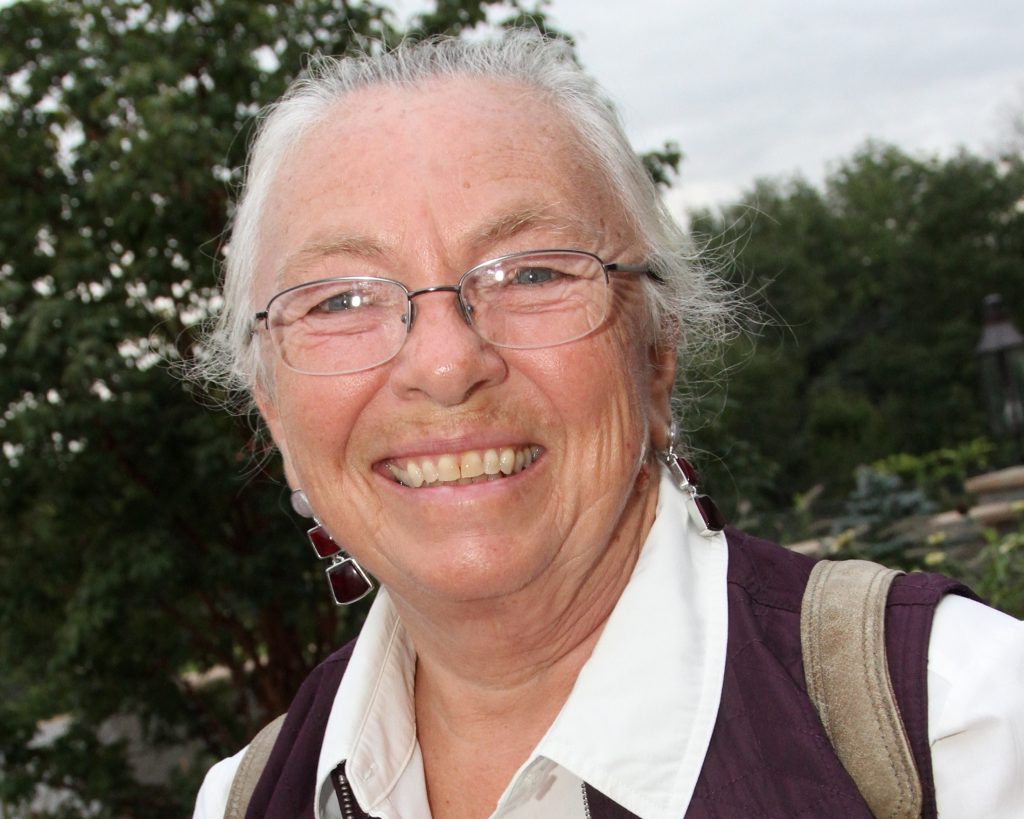
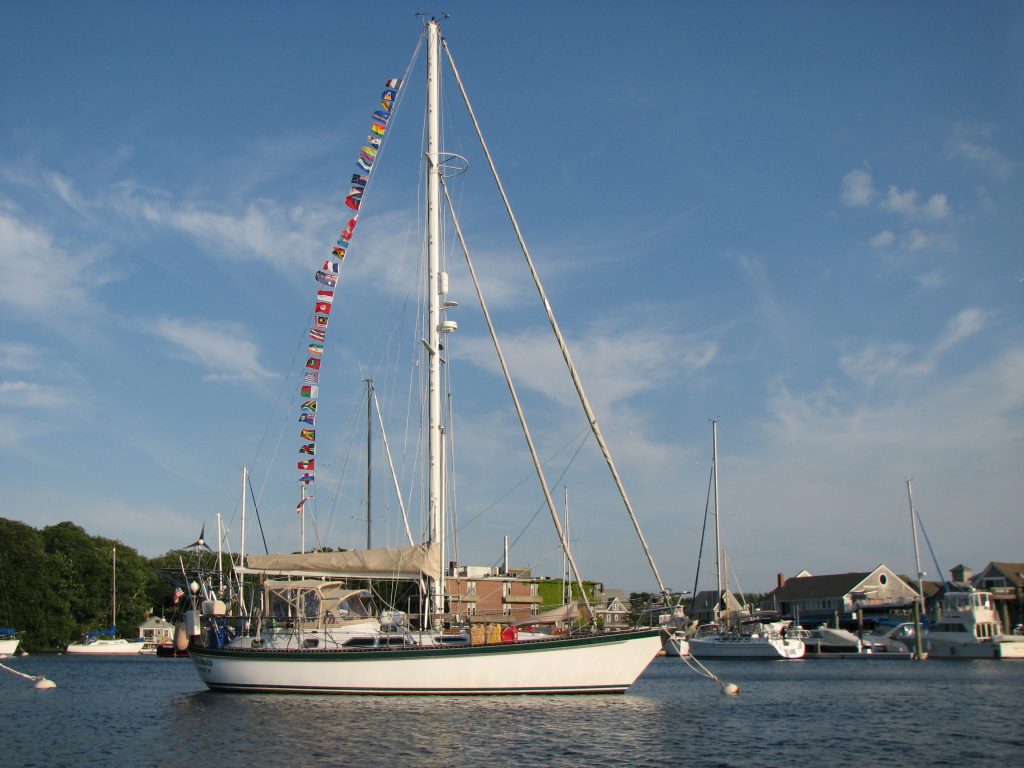
After almost 6 years of traveling, we sailed into Woods Hole on Cape Cod. We continued living aboard for the next five years and I wrote about that, adding ‘and Beyond’ to the title of the blog. Then shortly before Mark’s death in 2016, we sold our beloved Windbird and my travel logs became land logs. At this point, I had written a daily account for each and every day for 11 years. I fully intended to end the blog at that point, but when I wrote that news in a log, I got many responses saying that I really needed to keep posting. At the same time, I realized that I couldn’t stop writing. Summarizing each day had become a permanent part of my life and I will probably continue writing until I can no longer. These postings reflect the ordinary, and sometimes the extraordinary, days in my life and I would like to invite you to join me on my journey.
Day 156, Year 1: A Walk to the Top of Santa Cruz
Day 156, Year 1: A Walk to the Top of Santa Cruz
Date: Wednesday, March 22, 2006
Weather at Anchorage: No Change–sunny, clear blue skies
Daytime Air Temperature: No Change–82 degrees F daytime
Water Temperature: No Change–77 degrees F
Location: Academy Bay, Puerto Ayoro, Santa Cruz Island, Galapagos
We met Doug and Sylvia of Windcastle in town for breakfast this morning and then took off in a taxi for Bella Vista. That is the next town to the north and the place where you take off to walk to Mount Crocker, the highest point on the island at 864 meters.
Sylvia had arranged for the taxi and the driver was willing to take us up the mountain as far as he could drive, and then walk with us to the very top of the island. It took less than 20 minutes to get to Bella Vista and then we started the slow drive up the bumpy mountainous road. On the way up, we passed coffee and banana plantations. Once we were out of the plantation zone, we drove a little ways on up and then Jose Louis, our driver, parked the taxi and we started our walk. We walked through various vegetation zones, and we walked, and we walked and we walked. The climb was gradual, but it was a tough climb for all of us. It took us about two hours to reach the top, but the view was certainly worth it. It was a wonderfully clear day and we could view Santa Cruz and the surrounding islands with a 360 degree angle. We could see the Daphne Islands, Sante Fe Island, and San Cristobal. We could look down on Puerto Ayora and Tortuga Bay where we walked on Saturday. The view really was phenomenal and made us all feel good about pushing to the very top.
Sylvia and Doug had to make a 1400 launch back to San Cristobal, so once we basked in the glory of making it to the top, we walked very quickly back down. We made a quick stop at Bodega Blanca, the amazing little marine store here, and then to the dock to have a quick lunch before Doug and Sylvia had to leave. We hope to see them again when we reach Isabella. They are great fun and we love exploring with them. Doug got his Masters in geology from University of California Berkeley and then went to work in the aerospace industry at JPL. He has spent much of his professional life studying the geology of Io, the moon of Jupiter that is very, very volcanically active, and he is actually a world expert in the study of sulfur compounds associated with volcanic action. Since we were walking up the side of a volcano all morning, Doug was able to point out geologic details.
While Mark, Sylvia, and Doug were at Bodega Blanco, I walked around the corner to the Naugala office. Johnny Romero was there and he told me that Randy of Procyon had not improved and was being flown to the mainland of Ecuador. We saw his wife Sherri in town before heading back to Windbird, and we sent our best wishes with her. It is the fear of all sailors that some medical problem like this should happen in remote areas. Everyone here seemed to be working to do the best they could, but simply do not have the equipment to do the testing required to properly diagnose Randy’s problem. Hope with us that he will have a speedy recovery and will be back with us here in the Galapagos soon.
Tomorrow we are taking the day off to prepare for Heather and Jed’s arrival on Friday. We can’t wait to share with them the amazing things we are seeing here.
 |
| 060322 Day 156 Cerro Crocker, Santa Cruz, Galapagos |
Day 155, Year 1: Doug and Sylvia of Windcastle Visit Puerto Ayoro
Day 155, Year 1: Doug and Sylvia of Windcastle Visit Puerto Ayoro
Date: Tuesday, March 21, 2006
Weather at Anchorage: No Change–sunny, clear blue skies
Daytime Air Temperature: No Change–82 degrees F daytime
Water Temperature: No Change–77 degrees F
Location: Academy Bay, Puerto Ayoro, Santa Cruz Island, Galapagos
Today was another day with no big exploration, but we are ever amazed what a walk down the main street in Puerto Ayoro produces. Today’s find was the sea lions that frolic and then laze about on a local fishing boat that we pass every time we take the water taxi to town. If you don’t look closely, as we hadn’t on previous days, you would just think that there were piles of black trash bags on the boat under the wooden cover. But on closer observation, the “piles” move and when you zoom in, you see that there are sea lions piled on top of each other. That’s the way the wildlife is here. Animals you can see no where else in the world are right under your feet right in town. We constantly find this unbelievable, but are enjoying every moment. We also found a small heron in town that let me walk right up to him or her. The new identification book I bought today would tell me that this was a young Yellow-crowned Night Heron, but they are supposed to be out only at night. Maybe this one was confused. We walked a little further to some shops on the water, and there we found another “pile” of sea lions. In the next block, we walked out to the water between the ATM machines and the bank, and as always in that location, there are beautiful, bright red Sally Lightfoot Crabs and marine iguanas. You would truly have to be blind not to find wildlife here everywhere.
I have one correction to Saturday’s log. I said, “Just like our iguana friend, we headed away from the water and down the path that would take us back to the ranger station. We observed more birds and the ever present geckos on our way. These little geckos are seen climbing over and between the volcanic rock that is everywhere on this island.” When I bought the new ID book today, I learned that these were lava lizards, not geckos.
Our friends from Windcastle, Sylvia and Doug, came over from San Cristobal today on a small inter-island shuttle. We had lunch with them and are getting ready to go back into town to have dinner with them. They head back to their boat in Wreck Bay, San Cristobal tomorrow. They will be leaving the Galapagos before us, so this will be our last chance to see each other before our crossing to the Marquesas. We have really enjoyed getting to know them and hope to see them somewhere in the South Pacific.
We will be here in Puerto Ayora for ten days. Our daughter, Heather, and her husband Jed, arrive here on Friday of this week and on Sunday, we will leave Windbird to board a tour boat, Sullidae, for a five day cruise of the islands. We return here to Academy Bay, Santa Cruz, on Thursday, March 30. We will enjoy Puerto Ayoro for one more day on Friday, go to the fruit and vegetable market on Saturday morning (everything brought in fresh from mainland Ecuador once a week), and then take off for Isla Isabella. It is the largest island in the Galapagos, but the most sparsely populated. Heather and Jed will be with us for our sail to Isabella, then on to Floreana, and finally back to Santa Cruz on Monday, April 10. Heather and Jed fly back to the US on Tuesday, April 12, and we will then decide when we will leave the Galapagos headed for the Marquesas. Sometime in mid-April we will have to pull ourselves away from here, but if we continue to enjoy this wonderful place as much as we have so far, it will be very hard to leave.
I have mentioned Randy and Sherri from Procyon in our logs. They are some the “forty-somethings” traveling around the world. Other than the “twenty-somethings” from Audentes and Geodesic, Randy is definitely the most fit looking male we have met. And right now he is in the hospital here, on a 24-hour watch, with the possibility of having to be air-lifted to the mainland of Ecuador. He has had stomach problems for about four days now, but the pain became too much today and they had to go into the hospital. We are keeping him constantly in our thoughts and hope that all will be fine. But it is a reminder that you never know when you might have health issues. Age and fitness don’t seem to be the determiner. Who knows what is? All we know is that we certainly hope Randy is up and about tomorrow, and that things will be fine.
It’s time to head into shore for dinner, so I’ll sign off for tonight. Tomorrow we are planning a trip to Media Luna in the highlands, so our experiences from that trip will be in tomorrow’s log.
Day 154, Year 1: Caught Another Fish—Wrong Place, Wrong Size
Day 154, Year 1: Caught Another Fish—Wrong Place, Wrong Size
Date: Monday, March 20, 2006
Weather at Anchorage: No Change–sunny, clear blue skies
Daytime Air Temperature: 82 degrees F daytime
Water Temperature: 77 degrees F
Location: Academy Bay, Puerto Ayoro, Santa Cruz Island, Galapagos
We caught a fish today, but not of the size or kind that we could eat. We were running the engine to charge the batteries and suddenly we heard this deafening sound. Not the high water alarm, not any alarm we have heard before, but as we followed the sound it led us to the cockpit where we saw that the engine overheating light was on. This meant off with the engine and down into the engine room to find the problem. Unfortunately, we found a beautiful trunk fish in our intake valve, blocking the way for water to get to the engine to cool it. We removed the fish and all was well with the engine. Never a dull moment!
We took laundry into town to be done for us–$1.25 per kilo and we had ~9 kilos, so the total will be under $12.00. This is well worth it for sheets and towels. I don’t mind doing our daily clothes on board, but the sheets and towels take SO much water that it is better to have them done when we are in port. Mark spent most of the day on the computer in town trying to deal with financial issues and then we went to the bank to get money from a Visa card. You can get money from an ATM on a Master card here, but Visa card business must be done inside. The lines were long, but after about an hour we had our money and were on our way.
We had a very late lunch in a restaurant known for its local fare. We both ordered shrimp crevice-and it was wonderful. This is a dish where raw meat is marinated in an olive oil and lime juice mixture. It was phenomenal. And the accompanying plantain chips were also very good.
We stopped by Aqua Magic on our way home to see if we could help with an electrical problem they are experiencing, but we were of no help. Not sure what tomorrow will bring, but whatever, it will be fantastic.
Day 153, Year 1: A Lazy Sunday
Day 153, Year 1: A Lazy Sunday
Date: Sunday, March 19, 2006
Weather at Anchorage: No Change–sunny, clear blue skies
Daytime Air Temperature: 82 degrees F daytime
Water Temperature: 77 degrees F
Weather at Anchorage: No Change–sunny, clear blue skies
Location: Academy Bay, Puerto Ayoro, Santa Cruz Island, Galapagos
In response to yesterday’s log reporting on our explore starting at mid-day, our daughter Heather wrote: “There’s an old saying you might have heard … ‘Only mad dogs and Englishmen go out in the mid-day sun.’ There’s a reason for that.” I guess we are mad dogs, because I know we aren’t Englishmen (Sorry, Margaret and Patrick.). We’ll try to remember not to head out in to the mid-day sun again!
This place is amazing. The water in the anchorage is so very clear and the sky is always blue. We sit on the boat and watch blue-footed boobies float by and pelicans dive from high in the sky. There are no large fish that we can see here in the anchorage, but there are thousands of very, very tiny fish all around us. Today there was a very brown bird that I have not seen before. It looks like a tern and has not one bit of color other than brown-brown eyes, brown feathers. Not sure what this bird is but it is beautiful in its simplicity. When we take the water taxi to the town dock, we always see marine iguanas, loads of red crabs, and more blue footed boobies. They are not a very remarkable bird, except for those robin egg blue feet-a strange twist of nature. But the combination of blue feet and red crabs that are everywhere is quite picturesque.
During the night, a southern swell came in and kept us rocking and rolling all night long. We changed our stern anchor position today and hope that tonight will be a little calmer. But the rocky night meant we didn’t get as much sleep as usual, and as a result, we decided to take it easy today and work on the boat. Mark has been trying to find a time to replace the gaskets in all of our hatches since this trip began, and today was the day. I worked on the inside, rearranging things to get ready for Heather and Jed’s arrival on Friday. Mark took the opportunity of working on the hatches to reverse the way our front hatch opens. It has always opened backwards which does not let enough air come into the cabin, so it now opens the right way and allows a breeze to come in.
I went through all of our fruits and veggies that we have had stored since Panama City. All but one of the red and green peppers that are wrapped in waxed paper is still fine. We still have two cabbages left and a few oranges. We also have carrots, potatoes, and onions that are surviving the tropical heat. I am amazed that you can keep tomatoes and peppers this long-20 days so far-without refrigeration. But I sure am glad it can be done. We ate our last mango yesterday, and I have to say that the mangos we bought in Panama, grown in Peru, were the best we have ever tasted. We still have apples, but the bananas are long gone. When I listed the vegetables and fruits we bought for the passage from Panama to the Galapagos, I did not mention chocolate. I got an e-mail from my friend Sue Robichaud back in Concord noting the void. No worries, Sue. I stocked up on chocolate before leaving the US and still have plenty aboard. That’s something I wouldn’t be able to travel without.
Mark was also able to get my IBM ThinkPad computer to talk to our printer today. Since the loss of our main computer, we haven’t been able to print anything. Not sure why it is so hard, but we have found it difficult to get different computers to print through our Hewlett-Packard printer. We are fine for now, but when Heather and Jed get here with our new computer, we will probably have to start all over.
We will turn in early tonight to try and make-up for the loss of sleep last night. So far, the new stern anchor position seems to be keeping us from rocking and rolling. Let’s just hope this lasts through the night.
Day 152, Year 1: A Walk to Tortuga Bay
Day 152, Year 1: A Walk to Tortuga Bay
Date: Saturday, March 18, 2006
Weather at Anchorage: No Change–sunny, clear blue skies
Daytime Air Temperature: 82 degrees F daytime
Water Temperature: 77 degrees F
Location: Academy Bay, Puerto Ayoro, Santa Cruz Island, Galapagos
We had planned to begin our Saturday morning by taking off early in the morning for a walk to Tortuga Bay, but Johhny Romero called on the VHF at 0730 and wanted to come out at 0900 to finalize check-in paperwork. Johnny was a little delayed because three new boats for which he is the agent sailed into the anchorage-Procyon, Endangered Species, and Wind Pony, all US boats. He had to stop by to see them and got to us a little later. By the time we finished with Johnny and wrapped up a couple of projects we had started while waiting for him, it was getting close to noon. We went into town and had lunch. Patrick and Margaret from Aqua Magic stopped by to say hello, and Randy and Sherri from Procyon and Rick, Robin, and John from Endangered Species were also there. I think you would be amazed at how many people are out here doing what we are doing. The fact that we can go into a small town in the Galapagos, 2,817.8 miles from home as the crow flies or 5, 195 miles as Windbird sails, and meet people everyday that we have met along the way is unbelievable to me. It is reassuring to know that we will see some of these same people after we travel the next 3,000 miles to the Marqueses. When we see them there, it will be like old home week.
So after lunch, being the intelligent adults that we are, we took off for a long walk in the heat mid-day. We walked about a half mile from town to the top of the barranco (canyon) and climbed steep steps before reaching the “official” path to Tortuga Bay. After checking in with the national park ranger, who wanted to make sure we had agua with us, we started the trek down a path paved with the same tiles that pave the streets here. It was a lovely path winding through the arid zone of the palo santos, a scrubby little tree that has leaves only in the wet season, and Opuntia cacti that are tall like a tree with trunks rising up to 5 meters. We saw many of Darwin’s finches, a couple of yellow warblers, and a number of large brown birds with a very long tail. I’m not sure what those are, but when I read my guide, it seems like they must be dark-billed cuckoos. The book says these birds are rare and observed mainly in the highlands, although in the lowlands during a Nino year. I’ll have to keep checking on this and let you know. We certainly weren’t in the highlands, this isn’t supposed to be a Nino year, and this bird was not rare on our walk, so it was probably something else. I just don’t know what yet.
The sun beat down and the winding path got longer and longer. We came to a gazebo where some people were resting and I said to Mark that this was probably the half-way point. He hoped not, but it turned out to be true. The entire walk was only supposed to be 2.5 kilometers, but by the time we could see the beach and ocean in the distance, we felt like we had walked at least 3 miles. I think the heat just made the walk seem long, but when we got to the bay, the view was breathtaking. The white sand the consistency of finely ground sugar, the black volcanic rocks, the green of the palo santo trees, and hues of green and blue in the water combine to make quite a sensation. The white sand beach curved to make a small bay and surfing waves were rolling in one after another. This has become a hot spot for surfers and they were out trying their skills. We saw Zak from Audentes, and Peter and Jessie from Geodesic. They had walked out with their surfboards and reported that they had had an amazing day. They pointed out a marine iguana who was sitting on a black volcanic rock just above the breaking surf line, so we went near him to observe.
The only marine iguana in the world is found here in the Galapagos. They probably descended from a land iguana from the South American mainland and traveled here on vegetation drifting on the surface of the ocean. They are not a particularly pretty sight, but they are interesting. They vary in length from 60 centimeters to one meter long, with the tail being half of that. They have sooty black skin which serves as a camouflage when they sun on the black volcanic rocks during the day. We watched our little friend lazily climb off his rock and onto the white sand when the surf got closer to him. He then drug his body along as he slowly crawled away from the surf. Evidently they are very lazy and expend as little energy as possible, but after a while, he lifted his tummy off the sand as he continued to walk. They raise the front part of the body above the ground when they get too hot to allow the breeze to circulate under the stomach. He must have been as hot as we were!
There is a second beach a little ways from the one where we arrived, but we decided that walking to that beach would have to wait for another day. Just like our iguana friend, we headed away from the water and down the path that would take us back to the ranger station. We observed more birds and the ever present geckos on our way. These little geckos are seen climbing over and between the volcanic rock that is everywhere on this island. In the arid zone, there is no top soil on top of the rocks, so there are lots of hiding places for the small geckos.
We made it back to town and even had the energy to take a little detour to see the lagoon where local children swim. It was crowded on this Saturday afternoon and everyone seemed to be having a great time. We went back to Windbird to get ready for dinner in town. We were meeting Aqua Magic to celebrate Margaret’s birthday. We were going back in early so I could make a Skype call on the computer to Linda Stuart, my friend back in Concord. Linda, her husband Mike, and their son Garrett, are hoping to meet us somewhere in the South Pacific this summer and we needed to talk to coordinate plans. Looks like they might be coming to Rarotonga in mid-July, and we look forward to their visit. Linda told me that Laura, the professional development office assistant in the Concord School District central office, had her baby on Friday and that all went well. Congratulations, Laura! I know Parker must be so happy to a new baby brother. Enjoy this very special time with the “new addition”.
 |
| 060318 Day 152 Tortuga Bay, Santa Cruz, Galapagos |
Day 151, Year 1: A Trip to the Highlands
Day 151, Year 1: A Trip to the Highlands
Date: Friday, March 17, 2006
Weather at Anchorage: Sunny, clear blue skies
Daytime Air Temperature: 82 degrees F daytime
Water Temperature: 77 degrees F
Location: Academy Bay, Puerto Ayoro, Santa Cruz Island, Galapagos
I am writing this log on Saturday morning as I was so totally wiped out when we returned from our Friday afternoon explore of the highlands that I knew I couldn’t do justice to a log reporting on such an exciting day. We started the day by meeting Johnny from the Naugala Agency at a street café ´o discuss tour possibilities. Kathy and Bud from Invictus, who arrived on Thursday, Margaret and Patrick from Aqua Magic, and Erin and Zak from Audentes, who had just arrived, went to the meeting with us. Erin and Zac went to the meeting to meet with Johnny and get their arrival paperwork started, but the rest of us were interested in the highlands tour. We all decided to go and Johnny made arrangements to meet us at 1430 in the town square to introduce us to our guide. He said an afternoon tour would be much better as it would be a bit cooler.
After our meeting, Windbird, Invictus, and Audentes took off in search of a marine store. Aqua Magic split and went to the Darwin Center. Patrick arrived here with an infection in his finger and has been a bit under the weather, so this was their first explore of the island. As we started walking, Kathy and I hung back a bit from “the boys” and did a little window shopping on the main street in town. “The boys” were Mark, Bud, Erin, and Zak. Mark and Bud are both in their sixties and Erin and Zak are in their late twenties, but age makes no difference. Put a sailing man on land and they immediately search out a marine store. After a little searching, we found Bodega Blanco. We were all amazed. This small marine store 600 miles from the mainland of Equador is the most well stocked we have seen since leaving the US. Amazing!
By this time, it was time for lunch, so we found a neat little café ·ith blue checkered table cloths on tables with outside seating. Sandwiches here cost about $3.50 and a double-sized Pilsner cervesa (about the only choice) costs $1.80. Dinners here seem to cost about $8.00 with the exception of shrimp and lobster, but we hear there is one restaurant with a great lobster dish for $7.00, so we will certainly track that one down.
After lunch, we again roamed about town and then met Johnny at 1430. He introduced us to our English speaking guide, Marcela Fonseca, and off we went in a taxi. Taxis here are small pick up trucks that seat three in the front seat, including the driver, three in a back seat, and the rest pile in the truck bed. Mark and Bud opted for the back, and off we went. At the edge of town, we were in the outback. There is nothing for about five miles and then you reach the small village of Bellavista. In another five miles, we reached the village of Santa Rosa and headed further out into the wilderness. We came to the Primicias Ranch in the “Cerro Chato” area. There is a pavilion where you can buy drinks and souvenirs and then the minute you begin to walk the path, you see a mud pond and then you see dome-shaped tortoises. Our guide, Marcela, was so excited because the very first pair we came upon was just completing the mating process. We were amazed at the size difference between the male and the female. Adult females weight about 50 kilograms, whereas the adult males weigh 250 kilograms. There were many tortoises milling about the mud ponds. As we continued to walk through the woods, we found another couple mating. When we came to an open field, we could see one big guy walking toward a mud pond that was totally encrusted with green pond weed. These tortoises let you come right up to them and they pay very little attention. We also saw a female Bahama White-Cheeked Pintail or Bahama duck. This is the only duck to reproduce in the Galapagos. We walked back into the woods and saw more tortoises, this time learning to tell young males from adult females. They are both about the same size, but the young male has raised rings in each of the 13 plates on this back, whereas the adult female has a smooth shell. Basically, old equals smooth and young equals raised rings. So next time you see a tortoise, you’ll know the difference!
As we were getting ready to leave the area, I spotted a huge male up on a hill. He was partially hidden by tall grass and looked like a large rock. But when I pointed him out to Marcela, she said, “Let’s go.” He was a neat find as were able to get very close to him and watch him eating grass. We all got great pictures and video and then we were off to the next stop-Los Tunneles (The Lava Tunnels).
Lava tubes come in different sizes and lengths, but evidently there are many under the land on Santa Cruz. This tunnel was about the right size for a subway to run through when we started, but as we got further in, there was one point where we had to crawl. After that, the walls of the tunnel were eroding and there were large boulders to climb around. Marcela explained that the tunnel walls are formed as the first lava spreads out from a crater. The surface cools off quickly and hardens while the inner lava flow continues to rush downhill. Once the inner lava flow is gone, it leaves behind a tunnel through the original lava.
We emerged from the lava tunnel and hopped back in the taxi to continue our explore. Next we were to visit Los Gemelos-The Twins. These two huge pit-craters are over 30 meters deep. They were either formed by an explosion, or they may have been formed by the collapse of a magma chamber. The craters were interesting, but the most exciting thing was our sighting of a Vermillion Flycatcher. This tiny, but very colorful bird, flew all around us and landed various times allowing us to photograph him. We saw other Darwin finches, but this little red bird won our hearts for this explore. Marcella said that sighting the Vermillion Flycatcher is very rare and birdwatchers search for days for just such a sighting. We were very lucky.
Tomorrow (Saturday) we are walking to Tortuga Bay to see nesting pelicans, more Darwin finches, yellow warblers, and maybe flamingos in the lagoon. Every trip into town gives us opportunities to watch the blue-footed boobys, red crabs, and marine iguanas that hang out around the taxi dock. Wildlife is everywhere here.
 |
| 060317 Day 151 Highlands, Santa Cruz, Galapagos |
Day 150, Year 1: Tour of Puerto Ayoro
Day 150, Year 1: Tour of Puerto Ayoro
Date: Thursday, March 16, 2006
Weather at Anchorage: Sunny, clear blue skies
Daytime Air Temperature: 82 degrees F daytime
Water Temperature: 77 degrees F
Location: Academy Bay, Puerto Ayoro, Santa Cruz Island, Galapagos
Just as it takes a couple of days to adjust to life aboard while making a passage, I think it also takes a couple of days to adjust to life in a new anchorage. We haven’t really gotten out into the wild yet, but we did continue to explore the town of Puerto Ayoro and we once again visited the Darwin Center-this time to see the giant tortoises or “Galapago”.
We started our day by listening to the Panama Pacific Net to check in on the progress of about eight other boats that are headed this way. Windcastle arrived at San Cristobal this morning, but we did not hear Invictus check-in. They are the other boat that we knew should be arriving very soon, and later in the morning they motored right passed us while searching for an anchorage. They are very close neighbors to us here in the anchorage.
Mark and I went into town on the water taxi and met Johnny Romero, our Naugala agent, heading back in from another boat. He had called this morning to tell us that our paperwork is still with the port captain, but that we will be getting our official clearance tomorrow. When we reached the port, he took off on his bicycle and we headed for the internet café® Mark wanted to check financial information online and we also downloaded our e-mail from the g-mail account. To those of you who have e-mailed us through the website, we want you to know we received your e-mails today and loved hearing from each and everyone of you.
We had lunch in town and ran into Paul, Nancy, and Jennifer from Encore!-the boat that transited the Canal next to us. They are leaving tomorrow morning for the Marquesas, so it was great to have lunch with them and hear about their experiences here on the island of Santa Cruz. After lunch, Mark and I headed out for our tour through town. Since we were carrying the computer with us, we decided not to head out into the wilder areas, but rather to walk the streets in town and see how people live. There is the main street in town that follows the shore and goes to the Darwin Center. We walked that yesterday, so this time we took the first major street to the left and walked six or seven blocks until we reach the public market. Fresh vegetables, as well as a few other grocery store items are found here. We then made a right turn and walked into the residential area. This part of town was a little more like what we were expecting, except for the large sports arenas-one totally enclosed and one outside but covered with a roof. We turned right and right and right again and found most of the residential area to be much the same. The side streets were not paved, chickens were scattered here and there, and almost all homes are built of concrete block. Most are covered with stucco in a Spanish style, and all are in different stages of completion, with almost none totally finished. It is as if everyone got a great start, some with very nice looking wood trim, but something happened and no one finished their construction. Maybe “finish as you go” is just the norm here. There are very small tiendas (stores) every other block and insides of homes look very basic with concrete floors and very little furniture. Compared to the upscale shops downtown, the residential area painted a different picture-no complete poverty, but very modest living conditions.
As we wound our way around and back to the main street in town, we decided to go back to the Darwin Center to the tortoise exhibit. There were seven giant tortoises living together in one small area. There is a large feeding platform and the seven giant tortoises all sit behind that area. You are not allowed to stand on the platform or touch the tortoises, as it is feared that diseases could be transmitted to them, but you can get right next to them and then watch their behaviors. One guy decided he needed a drink from the concrete pond adjacent to the resting area, so he lumbered away from the group and had his drink. He then reentered the area with the other tortoises, but decided that he was king for the day, and showed his superiority in various ways.
It was great to see these tortoises in captivity, but I know it will be much more exciting to see them in the wild. Tomorrow morning we meet with Aqua Magic, Invictus, and our agent, Johnny Romero, to make plans for further exploration.
 |
| 060316 Day 150 Puerto Ayoro Tour, Santa Cruz, Galapagos |
Day 149, Year 1: Crossing the Equator and Arriving in the Galapagos
Day 149, Year 1: Crossing the Equator and Arriving in the Galapagos
Date: Wednesday, March 15, 2006
Weather at Anchorage: Sunny, clear blue skies
Daytime Air Temperature: 82 degrees F daytime
Water Temperature: 77 degrees F
Latitude: 00 degrees 44 minutes S
Longitude: 090 degrees 18 minutes W
Location: Academy Bay, Puerto Ayoro, Santa Cruz Island, Galapagos
I’m writing today’s log in two parts. This first part was written during the night while I was on watch and covers the crossing of the equator. The second part was written in the evening after our arrival in the Galapagos. Note that the time has changed for us. Galapagos time is the same as Central time in the US.
Part One:
It is currently 0245 and the full moon is high in the sky serving as our guiding light into the Galapagos Islands. At exactly 7:07 PM EST last evening, we had an absolutely spectacular red sunset in the western sky and at 7:08 PM EST, the full moon rose in the eastern sky. At this point, we were getting close to the equator, so we watched the show in the sky and anticipated the moment of crossing 00 degrees 00.00 minutes-our gateway into the southern Pacific Ocean. From now on, our latitude readings will be S–South, not N–North. Watching the red sunset, I remembered that we have a great rendition of “Red Sails in the Sunset” on CD and went below to put that on. As it was playing, we transmitted it over VHF radio to Aqua Magic. Watching the spectacular sunset with the music in the background set the stage for the rituals accompanying equator crossing. By the way, the woman who took my position in the Concord School District, Dorinda Gibney, gave me the CD with that song on it as a going away present. Dorinda, we thought of you and all of our friends in Concord while watching that sunset.
The colors in the sky and the music seemed to make the time fly and before we knew it, the GPS was approaching 00 degrees 00.00 minutes. For this occasion, Mark opened the special bottle of wine we had been carrying for just this moment and I changed the CD to Jerry Jeff Walker singing “LA Freeway”. That was our “theme song” back in the early 1970’s when we embarked on our first adventure that ended in our building a log cabin in the mountains of Idaho. That song is always there for special occasions in our lives. Aqua Magic was in front of us and crossed first. They radioed back to us the good news and seconds later, we were across and toasting the occasion. We had one glitch and that was that the camera batteries decided to quit just as I was taking the picture of Mark uncorking the wine. I put in a new set of charged batteries, and nothing. I put in another set of charged batteries, and still nothing. Mark ran downstairs to get new batteries. This necessitated getting in the cabinet under our bed in the aft cabin. We store various things there and currently it is a storage area for soft drinks and other miscellaneous items. Somehow in his effort to hurry with those batteries, he managed to puncture a can of coke with the cabinet door latch. He came running in to the galley with the spewing can and put it in the sink. Yuck! Coke was everywhere, but we had to carry on and clean up later. The batteries worked and I got my picture. Now it was time for the dousing of sea water. We had the bucket of salt water ready and waiting and poured the water over each other. A few coins from Panama and the Caribbean were sent overboard to appease Neptune, along with a share of the wine. We then drank the wine and absorbed this special moment.
We were both so excited that neither of us could possibly go to sleep, so I put on one of my favorite CDs, a traveling music mix given to us by Linda Stuart. Linda and worked closely in the Concord School District and I had to include her in our celebration. Finally, at 11 PM I turned in and Mark did first watch. It was an incredible evening.
As I write this, we have slowed ourselves down so that we will not arrive at our next waypoint until daybreak. We don’t want to negotiate the path through the islands at night. By 7 AM we will reach the set waypoint and have about 35 miles to go to the anchorage in Academy Bay off Santa Cruz Island. I will continue this log then.
Part Two:
We arrived in Academy Bay around noon. By the time I got up at 7:30 AM, we had already passed Isla San Cristobal and were approaching Santa Fe to port and Santa Cruz to starboard in the distance. There were lots of basking sharks out this morning, and a few sea lions and sea birds. We approached the crowded anchorage and found a place to drop our anchor. Unfortunately, we didn’t understand the currents running through the anchorage, and we misjudged. We were too close to the boat just behind us, so we reset the anchor. The anchorage is crowded because the Blue Water Cruising boats have not left yet. We weren’t supposed to get here until Friday, and most of them are leaving tomorrow. But we got here early and will live with the crowded conditions until they are ready to leave.
Upon arrival, we tried to hail Johnny Romero, our agent from Naugala Yacht Services. We weren’t successful on the VHF, but we got him on the Sat phone and then we were able to communicate on the VHF. Johnny processed our Galapagos cruising permit allowing us to stay here up to six weeks, and he will deal with our check-in with the Port Captain here. He said he would be out around 2:00 PM, Galapagos time, which reminded us that we needed to set our clocks back one hour. When Johnny arrived by water taxi, the means of transportation here, I was a little shocked. He looks like a teenager, but he founded Naugala Yacht Services six years ago, so he is probably more like 30. He was quick and efficient and by the time we meet him at 10:00 AM tomorrow morning, he will have all of our paperwork processed. In the meantime, we were free to go into Puerto Ayoro and start our explorations.
Margaret and Patrick from Aqua Magic arrived when we did, and also checked in with Johnny. Patrick had developed an infection in his hand due to a small cut on this finger and needed to go into town to see a doctor. We all took a water taxi to town, and Johnny went with Patrick and Margaret to the hospital. Mark and I decided to walk though town and make our first visit to the Darwin Center. I was not prepared for what we found in town. I assumed it would be much like towns in the Caribbean where poverty abounds, but I was very, very wrong. Puerto Ayoro is living proof that eco-tourism is a most lucrative industry. This town is anything but poor! It is more like Bonaire than other Caribbean islands. It is clean and has all kinds of interesting restaurants, upscale jewelry stores, shops with Ecuadorian handicrafts, many dive shops, etc. The streets are paved with something that looks like patio tiles. There are not many cars, but there are tour mini-buses and vans and lots of bicycles. I think I thought it would be more like the villages in the San Blas, but I was way off base. The ports in the other islands we will visit might be different, but Puerto Ayoro is a hub of activity and its residents and business people have figured out how to serve the eco-tourism crowd.
Mark and I walked out to the Darwin Center for a quick run through. We didn’t go to the tortoise exhibits today, but just surveyed the area to see what is there for a more thorough explore tomorrow.
I’ve gone on way too long, but we have just had an incredible 24 hours and I wanted to share each and every moment with you. Hope you can bear with me.
 |
| 060315 Day 149 Arrival in the Galapagos |
Day 148, Year 1: Sixth Day, Windbird’s Passage to the Galapagos
Day 148, Year 1: Sixth Day, Windbird’s Passage to the Galapagos
Date: Tuesday, March 14, 2006
Weather and Wind: Clear skies and calm seas; winds 1 to 6 knots SSW
Daytime Air Temperature: 81 degrees F daytime
Water Temperature: 79 degrees F and dropping
Latitude: 00 degrees 14 minutes
Longitude: 088 degrees 40 minutes
Location: Panama to Galapagos Passage, Day 6
Miles to 00 degrees 00 minutes:
Tonight is the night. We will reach the equator about 2030 and should be anchored in Puerto Ayoro in the Galapagos by mid-afternoon tomorrow. The excitement is building!
Today was a very quiet day. As the full moon set in the West around 0630 this morning, we had a subtle, but beautiful, sunrise in the East. During the night, Mark wrote another installment of Captain’s Ramblings. That is copied below. Our next log will come to you from the Galapagos. And for those reading this, don’t forget to celebrate with us tonight at about 8:30 PM EST.
Captain’s Ramblings II:
Maybe this is the way sailing is for my multi-hull friends (Is this right Ron & Suzie?). I can set a drink down and not worry about it spilling. Well, actually I worry because I am a mono-hull sailor and everything falls off the table when we sail – usually. But now everything is staying put. We are not heeled over. And yet we are doing six to seven knots. We are on a broad reach with light winds and no waves, just the large, gentle Pacific swell. The swell is so large that it hides the boat traveling with us up to above the boom – probably eight feet or so. But the distance between swells must be several hundred yards so we hardly feel them. Instead of rocking over the waves like a hobby horse, we gently rise with the swell and slide softly down the other side. The effect is mesmerizing. I can understand why Balboa (it was Balboa, wasn’t it) called it the “Pacific.” It is so peaceful.
Of course, we are not always sailing. This is the Doldrums after all. We have probably motored about half the time on the trip from Panama to the Galapagos. Because we want to conserve on fuel we have gone slow. Motoring at 1800 RPM’s we use about half a gallon of diesel per hour. At 2400 RPM’s we use a little more than a gallon per hour. But while fuel consumption is doubled, speed is only increased about 20 percent: from about 5 knots to 6 knots. We are in no hurry, so the extra speed is just not worth it. Besides, we have had a positive current with us of about one and a half to two knots for almost the entire passage. So our five knots turns into almost seven knots over the bottom. Motoring at 1800 is also a lot quieter. The hum of the engine is always with us, but it is not loud so that we don’t even notice it and feel almost as though we were sailing.
Since our computer stopped working a couple days ago we have decided to buy a new one. My immediate thought was that I needed to talk to someone who knew what the best computers for the money were. So I used the satellite phone to call Steve Bothwick who is the computer guru for New Hampshire Public Radio. Doreen Kilby answered the phone at the office and I was suddenly back home again and feeling very much among friends. We bought our satellite phone from Doreen, whose husband had it when he was stationed in Afghanistan. She got Steve on the phone and, sure enough, he had the answers I needed. Then he transferred me to Maureen Anderson because I so wanted to talk to everyone on the staff and I knew that Maureen would convey my feelings to them. It was a short call (satellite phone calls are expensive), but I was reminded of just how much I miss all the crew at NHPR, the staff and the board. I spent a lot of time in the hours after that call thinking of each and every friend I have back there.
When I think of all our friends, I want to write them each a personal letter. But then, it doesn’t get done. I just can’t seem to find time. You would think that we would have lots of time in this lifestyle. After all, we are retired (at least for now) and we are sailing, which is supposed to be a relaxing activity. And it is relaxing. But it is also demanding. We get up every day with a list of things that need to be done. Judy writes about some of them in our log. The ocean is a harsh environment. Metals rust, salt builds up on everything exposed, and the constant movement of the boat causes chafe and wear on all sorts of things. The sun deteriorates any finish so that varnishing of wood is a never-ending job. Canvas covers and shades need water-proofing. Stitching deteriorates in the hot tropical sun and needs to be re-sewn. And computers and cameras stop working because of the humid environment. We patch torn sails, sew webbing on areas of the dodger and bimini prone to chafe, sand and varnish woodwork, clean scum off the bottom of the dingy and off the waterline of the boat, change the engine oil and filters, replace a broken bolt on the alternator, grease the pump mechanism on the head, and put grease in the gear box of the water-maker. And the list goes on and on. But I am not complaining. After all, the definition of cruising is “working on your boat in exotic locations.” How else could I get to these exotic locations! And once there, we have to tear ourselves away from boat work to enjoy the place we visit. For those of you who know us, Judy and I have always drunk life from a fire hose. We don’t know how to do anything half way. We are constantly trying to fit ten activities into the time that any sane person would only attempt one or two. And we love it that way. So, if we don’t write, at least we hope our friends will read our logs (which are our letters home, after all) and keep us in their thoughts as they are in ours.
Mark
 |
| 060314 Day 148 Crossing the Equator |
Day 147, Year 1: Fifth Day, Windbird’s Passage to the Galapagos
Day 147, Year 1: Fifth Day, Windbird’s Passage to the Galapagos
Date: Tuesday, March 13, 2006
Weather and Wind: Clear skies; winds 8-12 early SW, 1-5 knots later SSW
Daytime Air Temperature: 83 degrees F daytime, 81 degrees F at night
Water Temperature: 83 degrees F
Latitude: 01 degrees 42 minutes
Longitude: 086 degrees 50 minutes
Location: Panama to Galapagos Passage, Day 5
Miles to Go: 165
What a glorious morning we had today. The almost full moon set about 0630 and by 0900 the skies were clear and we were sailing in 8 to 12 knots of wind. This was unexpected, and a peaceful retreat from the constant hum of the engine. The seas out here are very calm. There are swells, but they are ever so gentle. We still have a favorable current of about 2 knots carrying us along and if all goes well, we will arrive in Puerto Ayoro, Santa Cruz Island, Galapagos, Ecuador between noon and 1600 on Wednesday-much earlier than we had predicted.
We had a delightful breakfast this morning. I sliced some apples, cheese, made some toast and cut up some of the best mangos we have ever tasted. It is hard to describe the feeling of total contentment that comes from having a relaxed early morning breakfast while sailing gently along on peaceful seas.
Mid-morning we spotted what we think were white sharks off our port side. Glad we hadn’t decided to jump in for a swim. While we were sailing, Mark took advantage of the time to change the oil, the oil filter, and fuel filter. Then we started the hunt for inline filters for our forward head. This boat is not that big, but after an entire day of turning the boat inside out, we did not find the filters. We are going to try again tomorrow. Sometime during the hunt, the wind died and we had to start the engine once again, but motoring along on these calm seas is certainly more relaxing than any motoring we did in the Atlantic.
Tomorrow night we should cross the equator. Evidently there are “crossing the line” rituals that must be followed. Our daughter Heather sent this from Wikipedia: ‘Seafaring tradition maintains that all sailors who cross the equator during a nautical voyage must undergo rites of passage and elaborate rituals initiating them into The Solemn Mysteries of the Ancient Order of the Deep. These rituals date back to the Middle Ages, though the current ceremonies are most likely derived from Viking traditions. Those who have never “crossed the line” are derisively referred to as “pollywogs” or simply “slimy wogs”. Upon completion of the initiation ceremony, the wogs are then known as “trusty
shellbacks”. Generally, the initiation rituals include a dunking in or dousing with seawater, suspension of pay (which some websites say in modern days has been supplanted with an offering to Neptune of coins from the last port of call), being forced to eat gross concoctions, and groveling at the feet of a fully costumed, seaweed-draped “Neptune”.’ Heather went to say, “Of course, all of this is followed by a raucous party with much rum (some say champagne can be substituted). And, of course, Neptune must be cut in on the party as well. What to do when you have no shellbacks on hand is a bit of a dilemma, but I think at the very least a bucket of seawater per person and a couple of good stiff rum drinks are in order. :)”
My take on this is that anyone reading this log should celebrate with us by dousing a loved one with a bucket (or a glass) of water at about 2200 tomorrow night. That should be the time when we reach the equator under the light of a full moon. I think it is a good omen that we are crossing on the night of the full moon-and I don’t think I will need to worry about any howling wolves out here. Mark and I think a good dousing of sea water followed by drinking a bottle of the wine we first drank together 33 years ago should suffice as our celebration. In anticipation of this event, I have had a bottle of Louis Jadot Pouilly-Fouisse hidden away. And of course, we will send coins from previous ports overboard as our offering to Neptune. Let us know if you join in the celebration.