
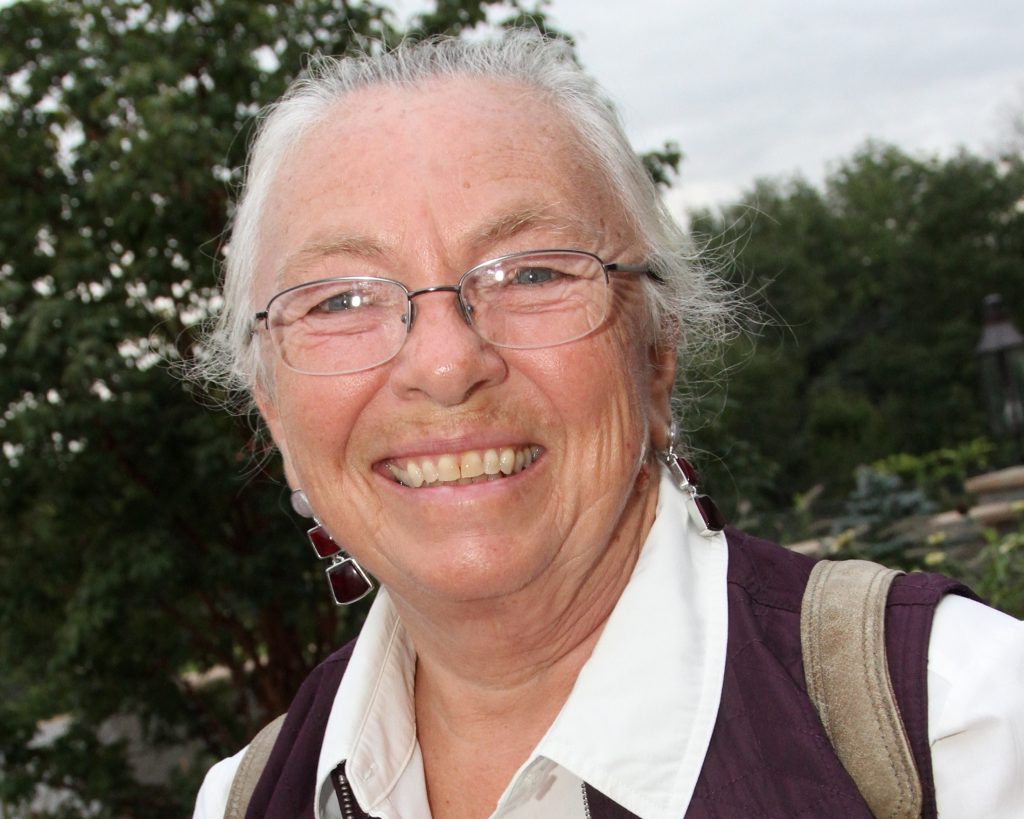
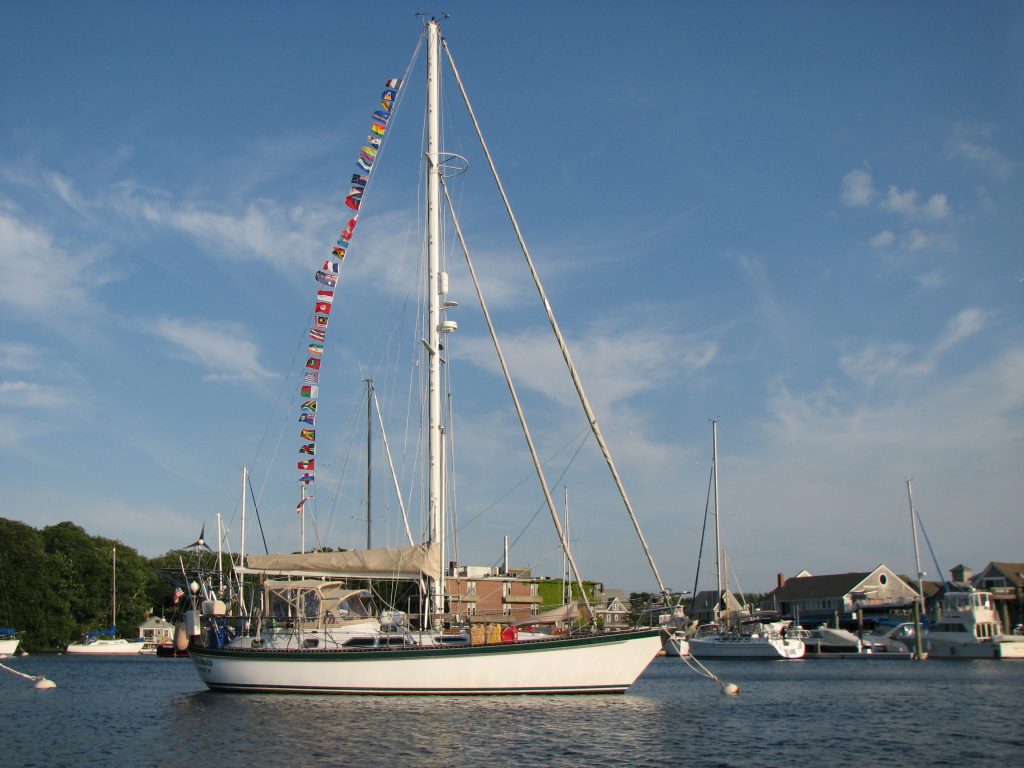
After almost 6 years of traveling, we sailed into Woods Hole on Cape Cod. We continued living aboard for the next five years and I wrote about that, adding ‘and Beyond’ to the title of the blog. Then shortly before Mark’s death in 2016, we sold our beloved Windbird and my travel logs became land logs. At this point, I had written a daily account for each and every day for 11 years. I fully intended to end the blog at that point, but when I wrote that news in a log, I got many responses saying that I really needed to keep posting. At the same time, I realized that I couldn’t stop writing. Summarizing each day had become a permanent part of my life and I will probably continue writing until I can no longer. These postings reflect the ordinary, and sometimes the extraordinary, days in my life and I would like to invite you to join me on my journey.
Day 176, Year 1: Heather and Jed Leave the Galapagos
Day 176, Year 1: Heather and Jed Leave the Galapagos
Date: Tuesday, April 11, 2006
Weather: No Change—Still Beautiful
Location: Academy Bay, Puerto Ayoro, Santa Cruz Island, Galapagos
I truly believe that when a child is born, a part of the mother’s inner being is transferred to the child she has been carrying . . . and that part of the mother’s inner being provides a very strong tie between mother and child. Of course, as fallible human beings we can always do something to either strengthen or weaken that bond, but if it remains strong, a mother has a very difficult time with separation from the child. When the child becomes an independent adult, the mother continues to strive to keep the bond intact. Even when hundreds or thousands of miles separate a mother from her child, I believe the mother can sense the happiness or sadness that the child is experiencing. This is what separates humans from many other species. So today when my daughter Heather and her husband Jed left the Galapagos, the sadness of separation overtook me. It was so very wonderful to share a place that I consider the top of my list of special places on earth and it was very hard to let Heather and Jed go. We had an incredible time together here-a time I will always cherish-and I only wish our son Justin could have been here with us. Mark and I said to Heather and Jed that we will have to return here with Justin for another family experience in the Galapagos, so I look forward to the time when we can do that. We also look forward to the time when Justin can join us in the South Pacific. But enough of a mother’s philosophical babbling and on to the happenings of today.
Our day began much earlier than we would have liked. Sometime in the middle of the night, Windbird started rocking and rolling. The anchorage here in Puerto Ayoro is known for this, but we have been lucky until now. Just before we arrived here there were reports of breaking waves in the anchorage, and while we were away on our five-day tour there was another 48-hour period where the swells rolled in and caused boats much anguish. Last night’s rough and tumble calmed with the rising sun, but who knows what tonight will bring. Whatever, we will just have to roll with the punches. Our next rough spot in the day also happened early. Around 7 AM we called our agent, Johnny Romero, to find out what time we should leave for the airport in order to make Heather and Jed’s flight out to the mainland. Johnny replied that Heather and Jed weren’t flying out until tomorrow and asked us to check the tickets. Sure enough, the flight from here to Quito was set for tomorrow, but their flight back to the US from Quito was also tomorrow and there is no way to do both in one day. This mix-up happened because the original departure day from here was April 12, but that had to be changed and evidently there was a confusion in the communication of this. As always Johnny said, “No worries.” And in about 20 minutes he got back to us with the news that there was still room on the mid-day flight to Quito, so all was well. By this time it was only 8:20 AM and we had survived crisis number two for the day.
Thankfully, the rest of the day went smoothly. Heather, Jed, Mark, and I headed to Baltra to the airport. You have to take a taxi or a bus from here north for about 20 miles and then get on a ferry that takes you to the island of Baltra. As we were sitting on the ferry waiting for transit, Mark opened the computer case that held our Sony Vaio that went on the brink a month ago. Heather and Jed had brought us a replacement and this computer was going back to the US with Heather and Jed for repairs. Mark hit the ‘on’ button one more time to try and start the computer that had refused to start since Panama, and miraculously the screen said, “Welcome to Windows”. We have absolutely no idea why, but the Sony is now working again. We turned it off and back on again, and it seemed to be working just fine. We decided to bring it back with us rather than send it on with Heather and Jed. We can at least retrieve the files we have lost and save them on our new hard drive. Miracles never cease. We are fairly certain that this reprieve is temporary, but for now we will have three working computers aboard. That is certainly better than none.
We said our farewells to Heather and returned to Puerto Ayoro. There was a huge emptiness inside both of us as we returned, but we have almost three weeks of wonderful memories. In fact, tomorrow we will have been here for four weeks. Most of the boats that were here when we arrived are gone now, but new ones come in everyday. Tom and Betty Lee Walker of Quantum Leap arrived today. We met them at the Panama Canal Yacht Club and look forward to seeing them once again. Randy and Sherri aboard Procyon are still here and so is Aqua Magic, so we have friends in port. We are so happy that Randy of Procyon is doing so well after being taken to the mainland to have stomach ulcers removed. I haven’t seen him yet, but everyone says he looks great and will be ready to sail on to the Marquesas after the first of May.
We are waiting for the transmission parts to arrive from the US. Until then, we will do some of the much needed maintenance on the boat and hope that the installation of the new transmission parts will get us up and running once again. Until then we will continue to enjoy this incredible place.
 |
| 060411 Day 176 Galapagos Santa Cruz–Saying Farewell to H&J |
Day 175, Year 1: Another Trip to Tortuga Bay
Day 175, Year 1: Another Trip to Tortuga Bay
Date: Monday, April 10, 2006
Weather: Another Really Beautiful Day in Paradise
Location: Academy Bay, Puerto Ayoro, Santa Cruz Island, Galapagos
We are making progress on getting the parts needed for our transmission repair, but we won’t know the extent of the damage until the parts come in and we can put things back together. It is our hope that when we do that, all will be fine, but there is a chance that there is damage in the transmission itself. Let’s hope not. Let’s also hope that the repair parts get here by week’s end or by the beginning of next week. Until then, we will just have to continue to enjoy our time here in Puerto Ayora and continue to get ready for our voyage to the Marquesas.
Once we ordered the needed parts for our transmission we knew there was nothing more we could do today to speed up the process, so we headed off to Tortuga Bay with Heather and Jed. This was their last day here in the Galapagos and they wanted to revisit the beautiful beach. Mark and I had walked to the beach once before, but we had not continued on to visit the nearby lagoon. Heather and Jed had done this and assured us that it was worth the extra walk time. They were certainly right. The lagoon area is a lovely place to laze the day away. We swam, read, and watched Darwin finches “up-close and natural”.
Today was Patrick of Aqua Magic’s birthday, so once evening came we all headed to a restaurant known to be the best in Puerto Ayora. We were not disappointed. The setting was beautiful, the service was good, and the food was fantastic. Heather and Jed leave tomorrow morning and we are going to miss them so much. It has been a wonderful gift to have them here with us. We will just have to look forward to the next time they can join us.
 |
| 060410 Day 175 Galapagos Santa Cruz–return to Tortuga Bay |
Day 174, Year 1: Transmission Blues with a Little Good News
Day 174, Year 1: Transmission Blues with a Little Good News
Date: Sunday, April 9, 2006
Weather: Another Beautiful Day in Paradise
Location: Academy Bay, Puerto Ayoro, Santa Cruz Island, Galapagos
Early this morning Heather and Jed left for a dive trip out to the island of Santa Fe. We stayed here waiting to hear from our agent and hopefully from a mechanic. About 9:30 the water taxi dropped off two mechanics and they immediately went to work in the engine room. Unfortunately they spoke no English and we speak no Spanish, but for the next three hours they worked and Mark tried to figure out what was happening. What we know for sure is that they were successful in removing the transmission from the engine and getting the coupling and the mounting plate removed. They took these parts and said, “Mañana.” They said something about welding the cracked mounting plate and ordering a new coupling from the continent. We assume that is South America-Ecuador, hopefully. We will hopefully get a translation of all of this from our agent in the morning, but the REALLY good news is that our engine runs just fine now that the transmission is removed. It purrs like a kitten and it doesn’t sound like there has been any damage to the engine. We also think the transmission looks good, but that is still to be determined. For now, we can once again use our engine to charge our batteries. That is very good news and we are hopeful that we might be able to get parts in and everything repaired in the next couple of weeks. Just yesterday we thought we might have to become permanent residents here, but today looks much more hopeful.
Heather and Jed had a great day diving and we are now headed into town for dinner. Life is good. It is continually full of little surprises, but we have truly learned to roll with the punches out here. And we have had to learn to trust. People we don’t know board our boat, work on our engine, and leave with the parts, and we ask no questions. All will be fine.
Day 173, Year 1: The Transmission Blues
Day 173, Year 1: The Transmission Blues
Date: Saturday, April 8, 2006
Weather: Another Beautiful Day in Paradise
Location: Academy Bay, Puerto Ayoro, Santa Cruz Island, Galapagos
Today was spent just trying to figure out exactly what to do about the transmission problem. At present, we cannot start the engine to charge our batteries. When we start the engine it sounds like a lot of bolts being mixed in a metal bowl-not good. We have contacted our agent here, Johnny Romero, and asked him to help us find a transmission mechanic. No one is available today, but he will find someone by tomorrow. Evidently they work here on Sundays. In the meantime, Patrick and Margaret on Aqua Magic have loaned us their gasoline Honda generator. It is not powerful, but it will keep the freezer going until we can figure something else out. In the meantime, we are limiting our use of power. I am writing logs, but I cannot send them until we have the power situation under control.
Here is what Mark has discovered about the transmission. Between the transmission and engine there is a coupling. Apparently when we were caught in the fishing net off the coast of Columbia, the force of stopping the propeller so quickly moved the prop shaft back slightly which put force on the mounting plate which holds the transmission to the engine. The mounting plate is cracked and a couple of bolts that held it to the motor are sheared. We didn’t notice any of this at the time, but with continual use, two more bolts have come loose and at that point-yesterday-the transmission was partially disengaged from the coupling and the odd angle at which the prop shaft from the transmission was entering the coupling caused the coupling to shatter. It appears that the noise we are hearing is the parts of that coupling rattling about inside the housing. What all of this means we are not sure, but once we get a mechanic onboard to help us remove the transmission and back it away from the engine so the broken parts can be removed. Our hope is that this will happen tomorrow.
 |
| 060408 Day 173 Galapagos Santa Cruz–Anchor Up and Sushi Dinner |
Day 172, Year 1: Be Careful What You Wish For
Day 172, Year 1: Be Careful What You Wish For
Date: Friday, April 7, 2006
Weather: Blue Skies, Calm Seas, Winds Building to 15-18 Knots PM
Location: Academy Bay, Puerto Ayoro, Santa Cruz Island, Galapagos
As we left Isabella, I commented to Heather, Jed, and Mark that I really don’t want to leave the Galapagos Islands. I love it here. Mark reminded me that I seem to feel this way about many places we have visited, but I assured him that this place is different. It is really special. But off we went back to Santa Cruz. There was very little wind and a current against us, so we motored along all morning and into the afternoon. At about 1:30 in the afternoon, I was down in the galley fixing lunch and I heard commotion on deck. Heather and Jed heard a strange sound coming from the engine room-something like tinkling bells-and then the tinkling became a very noisy rattle and we stopped moving forward. It seemed to me impossible . . . but we once again found ourselves without a working transmission. Unbelievable!
If you have followed these logs from the beginning, you know that we had transmission difficulties before leaving the US and actually had a new engine and transmission installed. Well, here we are in the Galapagos, which is in the heart of the doldrums with little or no wind, and no way to continue on the Marqueses without the engine. All I could think is that I didn’t REALLY mean that I wanted to stay here, but we will be here for a bit longer now until we can work this problem out.
At just the moment that the transmission died, the wind came up and we put out the head sail and started sailing to Santa Cruz. We were able to keep up our same speed, but had to go a bit off course to take full advantage of the wind. It was going to be sundown when we reached Academy Bay with the engine, and having to go off course meant that we would be coming in after dark under sail. Not an easy thing to do in a crowded anchorage, but we had very little choice. Aqua Magic had left Isabella after us and as we got closer to port, we called them on the radio and told them that we might need assistance. Since they would get in before us, we asked them to look for a good spot for us to anchor. We also thought that we might be able to get a water taxi to tow us in if necessary. Margaret and Patrick were very helpful and with wind that was totally cooperating and the light of half full moon, we were able to sail right in and drop our anchor successfully. It was wonderful to have Heather and Jed with us as extra eyes and hands. I’m sure Mark and I would have made it in alone, but probably not as gracefully!
We will spend tomorrow trying to figure out what to do. We know that getting repairs done from here is not as easy as on the mainland, but we are here and we will have to do the best we can.
 |
| 060407 Day 172 Galapagos Santa Cruz–Return to Puerto Ayoro |
Day 171, Year 1: Muro de las Lacrimas–The Wall of Tears
Day 171, Year 1: Muro de las Lacrimas–The Wall of Tears
Date: Thursday, April 6, 2006
Weather: Beautiful Day—Clear, Blue Skies
Location: Puerto Villamil, Isabella Island, Galapagos
The Wall of Tears is a physical reminder of a part of Isabella’s history that gives it the reputation as the black sheep of the Galapagos. In the mid-1940’s, a penitentiary was opened in Isabella about a two to three hours’ walk from Puerto Villamil. The 200 convicts that were sent here were sentenced to hard labor and were forced to build a wall of big lava blocks. The wall is 50 meters long, five meters wide, and eight meters tall. It stands as a scar on the face of Isabella. The cruelty of the guards is legendary and as you stand at the base and look up at the massive creation, you can almost feel the human misery that must have been endured here. The penitentiary was blown up in 1959 and currently the mayor is working hard to change the image of this beautiful island in order to open the doors for ecotourism here.
We took a taxi out to the wall, walked around it, and up some steps to the top. We then took the taxi back to the first view point and walked back to town from there. We enjoyed the view from the first vista and walked the many paths that have been built to make it easy to enjoy the area. There was an estuary, many lagoons, a lava tunnel leading out into the sea, and then the beautiful white sand beach that stretches as far as you can see. On our way back to the embarcadero, we saw Mathias, our guide from yesterday’s trip up Sierra Negra. Mathias had mentioned that he was a musician, but he had not told us about the CD he has for sale. It is called Musica del Ultimo Paraiso-Galapagos. We immediately went to buy it and each of the songs is about a different animal or plant that exists here. Mathias sees the Galapagos, and especially Isabella, as the ultimate paradise on earth, and he explained that he wants to make sure that these beautiful islands not only preserve the endemic species that live here, but that they also have “endemic” music.
We returned to the boat and got ready for one last snorkel here. We went out to the area where the family of six Galapagos penguins live and were able to snorkel right up to them. A couple of them jumped in the water and I was able to swim with them for just a minute. Then off they flew through the water. I was thrilled and will always hold dear the memory of swimming with the little penguins.
We returned to the boat and prepared a TexMex dinner of soft-shelled tacos, and beans and rice for Doug and Sylvia from Windcastle. We will not see them again until the Marqueses, so we wanted to celebrate our pending passage. It was a lovely last evening in Isabella and tomorrow morning we take off early for Santa Cruz.
Day 170, Year 1: An Easy Day
Day 170, Year 1: An Easy Day
Date: Wednesday, April 5, 2006
Weather: Clear Day, Cloudy Evening
Location: Puerto Villamil, Isabella Island, Galapagos
After yesterday’s big adventure to the volcano, we took it a bit slower today. Heather and Jed visited the turtle hatchery and saw flamingoes in the lagoons on the way there. Mark and I stayed on the boat and did some chores. After Heather and Jed returned we all went out to Las Tintoreas. This is actually close enough to snorkel to if you are truly adventurous, but we took the dinghy for this first trip out. Las Tinoreas is a trail that leads you around the reef islets that protect this anchorage. On our way out there, we came across a very large group of golden cowrays. They are a mustard yellow and are a treat to watch as they move slowly through the water. Once we reached the trail head we followed the path around the volcanic landscape reef and enjoyed its many surprises. First, there is a fissure between the main islet and a small outer bay that is full of white-tipped sharks. They just sit there on the bottom as if napping through the afternoon. Some were five to six feet long. In this same area, we also saw one of the largest spiny pufferfish any of us had ever dreamed of seeing. It was probably 22 inches long. When we looked it up upon return to the boat, we think it was a porcupine fish. When this big guy entered the white-tipped reef shark area, they all scrambled as if they were afraid of it. Interesting.
As we continued our walk, we came upon a beach with lots of sea lions. There was a particularly aggressive male protecting his harem and we decided not to enter the water to swim with these sea lions. As we continued our walk, we came to another rocky beach area that is home to the largest marine iguanas we have seen here. We then headed back to the beginning of the land trail where we had left the dinghy and searched for a good place to snorkel. As we started out of the protected area where we had anchored the dinghy, and before getting into the water we spotted a very large stingray-probably three feet across. We think it was a diamond stingray and we not to see it again! Unfortunately, it was getting late in the day and snorkeling was not great, but I did get very close to the rock where the little penguins spend their late afternoon hours. I took this opportunity to observe them very closely from only a few feet away.
Evening was approaching so we all headed back to the boat and then went into town for dinner. At $2.50 for a complete meal, it is hard to pass up. We will spend one more day exploring here and then head back to Santa Cruz. Heather and Jed want to get in a couple of dives before heading home and that has to be done from the main island. They fly out on Tuesday and we will then begin serious preparations for the run to the Marqueses. It will be hard to leave here, but that time is drawing near.
Day 169, Year 1: A Walk on the Moon
Day 169, Year 1: A Walk on the Moon
Date: Tuesday, April 4, 2006
Weather: Partly Cloudy Morning, Clear Afternoon and Evening
Location: Puerto Villamil, Isabella Island, Galapagos
Today was spent climbing one of the five volcanos here on Isabella–Sierra Negra. This is a huge caldera that is about ten kilometers wide and it last erupted on October 22, 2005-just 5 months ago. We climbed as close as we could to be point where the eruption occurred and as we got closer we could feel the tremendous heat coming of vents underfoot and out of the many fissures. It felt like walking on the moon and was another phenomenal experience. We again lucked out by getting a top-notch guide, Matthias Espanoza. He worked for 18 years as a naturalist and dive master in Santa Cruz, and has presently retired to Isabella to work on his music. He continues to lead land tours and has hired a manager to run his scuba business back on Santa Cruz. He has served as a guide for John McCain in the past few weeks, and earlier for Paul Allen of Microsoft and Bo Derek. And today he added the Handley-Goldstone crew to this list. He has also worked with many scientists and most recently with the BBC. They are making a documentary about the Galapagos.
In order to get to Sierra Negra we had to ride in the back of a farm truck for 18 kilometers and then ride on horseback for about an hour and a half. The final assault is done on foot and takes another hour and a half. The trail leads to Volcan Chico on the external slope of Sierra Negra. We went in that direction and then Matias took us toward the point of the eruption. It was a harder walk than just going to Volcan Chico, but well worth it. There is still steam rising out of the earth where the eruption occurred and you can smell the sulphur in the air. The entire walk is quite dramatic. At first there were small bushes and grasses, but then you are walking entirely on the pyroplastic scoria that blew out and covered everything in a one to two mile radius when the volcano erupted in October. This looks like black cinders and they are very porous with iridescent pinks, blues, golds, and greens that make them sparkle in the sunlight. They are so porous that even the very large rocks are so light you could pick them up and easily break them apart. They would easily float on water. We went on this expedition with Doug and Sylvia from Windcastle, and Doug’s expertise as a geologist who has spent a large part of his career studying the volcanoes on the moon of Jupiter, Io, added greatly to our knowledge base during the day.
We ended the day with a phone conversation with the Concord Yacht Club using the satellite phone we have here on the boat. The Concord Yacht Club is a group of sailors from Concord, New Hampshire, and surrounding towns. We attended the monthly meetings for the past 15 years and it was great to talk with them. The conversation inspired Mark to write another Captain’s Ramblings that I have copied below.
Captain’s Ramblings 3
Tuesday, April 4, 2006
Tonight I called in during the monthly Concord Yacht Club Meeting. It was good to hear the voices of so many friends once again and remember the great get-together’s we have had over the past 15 years. The Satellite phone is an acceptable means of communication, but it does break up occasionally and there is the couple-second lag between my talking and their hearing which can lead to one person talking over the other. I hope they got as much from the brief conversation as I did.
Our sailing friends often ask questions more about the sailing conditions than the experiences we have had. Since the logs concentrate on the many delightful experiences, I thought I would talk a bit about the sailing.
Each part of our journey has had entirely different conditions. In the north Atlantic heading from the east coast of the US to the Caribbean we had very rough seas and high winds, but then we should have expected as much since we sailed this leg in late November, early December – not the best time for avoiding the winter low pressure systems that come blasting across North America. The highest winds we recorded were about 50 knots at the mouth of the Delaware Bay. But most of the passage to St. Martin was in 25 to 35 knot winds and seas of 8 to 15 feet. Sleep was fitful and broken often by dropping off a wave or being slammed by one breaking against us. The boat always felt solid and safe, but we did suffer some chafe of sheets and the Sunbrella covers on the roller furling Yankee and staysail. As the boat bounced from wave to wave the sheets would rub up and down against the furled sails. We found to solution to be simply not furling the sails all the way, leaving a small triangle of the clew of the sail unfurled and then tightening both port and starboard sheets to their winches. Wear and tear on the crew was also evident. But it didn’t take two days in St. Martin for us to feel revived. As Judy said, it is a bit like having a baby: very painful at the time but the result makes it all worthwhile. Once it is over you quickly forget the pain and are ready to do it again.
The Caribbean was a whole different story. Winds were consistently 20 to 30 knots. We put both reefs in the main sail and never took them out until we got to the Pacific. While the passage to St. Martin was mostly beating, the Leeward and Windward Islands were almost entirely on a beam reach. Then we turned west to head for the ABC islands (Aruba, Bonaire, Curacao). This was dead downwind sailing. We mainly used a polled out Yankee, but tried the asymmetrical spinnaker and tried wing-and-wing with the main on one side and the Yankee on the other. In the end, we found we could make better speed using the Yankee instead of the spinnaker. In lighter winds that may not be the case. We also found that the Monitor wind vane steering (which we have only rarely used) was capable of keeping us on a stead enough downwind course that we could go wing-and-wing so long as the Yankee was poled out and the main had a preventer to the toe rail. No matter what, downwind sailing is a rolling experience. Some say you get used to it. We haven’t yet.
>From Curacao to the San Blas Islands in Panama we had to go well north to skirt around the high winds and seas typical at this time of year around Columbia. Still winds were 30 knots or better, but downwind that is actually pretty good sailing. We jibed back and forth in order to keep the wind on our quarter and sailed most of the way with the Yankee and double-reefed main. Once we got far enough west, we turned south to have a delightful sail on a broad reach.
Once through the Panama Canal our whole world changed as far as sailing was concerned. Tides had only been a couple feed in the Caribbean. In the Pacific they were 10 to 20 feet. And the winds were gone. We were now in the doldrums as well as in the lee of Panama so we only got occasional winds and then typically less than 15 knots. And the seas – the swells here are large – blocking out entire ships on the horizon. But they are very widely spaced so that it is often difficult to tell that there is any swell by the feel of the boat. Windbird rides gently up one side and down the next, remaining level all the time as though on a slow moving elevator. So we have found ourselves motoring a lot. Probably half of the almost 900 miles to the Galapagos was spent motoring. We are thankful that Windbird carries about 180 gallons of diesel in three tanks plus another 20 gallons in jerry cans on deck. And still we motor at only about 1800 RPM’s in order to conserve fuel. At that speed (4.9 to 5.0 knots) we burn only about a half gallon of diesel an hour.
Many of the anchorages here in the Galapagos are exposed to the prevailing swell and winds (when there are any). As the swells come into an anchorage the period gets shorter and the anchorage becomes rolly. In Academy Bay on Santa Cruz nearly everyone anchors with a stern anchor in addition to the main bow anchor in order to hold the stern of the boat into the swell. The boat may still hobby-horse (pitch the bow down and up) which is not nearly as uncomfortable as rolling from side-to-side which is what happens when you are beam to the swell.
So now we are in the Galapagos. We have been here three weeks and plan to stay another week at least. There is just so much to see and do here. And then comes the longest sail of our voyage – 3,000 miles to the Marquesas Islands. We will start out with little or no wind as we work our way out of the doldrums. We will likely head south of the rumb line in order to get to the southeast trades as soon as possible. We are just south of the equator now and will have to sail or motor to about 5 or 6 degrees south latitude to pick up the trades. Then we should have east-southeast winds of 5 to 12 knots all the way to the Marquesas. However, several boats that are already making the trip have reported winds up to 40 knots – probably in squalls. At any rate, we are planning on about 25 days to get to the Marquesas, though we have bettered every planned time so far. Perhaps we can better this one too. Maybe 21 days. But with that many days at sea, what difference would a few more make! We have found that we actually like the routine of passages and this one is often described by sailors as the best passage of their lives. We are looking forward to it.
Mark
 |
| 060404 Day 169 Galapagos Isabella–Sierra Negra |
Day 168, Year 1: The Day of the Flamingo
Day 168, Year 1: The Day of the Flamingo
Date: Monday, April 3, 2006
Weather: Cloudy Day . . . and, it actually rained!
Location: Puerto Villamil, Isabella Island, Galapagos
It is the hot season here, which is also the rainy season. But we have seen very little rain since we left the Caribbean. Today, however, it actually rained for an hour or so. It was cloudy all day with a little clearing in the late evening. That is the big weather news for today.
Mark and I got up early and went with Sylvia and Doug from Windcastle to the tortoise hatchery run by the National Park. It is similar to the Darwin Center in Puerto Ayoro, but actually we thought it was a little more user friendly. The Darwin Center has Lonesome George, but the center here has done a nice job of providing natural environments for the tortoises while still allowing them to be displayed. We took a taxi out to the center, but we walked their nature trail back to town. About halfway back, we came upon a lagoon with about four flamingos. They are so unbelievably pink! We hope to see more of these special birds later in the week.
Just as we returned to town, the sprinkles started. We decided to stop in one of the sidewalk cafes for a late breakfast before continuing our journey. We then went to check-in with the port captain and told Sylvia and Doug we would meet them in the internet café® We had also made arrangements to meet a guide in a local restaurant at lunch time to make plans for our volcano trip tomorrow. We had planned to be in town just for a couple of hours, but one thing led to another and we ended up returning to the boat very late in the afternoon with just enough time to get ready to go back to the dock for dinner at the Club Nautico run by Henry and his wife Marianna, the couple who took us to Cabo Rosa yesterday.
Heather and Jed came into town around noon to join us, and when we returned to the boat in the evening, they both decided to jump in for a quick swim and sea water “bath”. Just as they were ready to go in, Heather called down for Mark and I to come up into the cockpit. There were flamingos flying through the anchorage and they were quite a sight to see. Somehow you don’t expect to see bright pink birds flying in the sky, but they do and they are beautiful. And this comes from a person who has a pink phobia.
Tomorrow will be the day of the volcano. We will be riding in a truck to the highlands, riding horses up to the rim of the Sierra Negra volcano, and then walking around the rim to Volcan Chino. This volcano still has some steaming sink holes. It should be another fascinating day here in the Galapagos islands.
 |
| 060403 Day 168 Galapagos Isabella–Giant Tortoise Breeding Center |
Day 167, Year 1: Trip to Cabo Rosa
Day 167, Year 1: Trip to Cabo Rosa
Date: Sunday, April 2, 2006
Weather: Partly Cloudy Morning and Evening; Blue Skies and Sunny Afternoon
Location: Puerto Villamil, Isabella Island, Galapagos
Well, I didn’t get to swim with penguins today, but I did get to swim with huge sea turtles. It was another unbelievable day here in the Galapagos. We were picked up at 1045 by the Capitan Freud, a 25-foot panga (like a Boston Whaler but with a sun cover). The captain, Henry, his wife Marianna, their 18 year-old daughter Arianna, 6-year old son Freud, and either crew member or older son, Danny greeted us. Dick and Lynn from Wind Pony (Minnesota), Sylvia and Doug from Windcaste (San Juan Capistrano, California), Margaret and Patrick from Aqua Magic (Devon, England), and the four of us from Windbird were aboard. We headed out for Cabo Rosa going about 20-25 knots. As we flew through the water, we surfed the Pacific swells. We sincerely hoped that Captain Henry knew what he was doing, and it soon became evident that he did. It took about 30 minutes to reach Cabo Rosa. None of us really knew what to expect, so when Henry indicated that we were going to shore and all we saw were huge breakers rolling over a rocky reef, we braced ourselves for the ride. He was unbelievably competent and worked his way through the breakers, through the tiny entrance to the rocky reef, and then guided us through a rock strewn path to a quiet anchorage. It is always hard to comprehend how wild the surf can be outside a reef and just how quiet it can be just inside. Henry weaved in and out of a series of narrow channels until we reached a quiet anchorage.
The dinghy was hauled out and five of us went for a dinghy ride while five of us snorkeled. Heather and Jed were with the first dinghy crew while Mark and I snorkeled with very large sea turtles. It was magical. We stayed in the water over an hour and then got out just in time to switch over to the dinghy ride that was even more magical. We negotiated through an unbelievable lava landscape of tunnels, bridges, and columns until we reach what I would characterize as the “back bay”. There were so many huge sea turtles here that it was impossible to count. Most stayed just under the surface of the water, but others poked their heads above the surface to say hello. In addition to the turtles, we got to see a lava gull and her baby up close on the face of one of the lava tunnels. It was truly special.
Once we returned to the panga, it was time to depart and once again Henry negotiated the rock strewn path with great skill. We worked our way into another anchorage for a short stop and walk on the lava rocks, and then we headed out. We inched our way through the rocks and then when Henry saw the narrow pass, he gunned the engine and off we went into the huge rollers. Once we made it through the reef and the surf, we headed back to Puerto Villamil. We made one stop at a huge rock offshore, Roca Union, and watched as the surf climbed the sheer rock wall and rushed down off it, much like watching the water rush over Niagrara Falls.
We entered the anchorage shortly before sunset and all marveled at the day’s adventure. It wasn’t over, however, There were eagle rays swimming by our boat and Heather just had to jump in to swim with these beauties. We watched a beautiful sunset and called it a day. And what day it was.
 |
| 060402 Day 167 Isabella–Cabo Rosa |