
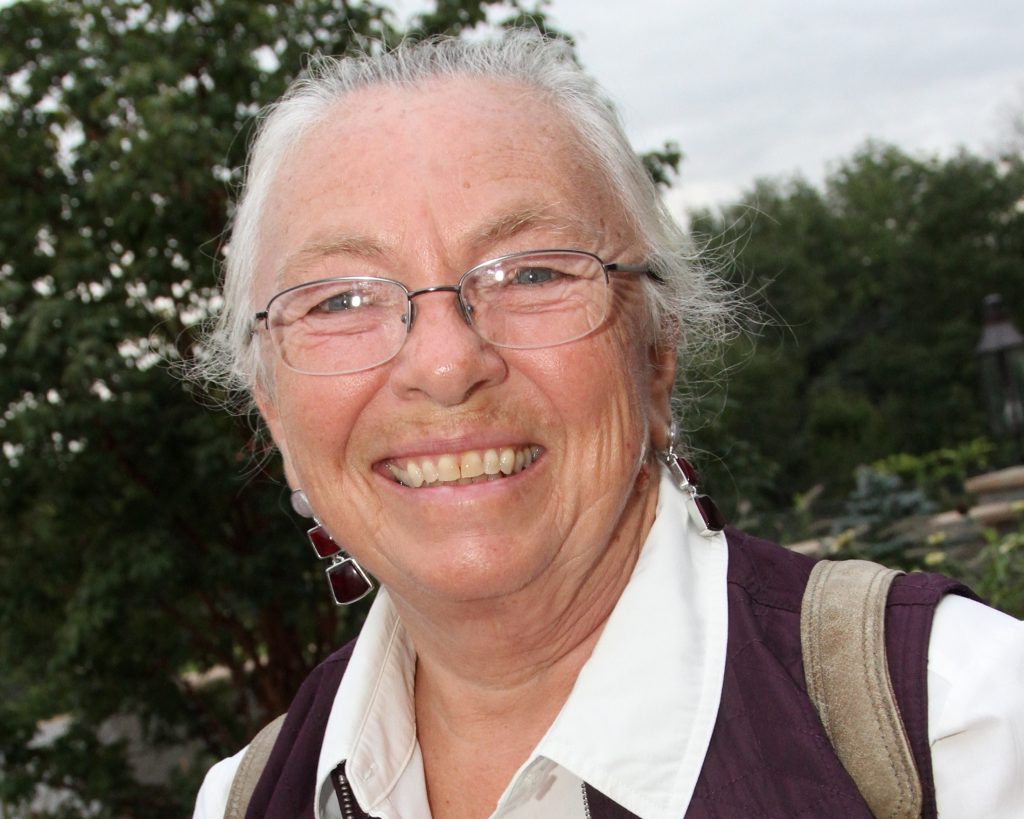
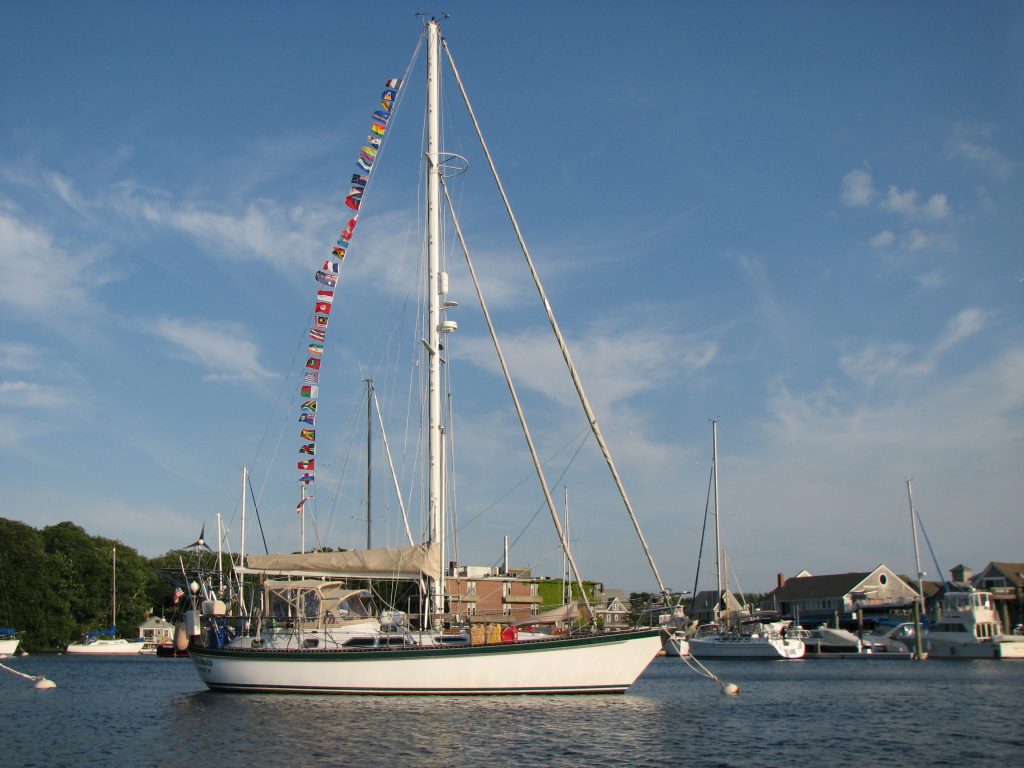
After almost 6 years of traveling, we sailed into Woods Hole on Cape Cod. We continued living aboard for the next five years and I wrote about that, adding ‘and Beyond’ to the title of the blog. Then shortly before Mark’s death in 2016, we sold our beloved Windbird and my travel logs became land logs. At this point, I had written a daily account for each and every day for 11 years. I fully intended to end the blog at that point, but when I wrote that news in a log, I got many responses saying that I really needed to keep posting. At the same time, I realized that I couldn’t stop writing. Summarizing each day had become a permanent part of my life and I will probably continue writing until I can no longer. These postings reflect the ordinary, and sometimes the extraordinary, days in my life and I would like to invite you to join me on my journey.
Day 197, Year 1: Halfway to the Marquesas–Day 11
Day 197, Year 1: Halfway to the Marquesas–Day 11
Date: Tuesday, May 2, 2006
Weather: Blue-Ribbon Beautiful Day
Air Temperature: Daytime 80 degrees F
Latitude: 06 degrees 26 minutes S
Longitude: 114 degrees 54 minutes W
Location: Passage from Galapagos to the Marquesas, Day 11
Miles to Go: 1440 (~ 139 miles last 24 hours)
Miles to Date: 1509
We are halfway there. Hurray! The winds are down to 10 to 15 knots today, but that still allows us to move along nicely. From talking to folks on the net, however, it appears that the winds are even lighter up ahead, but we can’t complain. We have had days of non-stop sailing without having to use the engine. It has been delightful.
I was taking a mid-day nap today when I awoke to the sound of the fishing reel. Some critter was running with our line. By the time I got up into the cockpit, it was too late. Whatever had our line was very large and it actually broke the line. So much for that line and lure and no fish for dinner tonight. At the same time, we saw sails on the horizon just behind us. Were we hallucinating? We had just passed the half-way point and were as far away from land as we can be, and there is sailboat coming up on us. Small world. We got on the VHF radio on Channel 16 and hailed the sailboat. It was Felix and Monica of Makani from Germany. We met them our last night in Puerto Villamil. They left a day after us, but their Bavaria 42 is obviously faster than our Tayana 42. The Bavaria is a lighter boat and they have now passed us and are headed into the sunset. Their HAM radio is not working, so they have no contact with anyone right now other than the close range VHF, thus the reason they have not checked into the net. We alerted the boats in front of us to be on the lookout for them and to contact them on Channel 16 when they can see them. They do have satellite email, but because of the expense they have only given their email address to their son. So, to send them an email we would have to send it to their son and he would forward it to them – complicated. It made me think long and hard about how I would feel without our radio contact. I don’t think I would like that very much.
Day 196, Year 1: Another Mahi Mahi–Day 10
Day 196, Year 1: Another Mahi Mahi–Day 10
Date and Time: Monday, May 1, 2006
Weather: Cloudy Morning Turning Sunny with Scattered Clouds
Air Temperature: Daytime 79 degrees F
Latitude: 06 degrees 05 minutes S
Longitude: 112 degrees 38 minutes W
Location: Passage from Galapagos to the Marquesas, Day 10
Miles to Go: 1577 (~ 160 miles last 24 hours)
Miles to Date: 1370
The winds are still in the 20 to 25 knots range, the seas are still causing us to rock and roll, but we are doing great. We will be at the half-way point sometime tomorrow, so we will have to plan a celebration. Today we caught another small Mahi Mahi so we are all set for dinner tonight. Life is good.
Today was baking day again, but this time I escaped getting burned. By the way, the burn on my leg is doing fine. Anyway, I needed to use up the multitude of ripening bananas, so I made two loaves of banana bread. It is great as a first breakfast and saves on the use of precious cereal. That is something that is very expensive in French Polynesia, so I welcome the banana bread while it lasts. I also made brownies. That will be our treat during night watch. And it was shower day. When you are on a long passage like this one, you do everything you can to conserve water “just in case”. We have the water maker, but you never know when something could go wrong with it. We have plenty of water to get us to the Marquesas if all goes well, but in case of no wind and a motor failure, you really have to make sure you don’t use up your reserves. So we shower only every third day and on those days, I use the shower water to wash any dirty clothes. I use fresh water to rinse the clothes, but using the shower water really saves water and works fine for the wash. So I am sitting here in the cockpit with clean clothes blowing in my face. With all this wind, they will be dry soon and can be taken below.
The sun is setting. There have been clouds on the horizon most evenings, and we have yet to see the green flash. When you watch the sun set over the ocean, you are supposed to see a flash of green light just as the sun sinks below the horizon, but it keeps escaping us. No green flash again tonight. The new moon is high in the sky right now. It will set before midnight, but in a few days as we get closer to the Marquesas, the moon will be filling and not setting until early morning. We will once again have the light of the moon to guide us.
Day 195, Year 1: Rockin’ and Rollin’—Day 9
Day 195, Year 1: Rockin’ and Rollin’—Day 9
Date: Sunday, April 30, 2006
Weather: Sunny Day with Scattered Clouds
Water Surface Temperature: Didn’t Check Today—Too Rough
Air Temperature: Daytime 79 degrees F
Latitude: 06 degrees 48 minutes S
Longitude: 110 degrees 16 minutes W
Location: Passage from Galapagos to the Marquesas, Day 9
Miles to Go: 1733 (~ 164 miles last 24 hours)
Miles to Date: 1210
Today was sunny with no rain, but other than that nothing has changed since yesterday. We are still being tossed about – with the great winds come the rougher seas. We are making great time and even though it is a bit uncomfortable, the conditions are safe. Our friends on Quantum Leap, a catamaran out of Mobile, Alabama, have passed us. They are making 200 plus miles a day. We are making about 160 to a 170 a day, but that is about as fast as our little monohull will go. There is also a Benateau 45′ that was still close to us this morning, but they should be ahead of us by this evening. Randy and Sherri on Procyon are well behind us, as well as a couple of other boats that we don’t know. We enjoy our contact twice a day with everyone and continue to enjoy the passage.
This afternoon I mentioned to Mark that I wanted to hear the song “Old Time Rock and Roll” as that is what we are doing-rockin’ and rollin’. That prompted him to get the MP3 player out. We hooked it up to its little but powerful speakers and searched through the music that our daughter Heather and her husband Jed put on the player. No “Old Time Rock and Roll” but we came across songs from the 1950’s and had a blast listening to Fats Domino, Elvis, the Everly Brothers, Little Richard, and on and on. There was plenty of rock and roll music to go with the movement of Windbird. We also found some Bob Marley on the player. I was reading this morning that the chief in Fatu Hiva likes Bob Marley CD’s, so we might have to burn one for him before we arrive.
Some of the first wave of boats have arrived in Fatu Hiva. We don’t have radio contact with most of them, but on the evening Pacific Seafarer’s Net, Mark has been able to keep track of Bud and Kathy on Invictus out of Mountain Home, Arkansas. They are a great couple and they should have arrived in Fatu Hive this afternoon. I keep talking about Fatu Hiva as if anyone reading this knows exactly where that is, but I, as most people, had never heard of this island until well into this trip. There are a number of islands in the Marquesas, the first group of islands you come to when crossing the Pacific on the classic route that we are taking. There are 10 islands and numerous rocks and islets that make-up the group. Fatu Hiva is the southern most island. Although it is not an official port of call, we have heard from other cruisers that the gendarme is currently allowing boats to stop there for a few days before heading north to Hiva Oa, the largest island in the group and the one where we will officially check into the Marquesas. There are a couple of reasons that we want to come into Fatu Hiva. One is that it will be an easier path to sail north-west through the other islands and second, it is the most beautiful island in the Marquesas. As you come into Baie Hanavave (Bay of Virgins), you first see the rocky spires near the head of the bay and on either side of the bay there are dark green steep-sided mountains. The spires are supposed to be even more dramatic in a setting sun. This Baie des Vierges (Bay of Virgins) is said to once have been named the Baie des Verges. This translates as the Bay of Phalli, so named because of the shape of the rocky pillars. Evidently when the first missionaries arrived, they didn’t approve and they inserted an “i” changing Vierges to Verges. Whatever, I look forward to arrival there.
Day 194, Year 1: The Grill is Gone–Day 8
Day 194, Year 1: The Grill is Gone–Day 8
Date: Saturday, April 29, 2006
Weather: Cloudy Day, Mid-day Squall with Wind and Rain
Water Surface Temperature: Didn’t Check Today
Air Temperature: Daytime 79 degrees F
Latitude: 05 degrees 48 minutes S
Longitude: 107 degrees 16 minutes W
Miles to Go: 1896 (~167 miles last 24 hours)
Location: Passage from Galapagos to the Marquesas, Day 8
Miles to Date: 1046
“The Grill Is Gone.” Not a title for a new song, but a fact. We lost our grill off the back of the boat today and I am greatly saddened. It is just a grill, but a lot of meals revolve around the use that handy little gadget. Hopefully we can find a replacement in Tahiti. Until then all meat will have to be prepared on the stove top as we have no broiler in our oven. I’ll get over it, but I hate losing any piece of equipment.
Now to the reason we lost the grill. The Coconut Milk Run has turned into a butter churn. We kept the 20 to 25 knot winds all through the night and this morning, but near noon the seas began to build and we hit a squall with 30 plus knot winds. We double reefed the mainsail and the headsail and we are doing fine, still traveling between 6 and 7 knots, but the ride is a lot lumpier. The seas are choppy and the swells are between 6 and 8 seconds. That means that every 6 seconds the boat rises and falls. The swells are hitting us on the port (left) rear quarter which is good, but once in a while one hits us broad-sided which causes a jerk. The 30 plus knot winds were short-lived and we are back to 18 to 22 knots right now. The sky is totally overcast, but once in a while a see a little patch of blue here and there. So back to the grill . . . It probably went over around noon when we were reefing the sails. It was a little rough for a few minutes and we have always known the grill attachment was its weak point. We looked for a better attachment in Panama and didn’t find one, so we probably should have rigged something up to save it if it broke, but we didn’t. Live and learn, and we seem to be learning a lot these days. But rest assured, it is not just us. When we check into the net it seems that someone is always working on something that has broken. About midnight on Thursday night, Quantum Leap lost their spinnaker halyard and had to spend an hour pulling their spinnaker out of the water. Yesterday Jade had to turn back to Puerto Ayoro in the Galapagos because their boom vang broke and their water maker stopped working. We talked to Doug and Sylvia on Windcastle this afternoon and in addition to the ripped headsail, their freezer has stopped working. And Vol (pronounced “yawl”) has lost its alternator. The list goes on. If you took your home and put it on the constantly moving ocean, you would have similar problems. It’s all part of the territory. So in perspective, a lost grill is not such a big deal.
Weather reports indicate that we should continue to have good wind through Tuesday. Wednesday looks a little lighter. Until then we are trying to head due west with the wind behind us. When the wind lightens, we can turn south on a broad reach. That’s the plan, at least.
Day 193, Year 1: Easy Ride–Day 7
Day 193, Year 1: Easy Ride–Day 7
Date: Friday, April 28, 2006; New Time Zone EDT
Weather: Clear Skies with Cumulus Clouds on Horizon (Cloudier Morning)
Water Surface Temperature: 79 degrees F
Air Temperature: Nighttime 79 degrees F; Daytime 82 degrees F
Latitude: 05 degrees 44 minutes S
Longitude: 104 degrees 31 minutes W
Location: Passage from Galapagos to the Marquesas, Day 7
Miles to Go: 2057 (~146 miles last 24 hours)
Miles to Date: ~879
Things are going well out here. The wind is still with us and because it is behind us, we are having an easy ride. This is why they call this the Coconut Milk Run. When things are working as normal, this is a great passage. The days are absolutely gorgeous with clear blue skies and just a few puffy clouds around the horizon. There is a swell but it is gentle and the winds are consistently 15 to 20. Each day the temperature is rising just a tad, but it really feels cool in the breeze. The forecast is for more of this for the next five days except the seas are supposed to build. I’ll have to wait and see how that affects the ride, but right now it is fantastic.
Yesterday after I sent the log we caught a small Mahi Mahi and had it for dinner. What a treat. We didn’t put out the line today as Mark was doing “investigative” work in the engine room. We are hypersensitive now to every little noise and we wanted to check all connections of engine to transmission to prop shaft one more time. It seems like all is well in the engine room, but we have no fish for dinner tonight.
There are two other boats that are very close to us, but not within sight yet. When we check in with the evening net, we will see exactly where they are. This morning when we reported our positions, the net controller joked about us being able to meet and have a barbeque with the other two boats. It is interesting that having a boat within 60 to 100 miles feels close! There are now four more boats that we know of that are behind us and numerous boats just ahead of us, so we have lots of company. We like checking into this net that we all established twice a day. It helps us feel connected. Our friend Patrick of Aqua Magic is net controller for the evening check-in and since we are further back, Mark helps with the relays from boats that are even further behind.
We have traveled almost 900 miles in our first seven days out here. Our average daily distance traveled has been 138.5 miles per day. If we can continue that, we will be in Fatu Hiva in the Marquesas in about 16 days from now. That’s the best case scenario, but it sounds good to me.
Day 192, Year 1: Calmer Day–Day 6
Day 192, Year 1: Calmer Day–Day 6
Date: Thursday, April 27, 2006
Weather: Clear Skies with Cumulus Clouds on Horizon (Cloudier Morning)
Water Surface Temperature: 79 degrees F
Air Temperature: Nighttime 77 degrees F; Daytime 80 degrees F
Latitude: 05 degrees 23 minutes S
Longitude: 102 degrees 07 minutes W
Location: Passage from Galapagos to the Marquesas, Day 6
Miles to Go: 2203 (~133 miles last 24 hours)
Miles to Date: ~733
Today was a much calmer day than yesterday. No flying squid, no whales, no getting burned while cooking. We are moving along, one quarter of the way to the Marquesas. When the wind stays above 15 knots, we make great time, but there are periods during the night and again during the afternoon when the wind drops to 10 to 12 knots. When that happens, we move much more slowly, but we are still averaging about 140 miles a day. The total number of miles to our destination from the Galapagos was about 3,000, so if we keep up this average the total trip will take us about 22 days. If we lose the wind entirely due to the weather system in French Polynesia, of course the trip will take longer. But we are settling in and enjoying the days.
The weather has been gorgeous. We are well protected from the sun and it actually feels cool at night and sometimes during the day. When the sun goes behind a cloud, I get chilly. At night we wear long pants and jackets-not what I expected south of the equator, but I’m not complaining, just explaining. The first couple of nights we had to zip our jackets and it was so humid that dew covered everything. It rained our third night out and since then the air has dried out and there is no need to zip a jacket at night. During the day, there are never clouds overhead but the horizon all around is decorated with puffy little clouds. The night sky has been phenomenal-so many stars. As we look to the south we see the Milky Way clearer than we have ever seen it before.
I got an e-mail from my friend Linda back in the Concord School District in response to my mention of being hit in the head with a flying squid. She said she didn’t know squid could fly, but she looked it up on the internet and learned that squid, like flying fish, don’t really fly. They literally shoot out of the water and glide using their fins to help them glide across the water. A certain species of squid can actually “glide” at 24 miles an hour. If the squid that hit me in the side of the head was traveling that fast, he probably had a good concussion from hitting my hard head!
For our sailor friends out there, I just want to remind you that you can check on our position daily by going to Yotreps at Pangolin on the web. There is a link on our website in the “Where We Are Now” section. I’m not sure that section is up-to-date on the site, but the link there will get you to Yotreps. Our son Justin that manages our website is leaving for a three week trip to Africa so I know that part of our website will not be updated from now until the end of April. Checking directly with Yotreps is the best way to get our position. All you need is our call sign to enter on the Yotreps site. It is KB1LDP.
Day 191, Year 1: Encounters with a Squid and a Whale–Day 5
Day 191, Year 1: Encounters with a Squid and a Whale–Day 5
Date: Wednesday, April 26, 2006
Weather: Clear Skies Above with Cumulus Clouds on the Horizon
Water Surface Temperature: 77 degrees F
Latitude: 04 degrees 47 minutes S
Longitude: 099 degrees 57 minutes W
Location: Passage from Galapagos to the Marquesas, Day 5
Miles to Go: 2337 (~137 miles last 24 hours)
Miles to Date: ~599
When you get hit in the head by a flying squid at exactly midnight, you should know that your day is going to be an interesting one. I was on watch and moved back to sit at the helm at exactly midnight last night to record the “vital signs”. At least twice a day, every night at 2400/0000 and every morning at 0900 the person on watch records wind speed, boat speed, course, weather, position, and all of the other details in the log book. I had just moved back to do this, when WHAM, a flying squid hits me in the head. Who knows what the squid was flying away from, but after observing the strange creature that was still wiggling, I threw him back in the water.
The next event happened at 0730. I was sleeping but I awoke to see Mark rushing past me to get the V-berth. I asked why he was in such a hurry and he said he had to fix the knot meter. Still a bit groggy, I asked what was wrong with it and he replied that we had just hit a whale and that the prongs on the knot meter were bent. That woke me up. “We just hit a whale?” Mark confirmed and I hopped up to help check to see what other damage was done. Hitting a whale at sea is always a threat and one of those things that you never want to happen. Once the knot meter was fixed, I asked for more detail. What other damage? Was water rushing into the bilge? What kind of whale? I had at least 40 questions and Mark patiently assured me that all was well. He saw a whale blow and then the boat lifted slightly out the water and the whale emerged on the port side. It was at least as big as our boat, maybe longer. I went to the cockpit to look for other whales, and sure enough, behind us and to starboard I saw at least two others. Mark saw more. I spotted a blow, strange, at an angle like it was being blown by the wind, and then I could see part of the whale’s back and small dorsal fin. It was moving fairly fast and came up three more times to blow and show its back and then it disappeared. We think we crossed the path of a pod of female sperm whales. The one we hit must have been close to the surface and then dipped when we hit. Unlucky to hit a whale; lucky we didn’t sustain more damage. Two other boats that are part of our net have had similar experiences. I hope this is our last whale encounter on this voyage.
Then came the news on the net this morning that there is cyclone in the French Polynesia – Tuamotu area. We had heard that there were 40 knot winds in Papeete, Tahiti, but on last night’s Pacific Seafarer’s Net, Don Anderson, the weather forecaster for the net, was reluctant to call this weather system a cyclone. By this morning, however, our Fatu Hiva Net was calling it a cyclone. Whatever, it is far from us right now, and will not move this direction. The bad news is that a cyclone in that area will probably suck all of the air out of this region. People two weeks ahead of us are already feeling the effects. Hopefully we are far enough away that the winds will return as we get closer. In a normal year, there should be no cyclones in the eastern Pacific after the first of April. I guess this is not a normal year.
I decided to spend the day baking bread and making banana bread from all of the bananas that fell on our deck yesterday. It looked like it was raining bananas! We bought a huge stalk of bananas for the trip and hung them from the boom gallows knowing we would probably not be able to keep them for long. When the winds picked up yesterday, the motion of the boat caused those that were a little ripe to fall. We collected those that fell and put a mesh bag around the remainder. So the bananas are under control for now and we have banana bread and whole wheat bread. Unfortunately, I got thrown against the hot oven when the boat lurched over a wave and have a nice size burn on my thigh. Another “interesting” event for this day.
The good news is the sailing right now is great. The seas are fairly calm and we still have about 15 knots of winds from the ESE. Except for a little rain on Monday night, we have had wonderful weather . . . so no complaints. I’ll try to make sure tomorrow is a calmer day aboard Windbird.
Day 190, Year 1: Flying with the Trade Winds–Day 4
Day 190, Year 1: Flying with the Trade Winds–Day 4
Date: Tuesday, April 25, 2006
Weather: Clear Skies Above with Cumulus Clouds on the Horizon
Water Surface Temperature: 77 degrees F
Latitude: 03 degrees 30 minutes S
Longitude: 095 degrees 21 minutes W
Location: Passage from Galapagos to the Marquesas, Day 4
Miles to Go: 2499 (~150 miles last 24 hours); 462 miles so far
If you look back at yesterday’s miles to go, it looks like we traveled 228 miles in the past 24 hours. Well, we have been flying, but not that fast. The trade winds kicked in full tilt about 24 hours ago and we adjusted our course. We were originally headed more south in order to get out of the doldrums and into the trade winds. Now that we seem to have entered the trade wind belt, we are running a more direct route to Fatu Hiva (our first landfall in the Marquesas) and that has shaved off some of the miles left to go. We will not have been out a full four days until tomorrow morning, but so far we have traveled 462 miles. We feel very good about this and just hope the wonderful winds and sea conditions stay with us.
We are falling into a routine-sleep, eat, watch and read, do a chore, cook a little, sleep, eat, watch and read. And once in a while we put out the fishing line. That’s about it, but we are really enjoying the time. Tomorrow is a fishing day and right now it is time to cook dinner. Ah, if only life could always be this simple.
Day 189, Year 1: Back to Sailing–Day 3
Day 189, Year 1: Back to Sailing–Day 3
Date: Monday, April 24, 2006
Weather: Alternates Between Clear and Totally Overcast, Some Squall Activity
Water Surface Temperature: 76 degrees F
Latitude: 03 degrees 30 minutes S
Longitude: 095 degrees 21 minutes W
Location: Passage from Galapagos to the Marquesas, Day 3
Miles to Go: 2728 (~125 miles last 24 hours)
We’ve had another good day. We motor sailed through the night and into the day, but we are currently sailing with a full main and headsail going 6.6 over ground, 5.8 through the water, which means we are finally getting a boost from a favorable current. Right now we have 12 to 15 knots of wind, rising to 18 to 20 when we go through a “storm patch”-my name for an area of convection activity. The sun is setting and it is raining a bit right now. This is the first rain we have seen on this passage, but the skies look as if we might have squall activity through the night. Windbird could use a good fresh water wash, so we will welcome the rain. We had two days with a drizzle in the Galapagos, but other than that we have not had rain since the Caribbean.
I have started my research reading for the South Pacific and already have learned so much. The Pacific Ocean is twice the size of the Atlantic and it is greater than all of the earth’s land surfaces combined. But on a map, the islands of the Pacific just look like little dots. Most people, myself included, have heard some names like Tahiti, Bora Bora, Fiji, and Tonga, but otherwise are very unaware of the republics, kingdoms, and protectorates in the whole of the South Pacific. If you are reading these logs, you will probably learn more about the South Pacific islands than you ever wanted to know. I am letting go of my attachment to the Galapagos and getting into the journey through the Pacific. And, of course, these logs will reflect that.
As I started reading The Pacific Crossing Guide, one of the first questions addressed was why anyone would cross the Pacific. The text explains that just as there are boats of many different sizes and shapes, there are numerous reasons for crossing the Pacific. Usually people are doing this as part of a circumnavigation or they are just South Pacific explorers who stay in this area for years. We fall in the category of the circumnavigators, although we will not make the final decision to go all the way around until we reach New Zealand. As the Crossing Guide states, “The Pacific is an ocean that needs time-six to eight months for a Pacific crossing from Panama to New Zealand.” We left Panama on the ninth of March and will probably leave Tonga or Fiji for New Zealand around the first of November. That means we will fall in the average of taking eight months for the Pacific passage. Right now, however, we have to concentrate on making the twenty to thirty days it takes to get to the first landfall. So far, so good. (Seems like that has become my mantra!)
Day 188, Year 1: The Wind is Gone–Day 2
Day 188, Year 1: The Wind is Gone–Day 2
Date: Sunday, April 23, 2006
Weather: Clear Day, Becoming Overcast in Late Afternoon
Water Surface Temperature: 76 degrees F
Latitude: 02 degrees 05 minutes S
Longitude: 093 degrees 19 minutes W
Location: Passage from Galapagos to the Marquesas, Day 2
Miles to Go: 2861 (126 miles last 24 hours)
We are still motoring. We had a great sail yesterday afternoon which was unexpected, and then it was back to the typical doldrums. We have had 5 to 8 knots out of the east for the past 24 hours. As I am writing this log, the wind is beginning to increase, so maybe we will get to sail tonight. We are prepared to motor for the first four to five days, but any wind that will save the precious fuel is most welcome. Our speed is averaging about 5.3 knots overall, which seems slow for us as we have had some great currents to boost our speed by as much as two knots on some previous passages. The charts show a current going our way just a little south of where we are so we may pick it up tomorrow. Other boats on the net are finding it strange that there has been a counter current where they were expecting a positive current. And the winds have been unusual for trade wind sailing. Some are getting no wind and others experience 25 to 35 knots. We have heard some boats wonder if this is going to be an El Nino year. Let’s hope not.
We checked in with the Pacific Cruisers Net last night and we were able to talk to Doug of Windcastle. He has a torn headsail. He is having to sail with it rolled up 30 per cent, but he is still making about 4.5 knots on average. He and Sylvie are over the halfway point and both are enjoying the passage. This morning we checked into the net that is being run by the few boats that left the Galapagos this past week. Aqua Magic is part of that net. They, along with another British boat named Shine, are three days ahead of us and seem to be doing well. The other boats that are within a day or two of us are Scottie from Scotland, Aventura from England, Islay from Turkey, Shoestring, Minaret, and Gdansk (not sure of home ports). We have met Derek and Glenda on Scotty and Mary and Chris of Aventura, but we don’t know the other cruisers. It will be great fun to meet them when we reach the Marquesas. Today Beam Muir and Quantum Leap left Isabella and joined the net, so they are just one day behind us. We are in good company and it is comforting to know that there are others out here with us.
Today was way too busy, but as always one thing led to another. I got up at 0600 and did the early morning watch while Mark slept. I checked into the 0800 net out of Panama to get the weather report. Once Mark was up, I started to fix breakfast. I was making an omelet with onions and peppers, but when I went to get a pepper, I found one that had gone bad. That meant cleaning out the whole veggie bin and by that time it was 1000 and time for the radio net of cruisers headed our way. After listening to that, I did manage to get breakfast. We read for a while and then started our daily chores. I got out the cleaner and UV protectorant for the dinghy and was about to head to the front of the boat to do that job when I heard the fishing reel whirring away. We caught a skipjack tuna about 28 inches long. This was great, but it does make a mess of the back deck and the clean up process takes a while. Obviously we are not very good at this yet as we were both a mess as well. After cleaning the fish, we needed to take showers. And when we take showers, I use the shower water to wash clothes. Being on a long passage and not wanting to waste a drop of water, I did the laundry which was not on the agenda for the day and then finally in mid-afternoon got to the dinghy cleaning job. This is how you pass the time out here. It seems that there is always something that needs to be done.
So all is going well. We will have fresh tuna for dinner tonight with mashed potatoes and fresh broccoli. And I’m thinking Bananas Foster would be a great dessert.
Note: I just finished this log and was getting ready to go downstairs to send it when a helicopter started circling the boat. I’m thinking, “What is a helicopter doing out here and why is it circling my boat.” There were two guys in the chopper and it circled three times and on the fourth pass I decided to wave and give the thumbs up sign. It seems that is all they wanted as they returned the thumbs up, smiled (they were very close) and headed east. The ID numbers on the helicopter were HP 1493. Mark got on the VHF and they indicated they were from the Galapagos. We couldn’t understand anything else. The only other signs of human life we have seen in the past 24 hours have been three fishing boats, so I am assuming the helicopter monitors fishing out here. Seems like a long way out for that, but not sure why else they would be here.