
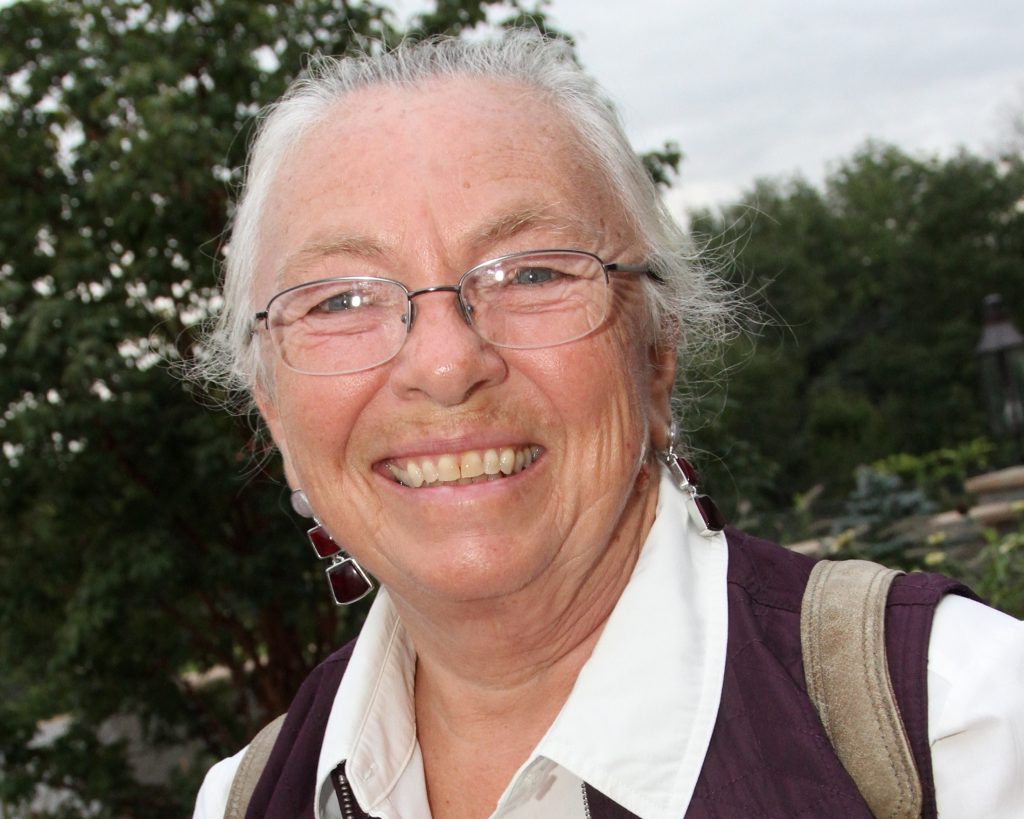
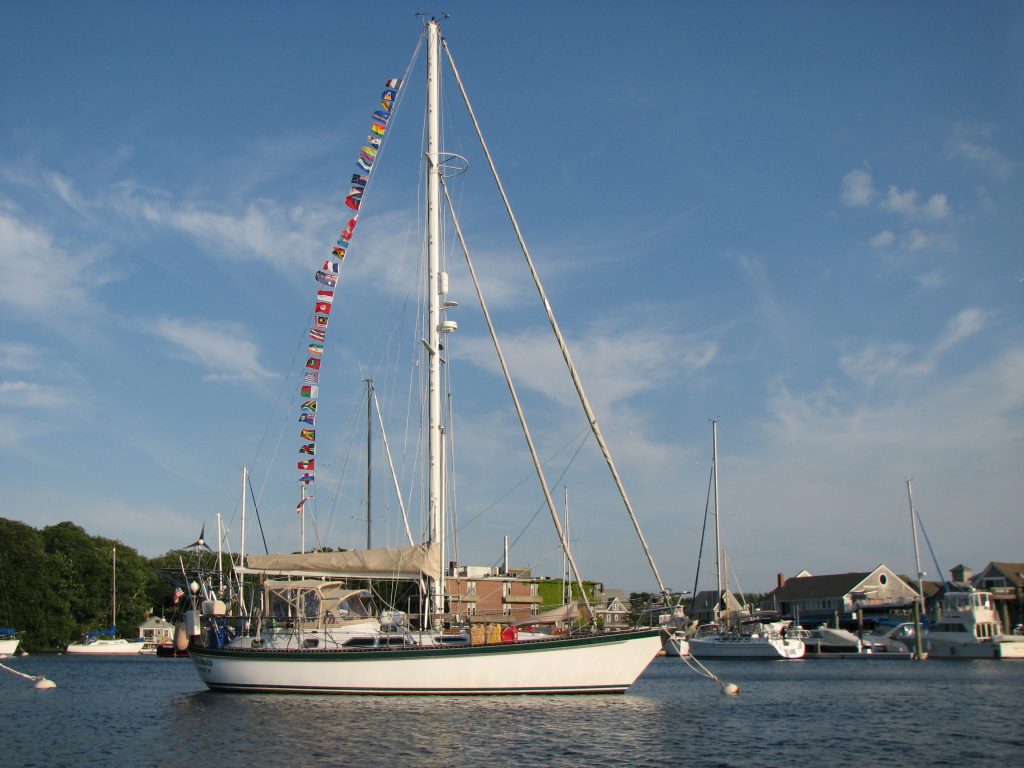
After almost 6 years of traveling, we sailed into Woods Hole on Cape Cod. We continued living aboard for the next five years and I wrote about that, adding ‘and Beyond’ to the title of the blog. Then shortly before Mark’s death in 2016, we sold our beloved Windbird and my travel logs became land logs. At this point, I had written a daily account for each and every day for 11 years. I fully intended to end the blog at that point, but when I wrote that news in a log, I got many responses saying that I really needed to keep posting. At the same time, I realized that I couldn’t stop writing. Summarizing each day had become a permanent part of my life and I will probably continue writing until I can no longer. These postings reflect the ordinary, and sometimes the extraordinary, days in my life and I would like to invite you to join me on my journey.
Day 207, Year 1: Rescue at Sea for Procyon–Day 21
Day 207, Year 1: Rescue at Sea for Procyon–Day 21
Date: Friday, May 12, 2006
Weather: Blue Skies Dotted with Puffy White Clouds (just doesn’t change)
Air Temperature: 84 degrees F
Water Surface Temperature: 81 degrees F
Latitude: 10 degrees 18 minutes S
Longitude: 134 degrees 48 minutes W
Location: Passage from Galapagos to the Marquesas, Day 21
Miles to Go: 238 (~112 miles last 24 hours)
Miles to Date: 2778
The saga here goes on with our friends on Procyon. The diverted ship, Manet, contacted Sheri this morning and wanted her to divert north to meet them. They thought if she did this, they might have a daylight rendezvous. But Sheri said she could not do that and still get to the Marquesas on the available resources. She would also be leaving the Norwegian boats that are traveling with her, and she needs their support for the rest of the trip. So until the afternoon net, we thought the rendezvous would happen around 1:30 am in the morning local time. And even though there is an almost full moon that will provide some light, this could be very dangerous in the dark. When Procyon checked into the evening net, however, Sheri reported that she and the Norwegian boats that are accompanying her all decided to divert north and that the exchange should hopefully happen in the daylight. We will all be on pins and needles waiting to hear, but we might not know until the morning net. We do monitor 8291 which is the ship’s emergency communication channel and hopefully we will hear that Randy is safely aboard Manet and headed quickly to Papeete, Tahiti, to a full health care facility. The ship does have a passenger aboard who is a doctor and they have the IV capabilities that Randy needs right now. When Sheri found this out, you could hear the relief in her voice. Making the decision to stay with the boat and let Randy go on alone could not have been an easy one, but knowing that he will have the care he needs is the important thing. Mark and I discussed this yesterday and we decided that we would do the same. We would send the injured or sick on the ship and the other would stay with the boat. In our case, we would call Heather and Justin and ask them to fly to wherever the transport would be landing. Not an easy decision, and one we hope we never have to face, but we do understand and support Sheri’s decision to stay with the boat. Like us, their boat is their only home and it would be very hard to lose it at sea. She will fly to join Randy as soon as she gets the boat safely to the Marquesas and we will all be waiting for the happy ending.
This morning Manet told Procyon that they would come alongside to get Randy, but we all know that is very risky. A sail boat can be destroyed in seconds by a large ship. It appears that Checkmate and Necessity, the Norwegian boats, have offered to put a dinghy in the water and to make the transfer that way. Much safer. They will also get the extra fuel to Sheri this way. Sheri will then start motoring to keep up with the Norwegian boats and will meet with friends aboard a catamaran, Endangered Species, which is leaving the Marquesas and coming back out to bring Sheri additional fuel and crew. She has about 750 miles to go and they will meet her 200 to 250 miles out. She still has 500 miles to go alone, but she sounds ready to do this. And believe it or not, she has one more complicating factor. This morning, a squall came up and damaged her mainsail. This leaves her with only her headsail, but since she is going to be motoring she should be fine.
We are trying to enjoy our last few days of the passage despite the sadness that we feel for Sheri and Randy. Our little wind angel returned today and is pushing us along at better than 5.5 knots, wing-and-wing. We are sailing wing-and-wing as it lets us stay directly on course. This morning the wind virtually died and we made the decision to poke along and not come into port until Monday. The option would be to motor in from here, but having to replace about $250 in fuel caused us to make the decision to sail if at all possible. Now that the wind has come up, our chances of a Sunday landfall is once again possible. I’ll go back to my mantra . . . We’ll just have to wait and see what happens.
We have just had another time change. Actually, we should have made the change a day or so ago, but we waited as it affects our radio net and watch times and we just didn’t need anymore excitement in our lives. We are now five hours earlier than Eastern Standard Time and four hours earlier than Eastern Daylight. When we reach Fatu Hiva, we actually have another 30 minute time change. We don’t quite understand why the half hour, but that is just the way things are. At that point our time will be minus 9.5 UTC (Universal Time).
It is so beautiful and peaceful out here. The seas have been calm for days, the sun shines all the time, and now an almost full moon lights our nights. There is a gentle rhythm to the rise and fall of boat as she forges ahead through the deep blue sea. I can’t smell the flowers yet, but I can “see” the turquoise waters, white sand beaches, and the tall mountains gracefully draped in green. It is really only a weekend away.
Day 206, Year 1: Procyon’s Medical Emergency Escalates–Day 20
Day 206, Year 1: Procyon’s Medical Emergency Escalates–Day 20
Date: Thursday, May 11, 2006
Weather: Blue Skies Dotted with Puffy White Clouds (just doesn’t change)
Air Temperature: 84 degrees F
Water Surface Temperature: 81 degrees F
Latitude: 09 degrees 43 minutes S
Longitude: 133 degrees 08 minutes W
Location: Passage from Galapagos to the Marquesas, Day 20
Miles to Go: 340 (~ 125 miles last 24 hours)
Miles to Date: 2666
WHAT a day! Mark and I are both emotionally exhausted. We, and many other boats, have been on the radio almost all day today dealing with Procyon’s medical emergency. I will tell that story below, but first I will give a quick update on Windbird’s progress.
All is well aboard. We have less than 350 miles to go. It is still possible that we will arrive in Fatu Hiva by Sunday evening, or we might have a Monday landfall. The wind hung in there for us all of last night and all day today. As evening is approaching, the winds are dying down, so we will have to see how tonight goes. Just a few minutes ago, Mark started the engine to charge the batteries. The engine ran for a couple of minutes and then started sputtering. All I could get out was, “Engine-fuel-out-stop.” We have been using our center tank for this whole trip and the sound I heard was the sound of a tank out of fuel. If you don’t catch it quick and turn off the engine before it stops, you then have to bleed the lines. That is one thing I didn’t want to do tonight. Mark understood my feeble attempt at communication and turned off the engine just in time. We then switched to a second tank of fuel and we were on our way.
The moon will be full on Sunday, but for all practical purposes it is essentially full now. Last night when I was on watch, our ocean world was lit up almost as bright as day. You don’t see as many stars when the moonlight is so bright, but it is a beautiful sight to sail at night by the light of the moon. My time to sleep is now from 1:00 to 5:00 am, so when I came back on watch, the moon was still lighting the world. It then set just before sunrise. When the sun came up this morning, the sky was painted with “baby shower” colors. The lightest pinks, baby blues, and hints of yellow colored the sky. What a show we have every morning out here.
We are technically in a new time zone but we are not going to change our clocks until tomorrow. We can’t take any more excitement today and since changing the clock changes our schedules; we will leave things alone for another day.
Now here’s the update on Procyon and the amazing story of cruisers coming to the rescue. The immediate problem has been keeping Randy hydrated since he cannot hold anything down. It is now pretty obvious that he has a bowel obstruction, probably caused by swelling in the area of his recent surgery due to his fall, and this means he can take nothing in orally. Late yesterday, those of us who have been in close contact with Sheri decided that it was time to make plans in case things worsen. When I sent yesterday’s log, I also sent an e-mail to four different boats that I know are in the Marquesas and for whom I had e-mail addresses asking for help. One of those responded immediately and another checked in with Mark on the Pacific Seafarer’s net last night. By this morning, they had a network of people working on the problem. They contacted other boats that are in the Marquesas with physicians aboard and got those physicians in touch with the hospital in Nuka Hiva to assess what can be done there. They also contacted the French Navy trying to find out what options there might be for medical evacuation. One of the boats that I e-mailed got in touch with the folks on Endangered Species who are very good friends of Randy and Sheri. They are readying themselves to come out to meet Procyon with extra fuel if needed. Two Norwegian boats that are in our net are very close to Procyon and they have adjusted their courses so that they can stay within VHF range in case Sheri needs something. In fact one of those boats has 40 gallons of diesel that they can get to Sheri in cans. This will extend her range for motoring. Another boat that is very close to us has lots of extra fuel and they are willing to back at least 250 miles to meet Sheri and share their fuel. If need be, we can do the same thing. The story just goes on and on.
In less than 24 hours after an e-mail was sent out by us and a radio request from Patrick on Aqua Magic to a New Zealand boat that is making landfall today, it feels like the entire fleet of boats that are in the Marquesas are working on this problem. Nationality plays no role here. Everyone is pitching in to help. It is really amazing . . . and very comforting to see people who don’t even know each other willing to do whatever is necessary for the health and safety of a fellow cruiser. We had hoped that we were just gearing up “just in case” but things accelerated this afternoon. Randy’s condition is worsening. Graham from Minaret out of New Zealand contacted Lynn on Shine who is in port in Fatu Hiva. She contacted a fellow Australian boat, Sea Bird, that is in Nuka Hiva. Sea Bird has a physician aboard who contacted the hospital there and got the French surgeon to come aboard and talk to all of us on our evening net late this afternoon. The surgeon listened to the report from Dr. Tom on Quantum Leap and made the decision to contact the French Navy to see if medical evacuation would be possible. At first, no go, as the ship that would make the rescue is in Tahiti and would take longer to get to Procyon than it would take Procyon to get to the Marquesas. Our entire radio net was tuned in as the surgeon asked us to hold on while he made another radio call. He came back with the news that there is a ship that can come alongside Procyon and take Randy off and on to Papeete, Tahiti. We talked to Sheri and she agreed to this.
So a ship named Manet will divert to rendezvous with Procyon within the next 24 hours and take him to Papeete, Tahiti. Sheri will have to continue sailing to the Marquesas alone, but the two Norwegian boats are within sight of her and will stay with her. One of the boats, Checkmate, will get the extra fuel to her if needed. She is one tough lady and all she could say tonight on the net was, “I can do it. Randy needs to get to a doctor.”
It is heart wrenching to go through all of this. We are so grateful that the French surgeon was able to find a ship that can help. But we know Randy is not going to want to leave Sheri out here alone to sail another 900 miles alone. But she will do what she has to do and all we can all hope is that the ship can get Randy to a full medical facility in time to save him. He’s doing okay right now and it should take only four more days to get him to Tahiti. I’m assuming Sheri will fly from the Marquesas to Tahiti to be with him once she arrives, and we will all make sure she does arrive safely.
This is the kind of high drama a sailor could do without. Having to be rescued at sea is one of the things that you have nightmares about and that you hope never has to happen. But it is going to happen and we just hope the exchange goes smoothly, Randy gets to the medical help he needs, and that Sheri makes it to the Marquesas safely. Sheri, our hearts are with you. Hang tough. We all want a happy ending to this story.
Day 205, Year 1: Less Than 500 Miles to Go–Day 19
Day 205, Year 1: Less Than 500 Miles to Go–Day 19
Date: Wednesday, May 10, 2006
Weather: Blue Skies Dotted with Puffy White Clouds
Air Temperature: 84 degrees F
Water Surface Temperature: 81 degrees F
Latitude: 08 degrees 50 minutes S
Longitude: 131 degrees 08 minutes W
Location: Passage from Galapagos to the Marquesas, Day 19
Miles to Go: 463 (~112 miles last 24 hours)
Miles to Date: 2535
3,000 – 2,500 – 2,000 – 1,500 – 1,000, 500 . . .Yeah! We have under 500 miles to go. My day started at 0500 in the dark with a threat of rain, and by the time the sun came up, the skies had cleared and we were sailing under a beautiful rainbow. Today was a bit of a slow day, but as I write this the winds are starting to pick up. Hopefully we will have another good night of sailing. Other boats in front of us are having a period of almost no wind, so it is hard to tell what we will have tonight and tomorrow. At least two other boats will make landfall tomorrow or Friday morning, and a couple of others will be in by Saturday. We are hoping for a Monday landfall, possibly Sunday depending on the winds. Mark is now the net controller for the morning Fatu Hiva radio net as we are the boat in the middle of the pack. It will be exciting to arrive and pass that duty off to someone further back.
Mark is down on the radio right now conferring with Quantum Leap and Aqua Magic about the medical situation on Procyon. Things with Randy are not worse, but they are not better, so we are trying to look into options in the case that things do deteriorate. Between e-mail, the satellite phone, and the radio, we do have good communication and for that I am very thankful. Just hope with us that things start to turn around for Randy or at least not worsen. I will keep you posted.
There is a flock of birds hanging out near us this afternoon. They are very noisy as they go about their fishing. I can actually see the fish jumping and just a bit ago we had a bite on our line, but when we reeled it in the fish had gotten away. We are not giving up. I’m still looking forward to fresh fish for dinner.
Day 204, Year 1: Spinnaker Weather–Day 18
Day 204, Year 1: Spinnaker Weather–Day 18
Date: Tuesday, May 9, 2006
Weather: Blue Skies Dotted with Puffy White Clouds
Air Temperature: 84 degrees F
Water Surface Temperature: 81 degrees F and rising
Latitude: 08 degrees 03 minutes S
Longitude: 129 degrees 29 minutes W
Location: Passage from Galapagos to the Marquesas, Day 19
Miles to Go: 569 (~129 miles last 24 hours)
Miles to Date: 2423
The thermometer has only gone up a couple of degrees, but inside the main cabin it is much warmer than it has been. It is 88 downstairs right now and 84 up here in the cockpit. The water temperature is still around 81 degrees. The only thing not in the eighties is the humidity. It is 69 per cent today, and varies from there to 79 per cent on some days. It was another beautiful day today with calm seas, but the boats in front of us are reporting squalls and rain. When they had rain earlier in the passage, we did not, so we shall see what happens this time.
Today was a spinnaker day. We had been sailing wing and wing for two days and heading further north than we would have liked, so we put up the asymmetrical spinnaker and we are able to be much closer to our desired course. And we are speeding along at six to seven knots with about 10 to 15 knots of wind. Our seas were calm all night and day, but just in the last hour we started getting a large swell from the south. It is gentle right now, but I can tell that we will have a bit of a romp tonight..
Two of the boats in our radio net, Vol and Invictus Reward, arrived in Fatu Hiva yesterday and Shine and Shoestring arrived today. But then two boats left who had been with the earlier radio net of about 45 boats have now switched to our net. I think they are the only two of the 45 that are still out and one of those is headed to Hawaii, not to Fatu Hiva. Our friends, Doug and Sylvia from Windcastle arrived in Fatu Hiva yesterday-a 30 day passage. They were certainly glad to reach land. We are still gaining on boats that left before us and other boats that left after us have gained on us. It is like a chess game out here.
Randy on Procyon is stabilizing somewhat, but he is still not back to normal and is not eating yet. He is starting to be able to hold down some fluids. Dr. Tom on Quantum Leap talks with Sheri, Randy’s wife, three times a day on the radio. They can often not hear each other because they are so far apart, so Patrick on Aqua Magic relays and we listen in just in case we can be helpful. Things are still in a holding pattern, so I’m hoping that by tomorrow he will be much better. Tom says he will turn around and come back to help if need be, but right now the two boats are about 800 miles apart. Let’s hope that is not necessary, but it is nice to know that people that you have only met a couple of times are willing to do whatever is necessary to help in an emergency. We are so glad that we have the services of the World Clinic. They are literally just a phone call away and we have never had to wait. And we don’t have to worry about poor radio connections. We call on the satellite phone and within a couple of minutes we have a doctor on the line who can help us. We’re also glad that we have a very well stocked medical kit. We bought the kit already stocked by the Wilderness Medical Associates sponsored by Ocean Navigator, and then the World Clinic supplied the prescription medications. We’ve only had to use a couple of different medications, but it is a nice feeling to know that whatever we might need is waiting in the blue bag. It may seem like Randy’s illness is getting a lot of attention from us, but the fact is that even non-serious problems can be a crisis when you are more than 1000 miles from a clinic or hospital.
I continue to fill my days with reading and research about the South Pacific and trying to outline our itinerary for the Marquesas, the Tuamotus, and the Society Islands. It completely consumes my days right now and I have had little time to even return e-mails. But I am just about to get the itinerary set. Mark then puts in all of the waypoints in the GPS. By the time we arrive in Fatu Hiva, we will have the next six weeks planned. Of course, plans change on a daily basis, but a national consultant in the field of education made this quote famous, “If you don’t have a plan, you’re planning to fail.” So we will have a plan!
Day 203, Year 1: Procyon’s Medical Emergency–Day 17
Day 203, Year 1: Procyon’s Medical Emergency–Day 17
Date: Monday, May 8, 2006
Weather: Blue Skies Dotted with Puffy White Clouds
Air Temperature: 80 degrees F, minus a degree or two at night
Water Surface Temperature: 81 degrees F and rising
Latitude: 08 degrees 12 minutes S
Longitude: 127 degrees 29 minutes W
Location: Passage from Galapagos to the Marquesas, Day 17
Miles to Go: 683 (~130 miles last 24 hours)
Miles to Date: 2294
Today’s big decision was whether or not to make brownies for watch snacks. I had to laugh as I tried to think back to a year ago this time when Mark and I were making daily decisions that certainly didn’t have anything to do with whether or not to cook something. But out here, today, that was the big decision. I did make the brownies and they will help the night watches to go much more smoothly. Chocolate in the middle of the night does wonders.
Every morning when we check into our radio net, the first thing the net controller says is, “If there is any emergency or medical traffic, come now.” There has not been a response to that on this passage or on any net we have been on since leaving home. But this morning there was a response from Sherri on Procyon. I think I stopped breathing momentarily, afraid to hear what she would say. If you have read prior logs, you might remember that Randy, Sherri’s husband, had to be air-lifted out of the Galapagos to mainland Ecuador for an emergency operation. That was about six weeks ago. He returned to Puerto Ayora after having stomach ulcers removed and spent the next four weeks recuperating. Randy and Sherri left the Galapagos five or six days after we did, and everything seemed to be going fine, but evidently last night Randy fell and hurt his back. Then later in the night he started having pain in his upper abdomen and was quite nauseas. Tom of Quantum Leap is a physician and Sherri talked to him this morning. We are all hopeful that he just has a case of mild food poisoning and that the fall had nothing to do with the nausea, but we just have to wait and see. When on a passage like this, so far away from land and any help, there are about three things that you don’t want to happen. You don’t want to hit something that might put a hole in your boat, you don’t want to fall overboard, and you don’t want to have a major health problem. Hope with us that Sherri can hold things together until Randy is better and that this is not a major health problem and that he will get better quickly.
We are still sailing wing and wing and heading a little more north than we would like, but we do have wind and that is good. It is amazing how quickly the days and nights pass. And it is truly a gift to be out here and to be able to enjoy nature at it’s finest. Last night when I came on watch at 9 PM, the half moon was shining brightly and the sky was filled with stars. When I come on watch, I sit in the dark for about 20 minutes just looking around and watching every carefully. Last night, I noticed a strange ruffling of the water near the front of the boat. I kept watching this to starboard but couldn’t figure it out. Then I went to port and look and saw the same thing, but on that side I could see what was causing the disturbed water. It was dolphins playing with us in the night. They were following along side Windbird and diving under the bow of the boat and coming out the other side. About that time, I saw a falling star. I then sat back and put on my headlamp so that I could read, but as I did so, I felt a great satisfaction of being in harmony with nature.
Day 202, Year 1: End of Windbird’s Wind Bubble–Day 16
Day 202, Year 1: End of Windbird’s Wind Bubble–Day 16
Date: Sunday, May 7, 2006
Weather: Blue Skies Dotted with Puffy White Clouds
Air Temperature: 80 degrees F, minus a degree or two at night
Water Surface Temperature: 81 degrees F and rising
Latitude: 08 degrees 40 minutes S
Longitude: 125 degrees 24 minutes W
Location: Passage from Galapagos to the Marquesas, Day 16
Miles to Go: 800 (~123 miles last 24 hours)
Miles to Date: 2166
Well, today it happened. Our little wind bubble burst. We have had wind when no one else in the fleet has, but today we are flailing along just like the others. The winds vary from 5 knots to 15, but they are directly behind us and the going is slow. Our weather buoy reports indicate that the wind should increase in the next 24 hours. Let’s hope so.
Otherwise, all is well onboard. We saw a flock of birds today which indicates that we are getting closer to land. Otherwise, no signs of life. Gdansk, a boat out of Canada, and Trisha Jean, a US boat, are both very close to us, but we can’t see them. We could see Gdansk for about two days, but last night they dropped out of sight.
It has been a lazy day and we have not had our French lessons. Maybe tomorrow…
Day 201, Year 1: Sailing Wing and Wing–Day 15
Day 201, Year 1: Sailing Wing and Wing–Day 15
Date: Saturday, May 6, 2006
Weather: No Change-Beautiful Blue Skies Dotted with Puffy White Clouds
Air Temperature: 80 degrees F, minus a degree or two at night
Water Surface Temperature: 79.5 degrees F
Latitude: 08 degrees 01 minutes S
Longitude: 123 degrees 33 minutes W
Location: Passage from Galapagos to the Marquesas, Day 15
Miles to Go: 915(~134 miles last 24 hours)
Miles to Date: 2043
During the night we dipped under 1,000 miles to go. Wow! It’s beginning to feel like we are almost there and yet we have more than 900 miles to go. That was the distance from Panama to the Galapagos and I know it will pass quickly. Problem. We were supposed to learn basic French while on this passage. We are, after all, going to French Polynesia. But I don’t think nine days will be nearly enough time. I’m not sure nine years would be enough time for me to learn French. But we will dig in tomorrow and begin an intensive short course. But we also have to practice pronouncing all of the Polynesian names by learning a whole new vowel structure.
‘A’ says the short sound of ‘o’ in the English language-the sound you make when a doctor puts a tongue depressor in your mouth to look down your throat.
‘E’ says the long sound of ‘a’ in the English language.
‘I’ says the long sound of ‘e’ in the English language.
‘O’ says the short sound of ‘uh’, like the ‘u’ sound in umbrella.
‘U’ says the sound you hear in the word ‘too’.
But it is not that clear cut. Just as in the English language, the sounds change sometimes when at the end of a word or in certain combinations. So Fiji sounds like ‘Fee-jee’. Fatu Hiva is pronounced ‘Fah-two-hee-vuh’. Hiva Oa is pronounced ‘Hee-vuh-O-uh’. Just practicing the names of the five islands in the Marquesas is challenging, but then when you get to the Tuamotus (Too-uh-mow-twos), it is REALLY challenging. There are lots of vowels in every word and you say the sound of every vowel. Try the names of these places in the Tuamotus: Fakarava, Tikehau, and Kauehi with the Arikitamiro and Tearavero passes into the lagoon. Or how about Rangiroa with the villages of Tiputa and Avatoru? Remember-say every vowel separately. Mark lived in American Samoa for a couple of years in the 1960’s and he has a handle on how to pronounce these names, but it takes me awhile to practice.
We have been sailing wing and wing since the middle of last night. That means that the headsail is poled out to one side of the boat and the mainsail is out to the other. Usually both sails are out to the same side, but the wind has taken a turn and is coming directly from the east when we want to go directly to the west. So it is dead behind us. We have continued to make good time, but we have really been rockin’ and rollin’. We have been able to head a little north of west and tonight we will go back to a normal sail configuration and sail southwest again. The ride will be much smoother.
Not much else to report today. Mark talked to a doctor with the World Clinic again this morning about his knees. We are still not sure what it is but he is better and that is good. We’ll just have to keep a careful watch to figure this one out. The burn on my thigh is beginning to heal although I still have what looks like a very large birth mark just above my knee. Otherwise, things here are great.
Day 200, Year 1: Thoughts About Email Communication–Day 14
Day 200, Year 1: Thoughts About Email Communication–Day 14
Date: Friday, May 5, 2006
Weather: No Change—Beautiful Blue Skies Dotted with Puffy White Clouds
Air Temperature: 80 degrees F, minus a degree or two at night
Water Surface Temperature: 79.5 degrees F (rising)
Latitude: 07 degrees 49 minutes S
Longitude: 121 degrees 1 minutes W
Location: Passage from Galapagos to the Marquesas, Day 14
Miles to Go: 1042 (~ 138 miles last 24 hours)
Miles to Date: 1909
I love e-mail. Today I have “talked” with my son Justin who is in Africa, my daugther Heather on Cape Cod in Massachusetts, some friends back in the Concord, New Hampshire school district, my sister Patsy in North Carolina, my nephew Tommy in Maryland, Mark’s sister Mary Ellen in Florida, and our new friends Felix and Monica onboard Makani. I can’t even think what it was like in the days of Captain Cook when he was exploring the South Pacific with no communication with anyone “back home” for months, maybe years. This is certainly a different age and instant communication defines the age. Makani, the boat from Germany that went right past us a couple of days ago, is having radio problems. One radio is not working at all and we don’t know if their back-up is working for receiving or not. But they are e-mailing us their position every morning and we are reporting in on the radio net for them. We can’t e-mail them back as they are using a satellite phone for their connection and they have everyone but their son back in Germany blocked. But at least we know where they are and can report that to the fleet headed to Fatu Hiva. I now check e-mail at 0730 before the morning net and again at 1700 just after the evening net. If Makani should have a problem, we can alert others that are closer to them. This morning they e-mailed their position as of 0700, I checked e-mail at 0730, and Mark reported their position and conditions on the net at 0800. And I can communicate with Justin in Africa to know that he is fine and to learn all of the new and exciting things that have happened over the past eight years in the small village where he is staying. He was there in the late 1990’s and there was no internet café in the village. Now there is one a block from where he is staying with his African “family”. I can keep up with my family news through my sister Patsy in North Carolina in the states and through Mark’s sister Mary Ellen in Florida-all from out here in the middle of the Pacific Ocean. Absolutely amazing.
Before the end of Day 14 of this passage we will have less than 1000 miles to go to reach Fatu Hiva in the Marquesas. We did not expect to be this far at this point. Windbird is not a fast boat, but she is steady. Everyday we gain on others who left two and three days before us. We have just kept a steady wind where we are and they have not. Luck of the draw. Things could slow down, but we still think we will arrive in the next seven to nine days. We could have a 21 day passage and that is fantastic.
Some of you who have been e-mailing us are trying to figure out just where we are going. Where and what are the Marquesas? I mentioned in an earlier e-mail that the Marquesas are a group of islands that look like little dots on a world map. If you locate Panama and then head a little southwest, you will see the little dots of the Galapagos islands. If you go south you see the dot representing Easter Island (part of Chile). If you move west and a little south of the Galapagos you will cross a long blank space on the map representing 3,000 miles and come to islands that are politically grouped as French Polynesia. French Polynesia is made up of five different groups or archipelagos: the Marquesas, the Tuamotus, Gambier, the Society Islands, now referred to as Tahiti Nui, and the Australs. We will visit the Marquesas first, head a little south and west of there and visit the Tuamotus, and then head to Papeete, Tahiti to begin our exploration of the Societies. We will not be going further south to visit the Australs or Gambier on this passage. Bora Bora will be the last island we visit in the Societies and then we will head south and west to the Cook Islands, specifically Rarotonga. From there we go north and and west to Niue and further north and west to American Samoa and on to Western Samoa. Finally, we head south again to the Kingdom of Tonga and on to Fiji. In late October or early November we will leave Fiji and head to New Zealand for the summer (summer in the northern hemisphere). I believe it is another 3,000 from the Marquesas to Fiji so we have lots of sailing to do in the next six months . . . and lots of wonderful exploration as well. But this sailing will be broken up into many shorter passages.
The islands of French Polynesia are all emerged underwater volcanoes like the ones you find in Hawaii. There are the youngest islands formed by a volcano erupting until it builds a mountainous island above the ocean surface. These are the Marquesas Islands. The next stage in island development is for the volcano to begin to sink back into the sea. As it does so, the coral reef that has begun to surround the island continues to build itself up to the surface. The space that develops between the volcanic cone and the reef is a lagoon. The Society Islands are of this type. The final stage of island development is for the volcanic cone to continue to sink until it is below the ocean surface. All that is left is the surrounding reef which now may extend a few meters above sea level. The land formed on these exposed reefs are called motus and are actually tiny little islands (islets). These rings of motus that surround a large lagoon are what we will find in the Tuamotus.
So much for the geography lesson for today. There is SO much to learn, so I’m practicing what I am learning by writing it here. Hopefully you find it as interesting as I do, or at least a little interesting. Tomorrow I will focus on the five principal islands that are the Marquesas.
Day 199, Year 1: Still Smooth Sailing–Day 13
Day 199, Year 1: Still Smooth Sailing–Day 13
Date: Thursday, May 4, 2006
Weather: No Change—Beautiful Blue Skies Dotted with Puffy Clouds
Air Temperature: 80 degrees F, minus a degree or two at night
Water Surface Temperature: 79.5 degrees F (rising)
Latitude: 07 degrees 17 minutes S
Longitude: 119 degrees 10 minutes W
Location: Passage from Galapagos to the Marquesas, Day 13
Miles to Go: 1180 (~ 145 miles last 24 hours)
Miles to Date: 1771
Our time has changed once again. We are now in the Pacific Standard Time Zone-same as California-but we are not on Daylight Savings Time. I think that makes us two hours behind the East Coast. We will change one more time before we reach the Marquesas and then when we arrive we understand that we will move the clock ahead one-half hour. Strange. Only the Marquesas has a time zone that is UTC minus 9 ½ hours.
Another good day. The Weather Buoy reports that we receive daily tell us that if we stay on our course we will keep the wind for the next five days. The seas are a little rowdy right now, but they should subside by Saturday. And actually the seas aren’t that bad. It is just that we are running down wind and we roll with the waves. It is something that you get used to, but cooking is always a challenge.
Our watch schedule has become routine. I sleep from 7 to 10 PM and I’m on watch from 10 to 2 AM. Mark comes on from 2 to 6 AM and then he sleeps from 6 to 8 AM. That was 9 AM until today when we had to set the clocks back another hour, so he will have to take a second nap after the morning net or we will just move everything back one hour. That’s probably the best solution. The net now comes up at 8 AM and 4 PM and life revolves around that.
Last night when I was on watch, we passed a fishing boat. It was 6 miles off, but it had very bright lights and a large image on the radar screen. Other boats on the net have reported seeing a fishing boat out here as well. Who knows where the boat is out of but wherever, it is a long way from home. When Mark got up at 2 AM, he had a fever. He has had a sore knee for days and it was very hot last night. We called the World Clinic and they put him on regimen of Keflex. He scratched his knee a week ago, and it was really a tiny little scratch, but the doctor believes that started the infection. The scratch has healed but the doctor is afraid the infection might have gone into the bone. Yikes! You have to be so very careful out here. Every little scratch can turn into a major infection. Mark is better today and we will hope that the antibiotic will work.
No signs of life today other than the flying fish. These little guys glide along the water everywhere you look and often in the morning we will have a few on the deck. Oops! They missed their target. Some boats are collecting and drying them to eat. We have just been throwing them back to the sea. Since we lost our good lure and fishing line, we have not caught anything. We’re using a lure that usually attracts smaller tuna, but no luck so far.
We want to wish our friends Claire MacKellar and Kevin Russell a safe and successful passage from Boston to the Potomac in the Chesapeake. They are scheduled to leave Boston tomorrow. Kevin and Claire lived aboard at Shipyard Quarters when we were there and we become very good friends. They are the age of our daughter and her husband, early thirties, and this is their first solo passage. Claire has just finished her graduate work at Harvard Medical and will be doing her post-doc work in the Washingon, DC area. They liked living aboard so much that they are taking their home with them. Fair winds and following seas!
Day 198, Year 1: Gliding Along on Calm Seas–Day 12
Day 198, Year 1: Gliding Along on Calm Seas–Day 12
Date: Wednesday, May 3, 2006
Weather: Another Blue-Ribbon Beautiful Day
Air Temperature: Daytime 80 degrees F
Latitude: 06 degrees 48 minutes S
Longitude: 116 degrees 48 minutes W
Location: Passage from Galapagos to the Marquesas, Day 12
Miles to Go: 1324 (~ 117 miles last 24 hours)
Miles to Date: 1626
It has been another beautiful day in the neighborhood. The winds died during the night and we had to motor for about 11 hours, but after our radio net this morning the winds increased a little and we set sail again. One incentive was that we found out on the net this morning that diesel is going to cost us $5.00 a gallon in the Marquesas. Wow! I heard from my sister Patsy that gasoline prices are also high back in the states. We sailed along slowly for part of the day, but right now the winds are back up to about 15 knots and we are going along at about 6 knots. The seas have calmed to almost nothing, so we are just gliding along. Mark wrote another Captain’s Ramblings installment today, so I’ll keep this short and share his thoughts for today.
Captain’s Ramblings 4
Wednesday, May 03, 2006
Subject: Galapagos to Marquesas Passage
A few nights ago (well, maybe a couple weeks ago) I was telling the story to some fellow sailors of how Judy and I once ended up hitchhiking to California from the Oregon desert just to get an artichoke. We were gathered for a barbecue under a thatched roof cabana (that calls itself a bar and restaurant!!) on a beach in the Galapagos. Of course, in the course of telling the story I had to tell of Jon Greenberg from New Hampshire Pubic Radio recording us telling this story for my retirement party. I have often thought of all my friends at NHPR and that great send-off. And today I had the time to write them and thought I would share some of that note with you.
We are a little over half way from the Galapagos to the Marquesas – the longest ocean passage with no land in between in the world – 3000 miles. We have 1365 to go and with 11 knots of wind and an easy swell we are sailing along at a leisurely pace of about 5 knots. We have now been out on this passage for a little more than 11 days. It is hard to explain what it is like out here. Until yesterday we had seen no one and no other boats for more than a week, even though we are traveling “with” about 15 other boats – all within about 200 miles of us (which seems close out here!). We talk to them twice daily on Ham radio. Most of the boats are not USA boats. We have made great friends from Germany, France, Switzerland, Australia, Great Britain, Denmark, Arkansas . . . and other foreign ports. Anyway, there is nothing to be seen but the endless rolling swell of the ocean and the enormous blue sky with a few (today very few) puffs of cloud on the horizon. Once in a while we see some birds, a lone turtle swimming by, a few dolphins crossing our path. It feels like you are the only people on earth. And then yesterday as I was getting over the shock of some enormous sea creature having taken my fishing lure and run away with it and all my fishing line as well, I see the mast of another sailboat on the horizon behind us. It turns out to be a much lighter boat than Windbird and it is soon pulling along side. We chat for a bit on the VHF radio and then Felix and Monica aboard Makani gradually pull ahead. By nightfall they disappear over the horizon. This boat was from Germany and had not been part of the group that logs in on the Ham radio net twice each day. We didn’t even know they were out here. Since we can only see to the horizon which is about six miles away, it is amazing that we ever see anyone else in this enormous ocean. They could have passed us ten miles away and we would never have known it.
There is a calming peacefulness to this kind of sailing. There is the soft swishing sound of the boat cutting through the water, and a gentle cooling breeze that makes the warmth of the sun feel welcome. Of course, we spend most of our time in the cockpit under the shade of the bimini. As I write, Judy is reading a Nelson DeMille thriller. We have a couple of books by him onboard and they are great reading when you are on watch in the middle of the night – they will really keep you awake!
Anyway, I find myself at a loss for words to describe this passage. Time takes on a whole new dimension. When we arrive in the Marquesas we will have been at sea 22 to 30 days – depending on how much wind we get from here on. You could wonder at what there is to do on a small boat for that long. Well, we never seem to lack for things that eat up our time. In fact, we have too little time for things like writing to friends and reading. Of course, much time is taken in just living. We spell each other sleeping during the night so neither of us gets a full nights rest. That means we each do some catching up with naps during the day. Then there are meals to fix which can take twice as long as at home because you are working on a moving, tilted surface where everything that is not tied down slides away or tips over. And we do have to spend some time each day on the boat – adjusting sails, cleaning, checking engine oil and changing filters, inspecting everything to see if something is working loose or if chafe is wearing through a line or a sail. The days do pass, and though in one way we are anxious to get to the Marquesas so we have as much time to enjoy them as possible, in another way we are simply enjoying the passage. One day melds into another. We simply take each day as it comes and don’t try to hurry it along. And though we seem to always be busy, I don’t mean to say this is anything like being busy at work. We don’t have deadlines. For the most part no one else depends on the work we do, but the success of this passage depends on the careful inspection and maintenance, resting enough to be really alert, making sure that no matter how rough it gets, we have plenty to eat. Out here, it is just Judy, myself, and Windbird sailing long on this endless and beautiful sea of blue.