
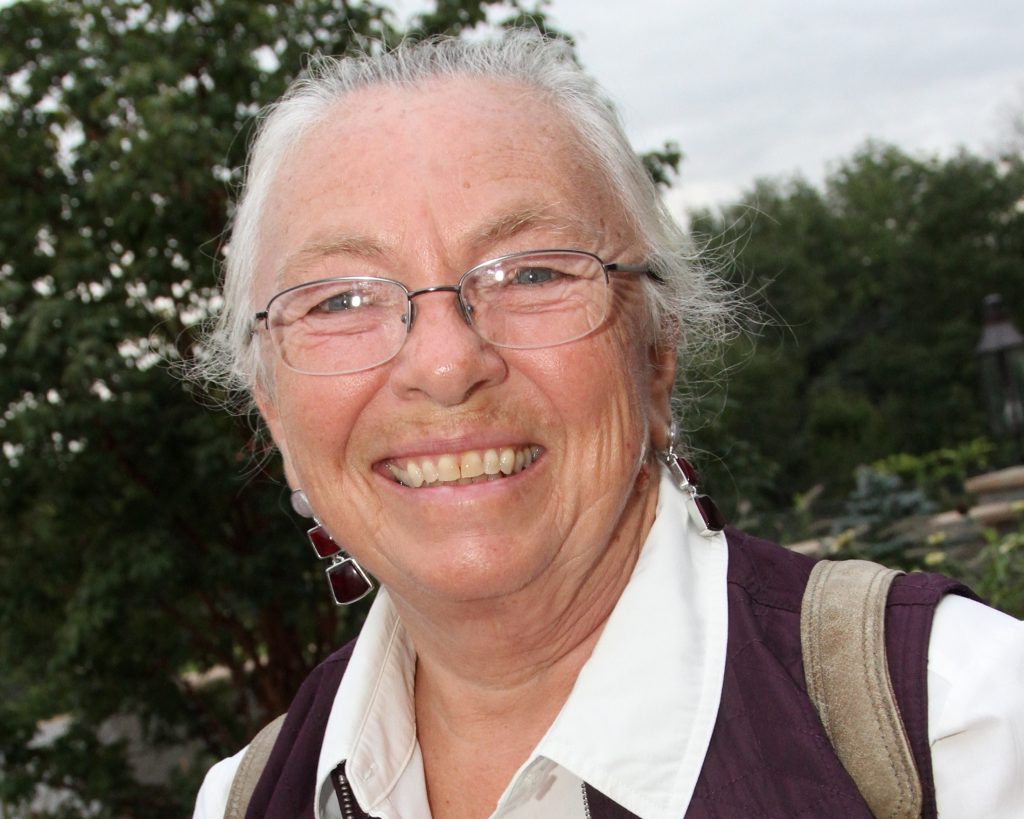
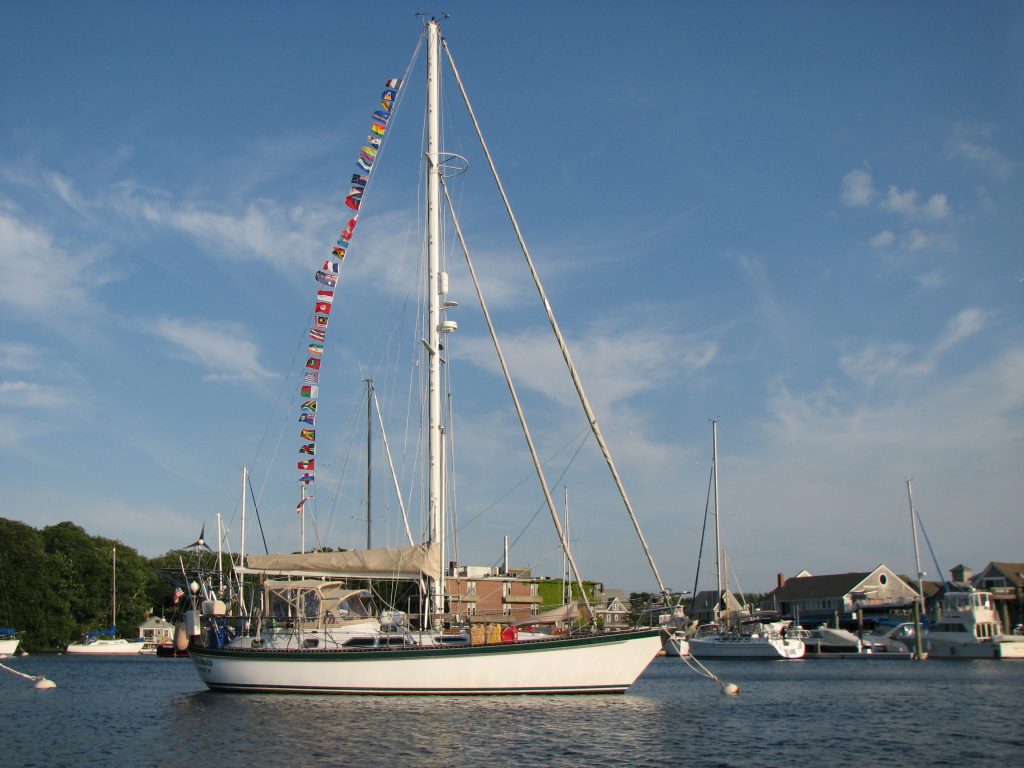
After almost 6 years of traveling, we sailed into Woods Hole on Cape Cod. We continued living aboard for the next five years and I wrote about that, adding ‘and Beyond’ to the title of the blog. Then shortly before Mark’s death in 2016, we sold our beloved Windbird and my travel logs became land logs. At this point, I had written a daily account for each and every day for 11 years. I fully intended to end the blog at that point, but when I wrote that news in a log, I got many responses saying that I really needed to keep posting. At the same time, I realized that I couldn’t stop writing. Summarizing each day had become a permanent part of my life and I will probably continue writing until I can no longer. These postings reflect the ordinary, and sometimes the extraordinary, days in my life and I would like to invite you to join me on my journey.
Day 53, Year 2: First Email from Sam
Day 53, Year 2: First Email from Sam
Date: Saturday, June 16, 2007
Weather: Still Windy, Still Mostly Cloudy
Location: Korolevu Bay, Kadavu Island, Fiji
\]
]\ //////////////KCCCCCC/////////////////////A BMM-P/ n [ ]; .’;;;;;;;./CCC99967t5f j,,,,,,,,,,,,,,,,,,,,,,,,,,,,,,,, ccdxg
..l9oozolpppp70pCVgft7u
No, this is not a typo. This is the content of our first ever email from that grand baby, Sam. This is the message just as he typed it, according to his father. So June 16, 2007, will go down in history as the day the youngest baby (147 days old today) sent an email. I sent one back to him, but it was not nearly as creative as the one he sent. Sam is starting to sit up now and is grabbing at everything in sight, including the nearest computer keyboard. I’m sure this is just the first of many
emails to come.
We are in a holding pattern but are still hoping to leave here tomorrow afternoon. The wind has subsided some, but not much. It has come around to the southeast, which is a good thing for us, but the problem is the sea state. Our Fiji reports are saying that the seas are rough. We’ll wait until tomorrow morning to make a final decision, but we will probably go, rough seas and all, unless high winds are predicted. We probably should have left a few days ago when we had a weather window, but
the snorkeling here was just too wonderful to leave. I think I can endure one night of rough seas while dreaming of a coral garden with the most beautiful fish one can imagine. That will get me through.
We have wonderful fish identification books onboard, but we have almost nothing that helps us identify coral and other sea creatures. Last night Paul on Ranger loaned me a book he had from Tahiti that showed some pictures of coral and had some nice descriptions. I spent my entire morning taking pictures of the pictures in the book and entering all of the written information into my computer. I’m a fast typist, but it still took me all morning. Mark spent the morning starting to read a new book.
He is reading River God by Wilbur Smith. It is about Egypt and I think I mentioned this when I read it a couple of weeks ago. He is entralled and it was hard to pull him away to go snorkeling, but we finally made the move. Gerry and Donna went out again today as well, and they took that new little digital underwater camera of theirs. We went over when they got back home and literally drooled over some of their pictures. They were kind enough to share and when I get to Savusavu in two or three
weeks, I will be able to post pictures of some the fantastic sights we have seen here underwater. Today’s prize was a lionfish. Well, technically it is called a turkeyfish, but it is what I have always called a lionfish, and what some other books call it as well. It was the classic striped fish with very long spines radiating all around. Actually Donna and I saw one a day or so ago, but today Gerry and Mark saw them and Donna was actually able to get pictures. I also saw pennant bannerfish today
for the first time, and a beautiful fish with a huge red ring just behind his head. But still for me, the highlight of the day was “finding Nemo.” I found an anemone I had not seen previously, and was able to bring Mark over to watch the pink anemonefish. I went on to search for the orange-fin anemone fish I have been observiing for the past few days. On the way, I actually found another little group of what looked like tomato anemonefish to me–dark orange, almost red. Mark got cold – the water
can feel quite chilly here – and went back to the dinghy, but I persisted and I found my little family so that I could say goodbye. The orange-fin anemonefish has two turquoise bands around an almost black body with a yellowish-orangish face and fins and a little white tail fin. They are beautiful and just so much fun to watch. I found Donna with her new camera and showed her the spot. She was able to get a couple of pictures, but you really have to be patient with these guys. They dart in and
out of the anemone and are very hard to capture on camera. But even without a photograph, I have fantastic picture memories in my head.
 |
| 070616 Day 53 Kadavu Island, Fiji–Kadavu's Waya Island Underwater |
Day 52, Year 2: Another Snorkeling Day
Day 52, Year 2: Another Snorkeling Day
Date: Friday, June 15, 2007
Weather: Very Windy, Party Cloudy Day
Location: Korolevu Bay, Kadavu Island, Fiji
It is evening and the wind is blowing here in Korolevu Bay. It should start to subside tomorrow, and if it does, we will be leaving here mid-day on Sunday for our overnight passage to Moala Island in the Lau Group. We are still really enjoying our time here, but it is time to move on. Three weeks from tomorrow, Mark’s brother Steve will arrive in Savusavu on the island of Vanua Levu. We hope to spend two weeks in the Lau Group and then get to Savusavu a few days before Steve arrives. If we stay
here much longer, we’ll have to cut our Lau Group visit short. So weather permitting, we will be out of here on Sunday.
We spent a lazy morning on the boat. I cleaned and Mark got out the cruising information on Vanuatu and New Caledonia. We looked at some of the information together and confirmed our earlier plan to sail from Fiji to Vanuatu in August and from Vanuatu to New Caledonia in September. How long we stay in New Caledonia will depend on when we want to arrive in Australia. We’re not ready to make that decision yet, but it was good to review our plans and learn more about our other ports of call for
this season. We are loving Fiji and will be here longer than we had originally planned, but that’s okay. Cruising is all about flexibility.
Last night we watched the DVD “Finding Nemo” and today while snorkeling I found a new family of anemonefish. I just love watching them dart in and out of the anemone, the bigger fish constantly protecting and actually herding the young ones back into the anemone when they venture outside. While we were snorkeling, Colette and Jean-Pierre saw a really big sea snake. These things are ringed in black and white and are very lethal. The good thing is that it is really hard for one of them to bite
you, but the bad thing about this sea snake was that it was really big. I’m glad I was looking at the anemonefish and didn’t see that sea creature. We discovered a few new fish today and enjoyed many that we have gotten to know over the past few days. We’ve been taking pictures with a disposable underwater camera, but those pictures never turn out very good. I’m hoping Scot Free II can use their new underwater digital camera tomorrow and capture some of the highlights of snorkeling around Waya
Island. Jeanie, the owner of Matava Resort, said that Waya Island and the Lion Pool were featured in a 2004 National Geographic. She didn’t have a copy readily available for us to look at, so I’ll be anxious to see that when we return home for the winter.
Safina invited us all over for Sundowners. Paul’s daughter, Cindy, didn’t make it. She is still recovering from 60 hours of flying and layovers. We found out today that her main piece of luggage didn’t arrive in Fiji with her, but the airline promises that it will be coming along in a day or two. We met a couple at Matava that were here on their honeymoon and their luggage didn’t arrive until day seven of a ten day stay. They were able to borrow clothes from other tourists, but it was their
dive gear that they really missed. They are new to diving and wanted to use only their own equipment that they were familiar with. They did get to dive for two of the days, but what a shame to miss out on all of the other days. I guess this is a warning to Mark’s brother to make sure what is absolutely necessary is in a carry on. Donna and Gerry of Scot Free II didn’t make to Safina until almost dark. They were in the village having kava with the chief. Gerry really likes to get into the village
life and he actually likes kava. The rest of us avoid it like the plague!
Day 51, Year 2: Fish, Fish, and More Fish
Day 51, Year 2: Fish, Fish, and More Fish
Date: Thursday, June 14, 2007
Weather: Same Old, Same Old–Another Beautiful Day in Paradise
Location: Korolevu Bay, Kadavu Island, Fiji
So what is life really like here in Korolevu Bay? The village of Kadavu is up the river and is only accessible when the tide is high. No boats can go in and out at low tide or on either side of low for a couple of hours. This is a large village with about 500 people, or so we were told. It certainly doesn’t look like that many people live there, but maybe there are dwellings out of the main village that we didn’t see. There is no electricity or running water in the village, but as in all of
the villages we have visited, there are televisions in the homes and satellite dishes on some roofs. In the evening, the village generator is turned on so folks can watch TV. The generator on Dravuni Island was not working, and neither was the one in Vacaleya village. We didn’t ask in Kadavu, so we don’t know. Then there is our little village of sailboats. We are now five. (I didn’t think that many boats could fit in here, but are doing just fine.) Another boat came in today. It was Moet.
Franz and Sylvia and their three-year old son, Dillon, are aboard Moet. There are also three other young people, two men and a woman. I think they are surfers from Europe here on vacation. I had heard that Franz, an avid surfer, sometimes hosts people for a week and provides them with surfing experiences. I think this is the way he and Sylvia make the money needed for cruising. Even though we are on sailboats, we have electric lights and running water. Our boats have many more modern conveniences
than the local villages. Not far from us is the Matava Resort. They also do not have electric lights, but they do have solar panels and generate enough electricity for strategically placed lights (very small ones) and running water. Once darkness falls, the only lights that can be seen around here are the lights on our sailboats. The rest of the world is black. Except for the sky that is so full of stars that it looks like it will just burst. Our days are filled with snorkeling and seeing so
many beautiful fish and corals that we are truly overwhelmed at the end of each snorkeling session. So that is a brief summary of what life is like in Korolevu Bay.
At 9:15 this morning, Mark took Paul and Marie of Ranger to Matava Resort so they could catch the morning shuttle (a small open boat with a large outboard motor) to the Kadavu airport. They were going to meet Paul’s daughter, Cindy. She was flying into the small airport located near Vunisea. That is the administrative center of Kadavu Island. From here, you have to go a few miles inside the reef and then go through a small boat pass and into Soso Bay to get there. The trip takes about an hour.
Since Paul, Marie, and Cindy didn’t return until late afternoon, we didn’t get a chance to talk to them to see how the trip went. We will ask tomorrow. They went in one of the open boats from the resort, and although they move fast, it was probably a wet ride today. We met cindy on a Le Truck bus in Papeete, Tahiti, last summer and will look forward to seeing her again tomorrow. Welcome, Cindy!!
It is much windier today (glad we didn’t head out of here yesterday) than it has been, so even taking the dinghy over to Waya Island to snorkel meant a wet ride today. But we didn’t let a little water stop us. Gerry and Donna of Scot Free II went with us again today and this time we went just before low tide and snorkeled for over an hour. I really like snorkeling with the morning light shining through the water and dancing about everything, and I like snorkeling this reef at low tide as I can
see all of the fish that live down the slope of the reef. I found my anemonefish friends again today. I just love watching the larger anemonefish swim around protecting the little guys. I have seen the turquoise and orange anemonefish (what looks like a momma or a pappa with a baby) each time I have snorkeled, but yesterday I found another family of tomato anemonefish–four larger fish and two babies–that I really enjoyed watching. I didn’t find them today, but I will be back out there tomorrow
looking once again. I borrowed the Finding Nemo DVD from Ranger and can’t wait to watch it. I’ve never seen it, but now that I have two families of anemonefish that I am observing daily, I think the movie will be great fun to watch.
One book we have classifies fish according to body shape, color, and use of fins. Another book we have simply divides the world’s fish population by Indo-Pacific species and Caribbean species and then further divides by the the various species. Yet another book we have onboard divides by cartilaginous and bony fishes, and then by species. This is our biggest reference book onboard and it is becoming our bible. It is called Reef and Shore Fishes of the South Pacific and was given to us by our
friends Linda, Michael, and Garrett Stuart when they visited us in Rarotonga last year. In fact, I think all of our fish reference books for the Pacific were given to us by them. We thank them over and over each day as we return from snorkeling and quickly grab the books to identify what we have seen. So thank you, thank you, thank you to the Stuarts! The more we observe, I can see that we are starting to divide by general characteristics and then by species. So our list of observed fish in
the Korolevu Bay reef community looks something like this (groups copied from the Reef Fish Identification book (for the Caribbean, Florida, and Bahamas) by Paul Humann and Ned Deloach:
1. Disks and Ovals/Colorful–butterflyfish, angelfish, and surgeonfish
2. Sloping Heads/Tapered Bodies–grunt and snapper
3. Small Ovals–damselfish, chromis, hamlet/sea bass
4. Swim with Pectoral Fins/Obvious Scales–parrotfish, wrasse, hogfish, razorfish
5. Reddish/Big Eyes–squirrelfish, bigeye, cardinalfish
6. Small, Elongated Bottom-Dwellers–gobie, blennie, dragonet, jawfish
7. Odd-Shaped Swimmers–trumpetfish, cornetfish, filefish, goatfish, drum, remora
During our snorkeling forays here we are not seeing fish in the following categories:
8. Silvery Fish like barracuda and wahoo
9. Eels
10. Sharks and Rays
11. Odd-Shaped Bottom Dwellers like flounder and scorpionfish
12. Heavy Bodies with Large Lips like grouper and sea bass
So we will continue to add to our list the fish sited in the first seven groups. Once in a while we see a fish from one of the other groups. For instance, yesterday we saw a lionfish and a bluestiped lizardfish from the Odd-Shaped Bottom Dwellers group. As with everything else in life, not everything fits neatly in labeled box.
Day 50, Year 2: Snorkel in the Morning, Snorkel in the Afternoon
Day 50, Year 2: Snorkel in the Morning, Snorkel in the Afternoon
Date: Wednesday, June 13, 2007
Weather: Unbelievable–Another Beautiful Day
Location: Korolevu Bay, Kadavu Island, Fiji
We’re still here. We are having such a great time snorkeling in the marine reserve around Waya Island that we just can’t pull ourselves away. Plus, we have great company. Ranger and Safina are still here, and Scot Free II came in today. We all came from Riverside Drive Marina in Whangarei, to Opua, and then to Suva together, so we have bonded. We didn’t expect to be together here in Kadavu, but it is great. So we delayed leaving for the Lau Group for a day or two or three–all depends on the
weather. The wind right now is moderate, but we would close-hauled all the way. Jean-Pierre thinks we might have a window with wind from the south or southeast in a couple of days, so we will continue to snorkel, socialize, and just enjoy this beautiful weather–and what for that window.
Mark, Marie of Ranger, and I went snorkeling at almost low tide this morning on the northwest side of Waya Island. At low tide, much of the reef close to the island is exposed, but there is a shelf that quickly slopes down and we were able to snorkel the top edge of the slope. The clarity was good and the coral and fish were once again amazing. Marie, Mark, and I are compiling a list of all the fish that we are seeing here, and I will try to find a way to share that in a log in the next day or
two. We got to visit our favorite anemonefish again, plus we found a new group of anemonefish. They are just so much fun to watch. After about an hour, you start to feel cool, almost cold. Mark went back to the dinghy first, but he told Marie and I to continue snorkeling. We went around the west end of the island and headed toward the south shore. We saw that we were not going to be able to make it all the way around that side, and about that time, Mark showed up to pick us up. It was time,
so we all headed back.
We hadn’t been back long when we saw a sailboat coming around Waya Island. We thought it must be Scot Free II, so we called on the radio. Indeed, it was them. They got safely anchored and we went over to say hello. We told them that Safina and Ranger were going diving with the Matava Resort dive master in the afternoon, so we invited them to go snorkeling with us. It was a date and at 2:30 we picked up Jerry and Donna and went back to Waya Island. Just when we got into the water, the dive boat
from Matava came by to see if we were going diving. They thought Safina and Ranger were coming to the resort to go diving, but Safina and Ranger thought the dive boat was coming to them. We explained that we were the wrong people, but that the right ones were anxiously waiting on their boats. We then went about snorkeling at almost high tide. It was very different. We could snorkel on top of the coral, but the clarity was not what it had been in the morning. There were many fish, but I think
the greatest variety seems to hang out just over the edge of the slope. It is easier to see them at lower tide, so we will go back in the morning to make a comparison.
After our snorkeling and diving adventures, we met on Ranger for “Happy Hour.” They shared their reef shark sightings while diving, and we shared our “fish stories” from snorkeling. We also told Donna and Jerry of our adventure last evening. I neglected putting in some of the details in last night’s log, but Donna and Jerry got a real kick out of hearing about Marie’s foot getting stuck in a hole in the mud flats. Mark and I had turned back to help her, but then I got my foot stuck. It was like
quicksand and pulling your foot out was no easy task. They also enjoyed the part of the story where Marie stood aside to let someone get into the boat and then found both feet stuck in a hole. She went down and her plastic baggie with her camera went with her. Fortunately, both Marie and the camera seem to have made it through the incident with little damage. I have to say that it was quite an interesting evening.
It looks like tomorrow will be more snorkeling for us. Paul and Marie are taking the resort shuttle boat to the next bay over tomorrow to pick up Paul’s daughter. Cindy is coming to spend about eight days. The Matava Resort is taking two people back to the airport tomorrow, so Paul and Marie will go with them, pick up Cindy, and bring her back here. I have so many things to share about the Matava Resort, but that will have to wait for another evening.
 |
| 070613 Day 50 Kadavu Island, Fiji–Korolevu Bay Anchorage |
Day 49, Year 2: How To Make A Calm Day Most Interesting
Day 49, Year 2: How To Make A Calm Day Most Interesting
Date: Tuesday, June 12, 2007
Weather: Yet Another Picture Perfect South Pacific Day
Location: Korolevu Bay, Kadavu Island, Fiji
If you want to turn a nice, calm day into one with some very “interesting” adventures, come sail with Windbird. I don’t know how we manage, but somehow we have a knack of doing this. Today we managed to lose our way coming back from snorkeling and found ourselves totally surrounded by reef. Navigating a dinghy in reef country with no GPS is almost impossible. If the light is on the wrong side, you really can’t see the underwater reef until you are right on it. We carefully paddled our way out
of that predicament without damaging any coral. And then tonight we went to dinner at a resort. Should be a no brainer. But, we are in an area where low tide really means low–like no water at all in places. The resort sent a boat for us at 5:30, but they forgot to mention that we needed to come home by 8:00. At around 9:00, we mentioned that we were ready to go, but as our host Maggie said, we might leave in three minutes or three hours–it all depends. We thought he was joking, but we soon
learned that there was more truth in his comment than we had hoped. We waited until 10:30 and then with resort lanterns in hand, we walked across the mud flats for quite a distance and got into the boat. We left the lanterns with resort people who came out to push us into deeper water. These guys had all been drinking kava for the past five hours, but they got us out into about a foot of water. We then still had to be poled out to where the motor could be started. Paul and Marie of Ranger and
Colette and Jean-Pierre of Safina were with us, and not one of us had a light of any sort with us. And the resort boat had absolutely no lights either. There are only lanterns at the resort at night for light, so everyone there is used to no light. To say the least, the whole experience was . . . well, very interesting. We are home safe and sound and it was actually a wonderful day. We just had a couple of unexpected happenings that added a little spice to life.
The weather has been nothing less than spectacular the last couple of days and our snorkeling experiences today were phenonmenal. At 8 AM as promised, Skelly came by in his boat full of local men on their way out to the reef to fish. We told him we had decided to go to Lion Pool instead of following him, so off they went. At 9 AM, Paul and Marie of Ranger took off with us to see Lion Rock and snorkel in the Lion Pool. I had a hand drawn map to guide us through the reef area, but fortunately it
was low tide and we could see the coral. As you will learn later, the return home was not as easy. We worked our way through the coral and out to Lion Rock. It looks more like a lion the closer you get to it. I took a couple of pictures and then we headed out toward the reef as it was too deep to anchor the dinghy near the rock. We saw a turtle swimming under us as we headed out, and we could see lots of coral. We came to a sandy area and threw the anchor in. It hooked and we got into the
water to explore. There were lots of fish, but there was a lot of dead coral. We saw many Crown of Thorns that destroy the reef which was sad. Some of the dead-looking coral was starting to regenerate and overall it was a good snorkeling experience. We were all wearing dive skins, but after an hour in the water, it gets cold, so we headed back. This is when the fun started. It was no longer low tide and we could not tell where to go. We took our best guess at how to get to the pass, but we
actually ended up on the wrong side of an inner coral bed and we were surrounded. This is when we had to get out the paddles and work our way carefully out of the coral. Hitting just one coral can destroy a thousand years of growth, so we wove our way out very, very carefully. We were successful, and from where we were now located, the sun was at our backs so we could see clearly how to get to the pass. At least we thought we saw clearly. It was very deceptive and we had to move slowly, again
coming way to close to shallow water. But finally we made it out of the Lion Pool.
After leaving the Lion Pool, we made our way to Waya Island for more snorkeling. This is an island owned by an American who never comes here, but still it is private property and you can’t go ashore. So we anchored the dinghy and spent the next hour snorkeling over and around the most beautiful coral any of us had ever seen. I had hoped to write about all of the different fish, but it is late. I think I’ll use Jean-Pierre’s way of describing what we saw today–bright yellow fish, red fish, blue
fish, purple and orange fish, neon green cabbage coral with lots of bluegreen chromis swimming around it, pink anemones that looked like velvet blankets with turquoise and orange anemonefish, a baby and a very protective mother. You get the pictures. The colors were so beautiful and there were so many different varieties of fish. When we returned, Paul and Marie sat in the cockpit with us for over an hour looking at the reef fish books. We wanted to identify everything we saw, but that task couldn’t
be accomplished in an hour. We are going to delay our departure to the Lau Group for another day so we can enjoy snorkeling around Waya at least one more time. I’ll include the detail on the variety of fish in tomorrow’s log. For now I think I’ll turn in and hope to have dreams of colorful fish.
 |
| 070612 Day 49 Kadavu Island, Fiji–Trip to Lion Rock |
 |
| 070612 Day 49 Kadavu Island, Fiji–Dinner at Matava |
Day 48, Year 2: From Vagola Bay to Korolevu Bay
Day 48, Year 2: From Vagola Bay to Korolevu Bay
Date: Monday, June 11, 2007
Weather: Another Picture Perfect South Pacific Day
Location: Korolevu Bay, Kadavu Island, Fiji
We (Safina, Ranger, and Windbird) made our transit to Korolevu Bay this morning and were settled at anchor by 11:30 AM. It was a beautiful day, and in the bright sunlight, it was easy to see the shallow reef areas. They are a beautiful turquoise green, but just below the surface are those dangerous coral heads. So in this case, looks are very deceiving. We motored between shallow areas, found the few stick marks that are on the chart, and they led us into Korolevu Bay. The bay is big, but the
anchorage area is actually very tiny. It is only big enough for the three boats, and maybe one more, because much of the area is very shallow.
We ate lunch as soon as we arrived and then all of us got into Windbird’s dinghy and we motored up through the mangroves to the village of Kadavu. A fishing boat passed us as we were heading in and they motioned for us to follow them. Even though it was coming up on high tide, parts of the river were too shallow for our dinghy motor. We hit the bottom a couple of times, but then made it safely to the village. We were greeted at the rocky shore by a young man named Skelly. He and some friends
had come out into the bay to make a cell phone call (they have no service in the village) and it was his boat that we had followed up river. He said he would take us to the village chief so we could present our sevusevu. Like, Vacaleya, this village also had nice sidewalks, but this village was much less prosperous. All of the houses in Vacaleya were constructed of clapboard wood siding or concrete block, but in Kadavu many are constructed of corrugated iron and even some thatched bures (traditional
Fijian dwellings). This is the first time we have seen those. People were friendly, but not with the same exhurberance that we were met with in Vacaleya and on Dravuni Island. Skelly found the chief’s son, Kadavu (yes, the same name as the village), and he went to find his father. The chief was sleeping. When he came out, he said he had too much yaqona last night and was sleeping it off. He actually let Skelly do most of the blessing and acceptance of our gift, and that was it. He invited
us to walk around the village, so we did. Jean-Pierre asked Skelly if he could buy kava or yaqona here in the village since much of it is grown here and he said that he could for $30 a kilo. We paid $38 in Suva for Kadavu kava and then brought it back here as a gift. It will now be taken back to Suva and sold again. Good business. Jean-Pierre and Colette went with Skelly thinking they were going to buy kava. We waited a bit for them to return from their kava purchase, but then we saw them climbing
rocks in the far distance. We saw Kadavu and asked him where they were going and he explained that they were at the village waterfall. He asked if we would like to go there and we said yes, so he led the way. Jean-Pierre didn’t know why they had ended up at the waterfall, but it was a beautiful spot, so we were glad for the confusion that led us there. While there a young man, probably about 14, came up to join us. He started climbing the high cliff above the waterfall and pool and Kadavu and
Skelly explained that he was going to jump off the cliff into the pool. Indeed, he did. And then he climbed the opposite cliff and jumped again from the other side. Each time he came up from his dive, he had the biggest smile I have ever seen. Evidently, he was really enjoying putting on the show for us.
We returned to the village and found the person who could sell kava to Jean-Pierre. He bought a kilo for more sevusevus, and then Skelly got in his boat and led us back down the river. We explained that we wanted to go to the Chinese store we had read about in the cruising guides. He took us most of the way, and then showed us where to turn in. We actually turned into the mangroves too soon and found ourselves at someone’s private home, so we turned around and tried again. We found Noah’s Grocery
Store, but it didn’t have a lot to offer. It was like the Chinese grocery stores back in Nukalofa in Tonga. You walk in and everything is inside a cage. You can look in but have to tell the person at the cash register what you want. The woman was definitely Fijian, not Chinese, but she explained that her deceased father-in-law was Chinese and had once owned the store. We had also read about the Matava Resort about a half mile from the Chinese store, so we motored on through the shallow water
until we found the resort. In the Lonely Planet, this is listed as the most popular budget resort with traditional thatched bure. Aceni had told us that Jenny was the owner and that she is from the United States. We went to the big restaurant-bar bure and met Maggie (as he told us, he is named after the Magpie). He runs the bar with a flair and made us feel quite at home. We didn’t meet Jenny today, but Marie of Ranger talked to her on the VHF after we returned. We are going there for dinner
tomorrow night and Ranger might have them pick up Paul’s daughter who is flying in on Thursday and bring her to the resort. Ranger and Safina also arranged for a dive trip on Wednesday, so our visit to the resort was a profitable one for all.
Skelly is coming by at 8 AM and is going to show us on the charts where we should go on the reef tomorrow for snorkeling. We’ll either follow him in his fishing boat, or we will follow his directions. He told us that about ten village men will be going out in his boat tomorrow to fish on the reef for the whole day. So even if we don’t go with them in the AM, we will probably see them out there. I’m just looking forward to snorkeling again, so that is the plan for tomorrow.
 |
| 070611 Day 48a Kadavu Island, Fiji–Vagola Bay to Korolevu Bay |
 |
| 070611 Day 48b Kadavu Island, Fiji–On Land Around Korolevu Bay |
Day 47, Year 2: Sunday in the Village of Vacaleya
Day 47, Year 2: Sunday in the Village of Vacaleya Date: Sunday, June 10, 2007 Weather: Picture Perfect South Pacific Day Location: Vagola Bay, Kadavu Island, Fiji Well, we are still in Vagola Bay and we have another evening with a fabulously star-filled sky. Our day today in the village of Vacaleya was truly amazing and when we all returned to our boats, none of us felt as if we should move on until tomorrow. So the plan is to leave here around 10 AM and head for Koralevu Bay. At 9 AM this morning we got in the dinghy and motored to shore. We could see a boat tied in an entrance into the mangroves, and that was our first destination. Jean-Pierre and Colette were already there and Paul, Marie, Mark, and I arrived and tied the dinghy to a tree. The men had on long pants and the woman had on long skirts as dictated by local custom, and getting out of a dinghy in shallow water with long clothes on is challenging. When we got ashore we met Aceni (pronounced Athen). He is probably in his early to mid-thirties and lives in the house at the edge of the mangrove with his wife and his “auntie.” He was very well-spoken and obviously very intelligent. He explained that he would walk with us over the hill to the village of Vacaleya. There we would attend a Methodist Church service and then present our sevusevu to the turangi or chief. That plan got modified as the day progressed, but at this point, we started the trek up the hill and across the island. We were in rainforest and the trek was a very narrow, and sometimes muddy path. We could hear the “whoo-whoo” sound of the Fiji pigeon–a little like the call of a mourning dove and an owl combined, and the sound of the Kadavu parrot (more cat-like than bird). As Aceni led us he often mocked the bird sounds or just started singing. We came to a vista of an inland valley that was beautiful and then rose to the top of the hill and saw the bay on the other side of the hill and the reef beyond. The vista was so beautiful, enhanced by the almost cloudless blue skies. It was a picture-perfect day. We then entered the village. Aceni stopped and asked us to take off our backpacks. It is very disrespectful to enter a village with a backpack, hat, or sunglasses on, and women must have on long skirts and men should have pants below the knee. Colette had on pants, but pulled out a sula to wrap around at Aceni’s prompting. We have read that you can never go into a village on Sunday, but Aceni assured us that it was fine with his sponsorship. The village was on a hilltop, not on the beach as other villages have been, and he explained that this village had once been down on the bay but had been moved to higher ground during World War II when many villagers contracted measles. Almost two-thirds of the people died, so the remaining moved to higher ground feeling it was healthier. It was a very clean and neat village with the church at its center. There was a concrete walkway from the church leading through the village and Aceni explained that the walkway had been built by the Candadian government. Jean-Pierre and Colette were excited about this since they are from Montreal. We walked on the paved walkway to the home of Albert and his family. Albert is not the chief of the village but is the son of the deceased chief. He was too young to become chief when his father died, so the title of chief went to the chief’s brother. The current turangi or chief is over 80 years old, and when he dies, Albert will be chief. At this point, duties are shared, so we entered Albert’s home and met his family. We were invited to leave our backpacks here while we further explored the village and attended church. We were also invited to return after church for a Fijian Sunday dinner with Albert’s family. We graciously accepted and then went across the walkway to the current turangi’s home. Each time you enter a home, you take off your shoes, and when you get inside, you sit cross-legged on the pandanus floor mat to talk with your hosts. We sat in the turangi’s home and talked with him and his wife. When we left, Aceni explained that we would present our sevusevu after church in either the turangi’s home or Albert’s home. That was still to be decided. Aceni thought we would have time to walk down the hill to the school before church, but we heard the second set of bells and drumming indicating that it was time to make our way to the church. When the third set of bells and drumming start, it is the beginning of the service. So we walked back through the village to the church. Aceni explained that there are four clans in this village. All attend the same church except for three families that are trying to start a Church of the Nazarene congregation. That group was already inside one home and singing as we walked past. The church service was much like others we have attended. The singing was just so beautiful–so many harmonizing parts. The minister presides, but there are many readers. The men sit on one side of the church and the woman on the other. In this church, all of the children that could walk sat in the front of the church on the women’s side, and the head village elder stood in front of them with a little switch. If any child started to misbehave, the village elder tapped them with the switch. Sometimes during the service, a mother would come over and pull the ear of a child misbehaving, but basically the children sat quietly for over an hour and a half. Babies were held by a parent, often a father, and were carried outside when they started to cry. The sermon was one of fire and brimstone, and afterwards Aceni explained that it was a sermon from the book of Genesis about Sodam and Gamorrah (I have no idea how to spell these names and am embassassed to admit that.). We had appointed Jean-Pierre as our “talking chief” and at the point in the service when we were welcomed in English, Jean-Pierre responded with our gracious thanks for allowing us to be a part of this service. After church, we met many of the people attending, and were then taken to the turangi’s home for our sevusevu. All of the village elders were in attendance. The man who had been in charge of the children during the church service serves as the talking chief for the village and he was the one who actually performed the blessing. After the ceremony, we took pictures and exchanged greetings of thanks. It was then time to go back to Albert’s home for Sunday dinner. A cloth had been spread across the floor and China dishes and silverware were set for all of us and for all of Albert’s family. There was fish, taro, coconut cream in pitchers, and a special clam mixture. Everything was delicious and the conversation was rich. Albert’s son, Albert, has four children (all beautiful) and he has been off island in Kuwait as part of his Fijian Army service. He and his father were very knowledgable in world affairs, and there was a television in the home and phone service. Many homes had television, but we saw no others with phone service. After dinner, Aceni walked with us down the hill to the school. This was a class one through class eight school with four teachers. Their homes were across the rugby field from the school. The school site was actually the original site for the village. We walked back up to the village on the Canadian sidewalk of many steps, and by this time we could really appreciate the concrete walkway. The ground here is red clay and very slippery when it is wet. For the school children to have this concrete walkway is really a gift. Thanks to the Canadians for this. When we got back up to the village, it was time for us to make our way back down the hill to Vagola Bay. People were most gracious and shook our hands and sent us away with good wishes. We could not have asked for a more welcoming village. Aceni walked us all the way back down to his home in the mangroves. We got in our dinghies and slowly left the mangroves. We had a very special experience and it was hard to pull away. It was 3 PM by this time and there was no way we were going to pick up anchor and head on to Korolevu Bay today. That will happen tomorrow. So no snorkeling today, but a fantastic land experience. We are hoping for more snorkeling tomorrow once we reach Korolevu Bay.
 |
| 070610 Day 47 Kadavu Island, Fiji–Sunday in Vacaleya Village |
Day 46, Year 2: Passage from Astrolabe Reef to Kadavu Island
Day 46, Year 2: Passage from Astrolabe Reef to Kadavu Island
Date: Saturday, June 9, 2007
Weather: Partly Sunny Day
Water Temperature: 81 degrees F in Anchorage
Air Temperature: 79 degrees F
Latitude: 19 degrees 01 minutes S
Longitude: 178 degrees 26 minutes E
Location: Vagola Bay, Kadavu Island, Fiji
We made the passage from the area of small islands inside the Astrolabe Reef down along the fringing reef (but inside of it) to the south-east side of Kadavu Island. The Astrolabe Reef is now to our north, but the fringing reef continues on around to our east and then to the south of Kadavu. Jean-Pierre and Colette in Safina led the way and we followed carefully behind, watching the computer screen in the cockpit the entire time. We use MaxSea as a navigation program with C-Maps charts and it
was pretty much right on today. We often had to work our way between two coral heads and between shallow areas to both port and starboard, but watching the computer screen allowed us to see every move we made in relationship to those obstacles. At the very end, we came to a mark and two little islands that just didn’t appear on the electronic charting. Actually the mark was there, but since the islands were missing on the electronic charts, we were all just a little unsure. This is the problem
with electronic charting. It is wonderful when it is correct, but you constantly have to check it against paper charts and what you are actually seeing. By this time, Mark and I were getting better at seeing the shallow areas indicated by turquoise water instead of darker blue, so we wove our way through the maze and made it into our anchorage for tonight. I must say that I feel much more confident about reef sailing after today. As long as you have good light, you can really see the shallow areas.
You just have to watch carefully, constantly. There is an unwritten rule in sailing that you always have to use at two ways of determining where you you, and we are seeing first hand just how important that really is. The electronic charts are one and visual navigation is the other. Of course, paper charts and radar can also supplement these.
The anchorage here looks like you are totally in the wilderness, but behind the mangroves there are dwellings. We thought we might be able to pull in here and not have to do sevusevu with a village, but sometime in the late afternoon, a boat came paddling by with three young people aboard. They went to Safina and Jean-Pierre invited them aboard. They stayed for about two hours and then close to sunset, we saw Jean-Pierre and Colette disappear into the mangroves behind this boat. Just as the sun
was setting, Jean-Pierre and Colette came by Windbird to tell us that we have all been invited to come ashore at 9 AM in the morning and walk across the island to a Methodist Church for Sunday service. After the church service, we will do sevusevu. It is unusual to be invited to come into a village on Sunday, so this will be an interesting excursion. After we return to our boats, we will move to the the bay just to the south of us. We hope to make it to Korelevu Bay and spend two or three days
there before leaving for the Lau Group.
We arrived at anchor at 1:30 PM in the afternoon. It was early, but we felt like we had put in a full day. Mark and I made the decision to just relax and read (and for me, to cook) for the remainder of the afternoon. I had lots of veggies that I bought back in Suva that needed to be cooked–okra, egg plant, green beans, and yams. And then there were the bananas. Although I supplied all of the bananas for the banana bread we baked on Dravuni, I still had more overripe bananas that needed to be
used. So I also made banana bread. While I was at it, I cooked potatoes to make potato salad and scalloped potatoes for tomorrow. I kept myself busy all afternoon.
Tomorrow will be another adventure. Our destination is Korolevu Bay and the village of Kadavu. We plan to present sevusevu there on Monday and get permission to visit Lion Pool and Vileileivi, a small islet right out on the fringing reef. There is a resort in Korolevu Bay and a Chinese store. We might be able to do a little reprovisioning while there. That is yet to be determined. No later than Wednesday, weather permitting, we hope to head east to the Lau Group. If the winds are still from
the east, we might have to delay departure until the winds cooperate.
A last note . . . The sky is absolutely filled with stars tonight. The Big Dipper is to our port and the Southern Cross is to our starboard. We can see the Milky Way and an unbelievable number of stars. It is a beautiful evening.
 |
| 070609 Day 46 Kadavu Island, Fiji–Namara Island to Vagola Bay |
Day 45, Year 2: Snorkeling At Last
Day 45, Year 2: Snorkeling At Last
Date: Friday, June 8, 2007
Weather: Mostly Sunny Day
Water Temperature: 77 degrees F
Location: Namara Island, Astrolabe Reef, Fiji
Today started as a beautiful, clear day, so we agreed with Safina and Ranger to pull up anchor at 10 AM and make the move to Namara. We waited until 10:00 so we would have good light for watching for coral heads. These waters are charted, but it is sometimes very tricky to know exactly where each of the coral heads are really located. Mark stayed on the foredeck watching the water and I steered. We looked like a flotilla as we carefully picked our way to our new anchorage. By 11 AM we were here
at our new anchorage and Mark and I immediately hit the water. Namara is a beautiful little uninhabited island and we had read that there is good snorkeling on the northwest corner of the island. It is such a tiny island that the northwest corner is within swimming distance, so we just jumped in and headed for shore so we could work our way to the point in shallow water. What a wonderful sight. I think I had almost forgotten just how beautiful the coral and the fantastically colorful little fish
can be. What we found was literally a kalidoscope of color. The coral was mostly plate coral and not tremendously colorful, but there were dashes of purple, orange, yellow, pink, and neon green. Add to that the colorful little Christmas Tree worms and then the fish of every color and you really have quite a phenomenal picture. We saw Moorish Idols today, lots of butterfly and bannerfish, damselfish of every color, and the list goes on and on. I think my favorite find of the the day was an orange
and turquoise anemonefish. The colors were stunning and I think Nemo would have been jealous. We took a break and then snorkeled again in the afternoon.
If the weather is “just right” for continuing on into coral head country, we will be leaving here tomorrow at 10 AM for the southern side of Kadavu Island. Leaving at 10:00 will give us just enough time for one more early morning snorkel.
We ended our day with a communal dinner aboard Ranger. We all brought enough salad for two and enough spaghetti sauce for two. We then combined the salads and the spaghetti sauce and had a feast. I baked fresh bread and that was yummy as well.
 |
| 070608 Day 45 Astrolabe Reef, Fiji–Dravuni Island Anchorage |
|
| 070608 Day 45 Astrolabe Reef, Fiji–Dravuni Island Anchorage |
Day 44, Year 2: Village Life on Dravuni Island
Day 44, Year 2: Village Life on Dravuni Island
Date: Thursday, June 7, 2007
Weather: Partly Sunny, Periods of Misty Rain
Latitute: 18 degrees 45.5 minutes S
Longitude: 178 degrees 31.1 minutes E
Location: Dravuni Island, Astrolabe Reef, Fiji
Tikotiko kina (once upon a time) . . . there was a man and a woman with a dream of sailing around the world and meeting the wonderful people on all of the islands along the way. Today that dream was played out to its fullest. It is one of the days where you have to pinch yourself to believe that what is happening is real. With that introduction, I will continue with today’s story.
We woke to beautiful blue skies and sunshine. It was perfect snorkeling weather, but Marie of Ranger and I had asked permission to visit the school, so we had to honor that commitment first. Paul took us in and dropped us off and someone met us and walked us to the school complex. That consists of a fenced area with the teacher’s home on the right, the school in the middle with a lawn in front, and the kinder (kindergarten) school building on the left. The teacher was just coming out of her home
and she greeted us warmly. We explained that we had asked the chief for permission to visit the school and she said that was fine. She had on a tailored suit, skirt over the knees and fitted jacket. We talked for a while on her porch and I watched the sixteen children in the school yard. They were very well-behaved although Mistress Siteri pointed out a couple of children that can be a little more challenging than the others. Primary teachers here are addressed by the formal “Mistress” followed
by the first name. It is not until secondary school that teachers are addressed by the last name. She explained that we would first witness the toothbrush drill, followed by the flag ceremony, and then the health inspection. After that we would enter the school for devotions, and then around 9 AM the instruction would begin with Maths (the Fijian word for mathematics). I was like a kid in a candy shoppe watching the school day begin. The flag ceremony was preceded by a very military style exercise
where the children stand at attention and in different positions on the command of the teacher. At all times when lining up, the students have been trained to leave an arm’s length between themselves and the next student. They did this with no prompting from the teacher. Siteri explained that hygiene must be stressed at school because it is not always at home. Every child must have their hair and fingernails inspected by the teacher and results recorded for the Ministry of Health. Each child
must bring a handkerchief to school and if they do not have it, they must immediately return home to get one. When the children entered the school the class one and class two children went in through one door and the class three and class four students through another. But then they all met at one end of the double classroom for devotions. A student provided seats for us and for Siteri. She started the devotions and we all had to close our eyes for a very long prayer. The students then sang
a few devotional hymns and some songs very familiar to us such as Rocka’my Soul in the Bosom of Abraham and My Bonnie Lies Over the Ocean. Most songs were sung in English and then in Fijian. After the singing the older students went to their side of the classroom where they sat at individual desks and started to work in the Maths Journals. There was also some boardwork that they had to write in their exercise books. Siteri stayed on the end of the classroom with the class one and two children.
The children pulled out their tables and benches and got right to work. The class one work was on one side of the chalkboard and the class two work on the other. The youngest children were to draw circles in their exercise books, labeled with numbers to seven. Their job was to draw the indicated number of objects in the set. The class two children were working with the number 13 today. It was written on the board that 13 is one ten and three ones. And then Siteri lead this group of children
through a written and oral recitation exercise where they explored the various combinations that make 13–yesterday was 12 and tomorrow will be 14.
12+1=13
1+12+13
13-12=1
13-1=12
This went on with the various combinations of 2 and 11, 3 and 10, 4 and 9, 5 and 8, 6 and 7, and finally 0 and 13. The communitive properties were written on the board, copied by the children, and then recited out loud. All this while, the older children were working quietly on their own doing division. Siteri showed Marie and I the English workbooks the students use. Grades one and two are taught in Fijian while the students are learning to read and write English. By grade three, the students
are fairly fluent in English and their reading books looked quite challenging. I was absolutely amazed at how easy it was to manage a classroom of grade one through grade four children. There just weren’t any discipline issues. How different from back in the USA and how wonderful.
Mark and Paul had come to the village at 8:30 AM to work on trying to get a pin out of the crankshaft of the village generator. The pin is broken and they have a new one to put in–just no way to get the old one out. The village generator has not been working for the past six months, but the efforts this morning were unsuccessful. The piece is going to have to be taken to Suva to a machine shop and evidently this doesn’t happen easily. As we were leaving the school, we saw that Paul and Mark
were in Siteri’s home with her husband Moses. Mark and Paul had wandered this direction when they finished working on the crankshaft and Moses invited them in. Siteri walked us over to meet Mark and Paul, and she invited us all to come back at 5 PM for tea. I had asked her to help me translate a couple of children’s books I bought in Suva for our little grandson, and she said we could do this over tea. We then trekked over to the village chief’s temporary home to find his wife Marianne. Our
next task was to make banana bread with her. Yesterday I had thought that we would make both regular whole wheat bread and banana bread, but Marie suggested that maybe just making the banana bread would be a good idea. I agreed that I had been a little too ambitious, so this was our goal. A woman called to us from inside the community building and told us Marianne was taking a shower and would return soon. This person was Emily and she was inside weaving a pandanus floor mat. Emily was obviously
a very spunky member of the community and she invited us in to see her work. She also showed us her beautiful flower gardens next door. She explained that Marianne had to lead the Women’s Prayer Group at the church at 10 AM, so we decided that we would have to come back later to make banana bread. As soon as Marianne came, she agreed with our decision and we said we would return between 2:00 and 3:00 in the afternoon.
We then returned to our boats to prepare for the next adventure of the day. That was a walk to the top of the knoll on the south end of Dravuni. We made the decision to walk first and then snorkel, which ended up to be a mistake, but our thinking was that we would walk and get very hot and then relish the dip in the water. Mark and I picked up Marie and Paul on Ranger and Jean-Pierre and Colette on Safina and headed back to the village to pick up the track leading to the south end of the island.
It was a delightful walk. The walkway leading from the village was lined with planted tropical ornamental plants. There were beautiful black butterflies flitting everywhere. We passed the village pig pens, stands of hemp plants and planted casava (tapioca), and continued on the little path to the top of the mountain. The weather had started to change as we began our trek, and by the time we were climbing the knoll, the views of the surrounding islands and reef were partially obscured by the
overcast skies and misty rain. I’m sure photos would have been more beautiful with sunshine, but we still really enjoyed the climb and the views. Once at the top, we saw someone working in the village gardens on the northeast side of the island. We called “bula” and the person working did the same. While we were sitting at the top of the mountain, the person working in the garden came up to join us. It was “little” David from the village. “Big” David is Emily’s husband, and this young man is
somehow related. He had his bush knife, his sharpening tool wrapped in a plastic bag, and a plastic bottle of water. Like everyone else, he walks barefoot. He became our guide and taught us as much about the island and the surrounding reef as we could absorb in our trek back to the village. When we were almost to the village, he climbed a coconut tree to get some coconuts for Jean-Pierre and Colette. Mark and Paul had already been paid for their crankshaft efforts with coconuts earlier in the
day, so we didn’t need any. When he shimmied back down the tree, he then went to a mango tree and cut a branch lying on the ground. The piece was about 2 feet long. He quickly sharpened both ends, and drove one end into a fallen log. He used the other sharp end to peel away the coconut shell. His dexterity and stength were impressive. Mark tried but was unsucessful. Shucking the shell of a coconut is no easy task.
By the time we returned to our boats we all made the decision that snorkeling without the sun to light the waters was not going to work. So no snorkeling today. Instead, we stopped on Safina for a mid-day break, went to our respective boats for lunch, and then Marie and I returned to the village to make the banana bread. Marianne and some of the other women from the village met us in the community center. They laid down pieces of clean cloth for us to work on and we got busy assembling the ingredients
for whole-meal banana bread. They were very excited that I had whole-meal flour. This is not something they can get easily, but they are convinced that it is better for them. Since Mark and I have been prophets for whole wheat all of our lives together, this seemed most fitting. Even Romero, the village chief wandered in to see what we were doing, and he sat down and stayed to watch the show. We got the ingredients mixed and carried the two loaf pans back to Siteri’s home to bake it. It seems
that only the teacher and the minister’s wife have gas ovens. I had thought that we were going to bake this in a wood-fired outdoor oven, but somehow that idea got lost in the process. Even the gas oven was a bit of challenge. There were no knobs and only an indication of high and low for temperature. We chose “high” and Marie stayed to watch the cooking while I returned to the community center with Marianne. I had thought we were going to clean up the dirty bowls, but she just wanted to sit
and talk. The minister’s wife was there busily copying the recipe over and over for different people. Emily was still weaving the floor mat, but she stopped for a bit just to talk. We talked about children and grandchildren and life in general. Emily asked how old I was and when I told her I am 60 and Marie is 65, she was very surprised. Another woman sitting with us look very old to me, and she said she was 65. Obviously, the slow moving island life is much harder on people than the life we
lead.
Once the bread was baked, we went back out to our boats to gather some things we wanted to give to Siteri and to Marianne, and then Mark and Paul returned with us to Siteri’s for tea. She had come home during the hour-long school lunch break and baked a chocolate cake to serve with tea. Another cruiser had given her the recipe for “Crazy Chocolate Cake” that requires no eggs and no milk. These are precious commodities in a village. The cake was delicious and the time we spent with Siteri from
5:00 to 6:00 was very special. Marianne and Romero joined us, but Siteri’s husband, Moses, was sleeping. He would be getting up soon to go out fishing for the whole night. I brought three children’s books I had bought in Suva, written in Fijian. I bought them for our grandson Sam, but I wanted to have them translated. Siteri and Marianne told us the stories in English and the village chief, Romero, sat there and read the books with us. This is when I learned that “tikotiko kina” means “once
upon a time.” It was a fairy tale day with a fairy tale ending. We hugged and kissed and said goodbye to our most gracious hosts. Weather permitting, we will be leaving this island tomorrow and going a short distance to another uninhabited island that is supposed to have good snorkeling. Maybe tomorrow will be the golden snorkeling day. I sure hope so.
 |
| 070607 Day 44, Astrolabe Reef, Fiji–Primary School Visit on Dravuni Island |
 |
| 070607 Day 44, Astrolabe Reef, Fiji–A Day on Dravuni Island |