
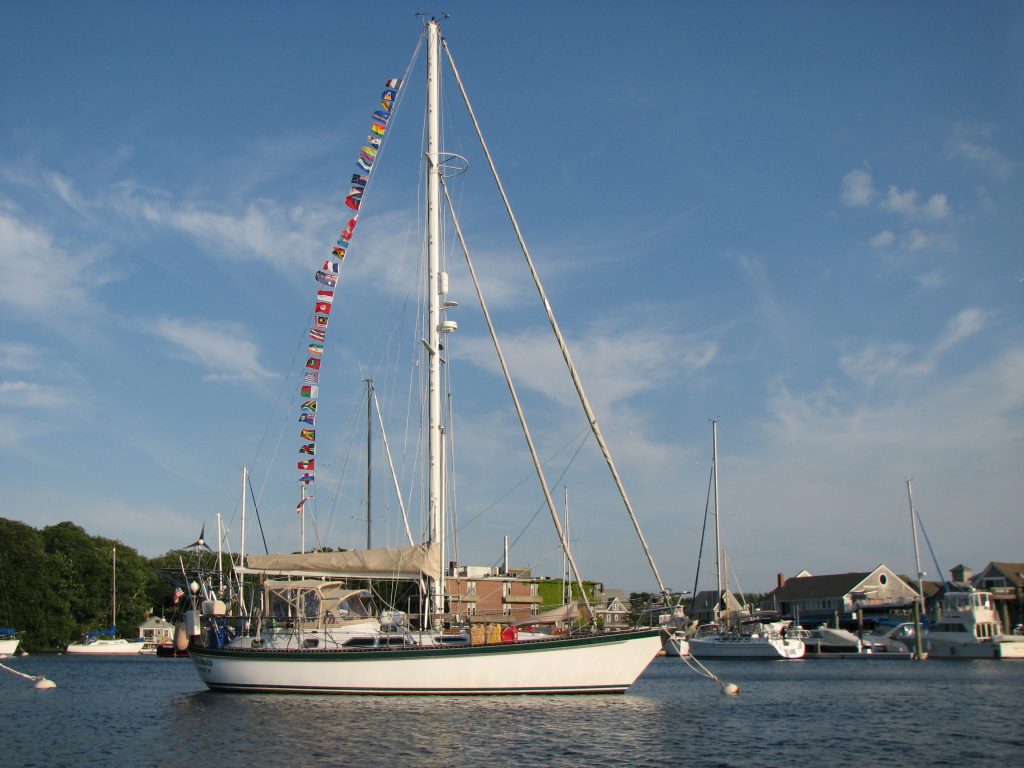
After almost 6 years of traveling, we sailed into Woods Hole on Cape Cod. We continued living aboard for the next five years and I wrote about that, adding ‘and Beyond’ to the title of the blog. Then shortly before Mark’s death in 2016, we sold our beloved Windbird and my travel logs became land logs. At this point, I had written a daily account for each and every day for 11 years. I fully intended to end the blog at that point, but when I wrote that news in a log, I got many responses saying that I really needed to keep posting. At the same time, I realized that I couldn’t stop writing. Summarizing each day had become a permanent part of my life and I will probably continue writing until I can no longer. These postings reflect the ordinary, and sometimes the extraordinary, days in my life and I would like to invite you to join me on my journey.
Day 63, Year 2: A Second Day in Fairyland
Day 63, Year 2: A Second Day in Fairyland
Date: Tuesday, June 26, 2007
Weather: More of the Same . . . Sunny Day with Periods of Misty Rain
Location: Bay of Islands, Vanua Balavu, Northern Lau Group
First, I must apologize to the Bay of Islands. In yesterday’s log I said that there didn’t appear to be good snorkeling here. All of that “rock” I thought I saw during yesterday’s dinghy ride is really coral and the snorkeling is especially nice along the shore line. There are all kinds of small, colorful fish, so I definitely stand corrected. The coral is spread out and certainly not as good as that around Waya Island in Korolevu Bay in Kadavu, but when we find a good colony, the fish abound and it is beautiful. This morning we saw the most beautiful Moorish Idol we have seen to date and some fairly large angel fish. Basically the rock cliffs here go straight down into the water and over time, a wall of coral has been built all around the edges. When there is not much coral, there are lots and lots of Picasso fish. This is a type of trigger fish with a white head, a beautiful blue vertical stripe dividing the head from the rest of the body, and then diagonal lines of orangish brown and blue. There was some soft coral, some fan coral, a coral that grows like a vine, some plate coral, a little brain coral, and only one little anemone. But when I found the anemone, there was a family of seven or eight rather large Dusky Anemonefish. And they were not behaving. They were not in the anemone, but out playing around. Nemo’s dad wouldn’t have been happy. The thing I like the very best about the snorkeling here is that I can jump right off the boat and less than 200 feet right behind the boat is the shore and good snorkeling. We are anchored in turquoise water that is crystal clear. The little cove right beside us has the two best coral colonies that we found today, so it takes little or no effort to find underwater beauty. There is a tiny little fish here that I call a Smuttynose. I have no idea what it is but it is slightly salmon colored with a little brown on its face and another smudge of brown just before its tail. There are literally hundreds of thousands of them hovering over, around, and down the coral wall. It is like they are encasing or protecting the coral. If anyone knows what these little guys are, please let me know. At low tide, we could swim over the top of the coral if we kept our hands on our backs and held our breath so as not to scrape our stomachs. By going over the top, we could look down into the crevices between coral and see big spotted grouper hanging out in the shadows. Another added bonus here is that the water is warmer than it was off Kadavu Island. So we could stay in the water longer. After an hour and a half, we swam back to Windbird and looked through the fish identification books trying to put names to new finds. But we find this an almost hopeless task. We can remember the shape of the fish, but not the color. Or the colors of the fish, but not the fin shape. There are so many different kinds of fish and identification is not easy for us. I know we will get better with time, but we find it frustrating not
being able to name what we see.
We didn’t get back from snorkeling until after noon, so we ate and read for a bit, and then took the dinghy on another explore through the little islands here. I was driving the dinghy today and Mark was taking pictures. We wove in and out of little passages between islands so close together that you can almost touch both sides as you go through. We scouted for other good snorkeling areas, now that we know what to look for, and we returned to the island of thousands of bats. They were there and Mark took his turn at trying to get some good pictures. We got back to Windbird just as another rain shower blew through, so it was perfect timing. We are still thinking that we will leave here tomorrow afternoon and go around to the north side of the island, but not before another morning of snorkeling and exploring. If the north side of the island is even more beautiful, we will stay there until we leave for Savusavu, but if not, we will definitely come back here and spend everyday snorkeling and exploring the islands by dinghy.
I got an email from my sister-in-law, Sue, and she was talking about eating fresh strawberries in Maine. It made my mouth water to think of strawberries. I love them so. She said she was trying to make me jealous but that she was sure we have plenty of fruit. Actually, that is not the case. When we were in Suva, we had plenty of fruit, but the only thing we have gotten since were the oranges the chief in Moala gave us. We haven’t seen a ripe banana since we left Suva. There are bananas, papaya, and lots of lemons and oranges, but for the most part, there is only enough to support the people in the villages. And even if we found ripe fruit, we could never pick it. Every fruit tree and every coconut tree here belongs to someone, so you have to wait to be offered something. Just wanted you to know that there is not an abundance of free food out here. We sure hope the market in Savusavu is like the one in Suva with lots of fresh fruit and veggies. After a month, we will be ready.
Another thing I find interesting out here is the way we have to dress. Last year, we started out in bathing suits in the Caribbean, by the time we got to Samoa, I had to start wearing capri pants over the knee. Mark could still wear shorts, but they needed to be almost to the knee, not shorter. We could still wear bathing suits when in the water as long as we were not near a village. In Fiji, things are a little different. Pants of any sort for women are never to be worn in a village. Lako in Daliconi explained to me that a Fijian woman can wear pants or shorts in her own home, but the minute she steps out the door, she must have on a long skirt. A woman can wear long pants or capris if walking outside of a village, but must put on a sula when entering the village. Women are also expected to wear shirts with sleeves. No tank tops here. So I have started wearing sulas. This is just a piece of material wrapped around as a skirt. I’m learning to climb in and out of the dinghy in a sula with some amount of grace, and find that trekking into the hinterlands in a skirt really isn’t all that bad. Mark is expected to wear long pants when visiting in a village, or he can wear a sula as well. Shorts here for men are always longish–right above or below the knee. I see men in the villages wearing shorts, but I have never seen a man without a shirt on here. It is just not done. Most men wear sulas and t-shirts, or dress shirts for church. So hot as it is, clothes are “in” here in Fiji.
 |
| 070626 Day 63 Vanua Balavu Island, Fiji–Another Day in the Bay of Islands |
Day 62, Year 2: Daliconi Village to the Bay of Islands
Day 62, Year 2: Daliconi Village to the Bay of Islands
Date: Monday, June 25, 2007
Weather: Sunny Day with Periods of Misty Rain
Location: Bay of Islands, Vanua Balavu, Northern Lau Group
We have been transported back to New Zealand. By moving no more than seven miles, we are in a totally different place and it looks and feels very much like the Bay of Islands on the North Island of New Zealand. This bay is totally uninhabited except by huge fruit bats, Fiji pigeons, herons, and Windbird. And there are so many little tiny islands. We went exploring in our dinghy after arriving this afternoon and I felt like I was in a fairy land of odd-shaped islands. Very Tolkeinish. There appears to be no way to get on shore, however. There are no beaches and landing areas. The limestone cliffs just rise up out of the water. The islands are undercut like the islands in Vava’u in Tonga where the water has eroded away the base. We wove in and out of the islands and at one point disturbed an island habitat of bats. All of a sudden there were hundreds in the sky above us. Some were still hanging in the trees, but most were making their little bat noise and flying overhead. I do hope these creatures are fruit bats and not vampire bats! We are anchored in beautiful turquoise water, and if there is any disappointment, it is that there doesn’t appear to be good snorkeling here. As we rode around in the dinghy, we saw lots of rock, but very little coral and almost no small, colorful fish. There are lots of eating-sized fish, however, so maybe we should put a line out. This place is so peaceful and beautiful.
Before leaving Daliconi this morning, we visited the primary school. The school here has Class 1 through Class 8 students. There were 29 students in attendance today and 20 of them were boys. Four of the nine girls are in Class 2 and Class 1 has only six boys–no girls. When these children grow up, they are going to have to go off-island to find mates. Lako, the woman that we had dinner with yesterday, met us and walked to the school with us. It rained during the night, and the red clay mud stuck to the bottom of our sandals as we walked over the hill and down in to the little valley where the school is located. There was a nice green playing field for the children and four buildings. Two were homes for the teachers and the the other two buildings were the classrooms. One building houses Class 1 and Class 2 students. And the other building houses the school office and the classrooms for Classes 3-6 and Classes 7-8. We met Pauline, the head teacher and Class 1 and 2 teacher. She had us sign their visitor book and then introduced us to the Class 7-8 male teacher. His wife is the Class 3-6 teacher and she was out in the field with the students. The day here is started with the toothbrush drill, just like in Dravuni, and she was overseeing this activity and the morning exercises. We met a young minister who comes each Monday morning to teach a bible lesson before formal school starts. Pauline, the head teacher, had her two year-old grandson with her, and the married couple had their four year-old with them. They attend school along with the other children. Since Lako was with us, we didn’t stay long to observe. We stayed through the bible lesson, and then we were asked to talk with the children. After that, they went to class and we walked back to the village. We had forgotten to bring a dish and dish towel that Lako had sent home with us yesterday filled with fried barracuda, so we invited Lako to come to the boat with us to get her bowl and see our home on the water. On our way through the village, we were invited to come into a home for tea and breakfast. There were about eight woman sitting on either side of a long cloth runner on the floor. The breakfast had been for the Telecom crew working in the village, so we got to have more of those wonderful Fiji pancakes. Actually, they are like yeasted-donuts, deep-fried in oil. They are really good. After tea, we continued on to the beach and headed out to Windbird. We gave Lako a big jug of New Hampshire maple syrup for being such a gracious hostess and then took her back to shore.
We waited until after one o’clock to head northwest back to the Bay of Islands. Since we were backtracking, it was not one of those tense reef passages. We just went back the way we came. We have no detailed charts of this area, but everyone assured us the Bay of Islands are easy to navigate with no obstructions. We found that to be true. So we are anchored in a little cove very close to shore and the lapping of the water on the rocky cliffs is a delightful sound. I think we will sleep well tonight.
 |
| 070625 Day 62 Vanua Balavu Island, Fiji–Dinghy Ride in the Bay of Islands |
 |
| 070625 Day 62 Vanua Balavu Island, Fiji–Daliconi Primary School Visit |
Day 61, Year 2: Sunday in Daliconi Village
Day 61, Year 2: Sunday in Daliconi Village
Date: Sunday, June 24, 2007
Weather: Partly Cloudy Morning, Rain at Noon, Beautiful Afternoon
Location: Daliconi Village, Vanua Balavu, Northern Lau Group
I think it would be safe to say that we have gone to church more in the South Pacific than we ever did back home. The people here are pretty insistent that everyone goes to church on Sunday and then spends the remainder of the day at rest. So when you are anchored just off a small village, you go along with the tradition. And if you want to get to know the people, this is one way to do it. The church service is always an adventure. It is different every place we go. I think today’s Methodist Church service in this little village was the most beautiful we have attended. It started at 10 AM and ended at 11:30 instead of at noon. One and a half hours of listening to something in a language you don’t understand is enough, two hours stretches things a bit. We were met at the beach by Lako’s husband, Sam, and he escorted us to the church. As we entered, the women sitting in the pews on the left side of the church were chanting scriptures. It was truly enchanting. We sat down on the men’s and children’s side of the aisle as directed by Sam, and then he went to sit with the choir. He explained that Laco was cooking and would be coming along shortly. I was totally enthralled by the chanting. It was so beautiful. Then we heard the loli or drum beating as the call to worship. The ministers and village elders entered the church and took their places, and then one of the ministers started the service. The choir sang the Lord’s Prayer in Fijian and I thought I had died and gone to heaven. Their voices sounded like angels. It was really beautiful–acapella, no musical instruments, just beautiful voices. Visitors are always welcomed and an elder came forward to welcome us in English and then Mark was prompted to respond. The visiting crew installing the new satellite dish was also welcomed and one of them did the response. He talked for a very long time, but unfortunately we could not understand what he was saying. The choir sang another song and Lako was the female soloist. It was then that I realized it is her voice that sounds like the angels. About 80 people were in attendance, so almost everyone in the village of 104 was there. The women were all dressed in ankle-length sulas and then a mid-calf length dress on top of that. This looked very similar to the dress we saw in Samoa. The men all wore sulas with a long-sleeved shirt and tie, and all of the elders had on dress jackets. Some people wear flip-flops, but many go barefooted. The first minister said many prayers and then a younger minister got up to give the sermon. He had lots of personality and was very charming. As he spoke, you could tell he was telling a story and then he would gesture and speak with a lot of emotion. It was not fire and brimstone but the sermon was delivered with, let’s say, a lot of enthusiasm. The sermon lasted about 30 minutes and was the story of Lazarus. The sermon in Vacaleya a couple of weeks ago was about Sodom and Gomorrah. One of these days I’m going to have to read the bible to see what these guys are talking about!
After church, we shook hands with the ministers and the village elders and then walked with Lako and Sam to their home for Sunday dinner. Laco’s marriage to Sam is her second. She has three children and he had three children, so they now have six but only one is still at home. Sero is in class seven and is probably 12 or 13. All of the other children are in Suva except for Lako’s daughter who is in England. Her husband is Fijian and joined he British Army. He signed up for 27 years so I guess they will away for some time. Lako has been to England to visit and her daughter and her husband come home at Christmas. While we were sitting waiting for dinner, neighbors came by and brought food for the kaitanis. They wanted to make sure we experienced real Fijian food. We had fried barracuda, boiled fish that tasted like mahi-mahi, taro, a type of boiled yam brought in by a neighbor, something like spinach cooked with coconut cream and fish brought in by a neighbor, and palusami (taro leaves cooked in coconut cream). Sam and Lako were were insistent that we eat first. It is the Fijian way. Their son, Sero, was then served as he needed to go to Sunday School class, and after we finished, Lako and Sam ate. Lako prepared a lemonade while we ate. She squeezed the lemons and just added water a very little sugar. This lemonade is better than any I have ever had before. The lemons look like limes but are orange inside. They are not lemons as we know them and I really like the drink. We ate on a cloth on the floor which is the Fijian way. There are no tables. There are stuffed couches and chairs, but I have never seen a table.
Lako and Sam have a washing machine and offered to do our laundry. I couldn’t take them up on the offer as I had just done the laundry before we went to church this morning. But I was impressed that they have a machine. They have a propane gas stove, a DVD player, a boom box, and a television. Lako said most homes in Daliconi have these things. The only income here is from fishing and copra (dried coconut sent away to be made into coconut oil). The fish and coconut are sent to Suva twice a month by boat. The village just south of here, which is next to the airport, is the storage area. I’m not sure how the fish is kept, but it must be frozen. Parents have to pay for their children to attend high school in Suva and they have to give to the church. Sam said that he only has to fish two nights a week to be able to pay for all of this, plus the sugar and oil and they need for cooking. All other food comes from the land and the sea. The government installs the satellite dish and provides the cell phone and television service. Lako says she buys phone cards that allow her to call Suva and anywhere in the world for $1.00 per minute. I’m not sure if the villagers have to pay for television service. I’m going to have to ask more questions about the television service and how much that might cost a village, if anything. At least people in this village seem to be able to continue to live a traditional lifestyle with the addition of a few modern conveniences and technologies. I only wonder how long they will be satisfied with what they have. I hope they are able to maintain it. I truly admire their lifestyle.
We spent a quiet afternoon on Windbird. Mark actually wrote a “Captain’s Ramblings” which will follow this log, and I baked bread. Tomorrow morning we go to shore at 7:45 AM to meet Lako. She will take us to the school so we can deliver some school books we have been carrying from school children in New Zealand. We hope to walk on the island and then return to Windbird by noon to move to an anchorage in the Bay of Islands. Evidently there are no villages there and there are no other boats, so we will have this beautiful place all to ourselves.
Captain’s Ramblings 1, Yr 2
June 24, 2007
I was just going through our recent photos that Judy has meticulously cataloged and labeled. My attention was caught by the photos of stakes in the water. They call them beacons here, but there is no light on the top. In fact, there is no sign of any kind on these posts. They are simply iron pipes stuck into the rocks and coral and sand. Some are canted over at an angle. Some that are listed on the charts are not even there. And there are some that exist but are not on the charts. These “beacons” are the only guide to navigation in these coral reef surrounded islands.
When approaching an island from sea you are looking for a pass – a break in the fringing coral reef big enough for a sailboat to get through. Some of these passes are a half mile wide or more. Most are much narrower, some as narrow as 50 to 100 meters. Back in the States electronic charts could lead you right to any place you wanted to go with accuracy within 50 feet. However, here the charts are mostly based on data that the military collected during the Second World War, so places of military importance may be pretty well charted. Other places (the kind of remote places we like to visit) may be based on data a hundred years old or more. Some of the surveying was done by Captain James Cook. So we have found that we cannot trust our electronic charts. In Moala, the charts were off by as much at three-quarters of a mile. Last year in Tonga it was more like a couple hundred meters. Here in Vanua Balavu the charts are off by about a half a mile. That doesn’t mean the charts are useless. They are still accurate depictions of the land masses, rocks, reefs, and depths of the water around them. It is just that they are in the wrong place. To some extent we can make a mental adjustment – if we know that the chart is off by a half a mile to the southeast, we just need to imagine ourselves being a half mile to the northwest. Of course, that is not accurate enough to assure that you miss submerged coral heads. That is where visual navigation comes in.
If you are from the northeast US, as we are, then you are wondering how visual navigation allows you to see what lies below the water. But if you have been to the Caribbean, or almost any tropical waters, you know that the water can be so clear that you can often see down 10 to 20 meters or more. It is easier to see down into the water if you are looking down on it instead of looking off in the distance when the surface of the water is at a sharp angle to your angle of view. Wind ruffling the surface of the water or the sun reflecting off the water can make visibility difficult. There are a few tricks that have been in use since people first took to the seas. If you get yourself high enough you increase your angle of view to the water. Some people climb part way up the mast for this. We tend to simply stand at the bow where we have a better angle than from the cockpit. We try to schedule our movement in reef strewn waters to times when the sun is overhead or behind us. And very windy days are better spent at anchor. After meeting these requirements, you need to know what to look for. Deep blue water is deep. As it gets shallower it gets lighter blue, finally turning turquoise. Bright turquoise water usually means sand. Darker patches are rocks and coral heads – or could be nothing more than sea weed there to scare you making you think that you are going to hit a rock. We like to sail (or motor) though areas of deep blue water. And we like to anchor in turquoise water with no dark patches close by.
So how did we get in here? Yesterday, after an overnight passage, we approached the island using electronic charts (we do have paper charts as backup should we loose power or if the computer stops working). We made allowance for the fact that the charts could be off by a great deal and stayed at least three miles from any obstacles. Then, about three miles from the pass through the reef, we sighted a white marker (beacon), one of the few that still have a marker on the top of the post. There were supposed to be two in a row that we could line up to be sure we were in the pass (called a leading line). They were both there. We followed them in through the pass. In addition, we were supposed to be on a heading of 105 degrees True as we headed toward the leading marks. That was a second way of checking we were on course. Finally, I stood on the bow looking for shallows and giving directions to Judy at the wheel through our walkie-talkies. We did have one other important aid to navigation. We had waypoints given us by another cruiser who had been here a few weeks ago. However, we knew that one of his waypoints was totally off so we used them with caution. We made an uneventful passage through the reef and then on around the island inside the fringing reed to the village where we are now anchored. Successful navigation in these waters, and anywhere for that matter, is the use of as many navigation aids as possible: electronic charts, beacons, GPS waypoints, and visual navigation. The person at the helm has to keep a very steady course and the person on watch has to concentrate totally. Coming in to an island through a reef is an exhausting experience.
I still feel a lot of anxiety when approaching a pass, but I also feel a great sense of accomplishment when we arrive safely at anchor. It takes team work and amazing amount of preparation. You have to check, recheck, and recheck again any waypoints you have. You stare into the water as you never have before. The person on the helm watches those electronic charts and has to stay “exactly” on course, no deviation. Fiji is challenging this way, but we are finding that the effort is certainly worth it. This is a very special place and we know we are very fortunate to be able to sail these waters and meet these incredible people.
 |
| 070624 Day 61 Vanua Balavu Island, Fiji–Daliconi Methodist Church on Sunday |
 |
| 070624 Day 61 Captain’s Ramblings |
Day 60, Year 2: Arrival in Vanua Balavu–Perfect Passage
Day 60, Year 2: Arrival in Vanua Balavu–Perfect Passage
Date: Saturday, June 23, 2007
Weather: Beautiful Day, E Winds 15
Latitude: 17 degrees 13 minutes S
Longitude: 178 degrees 58 minutes W
Location: Daliconi Village, Vanua Balavu, Northern Lau Group
I’ve heard of sailors who have had to reef down because they were going to arrive at a destination too early due to great winds in passage, but that doesn’t usually happen to us. It did happen on this passage, however. We sailed all the way from Moala with east winds anywhere from 7 knots in the middle of the night to 15 and even 20 after sunrise this morning. We were close-hauled for part of the trip, but on a beam reach for most of it. It was a clear night with a half-moon that didn’t set until midnight and a beautiful morning with blue skies and those puffy little trade wind white clouds. I got quite a start when I thought I saw the bright orange light of another boat approaching at midnight, only to find that it was the moon being swallowed up by the sea. At sunrise, I was on watch and as I looked around, I was amazed. I had been watching our progress on the electronic chart and saw that we were passing through the islands of the Northern Lau Group, but they look far away on the electronic chart. When dawn came and I could see them all, it was quite a show. There was Vatuvara that looks like a huge volcanic cone that someone cut the top off. It appears to just rise straight up out of the sea. There was a long, low island to the east known as Mago (pronounced Mango) and a little island with one pointed volcanic cone to the west. Kaibu, a tiny little island that looks like a loaf of bread except that one-third of the middle of the loaf must have fallen into the sea, was off to the northwest. Kanacea, a plantation island was to the northeast, and finally behind that I could see Vanua Balavu.
Entering the reefs that surround these islands is always a heart stopper. Thanks to Jan and Christina on the sailing vessel Christina from Norway (I think) we had waypoints that led us in with no problems. We have never met Jan, but we heard him on the net the other morning, called to him, and he emailed us detailed information and waypoints for Vanua Balavu where he had visited last week. One of the great things about cruising is that sailors love to share information. When we could clearly see the west side of Vanua Balavu, we heard someone calling for a yacht. It sounded like a Fiji official calling and we answered because we couldn’t hear the yacht name and thought he might be calling for us. Actually, the voice was not calling us but was calling another sailboat entering the anchorage in front of Daliconi (Dalithoni) village. This was our destination for today, so we made contact and explained that we were still about two hours from anchoring. The other yacht, Chaotic Harmony, was right in front of the village and we got to talk to them on the radio as they were leaving and we were coming into Daliconi.
Until we talked to Jan, we thought we had to go all the way around the east side of the island and almost to the south end to check in at a village called Lomaloma. Evidently that is old information that we have in our cruising guide. With the strong east winds, checking in on the west side of the island was much nicer. And the village of Daliconi has taken advantage of that fact and started a little tourism business by checking in sailboats and charging $20Fiji per person. I suppose the money pays for the Tourism Chairman that mans the radio.
We sailed past the northwest side of Vanua Balavu and marveled at how much it looks like Maine. We will be going back there tomorrow or Monday, and then on around the north side of the island later in the week. Chaotic Harmony, the boat that checked in this morning, called us on the radio and explained that they intend to spend the next six weeks or so here. There certainly appear to be unlimited bays and anchorages.
After getting the boat secured, we put the dinghy in the water and went to shore. Two woman came to meet us, Ana and Lako. They took us to the chief’s house for sevusevu, but explained that the chief was not at home and that one of the village elders, Qio (which means shark), would perform the ceremony. Joeli, the village tourism chairman, also attended, and he took care of the paperwork. The chief’s name is Mariko, which the women pointed out is the same as Mark. We hope to meet him tomorrow. His wife’s name is Moce (Mothe) and she served us small muffins with strawberry jam and hot tea after the ceremony. We marveled at all of the pandanus leaves she had hanging in the house to dry and finally got to see the huge aluminum pots that are used to cook the pandanus leaves. I said I had never seen a pot that large and the everyone was quick to tell me that the pots from the US. Lako took us on a tour of the village and we found it quite interesting. There are only 104 people here living in 40 houses with 50 flush toilets. The number of toliets is greater than the number of homes because the school and church have facilities as well. Lako is on the Tourism Committee and she really knows her stuff. She invited us to attend church tomorrow morning and come to her home for lunch afterwards. It was an invitation we couldn’t refuse. Every bure or home in this village has a cell phone and the village generator actually works and people have power for three hours every evening. A Telecom crew from Suva was here today installing a new satellite dish for phone and television, and most of the men of the village we sitting in the village green watching the installation. It was late afternoon by this time, and everyone in the village seemed to be engaged in preparing food for dinner. They were having a special dinner for the Telecom crew tonight and a few men were preparing the lovo or earth oven. Life here is such a mix of old and new.
 |
| 070623 Day 60 Vanua Balavu Island, Fiji–Passage and Arrival in Daliconi Village |
Day 59, Year 2: Overnight Passage, Reflections, and Sam–5 Months Old Today!
Day 59, Year 2: Overnight Passage, Reflections, and Sam–5 Months Old Today!
Date: Friday, June 22, 2007 at 1730
Weather: Sunny Day; ENE Winds 10 Knots
Latitude: 18 degrees 11 minutes S
Longitude: 179 degrees 51 minutes W
Location: Passage from Moala to Vanua Balavu, Lau Group
It is late afternoon and we are sailing along peacefully on calm seas headed northeast to Vanua Balavu. This is indisputably the most beautiful of the Lau Group islands, so we are anxious to get there tomorrow. Today has been a beautiful day. We waited until about 11 AM to leave Moala, but we didn’t wait long enough. Because it is winter here, the sun is never right overhead. It is a little to the north. And since that is the direction we were headed, we couldn’t see the shallow areas as clearly as we would have liked. I was at the helm and following the track of our trip in as closely as possible. We know the computer charts for this area are off, but we weren’t sure how much. We were taking every precaution, but we still we found ourselves with coral under us. It was beautiful, but not beautiful to be on top of it. Thank goodness, it was far enough under us not to cause a problem, but it sure gave us a scare. We now know the charts are about three-quarters of a mile off. We came out from behind the reef and entered calm waters. The wind is coming around to the east but is only blowing 7 to 9 knots. That moves us along at about 4 knots. I know we are going to have to start the engine in order to arrive at Vanua Balavu around noon tomorrow, but right now we are just enjoying a wonderful, calm sail.
Anytime we leave an island, my mind reels with all of the memories of that place. Here are some of my reflections on Moala.
–Meeting young men on shore when we first arrived and watching them jockey to see who would take the kaitanis to present sevusevu to the chief. These young men look and dress like any group of young men in the United States, but they really do live in two worlds–the ancient and the modern.
–Walking through a village where every home has a solar panel.
–Meeting a chief and a wife who were so welcoming. It took only a short time to see how the chief’s wife, Litia, truly is a partner with her husband. She takes care of everyone in the village and she made sure we knew the right things to do.
–Watching young women in a high school Home Economics class having to open cans with a long-bladed knife because there are no can openers.
–Meeting a man on the airport road who was cutting the grass with a bush knife and looking at the camera around my neck saying, “You have plenty money.” I tried to convince him otherwise, but compared to him, I probably do have plenty of money.
–Wading through shallow water and walking over coral to get to land at low-tide. Basically, the villagers have to live their lives according to the tides.
There are many other pictures that I carry with me as we travel on, but I wanted to share just a few with you. Tonight while I am on watch I will read what little information we have on Vanua Balavu. It is visited by a few tourists, and there is some information in the Lonely Planet guide. Tomorrow we will share with you what we find.
We have been away from grocery stores and markets for twenty-three days now. We used the last of the fresh veggies last night to make a curry. It was a head of broccoli that I found in a grocery story in Suva. What a treat! We are still eating the coleslaw made from a New Zealand head of cabbage. This coleslaw has no mayonnaise and is kept out of the refrigerator, and I find it amazing that I’m still eating New Zealand cabbage that was never stored in a refrigerator! We do have celery that Marie was able to buy for us in Vunisea when the Ranger crew went there to try and locate Paul’s daughter’s luggage. That will be our only fresh vegetable until we reach Savusavu. By the way, when we talked to Marie on the radio yesterday she said that Cindy’s luggage finally arrived in Suva on Wednesday. Of course, I think Cindy left for the US today, so I guess she will arrive home with a bag full of clean clothes.
And now for the story of the day . . . our grand baby Sam is 5 months old today!!! We received one of Heather’s weekly updates to the grandmothers this morning and she reported that they have had quite a week leading up to this milestone. “On Monday evening, Sam rolled over for the first time! He was playing on the living room floor, trying to get his toes into is mouth (as usual) and gently rolling side to side (again, as usual). Then, suddenly, he was on his tummy. He was as surprised as I was and not entirely happy as he had pinned both hands under his body and all his attempts to rectify this resulted in digging his face into the floor.” Heather writes to us with enough detail that I can actually see Sam doing these things. She went on to say that on Tuesday of this week, he had his first non-bathtub water experience in a pond, but he quickly found that too cold. But the big break-through was yesterday when Sam took his first drink of milk from a sippy cup. He has refused any kind of bottle, so this is good news for his mom. Heather also found out yesterday that she can delay going back to work until just after Labor Day, which made her very happy. This will give Sam two more months to learn to use that sippy cup so he won’t starve when she goes back to work. So it was a big week for Heather, Jed, and Sam.
It is getting close to sundown and while I have been writing this log the wind has picked up to 11 knots. Maybe, just maybe, we’ll get to sail through the night. Right now, there are no clouds in the sky. If that condition continues, we will have an almost half-moon to provide some light to guide us until midnight when it sets. It could be an incredibly nice sailing night. We just crossed the 180th parallel and are back in the Western Hemisphere. But since the dateline has been moved for political purposes, our date and time does not change.
 |
| 070622 Day 59 Moala Island, Fiji–Leaving Moala |
Day 58, Year 2: Naroi in Mourning
Day 58, Year 2: Naroi in Mourning
Date: Thursday, June 21, 2007
Weather: Sunny Day; Still NE Winds 15 Knots
Location: Naroi, Moala Island, Lau Group, Fiji
At promptly 9 AM we went to shore as we had arranged with Litia, the chief’s wife. Before we got all the way in we could tell that the village was in mourning. School children were walking back from the village green in their athletic uniforms, men walking on the road had on dress sulas and dark shirts, and the woman on the hill by the chief’s house had on black dresses and wore pandanus mats around their waists. This is mourning dress in Tonga but we had no idea that Fijians also wear the mats.
They might not on the main islands, but since the Lau Group is halfway between Tonga and Fiji, the Tongan influence here over the years has been great. We could see Litia waving us back, we waved, and I threw a kiss which she did in return. I doubt that we will see her again before we leave and I’m a little saddened by not saying a personal farewell. But it is not respectful for strangers to come to the village during mourning, so we must respect that. I had printed some pictures that I wanted
to leave with them, but we will look for a fishing boat coming by in the morning to see if they will deliver them to the chief for us. We are wondering where they bury people here. We have seen no graveyards in the villages we have been in since leaving Suva. Graveyards in Suva are prominently located, but in the out islands, they must be hidden away. Many questions. I guess we will ask when we arrive at our next destination.
Today was a day of “reality.” I looked at the calendar and realized that we have only two weeks before Mark’s brother arrives in Savusavu. Time sure flies when you are having a good time. We spent more time in Beqa than planned–waiting for a weather window. We spent more time in Kandavu than planned–waiting for a weather window. And we have spent more time here at Moala than planned–waiting for a weather window. Those weather windows seem to be few and far between this season. So we made
a decision late this afternoon to skip visiting the island of Tuvuca and will go straight to Vanua Balavu. Again, this was a hard decision for me. Tuvuca offers a people who have little if any contact with the modern world. But Tuvuca has no real anchorage. It is only possible to anchor there with an east wind, and we are still having wind north of east. Vanua Balavu offers the most beautiful anchorages that Fiji has to offer, but the people have had more contact with the outside world. After
long and hard thinking, we opted for beauty over remoteness. So in the AM we will head directly to the Exploring Iles in the Northern Lau Group. Vanua Balavu sits inside a barrier reef with eight other smaller islands. On the northwest of the Iles is Qilaqila or the Bay of Islands. It is supposed to be a “spectacular place for yachties to draw anchor” according to the Lonely Planet. By noon on Saturday we should know if the place is as beautiful as advertised. We talked with a boat named Christina
on the radio this morning and they just left there. They did say it was beautiful and they are sending us some waypoints for their favorite anchorages via email.
Today was also a day of connections. Since there was no field day to attend, we came back to Windbird and did a little reconnecting. we are planning to return to the United States at the end of this cruising season and work for a few months before returning to Australia and continuing our trek around the world. We wrote resumes and contacted old friends. Mark had an especially good time connecting with friends and faculty from college days at Eastern Illinois University. Darlene Miller wrote
with updates on friends who were on the Speech Department faculty and even his college roommate, Jim Rinnert. Darlene found us online through our web site. What a blast from the past!
We have heard from a few other cruiser friends recently. Bob and Dianna on White Swan have recovered from the traumatic passage from New Zealand and have headed out in the Mamanuca islands with Zfarse and New Dawn. Joe and Cindy of Maggie Drum have reached Suva, and Ranger is back in Suva as well. Quantum Leap with Tom and Bette Lee are on their way from New Zealand to Tonga. They have 420 miles to go and have had some ugly weather. Tom has been sending daily updates and he is truly a fantastic
story teller. Here’s a bit of his log from today, “We are in the grip of the dreaded low pressure system. In New Zealand they are experiencing 40 knots of wind with 15-20 foot seas. Up here things are not so bad, with 20-30 knots of wind and 5 foot seas. The problem is that the wind is blowing from the direction we want to go. We are having to sail against this torrent of wind. Sailors call it “beating”. Bashing, crashing, thrashing, splashing…would also be excellent words. QL is as salt encrusted
as a virginia ham. Moving around is much like standing in the saddle of a mechanical bull.” Eloquently stated!
So tomorrow morning we head a little north of northeast. We hope that winds come around to the east from the northeast, but if not, we will be doing a little bit of that bashing and crashing that Tom describes above. Let’s hope that is not the case.
Day 57, Year 2: Long Walk on Moala
Day 57, Year 2: Long Walk on Moala
Date: Wednesday, June 20, 2007
Weather: Sunny Day; NE Winds 15 Knots
Location: Naroi, Moala Island, Lau Group, Fiji
Since Leaving Suva three weeks ago, we have not been in places where long walks on land have been possible. We did have a wonderful walk to the top of the knoll on Dravuni Island, but other than that, we have basically been on the boat or in the water snorkeling. So today we walked. We worked around the boat for a couple of hours and at about 10:30 AM we took the dinghy to shore. It was high tide, so Mark dropped me off on shore and he took the boat out and tied it to one of the sticks where other small boats were tied. This meant wading almost up to his waist, but as we learned yesterday, it is the only safe way to leave the dinghy here when going ashore. The head teacher of the elementary school walked by as we were securing the dinghy. He was on his way to the village green where the primary students were preparing for tomorrow’s athletic field day. I told him we would love to attend and he said we were more than welcome. That event will start at 9:15 tomorrow morning. We walked up to the chief’s house to check-in with his wife, Litia, about coming to dinner tonight. When we saw her yesterday we weren’t sure we were going to be here, but the northeast winds are keeping us here another day or so. Litia explained that a woman in the village has taken ill and is not expected to live, so it wouldn’t be appropriate for the chief to be entertaining people for dinner. We hadn’t figured out how we were going to find our way back to our boat in the dark at low tide anyway, so that probably worked out for the best. Litia also explained that there will no field day tomorrow if the woman dies tonight, so she asked us to come to see her at 9:00 in the morning to check the status of things.
We are rocking and rolling at anchor tonight. The winds switched this morning and are now coming from the northeast. That leaves us exposed and the swell is coming in. Its not terrible, but standing up to do anything takes a little more effort than normal. The winds are supposed to continue to come from the northeast tomorrow, but by Friday they should be coming out of the east. If nothing changes, we still plan to leave Friday morning.
Now back to the walk. We walked around the island to the east today. We wanted to see the airport and try to make it to the next village. The airport is not far from town and there is a wide road leading there. On the way we passed a fenced complex that we assumed had something to do with the airport. Only one plane comes in here each week on Tuesday. Since tourists are almost non-existent, the plane is for locals who are going to Suva for a week. You can’t come and go on the same day, so you have to stay an entire week. When we got to the airport, we saw a man cutting the grass in the road we were walking on. He was cutting it with a bush knife. We had a nice talk and he explained that five men are employed to cut the grass on the road. They work for the Fijian DRT, Department of Roads and Transportation. Other people work for the government keeping the grass on the airstrip cut, but they work for a different department. Nothing is paved, and the grass grows quickly here, so they have full-time employment. Not everything is done by bush knife. They have one weed eater that they use as well. Since there are absolutely no vehicles on this island, we wondered why they keep the road cut so neatly, but we enjoyed it today and others must do the same. There used to be a truck on the island, but no more. We walked past more grass cutters and then came to a small house with loads of pandanus bunches laying in the road. A woman came out and explained that no one lives in the house. They just come there for processing the pandanus leaves. The leaves are cut, the rough edges of the leaves are stripped off, and the pandanus is brought to the house to be cooked. I couldn’t see what they cook it in, but it has be be a huge tub of some sort as the leaves are very long. They then lay the pandanus on the road in bunches to dry in the sun. When all of that is done, they can begin the weaving of mats. The mats are then sent to Suva to be sold.
We walked for well over an hour and finally came to a place were we could see the bay on the eastern side of the island. We decided not to go all the way to the village there as we were a little worried about the tide going down and leaving our dinghy high and dry. So we retraced our steps and got back to Windbird by about 1:30 in the afternoon. The dinghy was fine and the tide still high enough that we could get out easily.
If there is no field day tomorrow, we plan to do a little reef snorkeling here and get ready for our departure on Friday morning. We’re still not sure that we are really going to be able to anchor safely at Tuvuca, so we plan to leave here early on Friday so we will arrive there just after sunrise on Saturday morning. If we can’t figure out how to anchor safely, this will leave us enough time to get to Vanua Balavu, our next stop, before sunset. We have no information on Tuvuca, so this will be a real adventure.
 |
| 070620 Day 57 Moala Island, Fiji–Walk on Moala |
Day 56, Year 2: Visit to Naroi Schools
Day 56, Year 2: Visit to Naroi Schools
Date: Tuesday, June 19, 2007, 1930 Fiji Time
Weather: Gorgeous Day; Windy in the Anchorage
Location: Naroi, Moala Island, Lau Group, Fiji
Our day started early this morning with a visit to the Naroi Primary School. This school includes kida (prounounced kinde) plus class 1 through class 6. We were able to pole the dinghy all the way to the shore, but a young man standing on the road looked at us in a way that made us think that tying the dinghy to shore was the wrong thing to do. We tried it anyway, and the dinghy was pushed up against the rocks. Now we knew why he looked the way he did. Not a good idea. So another young kid
took the rope and walked out to one of the poles that was waist deep to tie it there for us. Since the tide would be coming down as the day progressed, we knew we would be able to wade out and get it for the return trip home. The chief’s wife, Litia, had sent Ravula’s (the chief) neice to greet us and walk us to the primary school. So off we went. She introduced us to the head teacher and he invited us to sit down and watch the beginning of the day. All of the students gathered on the green
area between the four wooden buildings that are the school and then one of the teachers dismissed a few students at a time to go to the library building. The students sang “This Land Is Your Land” (in Fijian) and a few other songs and then we were asked to speak. It is at this point that I become really embarrassed that I can speak no Fijian. Hello (bula) and thank you (vinaka) are just about it for me, but both Mark and I spoke about sailing around the world and about our jobs before we left to
go sailing. The students were then dismissed to go to their classrooms. Classes 5 and 6 are in one building, classes 3 and 4 in another, and kida and classes 1 and 2 in another. We went to observe the little ones. Just as in classes in the United States, the morning started with students on the mat and the teacher at the chalk board. She wrote “Today is ____.” on the board and the students filled in “Tuesday.” Then she wrote “It is a _____ day.” And the students fill in with “windy.” They
then had an English lesson using the words sit, stand, run, and walk. The class 2 students were dismissed to go to their seats and the teacher continued working with the class 1 students. She explained that once she was ready to send them to their seats to work independently, she would work on the mat with the kida students. The classroom appeared to be a well-run multi-age with about 20 children and a first year teacher.
Our next stop was the secondary school just up the hill. The principal and the school manager (head of maintenance) were sitting under a shade tree. The principal, Iliesa, was dressed in a sula with a dress shirt and tie. He was very friendly and we explained that we just wanted to walk by the classrooms and then visit with Rosa in the Home Econonomics building. The secondary school has about 120 students and the buildings are small wooden structures with clapboard siding. We learned that the
principal is the chief’s brother’s son and the school secretary is the chief’s sister. Evidently being related to the chief is a good thing. Iliesa explained that the secondary school starts at form 1 (grade 7) and goes to form 6 (grade 12). We spent the next couple of hours in Rosa’s classroom. She had seven students from forms 5 and 6 and today was their practical exam. They were cooking a complete dinner and we were invited to stay and eat the results. They were making palisami which I have
really been wanting to learn how to make, so we stayed and learned. Palisami is taro leaves with onions and meat (canned tuna in this case) rolled inside the leaves, folded over twice, and then cooked in coconut cream. To make coconut cream you take coconuts with brown outer hulls, hull them, crack them open, and then scrape out the insides. You then add a little water and start squeezing the grated coconut. Out comes what lookes like milk. Mark tried scraping out the coconuts and found it to
be hard work. I tried and was not very good at it, but with practice I think I can learn. I think milking a cow is easier, but then that is what I am used to. These kids scrape out coconuts and squeeze out the cream with what appears to be no effort. Lunch also included fish and boiled taro and a really nice lemonade. It was a fun morning.
We left the school and walked by the chief’s house to see if he and his wife, Litia, were coming to Windbird for dinner. The chief was not home, but Litia was there and explained that Ravula had to be at the church this evening so they would not be coming. But she did invite us to dinner tomorrow night. We met the chief’s son, who is in class 5 and was home during recess, the chief’s mother, and a woman they call the queen. More about the queen later. A young man who was already out in the water
brought our dinghy to us and we returned to Windbird to do some boat maintenance. When we were leaving Korolevu Bay we noticed that not as much water was coming out of our exhaust and we had a white smoke in the exhaust that we had never seen before. The engine ran slightly warmer than usual on the way here so we knew we needed to find the source of the problem. Mark took the heat exchanger apart and cleaned the insides, put in new antifreeze, and found that this wasn’t the problem. We needed
to change the antifreeze anyway, and it was good to clean out the heat exchanger, but we still had the problem. He then disconnected an elbow at the thru-hull. Bingo! The elbow was clogged with seaweed and small pumice stones from Korolevu Bay. At low tide, the volcanic pumice floated on the water and evidently it got sucked into our intake system. Mark cleaned the elbow and put it back in place. When he started the engine this time, there was no white smoke (which was actually just steam from
overheated water) and lots of water coming out of the exhaust, so he earned his keep today. While he was doing this, I was helping some and cooking dinner for Rosa. She had told us she would come whether or not the chief and his family could make it. I fixed salmon cakes, canned spinach with diced tomatoes and Handley currey spices, and fried potatoes. I also baked the eggless chocolate cake that I had gotten the recipe for from Siteri on Dravuni Island. Rosa wanted to taste it and wanted the
recipe. Eggs are hard to come by out here on the islands, so a cake with no eggs needed is quite appealing. She had sent us home today with cassava root and grated coconut to make tapioca pudding South Pacific style, but I decided to make American style tapioca pudding and let her try that. When we went in to get her, we saw that the queen was coming to dinner as well, so we all piled in the dinghy and went back to Windbird. We only had an hour as it gets dark here just after 5:30, so we ate
as soon as we got back to the boat. Renadi (I think this is the spelling the Fijian word for queen) and Rosa liked the cake and the pudding, so I gave them some of the tapioca, some eggs, vanilla, milk powder, and baking powder. That should at least get them started.
We have decided to stay here until Friday if the weather reports stay the same as they were this morning. That means we will be able to go to dinner at the chief’s house tomorrow evening if we can get back to Windbird before dark. We hope to walk around the island to the next village tomorrow and and on Thursday, the primary school is having an atheletic field day that we will attend if we are still here. Leaving on Friday morning will get us to Tuvuca early Saturday morning. If we find that
we cannot get into the harbor there and that anchoring outside just won’t work, we will continue on to Vanua Balava and will arrive there late in the day. Venturing into the Lau Group is like a mystery tour as there is absolutely no information on some of these islands and no close-up charts. So we’ll give Tuvuca a try but we know we might have to go on. We do have charts for Vanua Balava and have much more information on that island, so one place or another, we will find a new anchorage to explore
on Saturday.
 |
| 070619 Day 56 Moala Island, Fiji–School Visit and Naroi Anchorage |
Day 55, Year 2: Arrival at Moala
Day 55, Year 2: Arrival at Moala
Date: Monday, June 18, 2007, 1930 Fiji Time
Weather: Party Sunny Day; 10-12 knots ESE
Latitude: 18 degrees 33 minutes
Longitude: 179 degrees 56 minutes
Location: Naroi, Moala Island, Lau Group, Fiji
How many birthdays can one Queen have? June 4 was the Queen’s birthday in New Zealand. June 11 was the Queen’s birthday in Australia. And today was the Queen’s birthday in Fiji. So we arrived in the village of Naroi (roll the ‘r’) on the island of Moala on a holiday, but that wasn’t a problem here. In larger ports, arriving on a holiday is expensive as you have to pay overtime to the officials. Here we just had to check-in with the chief of the village, and it was fine to do that on a holiday.
Now I’ll backtrack to talk about the passage and then talk about the village of Naroi.
Trying to head east is not an easy task with trade winds coming from that direction. As our weather reports had indicated, the winds were at first from the southeast and under 10 knots, but as last evening progressed, the winds came more from the east. Sometimes we had 7 knots and sometimes 14. We tried to motor sail with the full main and headsail, but around midnight, I had to furl the headsail. So, for the rest of the passage, we motored with only the mainsail up. Of course, we could have
tacked back and forth and sailed without the motor, but that would have meant delaying arrival until after dark today and that is just not possible in these reef-laden waters. We had a knot of current against us most of the night, but the winds stayed light so we made good progress. We were shooting for an arrival time of 1:00 in the afternoon and we maintained that by increasing and decreasing the RPM’s. First light this morning was at 5:30 AM. It was very strange to have light directly in front
of Windbird as we don’t normally travel north and east. When the world is totally dark and you start to see spots of light that appear to be in the water right in front of you, you start to think a submarine with lots of lights must be surfacing. But as the light gets brighter, you realize that it is just the light of the sun on the horizon. By 6 AM I spotted land. Our ETA was not until 1 PM, but it looked like we were almost there. By 6:30 AM, the sun finally rose and at the same time, the
wind switched to come more from the east and directly on our nose. That eased about an hour after sunrise, and the rest of the trip in was non-eventful. And that’s a good thing.
We use MaxSea as our electronic charting with C-Map charts. And they are definitely off for these islands. According to the C-Map charts, we are currently anchored well on land. Out here it is all about being on watch constantly. When you see turquoise water, you turn the other way. But between paper charts, electronic charts that are off (but that train yourself to adjust based on just how far off they are), and having someone on the foredeck constantly watching, you make it in. It is certainly
not a science, but it works. I’m at the helm during all of this and Mark is on the foredeck watching and giving me directions. It is nerve-wracking for both of us, so once we anchored, we just had to kick back and relax for a bit. We delayed getting the dinghy in the water and going to shore for about an hour while we decompressed. But then we were back at it.
Low tide was approaching as we headed to shore. We made a decision to go around the reef that is between us and shore by going to the west and turning back in to the island. We found a spot to land the dinghy with a fairly short walk across the mudflats to land. We tied the dinghy to a rock that was conveniently placed on the mudflats and trudged on. We were being watched by anyone on the shore. We were definitely on display. When we walked up a concrete ramp to the beaten path on shore there
were some young men. We greeted them with a big smile saying “Bula” and they returned with the same. One young man came forth and introduced himself. His name was Enele. He was very well-spoken and said he would take us to the turangi or chief. He told us that the last yachties to visit here came in 2005 and were California. He explained that there were two boats in 2005. We know our friends from Galatea were here last year, but I think they came in the pass on the eastern end of the island
and must not have visited this village. As we walked along the path, he explained what we were seeing in the village. There was a village green where all of the primary-aged children were playing since it was a holiday and there was no school. He showed us the community center building, built much in the Tongan style with a rounded roof, and he explained that there is a definite Tongan influence here. He explained that he is half Tongan and as I am writing this, I am realizing that most people
I met today were much more Polynesian in looks than Micronesian. I’ll have to watch tomorrow to see if that observation is really valid. We had brought our dinghy to shore on the exact opposite end of the village from the chief’s home, so we had to walk through the entire village to reach our destination. The chief and his wife were sitting under a roofed area with mats on the ground. This was next to their very nice two-story concrete block home. We were welcomed to enter the meeting area by
the chief. We presented our yaqona or kava as our sevusevu and then got out our Lau Group permit and associated papers to present to him. The chief’s name is Ravula Draunidalo and his wife’s name is Litia. There was another woman sitting with them who explained that she is a secondary teacher presently living with Ravula and Litia. Her name was Rosa and she is a Nutritian and Home Economics teacher at the high school. The chief indicated something to Litia, his wife, and she quickly went into
the house and came out with a plate of lemons (really oranges, but called lemons) and a knife and invited us to partake.
As I was peeling an orange, the chief started the sevusevu ceremony. It was carried out in much the same way as the others we have attended. The chief says certain words and then claps and says, “Vinaka.” This means thank you. Then there are more words and everyone sitting claps and says the same. This continues a couple of times, and then you somehow know you are welcomed and the ceremony is over. We talked about the island and were asked where else we would be stopping in the Lau Group. We
are absolutely terrible with Fijian pronunciation, but with Enele’s help, we were able to explain that we will go from here to Tuvuca (pronounced Tubutha with the emphasis on the “tha”) and then on to Vanua Balava (Vanwah Balabah). If I leave here being able to pronounce my own name, I’ll be a lucky person.
Litia and Rose came back to Windbird with us. They wanted to visit our home and we had a nice visit. I tried to offer tea, but they declined, but they did accept an offer to come back for dinner tomorrow. Mark and I asked to visit the primary school in the morning and then at 4:30 PM we will pick up Litia, Rose, and hopefully the chief and his young son, to come to Windbird for dinner. Since sundown is around 5:30 we will have to eat fast and get them back to shore before 6 PM. After that, there
is no light and no way to know how to avoid hitting a reef with the dinghy. I’ll report more tomorrow night about that adventure.
I just went up into the cockpit to see if there were any lights in the village, and compared to other places we have been, it is lit up like a Christmas tree. Almost every home here has a solar panel given as a gift from the French government and they obviously use the power to light their homes at night. I’ve been looking for an island without television, but I haven’t found one yet. This one certainly does have TV. The secondary school has two computers, but I doubt that the primary school has
such a luxury. I guess we’ll find out tomorrow.
 |
| 070618 Day 55 Moala Island, Fiji–Naroi Village |
Day 54, Year 2: Happy Father’s Day–On Our Way to the Lau Group
Day 54, Year 2: Happy Father’s Day–On Our Way to the Lau Group
Date: Sunday, June 17, 2007, 1745 Fiji Time
Weather: Beautiful Morning, Party Sunny Afternoon; 10 knots ESE
Latitude: 18 degrees 59 minutes
Longitude: 178 degrees 43 minutes
Location: Overnight Passage to Moala Island, Lau Group, Fiji
Last year, June 17 was a Saturday and we were in Cook’s Bay, Moorea, in French Polynesia. Our son Justin was visiting with our daughter Heather, so we called them on the SAT phone to say hello. This is when we found out that we were going to be grandparents, but we were sworn to secrecy for six weeks. Heather and Jed didn’t want people to know until after the first trimester, so hard as it was, we kept the secret. That was quite the Father’s Day present–one we will never forget. Hard to beat
that one. Things this year aren’t quite as exciting. Mark’s Father Day present is an overnight passage to Moala Island. He also got a box of Lindt chocolate truffles that I have been hiding since New Zealand and he says that is what he is eating for dinner tonight.
We left Korolevu Bay at noon and will arrive at Moala in early afternoon tomorrow. The weather did cooperate and we have light winds from the ESE. We are basically traveling from the east, and even though we are having to motor sail, if the normal trades were blowing 20 from the east, it could have taken us much longer to get there. The seas are also fairly calm, so waiting for the weather sometimes pays off. At 10 AM this morning, Safina and Scot Free II pulled up anchor and headed one bay south
to Galoa. At 11 AM, Moet did the same. Franz had come over with three year-old Dillon this morning to tell us they were moving on. We talked about where we might meet again, and it sounds like we will see them around the end of July when we are in the Mamanuca or Yasawa Groups. Dillon informed me that he saw absolutely no fish on his first snorkeling excursion. Maybe that’s because he didn’t open his eyes! When we left Waya Island yesterday, Sylvia was doing everything in her power to convince
him to put on a snorkel and mask and get into the water, but he was just replying with, “No, no, no, no.” Evidently she got him in, but he must not have opened his eyes if he didn’t see any fish there! We hope to see Safina and Scot Free II in Savusavu. They are going back to Suva before heading north to reprovision. We will have been out here over a month without going to a store when we arrive in Savusavu, and it will definitely be time for us to reprovision at that point. As we pulled out
of the bay, Ranger was the only boat left in the anchorage. It looked so lonesome. But they can’t move on until Cindy’s luggage is recovered. They are hoping it will arrive today and they will then move back north to the Astrolabe Reef tomorrow before returning to Suva. We will miss seeing our friends, and look forward to a reunion in Savusavu.
Moala is not actually part of the Lau Group, but it is administered by them and therefore you have to have the special Lau permit to go there. There is absolutely no infrastructure for tourism, so it is going to be an interesting stop. It is close enough to Suva that the people there send their bananas and coconuts on overnight boats to Suva for sale. I don’t know if that means that they travel there themselves, or if it is some sort of transport boat that takes what they have to sell to market.
We have absolutely no idea what to expect, and I’m certain we will be the only sailboat as I don’t think anyone else has been granted a Lau Group permit through the Suva office this year, and that is the only place you can get a permit to allow you to visit Moala. So this will be an interesting stop. It is halfway to our final destination in the Lau Group, the island of Vanua Balavu, and that is its draw for us. From here to there is open water with no islands and no reefs, so it was a convenient
stopping place. We also heard from Ernst and Anna Maria on Galatea that it is a good place to visit. They were there last year and enjoyed the time on the island. We will stay a few days and then we hope to move on to Tuvuca in the Northern Lau Group. That will be another overnight sail, and from there we go to Vanua Balav–just a day hop.
Thinking back to where we were last year, this year of cruising is very different. The people of the Marquesas and the Society Islands in French Polynesia are subsidized by the French Government, so people there have a much higher standard of living than the people in this part of the Pacific. It is hard to label what we see here as poverty. The people don’t have much, but they don’t seem to want or need much. They seem very happy, but we have not had discussions with them about their standard
of living. It is very simple, but almost every village we have visited has had a generator that works off and on, and when it is working, the villagers gather in the evening to watch television. That must have an impact on them. It will be interesting to see if there is television in the Lau Group. The Fijian government has worked hard to keep those islands isolated and more traditional. We shall see if they have been successful.
 |
| 070617 Day 54 Kadavu Island, Fiji–Passage from Korolevu Bay to Moala Island |