

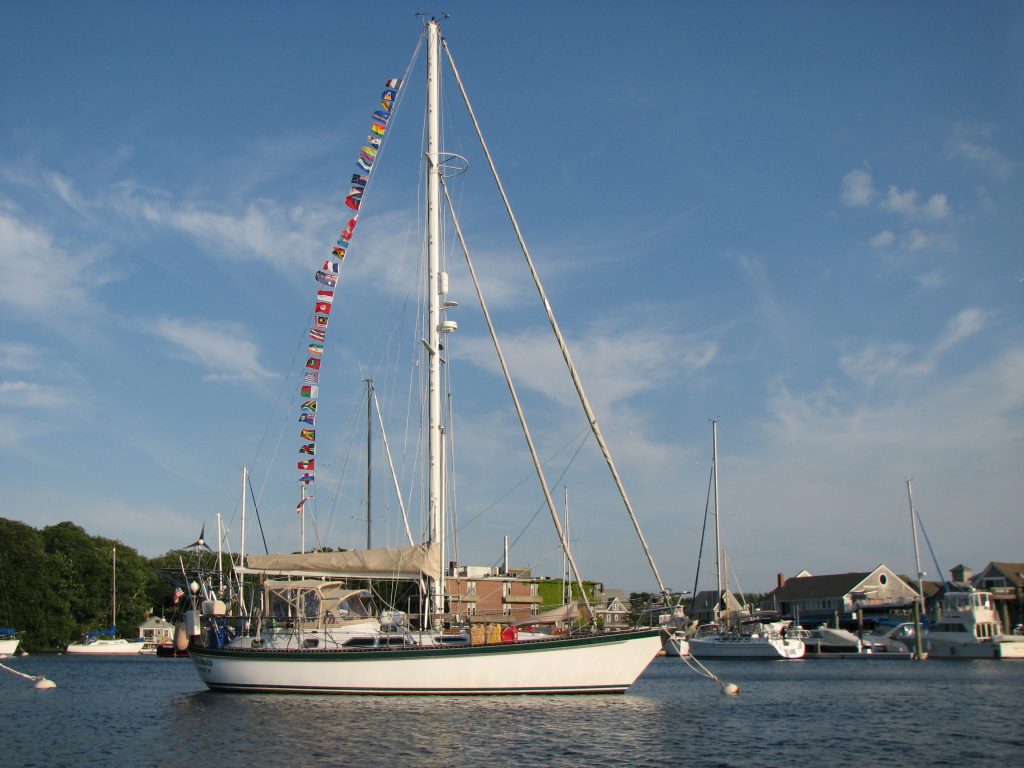
After almost 6 years of traveling, we sailed into Woods Hole on Cape Cod. We continued living aboard for the next five years and I wrote about that, adding ‘and Beyond’ to the title of the blog. Then shortly before Mark’s death in 2016, we sold our beloved Windbird and my travel logs became land logs. At this point, I had written a daily account for each and every day for 11 years. I fully intended to end the blog at that point, but when I wrote that news in a log, I got many responses saying that I really needed to keep posting. At the same time, I realized that I couldn’t stop writing. Summarizing each day had become a permanent part of my life and I will probably continue writing until I can no longer. These postings reflect the ordinary, and sometimes the extraordinary, days in my life and I would like to invite you to join me on my journey.
Day 89, Year 3: A LONG Trip to Alor
Day 89, Year 3: A LONG Trip to Alor
Date: Hari Rabu (Wednesday), Bulan Agustus 6, Pada Tahan 2008
Weather: No Wind, Then Wind, Then No Wind, But Always Sunshine
Latitude: 08 degrees 13.415 minutes S
Longitude: 124 degrees 30.885 minutes E
Location: Kalabahi, Alor Island, Nusa Tengarra Province, Indonesia
Total Miles: 134.82
We’re here, but what a looooong short trip. We can normally do 134 miles in a 24 hour period, but not this trip. Shortly after 5 pm yesterday, we started experiencing an adverse current that was unexpected. Dave and Pattie on This Way Up have done this trip before, and even they were totally surprised. And the negative current just didn’t go away. We fought it all night by motoring at high RPM’s with no wind. But pushing the engine as fast as she will go, we were only doing two to three knots until about 5 am in the morning. Then we got wind and with no current against us. We didn’t get a positive boost, but we were just happy to not be fighting the negative. We were feeling really good about this, but then we reached the selut (passage) going between Alor and Pantar Islands. We knew you can experience strong adverse currents here, but we thought we had the timing planned so that wouldn’t happen. Wrong again. We basically spent all day punching our way up the passage. And to top off the whole trip, we arrived in the anchorage area just before sundown and it took us an hour and a half to get our anchor to set. All the while we are listening to Muslim prayers being blared over the speakers while fireworks were lighting up the skies. Evidently there was some sort of welcome ashore, but we’ll just have to join the festivities tomorrow. We have heard on the radio that there will be no yachties’ gathering place here. It is evidently a dry island in more ways than one.
So we are tired and grumpy tonight, but I’m sure a good night’s sleep will solve our problems . . . as long as the anchor holds.
 |
| 080806 Day 89 Indonesia–Kupang to Alor |
 |
| 080806 Day 89 Alor, Indonesia–Opening Expo Photos from Anne on Habreasail |
Day 88, Year 3: Farewell to Kupang
Day 88, Year 3: Farewell to Kupang
Date: Hari Selasa (Tuesday), Bulan Agustus 5, Pada Tahan 2008
Weather: Sunny with No Wind . . . Again
Latitude: 09 degrees 44.211 minutes S
Longitude: 123 degrees 36.480 minutes E
Location: Overnight Passage from Kupang, West Timor to Kalabahi, Alor
Kupang Harbor always seems to have way too much wind, but the minute we were clear of the harbor the wind just died. So once again we are motoring. We will travel about 130 miles to the northeast to reach the island of Alor tomorrow. For the next month, we will be traveling in the province of Nusa Tengarra. Alor is one of the eastern islands in the province. We will island hop from east to west from Alor to Pantar, Kawula (also known as Lomblen and Lembata), Adonara, Flores, Rinja, Komodo, Sumbawa, and finally to Lombok. We exit Nusa Tengarra in Lombok and head from there to Bali and Java. We had a wonderful introduction to Indonesia during our stay in Kupang and we are looking forward to traveling through these islands. I don’t think I ever really understood the geography of this part of the world until this past week when we started seriously planning our route. According to the Lonely Planet, Indonesia is made up of 17,508 islands that are home to 242 million people. It is the world’s fourth most populous nation after China, India, and the United States. So we have lots of places to go and people to meet!
 |
| 080805 Day 88 W Timor, Indonesia–Leaving Kupang |
Day 87, Year 3: Free At Last
Day 87, Year 3: Free At Last
Date: Hari Senin (Monday), Bulan Agustus 4, Pada Tahan 2008
Weather: No Change – Still Sunny and Windy
Location: Kupang, W Timor, Indonesia
Customs came to Windbird today to rip off the impoundment sticker, so we are now free to leave. Unfortunately, Customs came while we had guests onboard and it was very busy. Mark had gone to shore earlier to pick up Cece, the young university student who has been a guide for us over the past few days, her mother Elisabeth, and a young man named Alex. They had no sooner arrived than Alex and Cece got a bit seasick, so Mark had to take the Customs agent, and our guests back to shore very quickly. We felt so badly that it was so rough this morning, but the Kupang anchorage is just that way.
We spent most of the rest of the day onshore today. We finally broke down and bought a cell phone. I think we might be the only boat out here without one. It was when Joe on Rendezvous Cay told us that people from the US could call us via Skype on their computers at very little cost that we decided to do this. For the next two months we will have no internet, so our only contact would have been via email. Now the cell phone gives us another possibility.
It is now after sundown and we are still onshore, so I will send this log via internet rather than HAM email. We will have dinner and then head back to Windbird to get ready to leave in the morning. We have had an incredible experience here and look forward to the rest of Indonesia.
 |
| 080804 Day 87 Cece Visits Windbird |
Day 86, Year 3: Sasandos and the Welcome of All Welcomes
Day 86, Year 3: Sasandos and the Welcome of All Welcomes
Date: Hari Minggo (Sunday), Bulan Agustus 3, Pada Tahan 2008
Weather: Still Sunny and Windy
Location: Kupang, W Timor, Indonesia
We now believe it when we are told that this trip through Indonesia just gets better and better and because each island and each village where we will have official rally stops along the way work very hard to outdo the one before. So we thought we had been given the ultimate royal treatment yesterday in None and Boti, but today hundreds of locals came out to give us a traditional welcome at Nefokouk Lake. It was overwhelming.
Our day started with a visit to the Oebelo to a sansando workshop run by Pak Pah and his family. The sasando is an twenty-stringed instrument made from a fan-shaped palm leaf that forms the cup-shaped body that is about eighteen inches across, two feet tall, and about a foot deep. A bamboo pole is run down the middle of this and the twenty strings run from the top of the bamboo pole down to the base of the instrument. The young man who played this for us just wrapped his hands around the base of the pole and his fingers gently plucked the strings producing a beautiful sound. This instrument is played just like the kora and our son learned to play in the Gambia in western Africa. The two instruments also produce a similar sound, but are made from very different materials. The kora is made from half of a huge hollowed out calabash gourd that is covered with a goat skin with a wooden pole with the twenty-one strings run down into the top of the instrument. This instrument along with the lontar-leaf hats (ti’i langga) worn by those at the workshop come from the nearby island of Rote. Once we were treated to the traditional music the young sasando player launched into a country and western format. And at the top was one of my favorites, John Denver’s “Almost Heaven, West Virginia” which they sang in English. When they finished, I ran up to tell them that I am from West Virginia and they were delighted. From Oebelo we went just a bit further up the highway to see the Oesau war memorial dedicated to an Australian Infantry Battalion. And from there we backtracked a bit to a pastry shop to sample cucur (sweet pastry). Here the blaring music was of the Willie Nelson variety. Mark and I started dancing to the one of the songs, and then others joined in until we had everyone dancing. We learned some of the local steps and they learned some of ours.
We were then told that we were going to see traditional dancing, and we drove and drove and drove back up into the mountains. Soon we began to notice that the road was lined on both sides with colorful flags and everyone was once again out to wave to us as we drove by. When we reached the end of the road, we got out of the buses and we were immediately greeted with traditional dancers and hundreds of locals dressed in traditional dress. Many of us were given scarves as part of the welcome and I was one of the lucky ones today. There were policemen posted around us crowd control and as the dancers faced us and backed up slowly, dancing all the way, we were led to Nefokouk Lake. The local dancers then joined hands in a circle and slowly took the hands of the visitors until we were all dancing to the traditional music. The welcome ceremony ended and the local people rushed to meet us and shake our hands. We were led to another venue where we feasted for lunch and watched more traditional dancing. Once again we were pulled into the action and an older woman chose me and taught me the traditional steps. One of the steps requires that you slowly bend your knees until you are almost sitting on the ground while doing particular hand motions and then rise slowly. I had to do this over and over with her and was sure my knees were not going to hold out, but thankfully the gods intervened and I made it. We had a beautiful walk along the shores of serene Nefokouk Lake where our guide, Cece, told us the history of the place. At one time a huge crocodile lived in the lake but it was killed and buried under a big tree at the edge of the lake. There was more to the story, but I’m not sure I understood it correctly. But today locals sit on bamboo platforms over the water and fish. You are not supposed to swim in the water as it is now a sacred place. But the important thing here was not the history, but the warm welcome we received by the local people. The governor of the province was there and before we left, we each went to thank him and have our picture taken with him. I’m not sure it can get any better than this, but that will have to await judgment until we reach the next rally venue.
In the evening we were treated to another dinner feast by the mayor of Kupang. Every single cruiser was given an ikat woven scarf and we were treated to more traditional dancing and music. It was quite a gala affair enjoyed by all.
Tomorrow we have a bit of down time before heading out of Kupang on Tuesday. We have been promised that Customs will come tear off the impoundment sticker in the morning and we will be free once again.
 |
| 080803 Day 86 W Timor, Indonesia–Oebelo & Nefokouk Lake |
 |
| 080803 Day 86 W Timor, Indonesia–Kupang Mayor's Offical Welcome Dinner |
Day 85, Year 3: Day Trip Inland To Traditional Villages
Day 85, Year 3: Day Trip Inland To Traditional Villages
Date: Hari Sabtu (Saturday), Bulan Agustus 2, Pada Tahan 2008
Weather: Still Sunny and Windy
Location: Kupang, W Timor, Indonesia
Today’s trip took us inland about halfway from Kupang to the East Timor border, and then we headed through the mountains on the southern coast to two wonderful traditional villages. This trip was free for all Sail Indonesia participants, so by 7:30 am many of us piled into the waiting bemos and took off with police escort. We first visited a village called None (no-nay) where we were greeted by villagers wearing their traditional clothing of ikat woven cloth. This is a heavy cloth made from locally grown cotton and died with natural dies. The patterns are intricate and the colors are fantastic. The men and women both wear a huge sarong wrapped around them as a long skirt. Narrow pieces of cloth are worn over the shoulder (shawls) and another narrow piece is worn by the men wrapped around their heads. Timorese people are petite and graceful and their music and dancing are mesmerizing. We were formally greeted and a representative of each country was asked to step forward and receive a scarf (the narrow woven piece) as a token of friendship and welcome. We then watched the dancing and when that ended, we walked to an area where the women were carding and hand spinning the cotton, and where others were doing the weaving. It was fascinating to watch. Most of the women were young and had their babies and toddlers sitting in their laps or at their feet watching them work. There were woven pieces for sale and we couldn’t resist buying a couple of the scarves.
With one comfort stop for more than a hundred people, the first stop was about four and half hours out of Kupang. After our stop at None, we traveled another hour on VERY a very steep mountain road with unbelievable hairpin turns going up and down and up and down. The views were phenomenal but it was a harrowing ride. Along the way there were traditional homes perched on ledges with million dollar views and almost everyone living along the road was out to greet us. The children waved and when we waved back they squealed with delight. There were at least ten bemos flying past them and for them it was a parade. The last twelve kilometers of road were unpaved and very rocky. The conditions got even steeper and we truly wondered if we would ever be able to climb out way back out. But when we arrived in Boti, we forgot about all the travel travails and enjoyed the welcoming villagers. The kepala suku (chief) is called Benu and when he took over as leader from his father in 2005 he vowed to keep his villagers following the laws of adat (animist beliefs). We were once again welcomed, but this time every visitor was presented with a scarf or shawl. Boti is one the only places left in Timor where men let their hair grow long, but his only happens after they are married. We witnessed a hair cutting ceremony today where a beautiful little two year-old boy’s head was shaved and a pig was then sacrificed in his honor. There were blessing bestowed upon us by the chief or rajah and then we were led through the village to his home where a luncheon feast awaited us. Before we left, there were ceremonies to bless our journey home and then we headed back to Kupang. We had a comfort stop in Soe (Sew-ay) on the way home where were treated to a boxed snack and there was one last stop in a town called Batubuti. Traffic was stopped while we witnessed more blessings as we were exiting the Soe province of West Timor. There was dancing and gamelon music and then back to the bus for another boxed treat which was dinner. It was almost 10 pm when we got back to Sail Indonesia headquarters. We were tired but our heads and hearts were filled with wonderful memories. And we thank the government of West Timor for today’s wonderful treat.
Tomorrow we go on a paid tour back out the same road to Soe, but this time we will only have to travel an hour to reach our destination of Oebelo. Here we will visit a workshop were sasandos are made by Pak Pah and his family. These are 20-stringed instruments originating from the island of Rote, just across the pass from Kupang.
 |
| 080802 Day 85 W Timor, Indonesia–None and Boti Villages |
Day 84, Year 3: Crumbling, Bustling Kupang
Day 84, Year 3: Crumbling, Bustling Kupang
Date: Hari Jumat (Friday), Bulan Agustus 1, Pada Tahan 2008
Weather: Sunny and Windy
Location: Kupang, W Timor, Indonesia
We actually got out about the city today and what an experience. The streets are fairly narrow and there are just hundreds of motor bikes and mini-van (bemos) flying everywhere honking their horns constantly. And the horns don’t just honk, they have some sort of repeating sound system that I think would drive me crazy if I had to live here and listen to it constantly. The waterfront is decorated with flags but when you look past the decoration, you see the crumbling concrete. It looks as if all the buildings along the shore could easily fall into the ocean with just a little push.
After checking in with the Harbormaster and completing our Quarantine process we headed to out of the Sail Indonesia headquarters area and tried as hard as we could to also escape all of the wanna be guides. We really just wanted to walk around the city and see the sights without assistance. But no sooner than we headed up the street, a young man approached us and followed us for a while. We walked faster and he lagged behind, so we thought we had made it. But then an older gentleman who didn’t speak much English started tagging along. We explored a part of the city away from the waterfront and saw lots of uniformed school children who squealed with delight when we greeted them with “Selamat Siang.” We stopped to have a cold drink and our tag-along guide enjoyed a Coke with us. We then walked back toward the waterfront and visited L’Avalon, a really rickedy looking shack by the sea with an owner that is quite knowledgeable about all of Nusa Tengarra. We had read about Edwin in the Lonely Planet and we just wanted to meet him while in that part of town. He has a great website and pointed out some of the beautiful spots on upcoming islands that we should not miss. We then continued down the main street back toward the Sail Indonesia area. We were looking for locks and finally found them in one of the street cart “stores.” After haggling a bit over the price, we successfully purchased eight locks that a little smaller than we wanted, but they will do. I wanted to stop in a fabric shop and look at some the beautiful material, but unfortunately we had not brought enough money to shore with us. We had lunch back at Teddy’s Bar and made a decision to go back up the main street to the bank where we had withdrawn money just yesterday and get seven million more. I love these Indonesian Rupiahs. They make you feel so rich talking about withdrawing millions. Unfortunately, the millions don’t go very far.
We came back to Windbird, after getting soaking wet trying to get the dinghy away from shore in the pounding surf, and in just a bit we will try to return to shore to go to the official welcome dinner. The surf is still running pretty hard against the shore, so most of us out here on our boats are having to wait longer than we hoped to go back in. Someone earlier today actually flipped their dinghy and we are not interested in that kind of activity. Tomorrow we leave by 7 am for our trip inland to Boti village. A young man we met today from Boti told us that it is a very long trip and that we should take headsets to listen to music, lots of mosquito repellent, and at least two memory cards for the camera as there will lots of photo opportunities.
There will be an announcement tomorrow morning about the political situation in which we have found ourselves. We were told late yesterday that an agreement has been reached, but the details are still forthcoming. We think we will be free to leave here by Monday, but I think we are going to need a day of rest before we head out. Evidently there is great internet here but we haven’t had a chance to use it. Somehow we have once again kept ourselves just too busy.
 |
| 080801 Day 84 W Timor, Indonesia–Jalan Jalan, Just Walking Around Kupang |
Day 83, Year 3: Tidak Apa-Apa (No Worries)
Day 83, Year 3: Tidak Apa-Apa (No Worries)
Date: Hari Kamis (Thursday), Bulan Juli 31, Pada Tahan 2008
Weather: Partly Cloudy and Too Much Wind
Location: Kupang, W Timor, Indonesia
The day starts early here with fishing boats plying through the anchorage before dawn and the mosque’s 4:30 am call to prayers. And that the radio traffic starts. Everyone has questions but there are no answers because “we are in Indonesia now.” At least that is what the rally organizers keep saying on the radio. The concept of time as we know it is just not practiced here. Indonesians wear watches but only for looks. The phrase here of “Jam Karet” is translated as rubber time and we have to learn to live this way while here. I don’t know how to say “chill out” in Indonesian, but that is what needs to happen here. The Australian “No worries, mate” is now “Tidak apa-apa.”
So while we were not worrying today the anchorage became real-life bumper car ride. In the early afternoon the winds became wicked and as the tide came in it was like we were in boiling cauldron. Boats started dragging everywhere. And of course, no one was on the boats that were dragging. The cruiser call went out and dinghies converged on the dragging boats and got them under control. This went on for more than an hour and then things calmed just a bit and no more boats were free floating. Mark and I needed to go into town to withdraw money from the bank, so we asked the boat next door to look after Windbird while we were gone. We found a guide that could walk to the bank with us and interpret if there were issues with the withdrawal. Cece (cheche) was our guide and she teaches English to students in junior and senior high school. She hopes to come to the United States to teach English to Indonesians. She became an instant soul mate and we hope to be able to bring her out to the boat when the winds calm down. She really wanted to see what a cruising boat looks like inside.
On our way back to Windbird we were going to stop by Rendezvous Cay to ask about their fuel delivery today. Mark had made arrangements with the same guy delivering fuel to Rendezvous Cay to also deliver to our boat. But when we got there, Marko was just leaving and he motioned for us to come to him. We paid him 3 million 900,000 Rupiah (about $460US) right on the spot and he promised to deliver 550 liters of diesel to our boat ASAP. Well, ASAP isn’t in the language here, but Marko said he would see us soon. This is business as usual in Indonesia. It wasn’t long until he arrived and then the true chaos began. Marko had obviously had a little too much to drink during the day and was a little just a little boisterous, but then this is what you get when you contract for services out of the main stream. If we had arranged for fuel through normal channels we would have paid almost twice this amount, so we just enjoyed Marko’s colorful character and chalked this one up as just one more interesting local experience.
Our evening was also just one more interesting local experience. We went to shore to have dinner and we were met by one of the young university guides that really wanted to take us to a great restaurant. We got in one of the bemos (small mini-van buses) and drove for what seemed like forever to a nice restaurant that ended up costing us much more than it should have. Plus we had to pay for the guide, but the amount we paid will go for his education so we couldn’t feel too bad about that. The bemo ride was quite an experience and made the whole evening worth it for me. When we returned to the waterfront, we stopped by the seaside bar to have a drink and watch some traditional dancing. The women wear the most incredible costumes made of the locally woven material. We also got to watch the men get into the act. They performed a dance where the object was to pick up the equivalent of a dollar bill with the mouth by bending down without letting knees touch the ground, all the while dancing. It was great fun.
We still have no word about when we can remove the impoundment sticker, but “Tidak apa-apa.” Tomorrow we will finish the check-in process and spend some time ashore exploring Kupang.
 |
| 080731 Day 83 W Timor, Indonesia–Second Day in Kupang |
Day 82, Year 3: Impounded in Kupang
Day 82, Year 3: Impounded in Kupang
Date: Hari Rebu (Wednesday), Bulan Juli 30, Pada Tahan 2008
Weather: Clear and Sunny, Again Very Little Wind
Location: Kupang, W Timor, Indonesia
Latitude: 10 degrees 09.640 minutes S
Longitude: 123 degrees 34.279 minutes E
We made it here right on schedule this morning, but we were met by some political confusions. Sail Indonesia had assured us that we would be cleared into Indonesia without following their new law that requires yachts to pay a huge fee. Well, evidently Indonesian Customs has a different take on this and while the forces are battling it out we are checked in but impounded. We have a big 12 x 18 inch sticker attached to the side our boat that says we are not to leave here. The powers that be assure us that this will be worked out in the next few days, and I trust that this will be done. In the meantime we will enjoy this new-to-us part of the world.
The welcome here has been tremendous. Putting the Customs issue aside, everyone else has been extremely helpful and friendly. Because there are so many yachties, a huge number of locals have turned out on shore to greet us. Many of the greeters are “wanna-be” guides and many of those are university students who can speak English. Their language skills help us and we can help them by paying a small fee for their help. It costs the equivalent of $250 for a student to attend University here for one year and our contributions while here can truly make a difference for many students.
After arriving here, we had Quarantine visit Windbird, then Customs, and then we went to shore to check in with Immigration. Kupang is a large city and it is old and crumbling. Captain Bligh made a stop here after being “cast adrift” after the mutiny on the Bounty. And now Windbird has made a stop here on her voyage around the world. We’re just hoping that we won’t have to be here longer than planned due to the political battle being waged on our behalf.
 |
| 080730 Day 82 Darwin to Kupang |
Day 81, Year 3: Passage to Indonesia, Day Empat (Four)
Day 81, Year 3: Passage to Indonesia, Day Empat (Four)
Date: Hari Selasa (Tuesday), Bulan Juli 29, Pada Tahan 2008
Weather: Finally a Few Clouds and a Little Wind, 12 Knots ENE
Location: Passage from Darwin, Australia to Kupang, W Timor, Indonesia
Latitude: 10 degrees 40.056 minutes S
Longitude: 124 degrees 29.858 minutes E
Miles to Go: 80.6
After 68 hours of motoring, the wind gave us an opportunity to turn off the engine and sail this afternoon. The wind is only averaging about 12 knots, but that seems like a wind storm after having absolutely no wind for more than two days. We will have to turn the engine back on sometime during the night so that we can make our waypoint at the southwest corner of West Timor when the tide turns in our favor, but at least we have had a delightfully peaceful afternoon. In Indonesia the passes between
islands are called seluts and you can have three or four knots of current against you if you don’t hit it just right. So by 8:30 am Darwin time tomorrow we should be headed up Selat Semau and be in Kupang about three hours later. We will have to set our clocks back 1.5 hours when we get there, so it will still be early morning there when we arrive. Of course, that is supposing that everything goes according to plan. And we all know how that goes.
There has been none of the excitement today that we had yesterday and into the night last night with fishing boats and fishing nets. Only one boat hit a net and they were able to quickly free themselves. Our next challenge will be in the Selut Semau which is said to be littered with fishing boats and nets of all sorts. But at least it will be daylight and we can keep a careful watch. I have worked non-stop on researching all possible anchorages in Indonesia. I spent my two 3-hour watches last
night reading and editing a document we got from Sail Indonesia. It is a compilation of comments on anchorages from previous Sail Indonesia cruisers. It is full of information but very poorly organized. Since we were too cheap to purchase the book called “101 Anchorages in Indonesia”, I am writing my own book. If nothing else, the exercise has familiarized me with all of the islands and all the possible anchorages we will be visiting. It is truly overwhelming to read about all we are going to
see and experience in the next three months.
The big news of the day is that fuel in Kupang is not going to be any cheaper than it was in Australia. And since we will be close to empty when we arrive, that is a real bummer. But it seemed unreal to me that we were going to be able to get fuel anywhere in the world as cheaply as had been reported in Indonesia. I think the days of cheap fuel anywhere are long gone. And if you are going to use precious resources, I think you need to be prepared to pay the price without complaints.
Day 80, Year 3: Passage to Indonesia, Day Tiga (Three)
Day 80, Year 3: Passage to Indonesia, Day Tiga (Three)
Date: Hari Senin (Monday), Bulan Juli 28, Pada Tahan 2008
Weather: Still Not a Cloud in the Sky; Winds SE 5
Air and Water Temperature: 78 degrees F (getting warmer)
Location: Passage from Darwin, Australia to Kupang, W Timor, Indonesia
Latitude: 11 degrees 14.559 minutes S
Longitude: 126 degrees 30.558 minutes E
Miles to Go: 204 (more than halfway)
If you are reading this pagi ini (in the morning),
“Selamit pagi!” (Good morning!)
or
“Selamit siang!” (Good day! – middle of the day)
“Selamit sore!” (Good afternoon! – late afternoon to sunset)
“Selamit malam!” (Good evening! – after sunset)
As you can see, I am practicing by bahasa Indonesian (the language of Indonesia). It is a form of Malay, a Southeast Asian language that is a member of a family of languages called Austronesian. Bahasa Indonesian is the official language taught in the schools and is used formally by most Indonesians, but there are hundreds of variations. They say there are as many variations as there are ethnic groups on the islands of the Archipelago. I will be very lucky to learn just a little of the official
language, but we will have to learn some as very few Indonesians speak English. Mark and I were shocked in the Rally information meeting we had last week. We were asked to raise our hands if we have been to Indonesia before and we felt like almost a third of the audience raised their hand. For us it will certainly be the first trip into any part of Asia, so the language and the culture will be totally new to us.
Siang ini (this afternoon) we got our first introduction to Indonesia. Seemingly out of nowhere, we were suddenly following a long line of flagged buoys. Then we spotted a fishing boat motoring down the line of buoys. The fishing boat was different than any we have seen and was painted in bright blue, red, and yellow. It was definitely flying the Indonesian flag, so we were glad that we had raised our Indonesian courtesy flag today. As I write this log, we are passing three huge Australian owned
oil rigs to our north and soon the continental shelf will drop off and we will be in deep water for the first time since arriving in Australia. Once we are in deeper water there should be less fishing activity until we reach West Timor.
There is still no wind and really no hope of any before we reach Kupang. So on we motor. We are kept busy learning more about the language and geography of the Indonesian Archipelago and working on a few projects. Before we reach Kupang, we need to make sure everything of value on deck is locked down and it took all morning for us to find the few locks we have onboard. It truly is amazing how things hide from you in such a small space as a sailboat. We found our Kryptonite bicycle locks and
are using those to lock down our outboard motors. We dug out the heavy chain and locks we used to secure our dinghy in the Caribbean. The locks were seized up but Mark has been successful in getting them to work once again. We really didn’t need to worry about security in the South Pacific, but it is an issue in Southeast Asia. We also had a watermaker issue today, but we think we have that under control. The pre-filter needed to be changed and we are dragging the dirty one in the water behind
us to clean it. That is the prescribed method in the manual. Scot Free called early today saying that they were not moving forward and thought they had lost their prop. Klinton, the son that is crewing with them through Indonesia, jumped in the water to inspect the prop and found that it was tangled in a mess of seaweed. Once he removed that, they were once again moving forward.
The moon is waning during this passage and it makes night watch a really dark experience. On the first night out when I came on watch at 10:30 pm and looked around, there were so many boat lights in the distance that it looked like we were surrounded by village lights. The lights behind us and to our port were closest with the lights in front of us twinkling in the distance. During the night, positions kept changing and we passed a couple of boats and a couple of them passed us. It took constant
vigilance to make sure we were at a safe distance from our neighbors. Last night things had changed. The lights behind us were much further in the distance and the lights in front of us were almost not visible. There was one other boat about a mile and half in front of us and that was our closest neighbor for the night. We have never traveled with so many boats, and we actually thought that by the second night we would have spread out even more. But since almost everyone is motoring, we are
all going about the same speed. The crescent moon doesn’t rise until the middle of the night, so the water and sky are pitch black except for the stars and boat lights. Usually the stars give off some light, but not last night. Watch during the daytime is much easier. We have only a couple of boats to starboard, so that is our escape route if anyone gets too close. When we approach West Timor, we have to go through a pass between two small islands and West Timor. We are hoping to do that part
of the trip during daylight hours as there are small unlit fishing boats and fish nets and no way to see them in this darkness.
Just one more note. The sunrises and sunsets out here are so different from what we had throughout the Pacific. Both sunrise and sunset look almost the same. The sky near the horizon looks like it is on fire. The reds, oranges, and yellows are so intense that the sky looks more like a painting than a natural occurrence.