
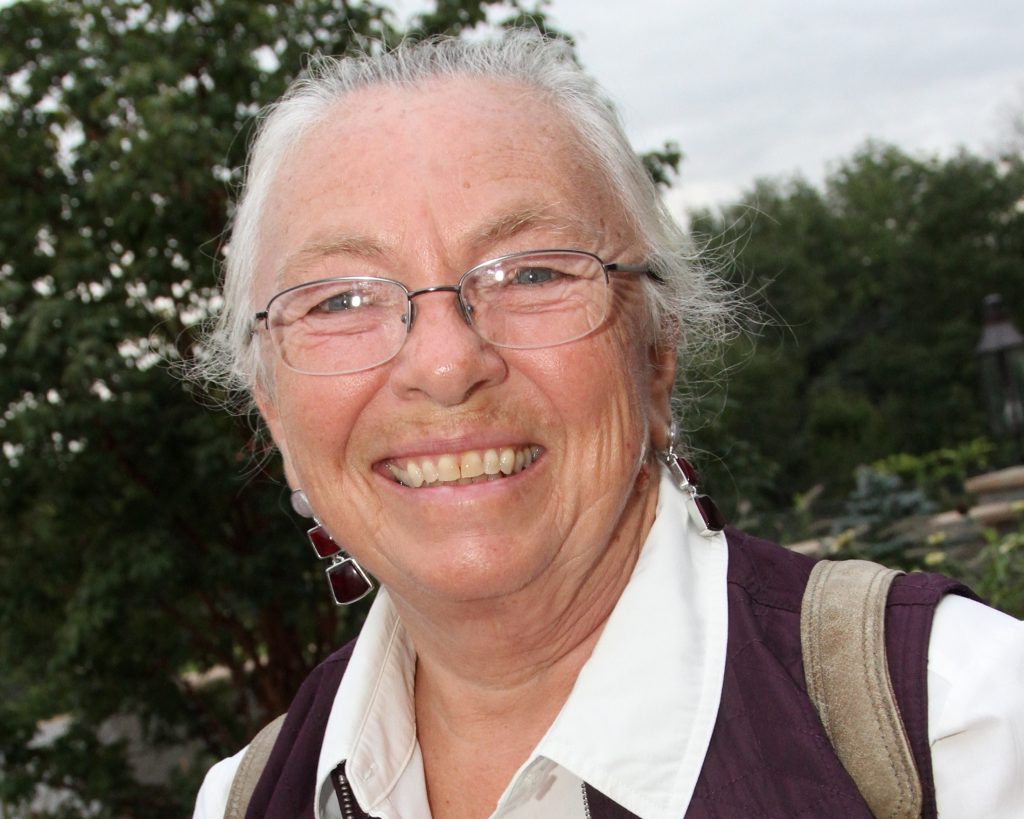
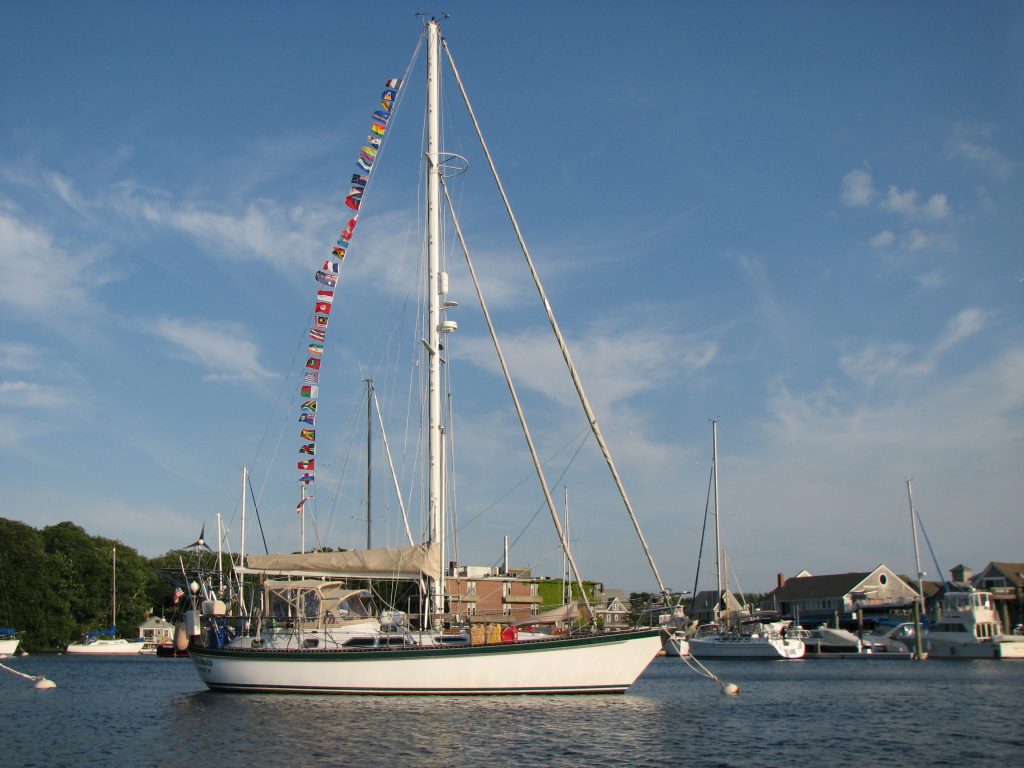
After almost 6 years of traveling, we sailed into Woods Hole on Cape Cod. We continued living aboard for the next five years and I wrote about that, adding ‘and Beyond’ to the title of the blog. Then shortly before Mark’s death in 2016, we sold our beloved Windbird and my travel logs became land logs. At this point, I had written a daily account for each and every day for 11 years. I fully intended to end the blog at that point, but when I wrote that news in a log, I got many responses saying that I really needed to keep posting. At the same time, I realized that I couldn’t stop writing. Summarizing each day had become a permanent part of my life and I will probably continue writing until I can no longer. These postings reflect the ordinary, and sometimes the extraordinary, days in my life and I would like to invite you to join me on my journey.
Day 231, Year 5 Winds Abating
Day 231, Year 5 Winds Abating
Date: Monday, June 14, 2010
Weather: Sunny, Winds SE 15-25 Knots
Location: Ampanasia Bay, NW Madagascar
I don’t remember a time when I have been happier about lessening winds. It was still a windy day but nothing like yesterday and the day before, and as evening approached the winds started to quiet down even more. Let’s just hope this continues into tomorrow. Mark needs to go up our mast to check out our sagging inner stay and Ed needs to get in the water to check out the gouge in the side of Constance and then he needs to go up his mast to check out their broken headstay. So a quiet day would be great. We might even get to go to shore for a walk in the dry bush country. It looks desolate, but I’m sure when examined up close there all kinds of things to see. The land here looks very much like the Northern Territory in Australia. It is red soil bush country just begging to be explored. Maybe tomorrow.
Mark continued working on projects all morning while I worked on my never ending job of editing and naming photos from Chagos. I had been looking at photos of turquoise water, white sand, and green islands for about two hours and when I went outside to hang out a laundry. I looked around and wondered why everything had turned brown. It really took me a second to remember where I was. Certainly not in Chagos! After lunch, Ed came over in his dinghy and took us over to Constance. We all examined the damages to Constance and then Mark and Ed worked on replacing a reefing line in the boom. The line had broken sometime during the trip. Lynne and I sat and talked and just enjoyed seeing each other in person again. We got out charts and discussed plans for where we would anchor between here and Nosy Be and Ed got on the SAT phone and called a phone number for a marine shop on Nosy Be that we found in the notes we have about Madagascar. He was told to call another number and finally reached a gentleman on a boat anchored somewhere on Nosy Be who is going to research the possibility of having Constance pulled out of the water for repairs if necessary. We didn’t find out any definites but it was good to make contact with someone who might be able to help. After returning from Constance I was out on the back deck rinsing out the clothes that had gotten salt water splashed on the way back to Windbird. All of sudden I hear Jingle Bell Rock, and I knew instantly that Mark had turned on the CD player. Evidently we haven’t listened to any music since Christmas in Thailand. He had been removing wooden panels to check out the chain plates to see if there was evidence of leaks. In doing so, he jostled some wires from the CD player and decided he needed to check it out. I came in and took out the Christmas music and put in some of our favorites. Right now we are listening to a Nora Jones CD given to me by my friend Linda Stuart back in Concord. Linda gave me the CD as a going away present so I would think of her when playing the CD thousands of miles away. Well, it worked. Linda, I’m thinking of you and missing you so very much.
Day 230, Year 5 Windy, Windy, Windy
Day 230, Year 5 Windy, Windy, Windy
Date: Sunday, June 13, 2010
Weather: Sunny, Winds SSE 30-35 Knots
Location: Ampanasia Bay, NW Madagascar
The weather forecast is for four to five more days of this over-the-top windy weather. Graham on the South Africa Maritime Mobil Net tells us that a 1030 high is sitting at 36S and 63E (as far south as South Africa and almost directly south of Mauritius) and that it plans to sit there for a few more days before moving on. This high normally sits much further south and it creates the SE trade winds, which in normal conditions provide the wind we need to sail the Southern Indian Ocean. In this case, it has moved much further north than normal, pushed there by lows in the deep southern ocean. So it is this high that is far, far away from us, but much closer than normal, that is causing our problems. In the meantime we are stuck here in Ampanasia Bay. (Note: Ampanasia Bay is also known as Jenkinson Bay and Ampanasinah Bay. It is the second little bay from the top of Madagascar.) We can’t even get the dinghy off the deck and even if we could it would be too dangerous to runabout in the bay. The strong gusts and waves could flip you over. Ed launched his dinghy last night out of desperate need. We had some epoxy that cures under water and he needed it to try to stop the leak in Constance. But even though he needs some tools from us to continue his repair work, he doesn’t dare try to come over again until the weather settles. At least the sun is shining. I did laundry today but couldn’t hang it outside because of the wind. I do have some wonderful clips that fit over our stainless handrails just outside the cockpit, so I was able to hang a few things that way. The other pieces are dripping and hopefully drying in the shower stall. I also worked on editing and naming photos. This is a perfect job for right now as we have unlimited power from the wind generator. We haven’t had to run the engine to charge the batteries since our second day of passage, so I can keep the computer on non-stop. This is a luxury that we have never had before. I guess our wind generator likes Indian Ocean wind. Mark spent his day ticking off chores on his list–replace the blocks on the traveler, replaced blocks on the Jyb-Easy, worked on oven pilot light, investigate why our instrument panel is no longer displaying engine hours (maybe we have traveled too many miles), seal the auto pilot cockpit controller with silicon, and on and on. He was a busy man today.
The news from Constance is that the leak is now down to a dribble but not completely stopped yet. The impact from whatever they hit was hard enough to move the cabinetry on the port side of Constance three inches toward the center of the boat. In order to continue to investigate the damages, Ed has to remove a wall that runs behind their settee. To do this, he needs a saw from us but we can’t get it to him. We just have to wait for a lull in the wind and hope that comes sooner than predicted. Ed and Lynne seem to be in amazingly good spirits considering the damage and clean-up from the water that got into the main cabin. Ed also has a number of other little things that broke along the way, so like Mark, he has plenty to keep him busy. When I talked with Lynne this morning she told me that her beautiful basil and arugula plants were killed by the saltwater that constantly blew into their cockpit during the passage. She was so proud of the basil that she had re-rooted from original plants that had turned woody. Her new plants were looking really good. I lost the plants in the pots hanging from our arch on the back of the boat, but since that was an experiment, I wasn’t upset about that and the ones in the cockpit made it through just fine. So I’ll divide and share with Lynne.
Even here at anchor the wind is still so strong that we are heeling over during the gusts. That means that even walking around the boat is still a hazardous sport. This morning I made biscuits for breakfast. I put the required butter and blueberry jam on the table and walked away. When I returned the blueberry jam had slid off the table and on to the embroidered silk settee cover I brought for myself for my birthday while in India. I love this cover and was devastated to think that my stupidity of setting something down and expecting it to stay there might have ruined it. Luckily the blue stain came right out but hopefully I have learned my lesson. Another not so bright human error also caused another bigger mess in our forward bathroom. We have four milk crates of food stacked in there along with countless other plastic boxes of crackers and granola, cardboard storage boxes containing our old freezer condenser and bottles of water, many individually wrapped rolls of toilet paper, packages of paper towels, and so on. Well, one of the containers of crackers bounced during one of our rogue wave experiences yesterday and turned on the water in the sink. It was just turned on a little, but over the course of the day, the sink filled and sloshed water all over everything in the bathroom including all of the food in the plastic milk crates. Most everything was vacuum packed but things that weren’t were wet inside the packaging. All of the packages of spaghetti noodles had parts of them that were water logged as well as the hard taco shells and a few packages of crackers. I opened each package of spaghetti (10 in all), removed the dry noodles and threw out the soggy ones. I did the same with the hard taco shells and crackers. A little foresight could have kept this from happening, but that’s what we learn in hindsight. We should have just shut off the pressure water while on passage. I use the foot pump in the galley and we only need pressure water for showers. So we could have turned it on just for showers and avoided any possibility of a leaky faucet in rough conditions. We will do this in the future. This was a lesson learned the hard way. For the second time in five years I also had to re-shelve all the books on the v-berth starboard book shelf. The first time they tumbled down was on our maiden voyage to St. Martin in the Caribbean. In that case, books on both sides of the v-berth were jumbled on the v-berth mattress along with water that came in through the forward Dorade vent. What a mess that was. We now seal that vent when in passage and we installed very sturdy straps that hold the books in place. Well, at least they held the books in place for almost five years. Yesterday’s little jaunt fixed that.
Day 229, Year 5 Arrival in Madagascar!!!
Day 229, Year 5 Arrival in Madagascar!!!
Date: Saturday, June 12, 2010
Weather: Sunny, Winds SSE 30-35 Knots, Gusts to 50
Latitude: 12 degrees 01.448 minutes S
Longitude: 049 degrees 12.057 minutes E
Passage Statistics:
1466 miles in 9 days 3.5 hours (219.5 hours)
Sailing Hours–216.5
Motor Sailing Hours–3
Average Speed-6.7 Knots
Fuel Usage–1.5 US gallons or about 6 liters
This was by far our fastest passage ever, but it was also the most challenging. Even now that we are at anchor we still have 30-35 knot winds. During the passage we had squall after squall and heavy winds which made for uncomfortable living conditions, but not until today did we feel the potential for serious problems. Conditions were not life threatening but I felt more unsafe than anytime since we left Boston in 2005. We had to be constantly alert as the seas were BIG and the winds were HIGH. We had 40 to 50 knots gusts a few times with winds typically above 30 knots. Seas were 12 to 15 feet and we found ourselves surfing down the waves and then sometimes while surfing we were hit broadsided by a rogue wave that would knock us violently sideways. Those were the scary ones and the ones that made a wreck of the inside of the boat. This really only happened twice, but twice was enough. For a time we were heading up the coast wing and wing with the wind behind us. We had an accidental gibe that blew one of the pulleys that attaches Gyb-Easy to the deck, so that gibe was not easy. The line and pulley flew into the plastic window of the new cockpit enclosure and ripped it two places. That will have to be replaced in South Africa. That same jibe also broke another pulley on the main sheet traveler. Basically this is a device that helps control the main sail. So we have a few things that need to be replaced, but nothing major. And that is why we are so thankful that we chose Windbird as the boat to take us around the world. She is steady and sturdy and very forgiving. We love you, Windbird.
Ed and Lynne also made it in today which is amazing considering that they have not had a head sail since the second or third day of the trip. Constance is also a steady, sturdy boat but today she was challenged when something hit her on the port side. They really didn’t know what had happened until they arrived here and Ed could get in the dinghy to look at the side of the boat and could see a gash in the hull, but what they did know earlier was that they had a leak into their main cabin. Ed put some epoxy in the cracked fiberglass near one of their scupper drains which helped, but they still have to isolate the real problem and figure out what to do. They also had a problem with a planned gibe that went wrong and broke something in their traveler.
So we are here and will slowly heal our wounds. We are hoping that the extremely high winds will settle in the next day or two so we can get in the dinghy and explore the land around this bay before moving further south. We had a beautiful sunset tonight and look forward to our first sunrise in Madagascar tomorrow morning.
I mentioned yesterday that my niece’s daughter graduated from high school. Today we got an email from our daughter telling us that Sam, our oldest grandchild, graduated from nursery school yesterday. Next fall he will be in preschool. Unbelievable. These babies grow up way too fast.
 |
| 100612 Day 229– Passage Chagos to Madagascar |
Day 228, Year 5 Passage to Madagascar, Day 9
Day 228, Year 5 Passage to Madagascar, Day 9
Date: Friday, June 11, 2010
Weather: Overcast and Squally; Winds SSE 22-24 / 30-35 Knots
Latitude: 12 degrees 01.111 minutes S
Longitude: 051 degrees 29.450 minutes E
Miles to Go: 150
Jessica Price is my sister Patsy’s oldest grandchild and she graduates from high school today. So congratulations to Jessica. It is times like these, when I know family members are gathered to celebrate, that I really miss, but I’m certainly there with them in spirit.
This morning on the radio Mark asked Ed to give his position report and all Ed said was, “Uncomfortable.” That sums up our experience of the last twenty-four hours. Today has been an ugly one-totally overcast with one squall after another. At least we have 30 to 45 minute periods between squalls when things settle down. And we are making amazing progress and should definitely reach the east coast of Madagascar in the morning. If that happens as planned, we will then round the top and be at anchor by afternoon. Evidently we aren’t going to get a break from this weather for another day or so as a weather system is basically sitting on top of us. It should be heading off by Sunday and I’m sure looking forward to sunny skies with no squalls. We had another all-time high mileage day the last twenty-four hours going 170 nautical miles. Yesterday at this time we had 320 miles to go and now we have 150, so progress is definitely being made. We are sailing with almost no headsail and a reefed main, but with winds like these you hardly need sails!
Madagascar: A Little Geography
I keep saying that we are going to round the cape at the top of Madagascar so I’ll take time to give a little background so you will know that that means. Madagascar is about a thousand miles from top to bottom. It is much longer than it is wide and at its closest point it sits only 225 miles from the East African coast, situated parallel to Mozambique. The cape at the very top of the island is called Cap de’Ambre. Once you are over the top and start down the west coast there are three bays, no more than five miles from the top. It is the middle bay where we plan to anchor first. This, of course, is in northwestern Madagascar and this is part of Mad where we will be spending most of our time. If you look at Madagascar on a map it almost looks like someone bit a huge chunk out of the northwestern coast and then they spit out the pieces and these became little islands scattered all along. That ‘bite’ leaves a crescent shape from the Cap de’Ambre out to Cap de’Andre some 350 miles south and west. Islands in Madagascar are called ‘nosy’ so Nosy Be is the island of Be. We will spend a week or so working our way south from Cap de’Ambre to Nosy Be where we will visit Hell-ville, the administrative center where we check-in. The distance is only a hundred miles but there are a number of anchorages on the mainland and a few ‘nosies’ that we want to visit on the way. Nosy Be is about the southern limit of what is referred to as Northern Madagascar. From there south along the coast is Western Madagascar and we will eventually travel the 250 miles from Nosy Be following the crescent-shaped curve of the ‘bite.’ From the southern end of the crescent we will then travel across the Mozambique Channel to South Africa. Geographically, there is also a southern section, an eastern section, and a second eastern section where the capital of Antananarivo is situated. We will only be visiting places in the northern section and some of the coastal western section. If the political situation were different, we might do more travel in the south, but at this time that would require flying in and out of the capital and that is the hot spot for political unrest. So northwest it will be for Windbird’s crew.
Day 227, Year 5 Passage to Madagascar, Day 8
Day 227, Year 5 Passage to Madagascar, Day 8
Date: Thursday, June 10, 2010
Weather: Repeat–Squally Night; Sunny Day, Winds ESE to SE 28-32
Latitude: 11 degrees 27.099 minutes S
Longitude: 054 degrees 14.055 minutes E
Miles to Go: 320
Another day, another 160+ miles, and all is well aboard Windbird. We didn’t realize we were going to be flying to Madagascar, but that’s how it feels out here. When we talk to Ed and Lynne of Constance on the radio Lynne says she misses looking out and seeing the “birds”—that’s us. But the “birds” flew away and can’t stop. The wind has not let up, and in fact, today it was even stronger, staying around 30 knots, sometimes gusting to 40. For most of the day we had the little triangle of headsail that we are flying poled out to port and we were sailing wing and wing. But the winds got even stronger late this afternoon and turned from ESE to SE, so now we have the headsail back out to starboard. Our speed over ground is over 7 knots due to a positive current of 1 to1.5 knots and if things continue as they have today, by this time tomorrow (Friday) afternoon we will have about 115 miles left to go to reach the east coast of Madagascar. That means we could reach the coast sometime Saturday morning. If that happens, then we can round the top and be at anchor late Saturday afternoon. I think both of us are looking forward to that. This passage has been fast, and it hasn’t been relaxing. We always have to be on alert for the next squall or a shift in the winds. With strong winds like we have been having, there is very little room for error, so once again being at anchor will be a great relief.
We have heard from a number of our sailing friends in response to our June letter to family and friends. It was so good to hear from friends that we crossed the Pacific with in 2006. Randy and Sheri of Procyon are back in California, Tom and Bette Lee of Quantum Leap are in passage to Fiji for one more season in the South Pacific, and Idunn and Rune of Blue Marlin are now living in South Korea where Rune is working as a subsea engineer on an oil rig being built. The twins, Hedda and Marita, are in the International School and all will be heading back to Norway for a summer holiday. Rune will join the rig in Singapore and sail with it to the Seychelles before he joins the rig
again in Tanzania. We will be in Madagascar at that time and he will try to connect with us via radio. Dave and Patti of This Way Up, friends from Australia that we met in the Sail Indonesia Rally are now traveling to the eastern part of Indonesia with another rally. Friends that we met in Chagos on the boat Nepenthe have made it safely to Dar es Salam in Tanzania and Far Niente has made it to Nosy Be in Madagascar. We’ll be catching up with them soon. Neil and Ley of Crystal Blues, friends we met at the Boat Lagoon while our boats were being painted are currently anchored on the north coast of Borneo. At least Ley is there in the boat waiting for Neil to return from a week’s work in India. Soon they’ll be heading back to Singapore. Friends from the Boston area, Susie Klein and Jim Hammitt are headed up the East Coast of the US in their boat Reveille. They sailed Reveille to the Med a few years ago and had it shipped back to Florida last season. So this trip will return Reveille to her home in Padanarum in Rhode Island. And our friends Larry and Angela Beavers in Fall River, Rhode Island, are launching their 24 foot C & C named Isabel this weekend. So our sailing friends are spread far and wide all over the globe and it is great to keep in touch with them.
Day 226, Year 5 Passage to Madagascar, Day 7
Day 226, Year 5 Passage to Madagascar, Day 7
Date: Wednesday, June 9, 2010
Weather: Another Squally Night; Sunny Day, Winds ESE 28-30
Latitude: 10 degrees 54.810 minutes S
Longitude: 056 degrees 56.731 minutes E
Miles to Go: 479
My day started at 4:30 am with squalls packing heavy winds and rain. Then at 6:50 am when I was getting ready to turn on the radio to report our position back to folks in Chagos, I found Windbird heading in the wrong direction. One minute we were headed West and the next we were headed due East. I looked over at the Auto Pilot display unit and it was reading in digital Chinese and I couldn’t control the wheel as it was still locked in auto mode. I called down to wake Mark and he turned off the Auto Pilot so I could steer. He hand steered while I checked into the Chagos net and then I hand steered while he tried to figure out the problem. We suspected that water getting into the system could be the problem, but in order to check things out Mark had to take our aft cabin bed apart and take down part of the ceiling. The drive unit for the auto pilot is under our bed and the wiring going to the control unit in the cockpit is above the ceiling. By 9 am he had found a disconnected wire, fixed that, but still the main display until was reading in digital Chinese. He brought out the fancy little hand-held remote for the auto pilot and after a few tries that worked and is still working. Mark bought this unit at the Newport Boat Show last fall and I have given him all kinds of grief about the purchase saying that was just another boy toy-not necessary. Well, I take back all of those unkind words back because after hand steering in heavy seas and winds this morning for an hour, I certainly wouldn’t want to do that for the next few days until we reach Madagascar. So praises for Mark’s trouble shooting and for the little hand-held unit. Later in the day I was waking from a nap when I heard Mark say that he was going out on deck-right now! I jumped up to find that he had noticed that a very expensive and very vital bolt that connects our roller furling to the chain plate was loose and about to fall out. We lost that bolt once before and certainly didn’t want to lose it again, especially not in these windy conditions. I cannot express how lucky I feel today. Things could have and still could turn out another way, but for now we have an auto pilot and we have our head sail roller furling. All is well.
The conditions out here are tough. The wind averaged 28 knots all day today with gusts up to 40 and times when 32-35 knots was the norm. That’s windy, but it is from behind us and that helps. The seas are a good three to four meters or nine to twelve feet and they come at us from behind the beam. The good thing is that they are far enough apart to make the conditions not too rough. So we rock and roll a bit and once in a while we lurch so that walking down below is a hazardous sport. If predictions are correct, things are going to stay this way until we reach the coast of Madagascar, so we have settled in and are just happy that things are not rougher.
Day 225, Year 5 Passage to Madagascar, Day 6
Day 225, Year 5 Passage to Madagascar, Day 6
Date: Tuesday, June 8, 2010
Weather: Repeat–Squally Night & Day; SE Winds 25
Latitude: 09 degrees 59.987 minutes S
Longitude: 059 degrees 23.599 minutes E
Miles to Go: 633
Windbird is more than half-way to Madagascar, we have lots of wind, and right now we have blue skies, so all is going well. Of course, the clearing skies and sunshine just appeared as it did at this time last evening. Today, as yesterday, was mostly overcast with squall after squall. Today’s squalls packed a little more wind than the ones during the night and yesterday, with some gusts up to 40 knots, but the strong winds come from behind us which makes it easier to deal with. The strain comes from having to constantly sit behind the wheel and adjust the autopilot. That’s easier than hand steering, but it does take full attention. So not much is getting done other than tending sails and steering via the autopilot. I must say now that the sun has come out, everything seems much better. When we are not dealing with a squall, the winds have been hovering around 25 knots. So we are flying across the waters even with a double-reefed headsail and single-reefed main. We put in a double reef in the main last night, but have decided to go with the single reef for tonight. If the winds continue as they have, we should make landfall on the western coast of Madagascar on Sunday. If that should happen that would make this a ten-day passage. We were expecting much longer, so we shall wait and see. Constance is now about 30 miles behind us but they are doing well. It’s hard not to move quickly in these strong winds, even with reduced sail. I did get to do a little reading about Madagascar during the night, and I think I’ll continue the research tonight and report on my findings tomorrow. But I’ll end with a couple of questions and I’ll bet you’ll know the answers. What island country is considered to be the world’s only Afro-Asian country? What is the world’s fourth largest island? More tomorrow.
Day 224, Year 5 Passage to Madagascar, Day 5
Day 224, Year 5 Passage to Madagascar, Day 5
Date: Monday, June 7, 2010
Weather: Overcast, Squally Night & Day; SE Winds 20-24
Latitude: 09 degrees 05.600 minutes S
Longitude: 061 degrees 59.415 minutes E
Miles to Go: 796
The last twenty-four hours have been our most challenging for this passage. Until noon yesterday we hadn’t made any adjustments to sails since leaving Chagos. We reefed the headsail yesterday to slow ourselves down to stay within sight of Constance, but shortly after sending the log in the evening, the decision was made to go on so we will have a chance of making it through the Saya Banks during the daylight hours tomorrow. We had a squally night with no rain, just wind, and then a squally day today with rain and low visibility alternating with periods with almost no wind. So we certainly haven’t left Constance in the dust. They are about 15 miles behind us now and we are still in VHF radio contact. They have had totally different weather from us. While we were overcast all day, they were in sunshine. The clouds are starting to clear where we are and the sun is shining brightly so maybe we are through the ugly weather for now. We still might make the banks by afternoon tomorrow. These are shallow areas and the pass we will go through can have a lot of current and be a bit rough, so we do hope to go through during daylight hours. We can then radio conditions back to Constance. So the miles are ticking away. Once through the banks we have four to six days of sailing to reach the east coast of Madagascar and then we head over the top. We’re getting closer but not at the half-way point yet.
We have had a bit of drama with our email the past two days. We have been able to send emails, but we can’t receive. We receive short emails but when it comes to the longer ones, like GRIB files, we get a strange error message. We haven’t been able to get a GRIB file for 48 hours so we tuned into a South African radio net this afternoon. The net controller is a man named Graham and he was glad to hear from boats in the Indian Ocean. Now that he knows where we are he will have more specific weather for us tomorrow. In the meantime, we are emailing Winlink and trying to figure out the problem.
Another cargo ship just passed behind us and we have seen a few birds today. Otherwise, our time has been spent adjusting sails and keeping ourselves on course. So I have no Madagascar science lesson today. Maybe tonight will be a calmer night and I’ll get some research reading time.
Day 223, Year 5 Passage to Madagascar, Day 4
Day 223, Year 5 Passage to Madagascar, Day 4
Date: Sunday, June 6, 2010
Weather: Sunny Day; SSE Winds 12-16 Knots
Latitude: 08 degrees 18.381 minutes S
Longitude: 064 degrees 16.696 minutes E
Miles to Go: 940
One-third of the way there, but things do happen. Both Windbird and Constance were sailing along on a fast track to Madagascar when Ed noticed that the headstay on Constance had broken at the top. The headstay is the heavy wire around which the roller furler and head sail are attached. The halyard holding up the headsail was holding up the whole mechanism, so thankfully nothing came down. He and Lynne were able to roll in the sail and reinforce the halyard with the spinnaker halyards that are not in use. For those of you who are not sailors, the halyards are the lines that pull sails up and down and in this case are being used like a wire stay. Constance is a cutter rig, so there is an inner staysail which helps support the mast, but the sail itself is very tiny. But they rolled that sail out and are sailing along about a knot to a knot and half slower than they were. Not wanting to leave them behind, we rolled in our headsail and put out the staysail. It was then that we noticed that the stay that holds our staysail roller furler and sail has somehow gotten very loose. So we rolled that in and went back to a double-reefed headsail. All of this happened about four hours ago and we are still about the same distance from Constance, so it looks like we have found a way to stay with them. They insist that we fly on, but we’ll continue like this through the night and make a final decision tomorrow on whether or not to go on or stay behind. We are still moving at 5.8 knots which is as fast as we normally go. This trip is faster because the winds are just right and we have a half to a knot of current going with us. The winds are less today, down to 12 to 16 knots, but they are a bit more southerly which puts us on a broad reach. So all is well and Ed thinks once he gets to a quiet anchorage in Madagascar that he can repair the damages. That’s good because there are basically no marine services in Madagascar and you don’t want to head to South Africa without strong rigging. Our friends Peppe and Bob on Far Niente have been in Madagascar for a few days now and they have found the northern anchorages to be VERY windy. So Ed might have to wait until we get down the coast a bit before attempting the repairs.
Another cargo ship passed about six miles in front of us early this morning, but we have seen no other fishing boats, cargo ships, or even birds today. During the night, I used my watch time to read a Bradt Visitor’s Guide to Madagascar Wildlife and the hours passed so quickly. I’ve always known that Madagascar is home to unique plants and animals that exist no where on earth, but I really didn’t know why until last night. If you feel a lesson in evolutionary biology coming, you are right. I’m no biologist, but I just have to share what I learned. We just left the atolls in Chagos which in their current form are very young, only thousands of years. For Madagascar, we have to go back MYA’s (millions of years ago). The Bradt Guide (the only one I have) uses the MYA abbreviation, so I will use that as well. If we go back 200mya to the days when dinosaurs roamed the earth, the huge land mass of Gondwana was just starting to break apart. This land mass broke apart to form South America, Africa, Antarctica, and Australia. Fast forward to 165mya and scientists say Madagascar, with India still attached, broke away from Africa. Then a ‘mere’ 80mya, India migrated north and left Madagascar as an isolated island. It would have been populated by dinosaurs as they didn’t start to die away for another 15 million years. So Madagascar has been isolated for a very long time and in that time some of the earth’s most interesting creatures have arrived and evolved in isolation. By the way, the oldest dinosaur bones discovered to date come from southern Madagascar. They date back 230 million years, before the break-up of Gondwanaland. So that’s the science lesson for today. I’ll wait to get a correction email from our daughter who is an evolutionary biologist to see just how far off these facts gathered in my wildlife book might be.
Day 222, Year 5 Passage to Madagascar, Day Three
Day 222, Year 5 Passage to Madagascar, Day Three
Date: Saturday, June 5, 2010
Weather: Sunny Day; SE Winds Alternating 15-20 and 12-15 Knots
Latitude: 07 degrees 27.317 minutes S
Longitude: 066 degrees 40.345 minutes E
Miles to Go: 1,092
The Indian Ocean can be angry, but so far on this passage she has been fabulous. We continue to roll through 155 miles days averaging about 6.5 knots. This afternoon the wind has diminished but our speed is still a 6 knots due to a positive current headed our direction. The early mornings are a bit cloudy, but by 9 am the sky is a bright blue with scattered white puffy clouds. Later in the afternoon, more clouds appear and by sundown the last light of the day must peak through the clouds. Then miraculously there is a clear, starry night until after midnight when the clouds seem to return. Last night when I came on watch at 10:15 pm I was looking at the Big Dipper to starboard and the Southern Cross to port. The night sky is amazing and it makes me wish I knew more about it.
We had another big cargo ship pass in front of us this morning, but this time we saw it coming. And then in the early afternoon we spotted what looked like a fishing boat coming up from behind us. That gave us a bit of a scare as that is the technique the pirates use, but there are no pirates in this part of the ocean. We called Constance and they had another fishing boat passing in front of them. The one came within a half-mile of Windbird and it was easy to see that is was definitely a working fishing boat. In fact, it looked like it was reeling in a very long fishing net that was piled high on the aft deck. BIOT makes a bit of money each year selling permits to fishing boats from as far away as Korea, so we shouldn’t have been surprised by seeing a boat. But they are few and far between.
Mark is down at the nav station trying to listen in on a South African weather net that comes on at 4:30 pm our time. We’re just starting to try this. It is when we leave Madagascar headed for South Africa that getting these reports will be critical. For now we have Captain Jay Burgess (from New Hampshire) of the UUS Lopez stationed in Diego Garcia watching for any heavy weather for us. We made contact with him when we first arrived in Chagos and we talked to him again yesterday morning on the High Frequency radio. Thanks to Alan and Helaine Kanegsberg back in New Hampshire, we now have his email address and we can also communicate that way. We are very thankful that he will be sending us any notice of adverse weather or piracy activity during this passage.