by Judy Handley | May 8, 2006 | Passage To French Polynesia - Marquesas, Sailing Logs Year 1 |
Day 203, Year 1: Procyon’s Medical Emergency–Day 17
Date: Monday, May 8, 2006
Weather: Blue Skies Dotted with Puffy White Clouds
Air Temperature: 80 degrees F, minus a degree or two at night
Water Surface Temperature: 81 degrees F and rising
Latitude: 08 degrees 12 minutes S
Longitude: 127 degrees 29 minutes W
Location: Passage from Galapagos to the Marquesas, Day 17
Miles to Go: 683 (~130 miles last 24 hours)
Miles to Date: 2294
Today’s big decision was whether or not to make brownies for watch snacks. I had to laugh as I tried to think back to a year ago this time when Mark and I were making daily decisions that certainly didn’t have anything to do with whether or not to cook something. But out here, today, that was the big decision. I did make the brownies and they will help the night watches to go much more smoothly. Chocolate in the middle of the night does wonders.
Every morning when we check into our radio net, the first thing the net controller says is, “If there is any emergency or medical traffic, come now.” There has not been a response to that on this passage or on any net we have been on since leaving home. But this morning there was a response from Sherri on Procyon. I think I stopped breathing momentarily, afraid to hear what she would say. If you have read prior logs, you might remember that Randy, Sherri’s husband, had to be air-lifted out of the Galapagos to mainland Ecuador for an emergency operation. That was about six weeks ago. He returned to Puerto Ayora after having stomach ulcers removed and spent the next four weeks recuperating. Randy and Sherri left the Galapagos five or six days after we did, and everything seemed to be going fine, but evidently last night Randy fell and hurt his back. Then later in the night he started having pain in his upper abdomen and was quite nauseas. Tom of Quantum Leap is a physician and Sherri talked to him this morning. We are all hopeful that he just has a case of mild food poisoning and that the fall had nothing to do with the nausea, but we just have to wait and see. When on a passage like this, so far away from land and any help, there are about three things that you don’t want to happen. You don’t want to hit something that might put a hole in your boat, you don’t want to fall overboard, and you don’t want to have a major health problem. Hope with us that Sherri can hold things together until Randy is better and that this is not a major health problem and that he will get better quickly.
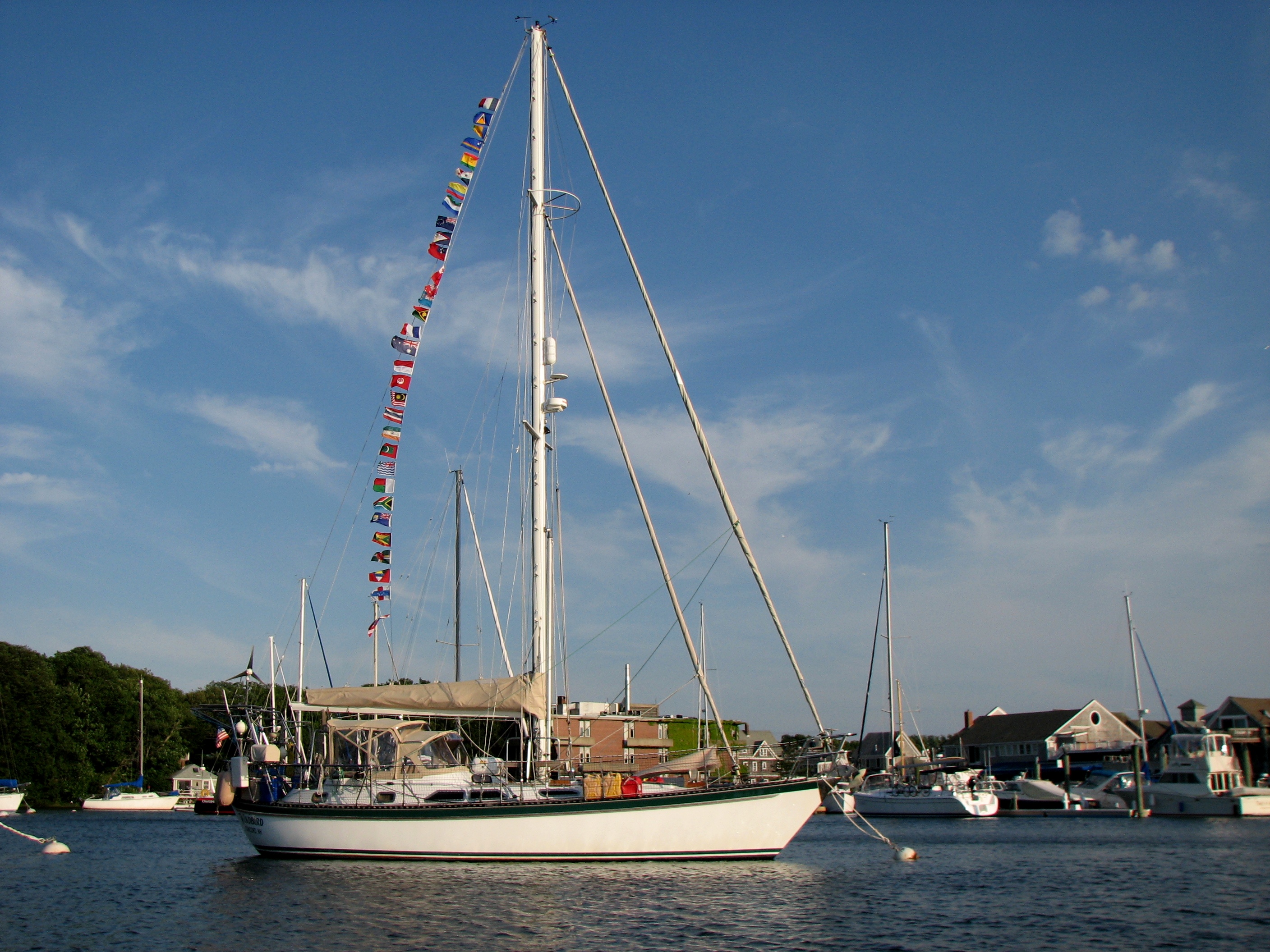
We are still sailing wing and wing and heading a little more north than we would like, but we do have wind and that is good. It is amazing how quickly the days and nights pass. And it is truly a gift to be out here and to be able to enjoy nature at it’s finest. Last night when I came on watch at 9 PM, the half moon was shining brightly and the sky was filled with stars. When I come on watch, I sit in the dark for about 20 minutes just looking around and watching every carefully. Last night, I noticed a strange ruffling of the water near the front of the boat. I kept watching this to starboard but couldn’t figure it out. Then I went to port and look and saw the same thing, but on that side I could see what was causing the disturbed water. It was dolphins playing with us in the night. They were following along side Windbird and diving under the bow of the boat and coming out the other side. About that time, I saw a falling star. I then sat back and put on my headlamp so that I could read, but as I did so, I felt a great satisfaction of being in harmony with nature.
by Judy Handley | May 7, 2006 | Passage To French Polynesia - Marquesas, Sailing Logs Year 1 |
Day 202, Year 1: End of Windbird’s Wind Bubble–Day 16
Date: Sunday, May 7, 2006
Weather: Blue Skies Dotted with Puffy White Clouds
Air Temperature: 80 degrees F, minus a degree or two at night
Water Surface Temperature: 81 degrees F and rising
Latitude: 08 degrees 40 minutes S
Longitude: 125 degrees 24 minutes W
Location: Passage from Galapagos to the Marquesas, Day 16
Miles to Go: 800 (~123 miles last 24 hours)
Miles to Date: 2166
Well, today it happened. Our little wind bubble burst. We have had wind when no one else in the fleet has, but today we are flailing along just like the others. The winds vary from 5 knots to 15, but they are directly behind us and the going is slow. Our weather buoy reports indicate that the wind should increase in the next 24 hours. Let’s hope so.
Otherwise, all is well onboard. We saw a flock of birds today which indicates that we are getting closer to land. Otherwise, no signs of life. Gdansk, a boat out of Canada, and Trisha Jean, a US boat, are both very close to us, but we can’t see them. We could see Gdansk for about two days, but last night they dropped out of sight.
It has been a lazy day and we have not had our French lessons. Maybe tomorrow…
by Judy Handley | May 6, 2006 | Passage To French Polynesia - Marquesas, Sailing Logs Year 1 |
Day 201, Year 1: Sailing Wing and Wing–Day 15
Date: Saturday, May 6, 2006
Weather: No Change-Beautiful Blue Skies Dotted with Puffy White Clouds
Air Temperature: 80 degrees F, minus a degree or two at night
Water Surface Temperature: 79.5 degrees F
Latitude: 08 degrees 01 minutes S
Longitude: 123 degrees 33 minutes W
Location: Passage from Galapagos to the Marquesas, Day 15
Miles to Go: 915(~134 miles last 24 hours)
Miles to Date: 2043
During the night we dipped under 1,000 miles to go. Wow! It’s beginning to feel like we are almost there and yet we have more than 900 miles to go. That was the distance from Panama to the Galapagos and I know it will pass quickly. Problem. We were supposed to learn basic French while on this passage. We are, after all, going to French Polynesia. But I don’t think nine days will be nearly enough time. I’m not sure nine years would be enough time for me to learn French. But we will dig in tomorrow and begin an intensive short course. But we also have to practice pronouncing all of the Polynesian names by learning a whole new vowel structure.
‘A’ says the short sound of ‘o’ in the English language-the sound you make when a doctor puts a tongue depressor in your mouth to look down your throat.
‘E’ says the long sound of ‘a’ in the English language.
‘I’ says the long sound of ‘e’ in the English language.
‘O’ says the short sound of ‘uh’, like the ‘u’ sound in umbrella.
‘U’ says the sound you hear in the word ‘too’.
But it is not that clear cut. Just as in the English language, the sounds change sometimes when at the end of a word or in certain combinations. So Fiji sounds like ‘Fee-jee’. Fatu Hiva is pronounced ‘Fah-two-hee-vuh’. Hiva Oa is pronounced ‘Hee-vuh-O-uh’. Just practicing the names of the five islands in the Marquesas is challenging, but then when you get to the Tuamotus (Too-uh-mow-twos), it is REALLY challenging. There are lots of vowels in every word and you say the sound of every vowel. Try the names of these places in the Tuamotus: Fakarava, Tikehau, and Kauehi with the Arikitamiro and Tearavero passes into the lagoon. Or how about Rangiroa with the villages of Tiputa and Avatoru? Remember-say every vowel separately. Mark lived in American Samoa for a couple of years in the 1960’s and he has a handle on how to pronounce these names, but it takes me awhile to practice.
We have been sailing wing and wing since the middle of last night. That means that the headsail is poled out to one side of the boat and the mainsail is out to the other. Usually both sails are out to the same side, but the wind has taken a turn and is coming directly from the east when we want to go directly to the west. So it is dead behind us. We have continued to make good time, but we have really been rockin’ and rollin’. We have been able to head a little north of west and tonight we will go back to a normal sail configuration and sail southwest again. The ride will be much smoother.
Not much else to report today. Mark talked to a doctor with the World Clinic again this morning about his knees. We are still not sure what it is but he is better and that is good. We’ll just have to keep a careful watch to figure this one out. The burn on my thigh is beginning to heal although I still have what looks like a very large birth mark just above my knee. Otherwise, things here are great.
by Judy Handley | May 5, 2006 | Passage To French Polynesia - Marquesas, Sailing Logs Year 1 |
Day 200, Year 1: Thoughts About Email Communication–Day 14
Date: Friday, May 5, 2006
Weather: No Change—Beautiful Blue Skies Dotted with Puffy White Clouds
Air Temperature: 80 degrees F, minus a degree or two at night
Water Surface Temperature: 79.5 degrees F (rising)
Latitude: 07 degrees 49 minutes S
Longitude: 121 degrees 1 minutes W
Location: Passage from Galapagos to the Marquesas, Day 14
Miles to Go: 1042 (~ 138 miles last 24 hours)
Miles to Date: 1909
I love e-mail. Today I have “talked” with my son Justin who is in Africa, my daugther Heather on Cape Cod in Massachusetts, some friends back in the Concord, New Hampshire school district, my sister Patsy in North Carolina, my nephew Tommy in Maryland, Mark’s sister Mary Ellen in Florida, and our new friends Felix and Monica onboard Makani. I can’t even think what it was like in the days of Captain Cook when he was exploring the South Pacific with no communication with anyone “back home” for months, maybe years. This is certainly a different age and instant communication defines the age. Makani, the boat from Germany that went right past us a couple of days ago, is having radio problems. One radio is not working at all and we don’t know if their back-up is working for receiving or not. But they are e-mailing us their position every morning and we are reporting in on the radio net for them. We can’t e-mail them back as they are using a satellite phone for their connection and they have everyone but their son back in Germany blocked. But at least we know where they are and can report that to the fleet headed to Fatu Hiva. I now check e-mail at 0730 before the morning net and again at 1700 just after the evening net. If Makani should have a problem, we can alert others that are closer to them. This morning they e-mailed their position as of 0700, I checked e-mail at 0730, and Mark reported their position and conditions on the net at 0800. And I can communicate with Justin in Africa to know that he is fine and to learn all of the new and exciting things that have happened over the past eight years in the small village where he is staying. He was there in the late 1990’s and there was no internet café in the village. Now there is one a block from where he is staying with his African “family”. I can keep up with my family news through my sister Patsy in North Carolina in the states and through Mark’s sister Mary Ellen in Florida-all from out here in the middle of the Pacific Ocean. Absolutely amazing.
Before the end of Day 14 of this passage we will have less than 1000 miles to go to reach Fatu Hiva in the Marquesas. We did not expect to be this far at this point. Windbird is not a fast boat, but she is steady. Everyday we gain on others who left two and three days before us. We have just kept a steady wind where we are and they have not. Luck of the draw. Things could slow down, but we still think we will arrive in the next seven to nine days. We could have a 21 day passage and that is fantastic.
Some of you who have been e-mailing us are trying to figure out just where we are going. Where and what are the Marquesas? I mentioned in an earlier e-mail that the Marquesas are a group of islands that look like little dots on a world map. If you locate Panama and then head a little southwest, you will see the little dots of the Galapagos islands. If you go south you see the dot representing Easter Island (part of Chile). If you move west and a little south of the Galapagos you will cross a long blank space on the map representing 3,000 miles and come to islands that are politically grouped as French Polynesia. French Polynesia is made up of five different groups or archipelagos: the Marquesas, the Tuamotus, Gambier, the Society Islands, now referred to as Tahiti Nui, and the Australs. We will visit the Marquesas first, head a little south and west of there and visit the Tuamotus, and then head to Papeete, Tahiti to begin our exploration of the Societies. We will not be going further south to visit the Australs or Gambier on this passage. Bora Bora will be the last island we visit in the Societies and then we will head south and west to the Cook Islands, specifically Rarotonga. From there we go north and and west to Niue and further north and west to American Samoa and on to Western Samoa. Finally, we head south again to the Kingdom of Tonga and on to Fiji. In late October or early November we will leave Fiji and head to New Zealand for the summer (summer in the northern hemisphere). I believe it is another 3,000 from the Marquesas to Fiji so we have lots of sailing to do in the next six months . . . and lots of wonderful exploration as well. But this sailing will be broken up into many shorter passages.
The islands of French Polynesia are all emerged underwater volcanoes like the ones you find in Hawaii. There are the youngest islands formed by a volcano erupting until it builds a mountainous island above the ocean surface. These are the Marquesas Islands. The next stage in island development is for the volcano to begin to sink back into the sea. As it does so, the coral reef that has begun to surround the island continues to build itself up to the surface. The space that develops between the volcanic cone and the reef is a lagoon. The Society Islands are of this type. The final stage of island development is for the volcanic cone to continue to sink until it is below the ocean surface. All that is left is the surrounding reef which now may extend a few meters above sea level. The land formed on these exposed reefs are called motus and are actually tiny little islands (islets). These rings of motus that surround a large lagoon are what we will find in the Tuamotus.
So much for the geography lesson for today. There is SO much to learn, so I’m practicing what I am learning by writing it here. Hopefully you find it as interesting as I do, or at least a little interesting. Tomorrow I will focus on the five principal islands that are the Marquesas.
by Judy Handley | May 4, 2006 | Passage To French Polynesia - Marquesas, Sailing Logs Year 1 |
Day 199, Year 1: Still Smooth Sailing–Day 13
Date: Thursday, May 4, 2006
Weather: No Change—Beautiful Blue Skies Dotted with Puffy Clouds
Air Temperature: 80 degrees F, minus a degree or two at night
Water Surface Temperature: 79.5 degrees F (rising)
Latitude: 07 degrees 17 minutes S
Longitude: 119 degrees 10 minutes W
Location: Passage from Galapagos to the Marquesas, Day 13
Miles to Go: 1180 (~ 145 miles last 24 hours)
Miles to Date: 1771
Our time has changed once again. We are now in the Pacific Standard Time Zone-same as California-but we are not on Daylight Savings Time. I think that makes us two hours behind the East Coast. We will change one more time before we reach the Marquesas and then when we arrive we understand that we will move the clock ahead one-half hour. Strange. Only the Marquesas has a time zone that is UTC minus 9 ½ hours.
Another good day. The Weather Buoy reports that we receive daily tell us that if we stay on our course we will keep the wind for the next five days. The seas are a little rowdy right now, but they should subside by Saturday. And actually the seas aren’t that bad. It is just that we are running down wind and we roll with the waves. It is something that you get used to, but cooking is always a challenge.
Our watch schedule has become routine. I sleep from 7 to 10 PM and I’m on watch from 10 to 2 AM. Mark comes on from 2 to 6 AM and then he sleeps from 6 to 8 AM. That was 9 AM until today when we had to set the clocks back another hour, so he will have to take a second nap after the morning net or we will just move everything back one hour. That’s probably the best solution. The net now comes up at 8 AM and 4 PM and life revolves around that.
Last night when I was on watch, we passed a fishing boat. It was 6 miles off, but it had very bright lights and a large image on the radar screen. Other boats on the net have reported seeing a fishing boat out here as well. Who knows where the boat is out of but wherever, it is a long way from home. When Mark got up at 2 AM, he had a fever. He has had a sore knee for days and it was very hot last night. We called the World Clinic and they put him on regimen of Keflex. He scratched his knee a week ago, and it was really a tiny little scratch, but the doctor believes that started the infection. The scratch has healed but the doctor is afraid the infection might have gone into the bone. Yikes! You have to be so very careful out here. Every little scratch can turn into a major infection. Mark is better today and we will hope that the antibiotic will work.
No signs of life today other than the flying fish. These little guys glide along the water everywhere you look and often in the morning we will have a few on the deck. Oops! They missed their target. Some boats are collecting and drying them to eat. We have just been throwing them back to the sea. Since we lost our good lure and fishing line, we have not caught anything. We’re using a lure that usually attracts smaller tuna, but no luck so far.
We want to wish our friends Claire MacKellar and Kevin Russell a safe and successful passage from Boston to the Potomac in the Chesapeake. They are scheduled to leave Boston tomorrow. Kevin and Claire lived aboard at Shipyard Quarters when we were there and we become very good friends. They are the age of our daughter and her husband, early thirties, and this is their first solo passage. Claire has just finished her graduate work at Harvard Medical and will be doing her post-doc work in the Washingon, DC area. They liked living aboard so much that they are taking their home with them. Fair winds and following seas!