by Judy Handley | Apr 29, 2010 | Chagos, Sailing Logs Year 5 |
Day 185, Year 5: Walk Around Takamaka
Date: Thursday, April 29, 2010
Weather: Yet Another Drop-Dead Gorgeous Day
Location: Ile Fouquet, Salomon Atoll, Chagos
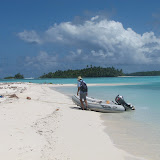
From our early morning walk all around Takamaka to an incredible moonrise foreshadowed by palm trees tonight, this has been a beautiful day. Low tide was just after 8 am this morning, so at 7:30 am we headed to Ile Takamaka with Ed and Lynne of Constance. We left the dinghy on the south end of Takamaka and started walking along the south end of the island. The pass between Ile Fouquet and Ile Takamaka was shallow enough to walk, so that we did. Ed stayed closer to shore and then headed to the outer reef, but Mark, Lynne, and I headed up through the pass and then toward the outer reef. The first thing we noticed were the hundreds of Red-footed Boobies and Great Frigatebirds that were flying above us. Then we got totally engrossed in the creatures of the reef. We found strange looking crabs, a turtle, incredible little coral structures, black sponges that we have not seen before, a soft-shelled mollusk, and sea stars of different types. On the east side of the island, we met up with Ed who was coming in from the outer reef further ahead of us and we then decided to keep on going to do a circumnavigation of the island. And we are so glad that we did because the bird population on the north side of the island was absolutely incredible. We saw hundreds of Red-footed Boobies and Great Frigate birds and the highlight of the day was seeing the baby and juvenile boobies. Adult Red-footed Boobies are white with black edging on their wings, having a blue bill and red feet. They are quite striking. The babies, however, are fluffy white with black bills, and the juveniles are a glossy brown with a black bill and pinkish-red feet. We saw all three stages in abundance. We thoroughly enjoyed the birds and the huge old hardwood Takamaka trees on the north side of the island. We could see the wreck of a freighter at the outer edges of the reef and saw another turtle. The views looking toward the north end of the island were spectacular and when we rounded the corner and headed down the west side, we enjoyed looking out over the anchorage and checking out the camps along the way. As soon as we rounded the north tip, we could hear roosters crowing. These are left over from the years when this island was a coconut plantation and workers visited camps here regularly. We stopped by the well and the camp which are the remnants from the days when this was a working copra plantation. We also saw clearly a wrecked sailboat that was just another reminder to tread carefully while here.
I spent the rest of my day editing photos while Mark changed the engine oil and read. We invited Ed and Lynne over for tuna chowder tonight and we watched the most incredible moon rise we have ever seen. As the one night after full moon rose behind the palm trees on Ile Fouquet, the silhouetted palms in front of the round moon were just spectacular. It was quite a lovely ending to a most beautiful day.
by Judy Handley | Apr 28, 2010 | Chagos, Sailing Logs Year 5 |
Day 184, Year 5: Exploring Ile Fouquet on Land and Water
Date: Wednesday, April 28, 2010
Weather: Another Beautiful Day; Few Storm Clouds in Evening
Location: Ile Fouquet, Salomon Atoll, Chagos
There’s a moon out tonight and it was full and beautiful as it rose over Ile Fouquet. And that was a fitting ending for the day we spent concentrating on that island. Yesterday when we were snorkeling between Windbird and the island, we were looking for a wrecked sailboat that went on the reef a few years ago. We found nothing yesterday, but this morning with the extra low tide we thought we saw a bow pulpit jutting up out of the water. So we hopped in the dinghy to check it out and sure enough, it was a wrecked sailboat. It sobers one to see just what going a reef can do to a sturdy sailboat. We came back to Windbird and got a plastic bottle and a piece of line to make a float to mark the wreck so we could find it later. We also took the spare GPS and noted the location so we can mark on it our CMap charts. While we were at it, we rode out behind Constance and marked the big bommie that is out there as well. We then spent a couple of hours working. I continued to work on the Madagascar anchorages spreadsheet and Mark changed the water and fuel filters on Windbird. Then we took the dinghy to the south end of Ile Fouquet and walked around the back side. We got almost to the end of the island before the incoming tide stopped us. We had also obviously come too close to nesting red-footed boobies and they flew up from the mangroves and soared right above us until we retreated. We walked half way back the way we came along the shore and then we cut through the middle of the island. This whole island was obviously a coconut plantation. There were probably camps here at one time, but I don’t think anyone lived here permanently. When we emerged from the coconut forest we were closer to the end of the island where we left the dinghy than we thought. We walked into the present day camp that has a BIOT sign and two recycling cans and we turned to walk back out to the beach. We got to watch two noddy terns fighting or mating, I think the latter. They would fly into the top of a coconut tree and then lock beaks and float together down to the ground. The tree they had chosen for this rite had little pieces of wood nailed into to make steps. When we looked around, we found another one with steps and in the top of that one we saw a red-footed booby scratching his chin with his little red foot. They are a white bird with black along the wings, a beautiful blue bill, and red feet. Mark tried and tried to get him to fly so I could get a photo, but the booby just looked down at his antics and shook his head.
After lunch, I worked MORE on the Madagascar anchorages spreadsheet and have now finished that task. Mid-afternoon, we called Constance to see if they would like to meet us at the wreck to dive on it. They joined us and we snorkeled over the wreck and dove down to look inside. What we found was the largest grouper any of us has ever seen. He has obviously taken up residency and was not about to move just because we were poking around. He did back up under something so all we could see was his huge head. We then snorkeled over the reef that caused the sailboat to sink. We saw lots of Parrotfish and Powderblue Surgeonfish and then we saw a completely red fish with very large pectoral fins. Lynne and I followed it around and then I spotted another. I dove down to see it more closely when all of a sudden it was no longer red. It still had vertical reddish-ink stripes but the rest of it was white. At first I thought the sun was playing light tricks through the water, but Lynne confirmed what I had seen. I have been trying to find out what kind of fish this is but so far I have only found one possibility. There is a black-tipped grouper that can turn its red vertical stripes off and on. This is not the fish we saw, but maybe it is related.
We had another 5-star fish dinner with yellowfin tuna seasoned with lavender pepper, a spice from a restaurant called the Silverwater Café in Port Townsend, Washington. It is by far the best seasoning for tuna in the entire world. With that we had green beans (ala a can) stir fried with freshly picked Thai basil. The fish and potatoes were grilled and it was a delicious meal.
Tomorrow we are going to focus on exploring Takamaka. We’ll start with an early morning low tide trip to the reef between Takamaka and Ile Fouquet. And then if we can, we hope to explore the outside of Takamaka.
by Judy Handley | Apr 27, 2010 | Chagos, Sailing Logs Year 5 |
Day 183, Year 5: A Dinner Invitation
Date: Tuesday, April 27, 2010
Weather: Another Beautiful Day
Location: Ile Fouquet, Salomon Atoll, Chagos
Early this morning a neighbor we have not met came to invite us to dinner tonight. Jean-Alain and his wife Armelle are from Brittany in France, but they now live in Belgium. Their boat, the Armelle T, is a 17.5 meter (57 foot) boat that came in a couple of days ago. Yesterday Mark and Ed took them a huge chunk of the yellowfin tuna Ed caught. So as a good neighbor, they invited us all to dinner. We learned that they left Europe in 2003 and ended their first season in New Zealand. Then they went back to the South Pacific, up to Japan, Alaska, back down to San Francisco, and back to New Zealand. While in Raitea in French Polynesia they met Phillipe who is now permanent crew. Jean-Remy flies in from Europe to crew with them and will stay with them until they get to Mauritius. We had a great evening aboard and hope to see them again in Madagascar or South Africa.
My morning was spent in the dinghy cleaning the waterline and then the whole outside of the boat. I washed it down with Awl Wash and then put Awl Care on the green stripe at the top of the hull. I was going to Awl Care the waterline, but it was noon by this time and the water was no longer flat, so that will wait for another day. Once a boat is painted with AwlGrip paint, the recommendation is to wash the boat with Awl Wash, and then once a year apply the Awl Care. So I will continue doing a bit of this each day until the whole boat is done. Mark worked upside down in the engine room for most of the morning fixing one of the bilge pumps that got struck in the wrong position on the bumpy ride here from Peros Banhos. He also adjusted the oven as it has been unreliable lately. Then he worked on his fishing gear, replacing the lure he lost yesterday. In the afternoon, we worked together on our Madagascar anchorages spreadsheet and then we jumped in the water and snorkeled the reef in front of our boats close to the shore. The water was not as clear as we would have liked, but we had a delightful time exploring and enjoying the colorful rusty orange brain coral that is interspersed among much less colorful coral. There are some lovely little clams here that will someday be giants and the same array of fish that we have been seeing since we reached the Maldives, all of which are beautiful.
When I wrote the date for this log, I realized it is my niece Jennifer’s birthday. And then I remembered that yesterday was the birthday of another niece, Candi. So happy birthday Jennifer and Candi.
by Judy Handley | Apr 26, 2010 | Chagos, Sailing Logs Year 5 |
Day 182, Year 5: BIG Yellowfin and Visiting Takamaka
Date: Monday, April 26, 2010
Weather: Beautiful Day
Location: Ile Fouquet, Salomon Atoll, Chagos
An early morning fishing expedition resulted in a whopper of a yellowfin tuna. Ed caught this one and it was big enough to feed all five boats in the anchorage here for two days. So we will definitely have sushi tonight. Ahi is the name for yellowfin tuna in Hawaii and the Portuguese call it atum albacora, whereas the Japanese refer to it as kiwadamaguro. These fish have long bright yellow dorsal fins and a yellow stripe down their steel-blue backs. When caught and canned, they are referred to as “light” tuna. But we know first hand that it makes great sushi. So tonight we went to Constance for sundowners and we took sushi and sashimi and Chagos rum punch. John and Susan Margaret from the boat named Susan Margaret joined us. John is from the UK and Sue is originally from Durban in South Africa. They met climbing Mount Kilimanjaro and then both worked in Dubai. They have been to Chagos before and have sailed the Persian Gulf. This year they are headed to Madagascar and then on to South Africa. They are not leaving here until sometime in late June, but I’m sure we will see them again in Madagascar.
In the afternoon, Mark, Ed, and I headed out in the dinghy to Takamaka to burn garbage and get water. We took the dinghy into the pass between the Ile Fouquet and Ile Takamaka and wove our way through the coral. When we got almost to the southern tip of the Takamaka, we turned and motored north along the shore. The water was probably about three feet deep all along the shore. We first came to a 55 gallon drum on the shore that has been placed there for burning garbage, so we did just that. Then we continued on until we came to a break in the greenery. We brought the dinghy up on shore and took our water jugs inland a bit. We got water but it smells a bit Sulphurous and there are a few leaves and twigs mixed in. John and Sue tell us we will also find mosquito larvae in it, so I might only use this for washing clothes, certainly not for washing dishes. We’ll have to see if it is okay for showers, but every little bit keeps us from running the watermaker and that saves fuel. The highlight of the trip was the sighting of two beautiful rays. The first one was small and black but we were amazed by how fast it moved away from us. The second was a large ray with at least a six-foot wing span. It moved much slower and was so graceful as it swam by the dinghy. What a treat to see such beautiful animals. We feel so privileged to be here. It is just impossible to describe in words how beautiful it is.
Tomorrow is an in-the-water day. We hope to snorkel in between cleaning the waterline of Windbird. It has started to grow a lovely green algae that needs to be removed ASAP.
by Judy Handley | Apr 25, 2010 | Chagos, Sailing Logs Year 5 |
Day 181, Year 5: Visit to the Chagos Social Center
Date: Sunday, April 25, 2010
Weather: Beautiful, Windy Day; Lightening Tonight
Location: Ile Fouquet, Salomon Atoll, Chagos
On April 25, 1915, the Australian and New Zealand Army Corps (the Anzacs) joined French and British troops in an assault on the Gallipoli Peninsula in Turkey. It was their first act in the First World War and it failed tragically. Nevertheless, since that time the Aussies and Kiwis honor their military on April 25. It is like Memorial Day in the US, but for the Australians and New Zealanders it’s called Anzac Day. Today was that day, so the Aussies here in Chagos hosted a cruiser swap shop at the Boddam camp in honor of Anzac. Ed, Lynne, Mark, and I headed off in our dingy from our calm anchorage at 9:30 am and by the time we were half-way across the atoll, we realized that it was very windy outside of our little anchorage. Ile Boddam is about three miles from here and is the main anchorage for cruisers visiting Chagos, but when the southeasterly winds set in, it is a bit bumpy. It was that way today and has been for about four days. The veterans who come here year after year say winds like today are unusual before mid-May, but we are certainly glad we are anchored here and not there right now. The boat, Mr. Curly, was the organizer of today’s event and it was great to meet the other cruisers. Ile Boddam was the main community in Chagos during the years when these islands were inhabited and it was the center of the copra industry. We’re hoping the winds will calm a bit in a few days so we can go down and anchor off Boddam to explore and get to know the other cruisers there better, but we will just have to see what happens with the weather.
There are the remnants of a pier on Boddam but it is right next to shore versus the long pier in Peros Banhos at Ile du Coin. The entire anchorage at Boddam is filled with coral bommies and people do not anchor there. They wrap chain around designated coral heads which serve as moorings. There are fewer boats here this year than there have been for a number of years. People who have been here before have seen as many as forty boats at Boddam, but today there were only ten. But that was a great number to be able to meet everyone and have some good conversations. Lynne and I are going to compare notes tomorrow, but we think there are only ten boats headed to Africa this year, versus at least double that number last year, and all but one other are going south to Mauritius for a few months before heading back up to Madagascar. Because we want to spend more time there, we are going directly, but it looks like Constance will be the only other boat going that way with us in early June. So we’ll have the whole west coast of Madagascar to ourselves! I doubt that will be the case, but we shall just have to wait and see.
On our way home we stopped to snorkel one of the many bommies near the reef. The place we chose was nice, but there weren’t as many fish as we had hoped to see. We had wanted to do another afternoon snorkel, but by the time we got back and had lunch, it was time to get ready for dinner. We had Ed and Lynne over for a taste test of marinated Bonito and Yellowfin. Lynne doesn’t care for Bonito, but I wanted her to try it with our marinade. She found it tolerable but still likes the Yellowfin better. Ed, Mark, and I find the Bonito more like beef tenderloin with no fishy taste at all. So the marinade really works to mask the taste of fishy Bonito.
Tomorrow morning Mark and Ed will go fishing and try to retrieve the lure that snagged on coral yesterday. In the afternoon I hope to go to Takamaka and find the well that is there. We can use the water for showers and washing clothes, but another boat that has been using the well says it is best not to use it for washing dishes. So we will spend this week exploring Ile Fouquet and Ile Takamaka and getting to know the other couple of boats that in are in this anchorage.
by Judy Handley | Apr 24, 2010 | Chagos, Sailing Logs Year 5 |
Day 180, Year 5: A Quiet Day
Date: Saturday, April 24, 2010
Weather: Mix of Sun and Clouds, Squalls All Day
Location: Ile Fouquet, Salomon Atoll, Chagos
Our first full day in Salomon Atoll was a rather quiet one due to the weather. The first little squall of the day woke us early and these “little’ squalls continued all day. There were very black clouds, a little wind and just a sprinkling of rain. Then it would clear and we would open up all the hatches. Then another squall would develop. This is still continuing into the night.
Lynne of Constance called early this morning to tell us that friends at Boddam, the main island in this atoll, had called to tell those of us in this anchorage that there will be a swap meet at 10 am. It will really be more of a social event than a swap meet, and anyone attending has to bring a breakfast pastry. I was already taking advantage of the unsettled weather to bake bread so I just turned one loaf into cinnamon rolls to take to Boddam. While getting out the raisins for the cinnamon rolls, I found some Ghirardelli semi-sweet chocolate chips that have been onboard since we left Boston, so I decided to also bake chocolate chip cookies just to see how five year-old Ghirardelli chips taste. The cookies are delicious, so I guess chocolate only gets better with age.
In the afternoon, Mark and Ed went fishing and got a Yellowfin and another Bonito. Mark got yet another lure caught on the reef, so Mark and Ed will return on Monday morning at low tide and try to retrieve it. We are having a tough time keeping ourselves in lures. Yesterday on the way here, the brown boobies once again attacked our lure. This time we didn’t catch one, but they totally destroyed the squid-like lure. It has no tentacles left. When Mark and Ed got home from the fishing venture, Mark and I took our dinghy and trolled along the reef as we headed to the southern tip of Ile Fouquet. We went ashore to find the “camp” where BIOT has bins for recycling cans and glass. It was getting late in the day and there were black clouds all around us, so we didn’t stay long to explore. Tomorrow we will take the dinghy to Boddam, spend the morning meeting folks there, and then snorkel some of the bommies on the way back. From this distance I count about ten boats anchored at Boddam and there are six of us here at Ile Fouquet. We left eight boats in Peros Banhos so it seems we have a grand total of about twenty-four cruising boats in Chagos this year.