by Judy Handley | Jul 6, 2010 | Madagascar, Sailing Logs Year 5 |
Day 253, Year 5 Another Play Session with Lemurs
Date: Tuesday, July 6, 2010
Weather: 16th Gorgeous Day in a Row BUT Cloudy, Cloudy Evening
Location: Ampangorina Village, Nosy Komba, NW Madagascar
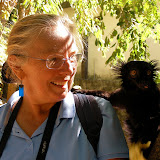
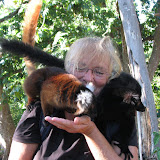
Mark and I just can’t get enough of playing with lemurs, so we ventured back into the village late this morning to have another play session. The people at the park office know us so well now that we didn’t even have to pay the fee, but our guide from yesterday, Rio, wanted to go with us anyway. We now know where the different troupes of lemurs hang out, so we went to the closest location and started calling, “maki, maki, maki.” The call plus a little banana and they come scrambling down out of the trees. This time we had one mature female and one younger with three young males. I can’t wait to come back here in September and see the babies. Rio said the babies ride on the mother’s tummy for 90 days and then ride on the mother’s back for the next 30 days. At that time they are weaned, but we are not sure what happens next. We don’t know if they stay with the mother once they are weaned or if they are sent out into the world to be on their own. We think Rio was saying the babies will join a different troupe, but we were not sure. But one thing we do know is that by the time we leave Madagascar we hope to learn as much as we can about these delightful little creatures.
After playing with the lemurs we spent time walking about the village looking at all of the beautiful embroidered table cloths and door and window hangings. We have never had curtains in Windbird and we thought we might be able to buy some of the narrow hangings and turn them into curtains, but we don’t think it is going to work. These embroidered pieces are called recelet. They begin as a piece of plain muslin. Then the women draw the designs on the cloth free-hand. We watched a woman do this today and it was fascinating. Then every drawn design is outlined with an embroidery stitch taught to the women here by the nuns in the missionary. When everything is embroidered, they then cut out the material inside the embroidered designs. The traditional purpose of recelet was to hang the pieces in the doorways and windows of huts to allow for a little privacy but still allow light and air to flow through the holes. Somewhere along the line, the women of the village discovered that they could sell these pieces to tourists in the form of tablecloths, and sell them they do. Since this island is very close to Nosy Be, tourists can be brought in by speedboat and traditional dhows every morning. They stay just long enough to buy recelet and wood carvings and then back to the main island they go. There are also a number of small resorts on Nosy Komba, some in our little village and some on the south side of the island, and these tourists buy as well. Most pieces sell for $25US or under, and in Madagascar $25US is a lot of money.
We added to the local economy today by buying a few pieces, so now we are ready to move on. Tomorrow is Mark’s birthday and he wants to go back to Nosy Sakatia so that we can purchase more food and drink and head ourselves south for a few weeks. So since he is the birthday boy, he will get his wish. We are all set to pull up anchor and move on in the morning, weather permitting. We have had over two weeks of beautiful weather, but a heavy cloud cover came in late this afternoon and we’re not sure what that means. If it is raining in the morning, or the wind is blowing from the west, we will stay here. Otherwise, it is back to Sakatia. Wherever we are tomorrow night, Ed and Lynne have invited us over for a Mexican dinner complete with Margaritas. That will be a perfect way to celebrate Mark’s birthday.
by Judy Handley | Jul 5, 2010 | Madagascar, Sailing Logs Year 5 |
Day 252, Year 5 Walk to the Top
Date: Monday, July 5, 2010
Weather: 15th Gorgeous Day in a Row
Location: Ampangorina Village, Nosy Komba, NW Madagascar
Today’s walk to the top of the mountain took us from sea level to 1,850 feet in three hours and we are estimating that to be about four miles. Climbing the first 300 feet up, walking what felt like straight up the mountain, was the hardest, but the whole trip was exhausting. At the same time, we had a great guide, a young man named Rio, who shared so much information about the flora and fauna of Madagascar. He is just learning English, but he did a great job. We saw a gecko, lizards, two different kinds of VERY large snakes, two large birds, and loads of tiny butterflies-white, yellow, orange, and blue. We learned much about how people here traditionally use the wayside plants for medicinal purposes, and from time to time we emerged from the jungle to have great views of the area. We learned much about the history of the island including the coming of the Catholic mission in the mid-1830’s, the building of a sanatarium on the mountain later in the 1800’s where military personnel were brought to recover or die or from malaria and various bronchial problems, mostly tuberculosis.
The lizard we saw was a Zonosaurus madagascariensis with gold, cream, and black coloring. The snakes were boas and a couple of Madagascar hog-nosed snakes. Both are at least six feet long and two to three inches in diameter, but not threatening in any way. Rio could pick them up and plop them back down so we could see them more clearly. The birds we saw were black crested drongos (Dicrurus forficatus) and the giant coua (Coua gigas). Getting a photo of this guy deep in the jungle was not really possible. I have a great shot of the very long tail and a shadow of the whole bird, but nothing identifiable. At various places along the way we could smell the wonderful perfume of the ylang ylang trees. We visited the village of Antamanom (means city of the missionaries) which was built by the Catholic missionaries, another tiny village off the beaten path on the way to the military cemetery with wonderful examples of traditionally built homes, beautiful gardens, and Arabica coffee drying everywhere on the ground. All of this was at about 1,500 feet, so walking up and down the mountain has to be an arduous task. But we met women carrying heavy loads on their heads with babies on their backs, and men toting bags of sand. These are hardy folks!
At the end of the trip, after six hours of hiking, we descended back to the Parc Lemurier and visited the tortoises, chameleons, and lemurs once again. We enjoyed our second look at the tortoises, the panther chameleon, and the lemurs. The chameleons are fascinating in that their circular eyes are covered with skin, all but the pupils, and the eyes can be swiveled independently so that one eye is looking at me and another at Mark. Today the male climbed on to Mark’s arm and went from Mark to Lynne to Rio. We only got to play with the all black male lemurs today, but what a delight. Rio had fed most of the bananas he had to the tortoises, so the lemurs proceeded to steal what was left from the giant tortoise. They have no fear. We are absolutely addicted to them and will return in the morning for another visit. They are just too much fun.
by Judy Handley | Jul 4, 2010 | Madagascar, Sailing Logs Year 5 |
Day 251, Year 5 Lemur-mania
Date: Sunday, July 4, 2010
Weather: 14th Gorgeous Day in a Row
Location: Ampangorina Village, Nosy Komba, NW Madagascar
Winter weather in this part of Madagascar is just fabulous. Sunshine and blue skies without a cloud, just enough wind to feel a breeze but not be blown away, with 80 degree days and 70 degrees night. Perfect! Today was a special perfect day as we got to see our first lemurs. What characters they are! They are about the length of a cat but skinnier, with longer hair, silky soft paws with long fingers that are very human-like but at the same time look like those of a tree frog, just longer, tails that are twice as long as their bodies, and a face that looks like a dog with little sticky up ears. In fact, our son Justin and his wife Jo have a mutt named Alfie and the male black lemurs look like him. The male black lemurs are black, but the females are a chestnut brown with a black face and white hair around their ears. Both male and female have orange eyes and are just as curious as they can be. Add a little banana to the mix and they readily jump on your shoulders, on your back, even on your head to get a little taste of banana. We saw three males and one female today, but no babies. Our guide, Florice, told us that the babies will arrive in September, so you can bet we will be back here again then. In fact, we are going back again tomorrow morning for a much longer walk up to the top of the mountain and we will get another chance to play with the lemurs. In addition to seeing the black lemurs, we got to see our first Madagascar boa, tortoises of various types including the radiated tortoise named for the radiating lines on its shell and the endangered little flat-tailed tortoise (Pyxis planicauda). We saw a tortoise that looks like a ploughshare but the scientific name posted in the park doesn’t match that of the ploughshare, so we’ll have to research this further. Another highlight was seeing the most outlandish looking chameleon that you can imagine. It was green with a tail curled like a fiddlehead, a nose like a pig, and outrageous looking eyes dotted with red. The female was not as colorful, but her walk caught our attention. She took one step forward with one front leg and one back leg and then gyrated back and forth a couple of times before taking the next step forward with the opposite front and back leg. Very interesting! Our guide through the park was a young man named Florice who was very good and spoke good English which is rare here. After the tour, we spent a long time walking through the village craft shops showcasing wooden carvings and the embroidered cloths that the women of Nosy Komba produce. We think it is called resseèleè. This is a cut out calico/cotton embroidery done in white thread on white calico. The designs are intricate and beautiful and my favorites are those with fish and turtles as the theme. We learned from another cruiser in Chagos that this art originated as door and window hangings for privacy with the cut-out areas allowing air to flow in and out. Now the designs are sold to tourists as table cloths, but we have seen them hanging in doorways and in windows on our way south from northern Madagascar, so they are still used in everyday life. Here in Nosy Komba they are hanging everywhere just waiting for the next tourist purchase. This tourist is certainly going to have to buy a few of these.
Tonight we invited Ed and Lynne over for a 4th of July barbeque. We had our first taste of barbecued zebu and it was quite good and very tender. So Madagascar beef gets a thumbs up. Our trek up the mountain starts at 7:30 am, so it is time to turn it and get ready for another day of lemur fun.
by Judy Handley | Jul 3, 2010 | Madagascar, Sailing Logs Year 5 |
Day 250, Year 5 Crater Bay to Nosy Komba
Date: Saturday, July 3, 2010
Weather: Same Same-Still Gorgeous
Latitude: 13 degrees 26.489 minutes S
Longitude: 048 degrees 21.115 minutes E
Location: Ampangorina Village, Nosy Komba, NW Madagascar
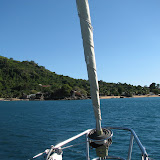
During the night, Windbird became a gentle rocking horse as the swell came into the bay from the south. Early this morning, the anchorage was not a place you wanted to negotiate in your dinghy unless you wanted to get wet, so we cancelled our plans to go back into Hell-ville and decided to just work on the boat until time to leave for Nosy Komba. I did laundry and baked bread while Mark tackled yet another plumbing problem. But by noon we were ready for take-off. Constance, however, needed a little more time, so we set 2 pm as the time for departure. At 1:57 pm we started bringing up the anchor. About half of it came up and then we were at a standstill. I am always in the anchor locker flaking chain when we raise anchor, but Mark called for me to come up on deck. We had pulled up enough chain to be sitting right on top of some big ugly rocks. Fortunately, they were just below our keel but the problem with bringing up the anchor became evident. The chain or the anchor was wedged under the rocks. So we motored forward, backward, and sideways until we could finally bring up the anchor. Whew! We thought we might have to dive on the anchor to get it up, so we were very grateful when the other maneuvering worked. We had almost a knot of current with us for the nine mile trip to Nosy Komba, but the ten knots of wind was right behind us and we had to give ourselves a motor assist to reach our destination before sunset. Nosy Komba is a tourist destination and we can see the little village of Ampangorina from the anchorage. We are anchored right in front of a small resort and we know that there are restaurants onshore. One called Chez Yolande is supposed to have wonderful Madagascar seafood dishes and we are anxious to try that. But tomorrow is the Fourth of July and we will definitely barbecue zebu aboard Windbird. But first thing in the morning we will go ashore in hopes of seeing the black lemurs that live here. I’m just hoping they don’t take the day off on Sunday!
by Judy Handley | Jul 2, 2010 | Madagascar, Sailing Logs Year 5 |
Day 249, Year 5 Provisioning, Provisioning . . . Again
Date: Friday, July 2, 2010
Weather: Same Same-Gorgeous; Air & Water Temp 80 degrees F
Location: Crater Bay, Nosy Be, NW Madagascar
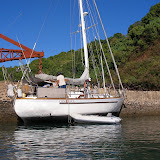
It was off to Hell-ville again today after we got Constance situated on the wall. I’m not sure I have explained what happens when they go to the wall, but basically, they go in at high tide and tie to things on land that will hold them tight against the wall. As the tide goes down, they eventually sit on the bottom and there is no water under them. This is when the work gets done. Then they have to sit another five to six hours to wait for the tide to rise again so they can float off the bottom. Today it was after sundown before we could use our powerful Yamaha to pull them off the wall and help them get back out into the anchorage. The difference between high and low tide is getting less each day, so it is great that the work is completed. I know Ed and Lynne must be celebrating tonight. But I got a little ahead of myself. Let’s go back to this morning.
Mark, Lynne, and I walked into Dar es Salama, visited the super market and fresh market there, and even found a little chandlery. Mark was so excited that they had a snap shackle that we need as a replacement for one of our headsail sheet blocks that needs serious repair. Of course, it was VERY expensive, but I decided that it would make a great birthday present, so we spent the $110 US and I wished Mark a happy birthday five days early. Then we took a taxi into Hellville. We shopped at Shampion’s SuperMarche, the fresh market, and Akhem Oliver’s, the Chinese store. Since we haven’t been shopping since March 27, over three months ago, I shouldn’t complain about provisioning. And I wouldn’t if I only had to go buy the food. It is putting it away that is the killer. All tomatoes have to be individually wrapped in newspaper, limes must be individually wrapped in foil, many things have to be vacuumed-packed, and other things must be put into plastic containers. Each beer bottle must be wiped down and the plastic case has to be washed first in sea water and rinsed with fresh water. But we are now ready to go cruising for a few days, assess the whole food situation, and then come back to Nosy Be for a few days to buy what we have forgotten before heading south for about a month. There will be no stores where we are headed. And we do have to decide if we are going to do any inland traveling now or wait until later, and in order to make that decision, we need to go back to Sakatia Towers and talk with John Sheppard. We are hoping he can give us some guidance on this. But tomorrow, we will make a quick trip back to Hell-ville to the bank to get more money and then we will head off to Nosy Komba to see our first lemurs. We will have to wait until early Sunday morning to see them, but I just can’t wait.
by Judy Handley | Jul 1, 2010 | Madagascar, Sailing Logs Year 5 |
Day 248, Year 5 Another Trip to Hell-ville
Date: Thursday, July 1, 2010
Weather: Same Same–Gorgeous
Location: Crater Bay, Nosy Be, NW Madagascar
What gorgeous weather we are having here. And what a difference from what we had when we were up north in Ampanasia Bay. It is officially winter here, but the daytime temperature is in the mid-80’s. It does cool down when the sun sets and by morning the temps are probably in the mid-70’s and it feels really cool. This morning I got up very early and had to shut the front hatch so I wouldn’t freeze. But you are enjoying the same kind of weather; it is just summer for you.
Constance went to the wall again today and unfortunately they have to go back again tomorrow. We are all going to get really good at this routine. Once the patch was sanded a decision was made that it needed more epoxy faring compound and another sanding before bottom paint could be applied. So today the additional epoxy was applied and tomorrow it will be sanded and hopefully the bottom paint will go on. We helped Constance get situated this morning and then we walked into the little town that is close to here. The road is hard-packed rock and dirt and very rough for driving or walking. The transport of local goods here is done by a cart pulled by a zebu and I think that is probably the best mode of transportation on these rocky roads, but we enjoyed the walk. Along the waterfront there are storage sheds for local building materials-bamboo poles, hardwood poles, palm fronds for thatching, a different palm frond for fencing, cut boards, sand, gravel of all sizes, paving stones, and even a little operation producing concrete blocks. In between all of this were thatched roof huts where people live. Once we were further from the water, the enterprise changed from building materials to small roadside shops selling a little of this and that. It seems like every hut has something out front for sale-a few lemons, some tomatoes, small bags of snacks, bananas, or squash. Then we came to the small town. The taxi drivers call it Dar es Salam but the local fresh market sign said Ambatoloaka, so we’re not exactly sure. But it is bustling little town with a nice super market and a decent fresh food outside market. So it was worth the walk to find out what is available without having to pay for a taxi. But in order to get to Hell-ville, we did need a taxi. The first one we got into had to be push-started and it would only go for a few feet and die. So we got out of that one and found another one heading our way. We went all the way into the harbor area so we could make another ATM withdrawal. Then we used our Lonely Planet map of Hell-ville to guide us through the town. Our first stop was the Catholic Church with the famous Cours de Hell sign tacked on the front. Someone has damaged the street sign so only the H and part of the e are still readable, but it still gives you a chuckle. We then walked up a street with a few neat restaurants that we will have to go back to visit as we made our way to the SuperMarche. I needed to walk the aisles one more time to write down prices so I can make comparisons with other shops and to check carefully to see what is available. We bought a few things that we know we won’t find anywhere else, so comparing prices on those things is not urgent. Mark went to buy more top-up cards for the cell phone and the computer modem while I went to the fresh food market. By the time we got a taxi, our backpacks were full, as well as huge LL Bean bag. But we made one more stop at Akhem Oliver’s Chinese store to buy a couple more cases of beer and a bottle of local rhum-must give it a try. When we got back to Crater Bay, we say that our dinghy was high and dry on the rocky beach. Yuck! Mark went to check-in with Ed and Lynne while I started carrying the bags down to the beach area. Just as I was contemplating how in the world we were going to carry our dinghy across all the rocks, two young men came by and offered to help me. With one of them on each side of the back where the heavy engine sits and me on the front, we were able to carry the dinghy into the water and then I loaded all the bags and waited for Mark to load the beer. I have to explain that a case of beer here is 20 heavy glass bottles, about 2/3 of a liter, in a plastic case 14 inches wide x 17 inches long x 12 inches high. And when I say ‘heavy’ glass, I mean ‘heavy’ glass. You don’t see broken bottles along the roadside here because I don’t think you could break these bottles!
Tomorrow is more of the same. We’ll get Constance situated on the wall and then we might take Lynne and go to Hell-ville again. It is a kicky little town and we’d love to have lunch there. Cruisers from another boat told us they had huge zebu steaks for lunch and the cost was $5 US. Sounds like something we’d like to try. Lynne is strict vegetarian, but she is even contemplating giving zebu a try.