by Judy Handley | Aug 15, 2010 | Madagascar, Sailing Logs Year 5 |
Day 293, Year 5 Moramba Bay
Date: Sunday, August 15, 2010
Weather: Beautiful Day; Wind 15-20 Knots SE
Latitude: 14 53.895 S
Longitude: 047 19.719 E
Location: Moramba Bay, NW Madagascar
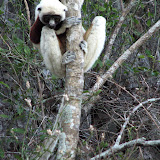
The winds blew us quickly from Nosy Lava to Moramba Bay. We delayed our 6:15 am start due to strong winds, but just before 7 am we decided to go for it. The winds were coming from the SSE and we were going SW so we were tight to the wind, but made great time. There were a few bumpy times but for the most part it was a great sail. We have left the mountains behind and are in dry, dry country. Much of the coast we sailed along is being cultivated. From a distance it looks like bushy little trees being grown in rows. All I could think is that it might be wine country, but I have nothing to substantiate that. Moramba Bay is big and as we got deeper into it we started seeing the mushroom-shaped limestone islets. These little rocky islets are undercut deeply and growing on top of them are baobabs and other trees and plants characteristic of this dry region. We anchored, I pre-cooked dinner, and then we took off in the dinghy for any explore among the limestone islets. Our hope was to get to shore and possibly spot our first Coquerel’s Sifakas (Coo-kell’s Sah-feeks). This is a type of lemur (part of the Indri family) that I have been so anxious to see. We motored among the islets, stopped to take photos of different kinds of baobab trees and just as we were about to try to land the dinghy, I saw some spots of white on a rocky outcrop. I asked Mark to go in that direction and it was soon apparent that the white spots were beautiful lemurs. These guys are about four feet long, but two feet of that is tail. There are fuzzy white with dark maroon patches on the front of their thighs and on their arms. The little faces are black with yellow eyes. They didn’t back off as we motored closer and then we stopped the motor and just sat and watched them. They have powerful legs and can take huge leaps from branch to branch. You can be sure we will go back to this same spot tomorrow morning and see if we can get ashore to get good photos. The water was bit choppy late this afternoon and that made picture taking from the dinghy a bit challenging. These guys are beautiful and graceful and I hope to see more and more of them in the next few days. We just couldn’t believe how lucky we were to see them on the first try. We also saw Madagascar Sacred Ibis with their long curved beaks roosting in the tops of trees with Greater Vasa Parrots and Dimorphic Egrets. The parrots are small and grey but the egrets are white or black and quite beautiful. We also saw caves in the sides of some of the islets. Our introduction was nothing less than spectacular, so we hope to have a repeat performance in the morning.
by Judy Handley | Aug 14, 2010 | Madagascar, Sailing Logs Year 5 |
Day 292, Year 5 Not Where We Meant To Be
Date: Saturday, August 14, 2010
Weather: Beautiful Day; Wind 10-12 Knots SE then W
Latitude: 14 32.599 S
Longitude: 047 37.195 E
Location: Nosy Lava, NW Madagascar
We had hoped to be anchored at Nosy Saba tonight, but after a mid-day stop there we decided that it was just too chancy to spend the night. It is a beautiful anchorage and we will return, but we’ll plan to spend the night in a close-by anchorage on the mainland and go to Nosy Saba for the day only. That is unless the winds are more favorable than they were today. We moved on but not before jumping in the water for a quick snorkel. The anchorage was just beautiful due to the colors in the water-sparkling turquoise, milky turquoise, emerald, sky blue–there was every color of blue you can imagine. The beach looked inviting and we tried to swim ashore, but there was coral between us and shore and we were afraid of being slammed down on top of it due to the low, low tide. So we gave up and returned to Windbird. Ed and Lynne had decided not to stop and to go on to Nosy Lava. So we followed. Our stop of an hour at Nosy Saba was just the right amount of time to let the wind switch from onshore to offshore which gave us a great sail to within a mile of the anchorage on Nosy Lava.
As we have moved south, the islands and mainland have gotten much drier looking. There are spots of green, but the predominant colors are shades of harvest gold and burnt orange. And we are starting to see interesting rock formations. The anchorage here at Nosy Lava is calm and reflects these changes to a drier area. It is striking the way the desert can be striking, but not beautiful like palm-fringed white sand beach islands. In 1993 this was the location of Madagascar’s maximum security prison. One night some of the inmates escaped, swam out to a boat anchored here, killed the occupants and tried to escape in the boat. Since then, cruisers have not stopped here. The prison had such a terrible reputation that a few years ago, they simply shut it down. We have heard from other cruisers who stopped here this year that three of the inmates were left behind and still live on the island, but they are friendly and will even give you a tour of the old prison. We’ll not push our luck that far, but we did go ashore for a walk and to burn garbage. We did this just below the high tide line so this evening’s high tide will wash away the ashes.
Early in the morning we will head for Moramba Bay. It seems to be everyone’s favorite Madagascar anchorage, so we want to spend time there enjoying the beauty. One of the draws of Moramba Bay is that the Coquerel Safika lemurs live there. These lemurs are white with maroon thigh, arm, and cheek patches and leap through the trees and on land in huge bounds. They are not acclimated to humans, so they won’t be jumping on our shoulders, but just a glimpse of them in the wild will make me a happy cruiser.
by Judy Handley | Aug 13, 2010 | Madagascar, Sailing Logs Year 5 |
Day 291, Year 5 Friday the 13th
Date: Friday, August 13, 2010
Weather: Weather Almost Back to Normal
Latitude: 14 06.015 S
Longitude: 047 54.275 E
Location: Paradise Hole near Berangomaina Point, NW Madagascar
I heard from my sister-in-law Conda this morning and she reported that my niece’s surgery went well and that the doctors don’t feel that the cancer had gotten into the lymph nodes. They won’t know this for sure until the test results are returned, but the news early this morning was so good to hear.
We did stay put today and we have had only one little Friday the 13th scare. As noon approached and low tide neared, we found that we were much closer to the reef in the head of the bay than we thought. So both Constance and Windbird upped anchor and moved far enough from the reef to be comfortable. Well, you are never really comfortable when there is reef around, but at least now we have some breathing space. The winds were still coming from due south and then west of south this morning instead of from the southeast, so that plus the fact that it was Friday the 13th helped make the decision to stay put. Mark worked on our auto pilot controller/display unit which he really thinks he might have fixed. We have been using the hand held for months now, but tomorrow we will try the real thing. I did some of my favorite things-worked on photos and did more laundry and took advantage of the extra time to try and figure out how to merge photos of each of our grandchildren into one so I can see them on my desktop each time I turn on my computer. I haven’t figured it out yet, but I sure enjoyed looking at the photos of the three of them while working on the project. We put our dinghy in the water and went over to talk to Lynne and Ed and pick up some fish that he caught yesterday. He caught a Wahoo and wanted to share his bounty, but we were just too spent last night when we got here to launch the dinghy and go get it. And I know it will still taste great tonight.
We plan to leave here early in the morning and travel about 22 miles to Nosy Saba. It is supposed to be a beautiful island but the anchorage is exposed. We’ll see what the wind is like once we arrive and decide whether we can stay the night or whether we will have to go the three miles to the mainland for the night. We’re sure hoping we don’t get winds on the nose like we had yesterday. That is very unusual here, so we’re hoping for ‘normal’ tomorrow.
by Judy Handley | Aug 12, 2010 | Madagascar, Sailing Logs Year 5 |
Day 290, Year 5 Thinking of Jennifer
Date: Thursday, August 12, 2010
Weather: Beautiful Day but Mixed and Strong Wind
Location: Paradise Hole near Berangomaina Point, NW Madagascar
My niece Jennifer is having breast cancer surgery today and we send our hopes for a speedy and complete cancer-free recovery her way. I know Jennifer will have lots of support from family but I miss being able to be there to be a support to my sister Patsy and to Jennifer. So Jennifer, just know that we are thinking of you and with you in spirit.
Today was a MOST interesting sailing day. For weeks now we have had 10 knot winds coming from the land in the morning and from the sea in the afternoon and evenings. Land breeze, sea breeze, moderate winds-that’s been our pattern for Madagascar sailing. We get GRIB files and talk to the South African Mobile Maritime Net to get weather a few days a week, but weather has just not been an issue. Well, today was a different matter. We left completely protected Baramahamay Bay at 6 am and we motored for the first hour and a quarter. Then we had 10 knots of wind from the south but we still needed a motor assist. By 7:30 pm we had 15 knots, still from the south, and we sailed along beautifully all morning even though we had a big westerly swell. We had expected the wind to come from the southeast instead of due south, so we did adjust our course to sail with the wind. And we expected the wind to die sometime between 11 am and 1 pm-it always does. But today it waited until 1:30 pm to die down, but then all of a sudden we had 20 knots of wind hitting us right on the nose from the south. NOT what we expected. So we had to beat into 20-25 knot winds all afternoon, running the motor hard, and still barely got to an anchorage before sundown.
The seas were big and sloppy today and we knew anchoring out at Nosy Kalakajoro would be untenable. So we changed our destination to a bay called Paradise Hole on the mainland. This is the cruiser name for the little bay and it doesn’t have another name on any of the charts. The winds are still blowing 15-25 knots as we sit here. We are bouncing a bit, but basically we think it will be fine even in these strong winds. If the south winds are still blowing strong tomorrow morning, we will probably stay here for another day. And seeing as how tomorrow is Friday the 13th, sitting still is fine with me. There is a tiny village here and lots of low, dry hills we could climb. So that might be tomorrow’s activity.
by Judy Handley | Aug 11, 2010 | Madagascar, Sailing Logs Year 5 |
Day 289, Year 5 Exploring Baramahamay Bay & August Letter to Family & Friends
Date: Wednesday, August 11, 2010
Weather: Mix of Sun and Threatening Clouds
Location: Baramahamay Bay, NW Madagascar
Windbird’s dinghy got little rest today. In the morning we took the dinghy back out of the bay and tried to get to the beaches on either side of the entrance. Unfortunately, the tide was too low and there were too many rocks, so it seemed like too much a risk to try and beach the dinghy. We tried three different places and finally gave up. I had hoped to take a long walk on the beach but that was not to be. On our way back to Windbird we stopped to meet Richard on Chant de Mer. Richard grew up in France and then moved to South Africa as a young adult. He has sailed back and forth from South Africa to here numerous times since1991 and we really enjoyed talking with him learning about different anchorage possibilities. We also enjoyed hearing about how he built his built. We spent at least an hour aboard Chant de Mer and then headed back to Windbird for lunch. In the afternoon we took the dinghy and headed further into the river. Richard had drawn a map for us, without which we would have been lost again, and went as far as we could go before there was barely any water over the rocks. The Baramahamay River is big and the tributary we took was also wide for a bit, but then it narrowed. We didn’t see any crocodiles, which is good, but we also didn’t see many birds. Beyond the mangroves, it looks as if the hills have been stripped-of what, we don’t know. Hardwood trees have probably been logged, but we really have no idea.
Tomorrow we will head further south to an island called Nosy Kalakajoro. If it looks like a good anchorage, we will spend the night there. If it doesn’t, we will continue on to a little bay on the mainland called Paradise Hole by cruisers. We’ll see where the wind blows us.August 11, 2010.
In the meantime, we have included our August Letter to Family and Friends below:
===================
Dear Family and Friends,
Windbird’s Indian Ocean adventure continues. The last letter to Family and Friends was sent on June 2. Since that time we have traveled from the atolls of Chagos to the island country of Madagascar off the coast of East Africa. In the last letter I mentioned that the 1500 miles from Chagos to Madagascar might be windy ones, and that they were. We had our first ever passage where we traveled over165 nautical miles each day at an average speed of 6.7 knots. It was a beautiful day when we rounded the top of Madagascar, but the winds gusting to 50 knots made it a ride we will never forget . and never want to repeat!
The islands of the atolls in Chagos didn’t peak their heads above water until about 6,000 years ago. In comparison, Madagascar broke away from Gondwanaland and has been in its current location for hundreds of millions of years. And because of its isolation from the mainland of Africa and Asia, the plants and wildlife here have evolved differently from any other place on earth. We have done one trip inland to see some of the world’s strangest rock formations called ‘tsingy’ (razor sharp limestone formations) and to see lemurs and chameleons. It was spectacular. As we have sailed around the world, it seems that every place we go we think, “Does it get any better than this?” And then we move on and the next place seems even better. Maybe we are too easy to please or maybe the world is just a beautiful place. Each place is so special in its own way that there can never be an answer to the question most people ask us, “What has been your favorite stop?” Madagascar is very different from anyplace we have been and we are loving it. The red soil looks like that of New Caledonia in the Pacific. The mountains remind us of the Rocky Mountains in the US. The islands are beautiful. The word for island in Malagasy is ‘nosy’ and there are many little off-shore ‘nosies’ that provide great cruising grounds. Some are just patches of sand with a few trees in the center but others have high green hills coming down to white sand beaches. Nosy Be is the most populated island with 40,000 people and it’s main town is Hell-ville, named after French Admiral de Hell and not the condition of the town. The buildings in this once French colonial town are now crumbling, but the town is always buzzing with activity. Some of the houses on Nosy Be are built of concrete block, but most of the housing that we see is in the form of traditional huts with walls built of palm frond stems and roofs covered in thatch of palm frond leaves. Most places have no electricity and plumbing is most often a bucket. Resorts have generators, but most villages do not. In Hell-ville there are little hole-in-wall shops, but no place to buy anything major. There is a super market in Hell-ville, but elsewhere you can only find little shops that carry a limited supply of anything. In the islands, you can trade for bananas, papayas, and sometimes limes, crabs, and lobster, but there are no food markets. You have to travel to Antananarivo, or Tana for short, the political and economic center of the country, if you want to find stores with major appliances, tools, computers, etc. If you want a vehicle, you have to order it and have it shipped to the main port on the east coast of the country. The elected president, who also happens to be the richest man in the country, was Marc Ravalomanana, but he was ousted in a coup last October. The current head of the country is a high profile disc jockey turned politician. Currently, the Chinese are raping the forests of rosewood and other resources. The government is paid for the resources taken, but local people are not hired to do the work so none of money reaches the common man. Madagascar is a poor country, getting poorer everyday, but it is beautiful and the people live simply and happily. The national languages are French and Malagasy (pronounced Mala-GASH) so we do have a language barrier, yet somehow we manage to communicate with these gentle people.
It is still the Age of Sail here and there are sailing dhows and outrigger canoes everywhere you look. We are basing our travels north and south out of an anchorage between bustling Nosy Be and quiet Nosy Sakatia. Nosy Sakatia is the home of a lovely little resort called Sakatia Towers, named after the 1980’s British sit-com called Faulty Towers. John Sheppard, the owner, was once a sailboat racer and cruiser and he takes good care of sailors coming in here from around the world. Happy Hour begins at 5 pm on his deck overlooking the anchorage and there is always an interesting mix of his guests and visiting cruisers. There are not many of us cruisers this year, however. The scare of theft in a dirt poor country and of pirates moving further south to the Mozambique Channel has kept most cruisers away. A very few of us came here from Chagos and there are a few South African boats that have come up for the season. There are no marinas in Madagascar, so John’s Sakatia Towers has become a bit like a yacht club for us. It is really the only place where we can gather and meet other people.
When we send our Letter to Family and Friends we always include an update on what is happening in the lives of our children. This time the news is mixed. They are doing great but unexpected things have caused some changes in their lives. Our son Justin, his wife Jo, and their one year-old Ziggy were visiting Jo’s family in England in July. They had a fabulous visit. Ziggy especially loved playing in green grass as there’s none of that in the New Mexico desert. They were supposed to fly home early last week, but when they got to the airport they were told that Jo could not go back to the US because her Green Card had expired while she was out of the country. When she initially received the card, the 2010 renewal date seemed far in the future and she simply forgot about it. So now she and Ziggy are having an extended vacation in England while Justin is back in New Mexico trying to figure out if he will return to England to wait with them until Jo can return or whether he will stay in New Mexico. They have hired a lawyer who says he can get her back in the US in five weeks rather than the six months the US government officials are quoting. So that’s the news from Justin, Jo, and Ziggy. The Goldstones, our daughter Heather, her husband Jed, and three year-old Sam and one year-old Jonah, have been having a great summer on Cape Cod, but the big news in that family is that Heather is going back to work full-time for the first time since the birth of Sam in 2007. This was not planned, but a job opportunity came up a few weeks ago and she just couldn’t pass it up. She is a research scientist by education, but her part-time work since Sam was born has been doing science reporting on the local public radio station. National Public Radio got a major grant to start up a series of blogs around the country to get more people involved in conversations around major issues affecting our lives. Woods Hole on Cape Cod was chosen as the blog location dealing with oceans and global warming. Heather has always wanted to help people understand the complexities of science in order to help them make life decisions that are eco-friendly. She applied for the job and has already started working part-time, albeit reluctantly, as she hates being away from Jonah and Sam. Her blog goes public the first of September, so I’ll update you on that as it develops.
When we reach South Africa sometime in October it will have been a year since we last saw family. Even if we had the money, flying home from South Africa is not possible because we need to watch the weather and take every weather window we get to work our way down the coast of South Africa and then finally round the Cape of Good Hope. The weather of the South African coast is just not cruiser friendly, so you make the trip in small hops from harbor to harbor when you get a good weather forecast and then wait days or weeks for another small window of opportunity. This process will take all of November and December and will begin the sixth year of the voyage of Windbird. By mid-January, we will leave Cape Town, South Africa, to start our voyage across the southern Atlantic Ocean to Brazil. We are hoping that our children and grandchildren can come to Brazil to see us before we start the 1500 mile trek to the Caribbean and then the next 1500 mile trek from the Caribbean to southern Florida. As you can see, we are still a very long way from home.
This is a long and lonely cruising season without seeing friends, family, and fellow cruisers, so that means hearing from you means even more to us than ever. But please remember that we are bandwidth impaired, now more so than ever as Mark’s computer he uses for communications has a virus that is slowing things to a crawl. Please do not send attachments and make sure that you delete our message if you hit the reply button. Whether you are family, friend, or fellow cruiser, we miss you.
Affectionately,
Mark and Judy
S/V Windbird
by Judy Handley | Aug 10, 2010 | Madagascar, Sailing Logs Year 5 |
Day 288, Year 5 Nosy Iranja to Baramahamay Bay
Date: Tuesday, August 10, 2010
Latitude: 13 42.792 S
Longitude: 047 54.060 E
Weather: Totally Overcast
Location: Baramahamay Bay, NW Madagascar
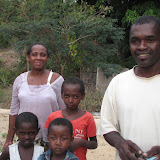
The name of this bay looks a little overwhelming at first, but if you just say Obama and then replace the ‘Ob’ with “Bar” and then add ‘hamay’ you have have it. And in Baramahamay Bay, we are experiencing a little change in the weather. I’ve forgotten how long it has been since we have had such an overcast day. Maybe it is because we are tucked into the mainland, but for whatever reason, it was fine as I was busy, busy doing loads of laundry and baking banana bread, whole wheat bread, and brownies. We motored the ten miles from Nosy Iranja to the mainland and then into this little bay. Or maybe it is technically a river. Cruisers refer to it as Honey River as the chief’s wife in a village on the south side sells local wild honey to cruisers. Ed and Lynne picked us up in their dinghy and we went to the village to buy honey. When we got to the village Mark was trying to ask the women he saw if they knew where we could get honey. No one understood a thing he was saying, so I just said ‘miel’ and they immediately pointed to where Ed and Lynne were standing with the chief of the village. I had learned from Lynne that ‘miel’ is the French word for honey and will not forget that one. We met the chief, his wife, and three children, and the chief went to a small hut on stilts, unlocked the door, and poured a plastic pitcher full of honey. That much cost us the equivalent of $10 US. It filled two wine bottles and a mayonnaise jar, so now I can make granola. I was totally out of honey and just waiting to get here to buy some.
We’ll stay here tomorrow and do some exploring and will probably move further south on Thursday. Unlike Nosy Iranja, this is a very calm anchorage. All of the islands off the coast of Madagascar have a bit of a roll to them when the tides change. Nosy Iranja was actually very calm last night, but the night before we rocked and rolled at 3:30 am. But just the thought of getting to see the baby turtles and the stunning location helped me to ignore the rock and roll. And it was certainly worth it. We’ll never forget seeing those baby turtles hatch and head out to sea.