by Judy Handley | Jun 9, 2007 | Fiji, Sailing Logs Year 2 |
Day 46, Year 2: Passage from Astrolabe Reef to Kadavu Island
Date: Saturday, June 9, 2007
Weather: Partly Sunny Day
Water Temperature: 81 degrees F in Anchorage
Air Temperature: 79 degrees F
Latitude: 19 degrees 01 minutes S
Longitude: 178 degrees 26 minutes E
Location: Vagola Bay, Kadavu Island, Fiji
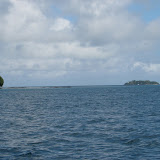
We made the passage from the area of small islands inside the Astrolabe Reef down along the fringing reef (but inside of it) to the south-east side of Kadavu Island. The Astrolabe Reef is now to our north, but the fringing reef continues on around to our east and then to the south of Kadavu. Jean-Pierre and Colette in Safina led the way and we followed carefully behind, watching the computer screen in the cockpit the entire time. We use MaxSea as a navigation program with C-Maps charts and it
was pretty much right on today. We often had to work our way between two coral heads and between shallow areas to both port and starboard, but watching the computer screen allowed us to see every move we made in relationship to those obstacles. At the very end, we came to a mark and two little islands that just didn’t appear on the electronic charting. Actually the mark was there, but since the islands were missing on the electronic charts, we were all just a little unsure. This is the problem
with electronic charting. It is wonderful when it is correct, but you constantly have to check it against paper charts and what you are actually seeing. By this time, Mark and I were getting better at seeing the shallow areas indicated by turquoise water instead of darker blue, so we wove our way through the maze and made it into our anchorage for tonight. I must say that I feel much more confident about reef sailing after today. As long as you have good light, you can really see the shallow areas.
You just have to watch carefully, constantly. There is an unwritten rule in sailing that you always have to use at two ways of determining where you you, and we are seeing first hand just how important that really is. The electronic charts are one and visual navigation is the other. Of course, paper charts and radar can also supplement these.
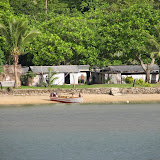
The anchorage here looks like you are totally in the wilderness, but behind the mangroves there are dwellings. We thought we might be able to pull in here and not have to do sevusevu with a village, but sometime in the late afternoon, a boat came paddling by with three young people aboard. They went to Safina and Jean-Pierre invited them aboard. They stayed for about two hours and then close to sunset, we saw Jean-Pierre and Colette disappear into the mangroves behind this boat. Just as the sun
was setting, Jean-Pierre and Colette came by Windbird to tell us that we have all been invited to come ashore at 9 AM in the morning and walk across the island to a Methodist Church for Sunday service. After the church service, we will do sevusevu. It is unusual to be invited to come into a village on Sunday, so this will be an interesting excursion. After we return to our boats, we will move to the the bay just to the south of us. We hope to make it to Korelevu Bay and spend two or three days
there before leaving for the Lau Group.
We arrived at anchor at 1:30 PM in the afternoon. It was early, but we felt like we had put in a full day. Mark and I made the decision to just relax and read (and for me, to cook) for the remainder of the afternoon. I had lots of veggies that I bought back in Suva that needed to be cooked–okra, egg plant, green beans, and yams. And then there were the bananas. Although I supplied all of the bananas for the banana bread we baked on Dravuni, I still had more overripe bananas that needed to be
used. So I also made banana bread. While I was at it, I cooked potatoes to make potato salad and scalloped potatoes for tomorrow. I kept myself busy all afternoon.
Tomorrow will be another adventure. Our destination is Korolevu Bay and the village of Kadavu. We plan to present sevusevu there on Monday and get permission to visit Lion Pool and Vileileivi, a small islet right out on the fringing reef. There is a resort in Korolevu Bay and a Chinese store. We might be able to do a little reprovisioning while there. That is yet to be determined. No later than Wednesday, weather permitting, we hope to head east to the Lau Group. If the winds are still from
the east, we might have to delay departure until the winds cooperate.
A last note . . . The sky is absolutely filled with stars tonight. The Big Dipper is to our port and the Southern Cross is to our starboard. We can see the Milky Way and an unbelievable number of stars. It is a beautiful evening.
by Judy Handley | Jun 8, 2007 | Fiji, Sailing Logs Year 2 |
Day 45, Year 2: Snorkeling At Last
Date: Friday, June 8, 2007
Weather: Mostly Sunny Day
Water Temperature: 77 degrees F
Location: Namara Island, Astrolabe Reef, Fiji
Today started as a beautiful, clear day, so we agreed with Safina and Ranger to pull up anchor at 10 AM and make the move to Namara. We waited until 10:00 so we would have good light for watching for coral heads. These waters are charted, but it is sometimes very tricky to know exactly where each of the coral heads are really located. Mark stayed on the foredeck watching the water and I steered. We looked like a flotilla as we carefully picked our way to our new anchorage. By 11 AM we were here
at our new anchorage and Mark and I immediately hit the water. Namara is a beautiful little uninhabited island and we had read that there is good snorkeling on the northwest corner of the island. It is such a tiny island that the northwest corner is within swimming distance, so we just jumped in and headed for shore so we could work our way to the point in shallow water. What a wonderful sight. I think I had almost forgotten just how beautiful the coral and the fantastically colorful little fish
can be. What we found was literally a kalidoscope of color. The coral was mostly plate coral and not tremendously colorful, but there were dashes of purple, orange, yellow, pink, and neon green. Add to that the colorful little Christmas Tree worms and then the fish of every color and you really have quite a phenomenal picture. We saw Moorish Idols today, lots of butterfly and bannerfish, damselfish of every color, and the list goes on and on. I think my favorite find of the the day was an orange
and turquoise anemonefish. The colors were stunning and I think Nemo would have been jealous. We took a break and then snorkeled again in the afternoon.
If the weather is “just right” for continuing on into coral head country, we will be leaving here tomorrow at 10 AM for the southern side of Kadavu Island. Leaving at 10:00 will give us just enough time for one more early morning snorkel.
We ended our day with a communal dinner aboard Ranger. We all brought enough salad for two and enough spaghetti sauce for two. We then combined the salads and the spaghetti sauce and had a feast. I baked fresh bread and that was yummy as well.
by Judy Handley | Jun 7, 2007 | Fiji, Sailing Logs Year 2 |
Day 44, Year 2: Village Life on Dravuni Island
Date: Thursday, June 7, 2007
Weather: Partly Sunny, Periods of Misty Rain
Latitute: 18 degrees 45.5 minutes S
Longitude: 178 degrees 31.1 minutes E
Location: Dravuni Island, Astrolabe Reef, Fiji
Tikotiko kina (once upon a time) . . . there was a man and a woman with a dream of sailing around the world and meeting the wonderful people on all of the islands along the way. Today that dream was played out to its fullest. It is one of the days where you have to pinch yourself to believe that what is happening is real. With that introduction, I will continue with today’s story.
We woke to beautiful blue skies and sunshine. It was perfect snorkeling weather, but Marie of Ranger and I had asked permission to visit the school, so we had to honor that commitment first. Paul took us in and dropped us off and someone met us and walked us to the school complex. That consists of a fenced area with the teacher’s home on the right, the school in the middle with a lawn in front, and the kinder (kindergarten) school building on the left. The teacher was just coming out of her home
and she greeted us warmly. We explained that we had asked the chief for permission to visit the school and she said that was fine. She had on a tailored suit, skirt over the knees and fitted jacket. We talked for a while on her porch and I watched the sixteen children in the school yard. They were very well-behaved although Mistress Siteri pointed out a couple of children that can be a little more challenging than the others. Primary teachers here are addressed by the formal “Mistress” followed
by the first name. It is not until secondary school that teachers are addressed by the last name. She explained that we would first witness the toothbrush drill, followed by the flag ceremony, and then the health inspection. After that we would enter the school for devotions, and then around 9 AM the instruction would begin with Maths (the Fijian word for mathematics). I was like a kid in a candy shoppe watching the school day begin. The flag ceremony was preceded by a very military style exercise
where the children stand at attention and in different positions on the command of the teacher. At all times when lining up, the students have been trained to leave an arm’s length between themselves and the next student. They did this with no prompting from the teacher. Siteri explained that hygiene must be stressed at school because it is not always at home. Every child must have their hair and fingernails inspected by the teacher and results recorded for the Ministry of Health. Each child
must bring a handkerchief to school and if they do not have it, they must immediately return home to get one. When the children entered the school the class one and class two children went in through one door and the class three and class four students through another. But then they all met at one end of the double classroom for devotions. A student provided seats for us and for Siteri. She started the devotions and we all had to close our eyes for a very long prayer. The students then sang
a few devotional hymns and some songs very familiar to us such as Rocka’my Soul in the Bosom of Abraham and My Bonnie Lies Over the Ocean. Most songs were sung in English and then in Fijian. After the singing the older students went to their side of the classroom where they sat at individual desks and started to work in the Maths Journals. There was also some boardwork that they had to write in their exercise books. Siteri stayed on the end of the classroom with the class one and two children.
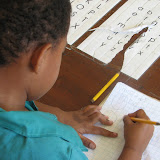
The children pulled out their tables and benches and got right to work. The class one work was on one side of the chalkboard and the class two work on the other. The youngest children were to draw circles in their exercise books, labeled with numbers to seven. Their job was to draw the indicated number of objects in the set. The class two children were working with the number 13 today. It was written on the board that 13 is one ten and three ones. And then Siteri lead this group of children
through a written and oral recitation exercise where they explored the various combinations that make 13–yesterday was 12 and tomorrow will be 14.
12+1=13
1+12+13
13-12=1
13-1=12
This went on with the various combinations of 2 and 11, 3 and 10, 4 and 9, 5 and 8, 6 and 7, and finally 0 and 13. The communitive properties were written on the board, copied by the children, and then recited out loud. All this while, the older children were working quietly on their own doing division. Siteri showed Marie and I the English workbooks the students use. Grades one and two are taught in Fijian while the students are learning to read and write English. By grade three, the students
are fairly fluent in English and their reading books looked quite challenging. I was absolutely amazed at how easy it was to manage a classroom of grade one through grade four children. There just weren’t any discipline issues. How different from back in the USA and how wonderful.
Mark and Paul had come to the village at 8:30 AM to work on trying to get a pin out of the crankshaft of the village generator. The pin is broken and they have a new one to put in–just no way to get the old one out. The village generator has not been working for the past six months, but the efforts this morning were unsuccessful. The piece is going to have to be taken to Suva to a machine shop and evidently this doesn’t happen easily. As we were leaving the school, we saw that Paul and Mark
were in Siteri’s home with her husband Moses. Mark and Paul had wandered this direction when they finished working on the crankshaft and Moses invited them in. Siteri walked us over to meet Mark and Paul, and she invited us all to come back at 5 PM for tea. I had asked her to help me translate a couple of children’s books I bought in Suva for our little grandson, and she said we could do this over tea. We then trekked over to the village chief’s temporary home to find his wife Marianne. Our
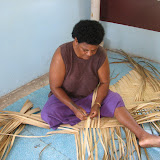
next task was to make banana bread with her. Yesterday I had thought that we would make both regular whole wheat bread and banana bread, but Marie suggested that maybe just making the banana bread would be a good idea. I agreed that I had been a little too ambitious, so this was our goal. A woman called to us from inside the community building and told us Marianne was taking a shower and would return soon. This person was Emily and she was inside weaving a pandanus floor mat. Emily was obviously
a very spunky member of the community and she invited us in to see her work. She also showed us her beautiful flower gardens next door. She explained that Marianne had to lead the Women’s Prayer Group at the church at 10 AM, so we decided that we would have to come back later to make banana bread. As soon as Marianne came, she agreed with our decision and we said we would return between 2:00 and 3:00 in the afternoon.
We then returned to our boats to prepare for the next adventure of the day. That was a walk to the top of the knoll on the south end of Dravuni. We made the decision to walk first and then snorkel, which ended up to be a mistake, but our thinking was that we would walk and get very hot and then relish the dip in the water. Mark and I picked up Marie and Paul on Ranger and Jean-Pierre and Colette on Safina and headed back to the village to pick up the track leading to the south end of the island.
It was a delightful walk. The walkway leading from the village was lined with planted tropical ornamental plants. There were beautiful black butterflies flitting everywhere. We passed the village pig pens, stands of hemp plants and planted casava (tapioca), and continued on the little path to the top of the mountain. The weather had started to change as we began our trek, and by the time we were climbing the knoll, the views of the surrounding islands and reef were partially obscured by the
overcast skies and misty rain. I’m sure photos would have been more beautiful with sunshine, but we still really enjoyed the climb and the views. Once at the top, we saw someone working in the village gardens on the northeast side of the island. We called “bula” and the person working did the same. While we were sitting at the top of the mountain, the person working in the garden came up to join us. It was “little” David from the village. “Big” David is Emily’s husband, and this young man is
somehow related. He had his bush knife, his sharpening tool wrapped in a plastic bag, and a plastic bottle of water. Like everyone else, he walks barefoot. He became our guide and taught us as much about the island and the surrounding reef as we could absorb in our trek back to the village. When we were almost to the village, he climbed a coconut tree to get some coconuts for Jean-Pierre and Colette. Mark and Paul had already been paid for their crankshaft efforts with coconuts earlier in the
day, so we didn’t need any. When he shimmied back down the tree, he then went to a mango tree and cut a branch lying on the ground. The piece was about 2 feet long. He quickly sharpened both ends, and drove one end into a fallen log. He used the other sharp end to peel away the coconut shell. His dexterity and stength were impressive. Mark tried but was unsucessful. Shucking the shell of a coconut is no easy task.
By the time we returned to our boats we all made the decision that snorkeling without the sun to light the waters was not going to work. So no snorkeling today. Instead, we stopped on Safina for a mid-day break, went to our respective boats for lunch, and then Marie and I returned to the village to make the banana bread. Marianne and some of the other women from the village met us in the community center. They laid down pieces of clean cloth for us to work on and we got busy assembling the ingredients
for whole-meal banana bread. They were very excited that I had whole-meal flour. This is not something they can get easily, but they are convinced that it is better for them. Since Mark and I have been prophets for whole wheat all of our lives together, this seemed most fitting. Even Romero, the village chief wandered in to see what we were doing, and he sat down and stayed to watch the show. We got the ingredients mixed and carried the two loaf pans back to Siteri’s home to bake it. It seems
that only the teacher and the minister’s wife have gas ovens. I had thought that we were going to bake this in a wood-fired outdoor oven, but somehow that idea got lost in the process. Even the gas oven was a bit of challenge. There were no knobs and only an indication of high and low for temperature. We chose “high” and Marie stayed to watch the cooking while I returned to the community center with Marianne. I had thought we were going to clean up the dirty bowls, but she just wanted to sit
and talk. The minister’s wife was there busily copying the recipe over and over for different people. Emily was still weaving the floor mat, but she stopped for a bit just to talk. We talked about children and grandchildren and life in general. Emily asked how old I was and when I told her I am 60 and Marie is 65, she was very surprised. Another woman sitting with us look very old to me, and she said she was 65. Obviously, the slow moving island life is much harder on people than the life we
lead.
Once the bread was baked, we went back out to our boats to gather some things we wanted to give to Siteri and to Marianne, and then Mark and Paul returned with us to Siteri’s for tea. She had come home during the hour-long school lunch break and baked a chocolate cake to serve with tea. Another cruiser had given her the recipe for “Crazy Chocolate Cake” that requires no eggs and no milk. These are precious commodities in a village. The cake was delicious and the time we spent with Siteri from
5:00 to 6:00 was very special. Marianne and Romero joined us, but Siteri’s husband, Moses, was sleeping. He would be getting up soon to go out fishing for the whole night. I brought three children’s books I had bought in Suva, written in Fijian. I bought them for our grandson Sam, but I wanted to have them translated. Siteri and Marianne told us the stories in English and the village chief, Romero, sat there and read the books with us. This is when I learned that “tikotiko kina” means “once
upon a time.” It was a fairy tale day with a fairy tale ending. We hugged and kissed and said goodbye to our most gracious hosts. Weather permitting, we will be leaving this island tomorrow and going a short distance to another uninhabited island that is supposed to have good snorkeling. Maybe tomorrow will be the golden snorkeling day. I sure hope so.
by Judy Handley | Jun 6, 2007 | Fiji, Sailing Logs Year 2 |
Day 43, Year 2: Across Kadavu Passage to Astrolabe Reef
Date: Wednesday, June 6, 2007
Weather: Sunny, 5-10 knots E, Calm Seas
Latitute:
Longitude:
Location: Dravuni Island, Astrolabe Reef, Fiji
It pays to wait for the weather. We had to motor sail the 35 miles from Beqa to the Astrolabe Reef, but we didn’t have to fight strong southeast winds and heavy seas. It was a beautiful day for a passage south. Astrolabe Reef is on the northeast side of Kadavu Island. We left Maluma Bay at 0730 and by 1000 we could see Kadavu. We sailed past this island on our way to Suva, but we turned north before we could clearly see the islands in the Astrolabe Reef. Today was clear so we could easily see
them as we approached. We called Ranger on VHF 16 as we were leaving Maluma Bay just to see if they could hear us and they answered. We haven’t been within VHF range for the past few days, but they were actually leaving Suva and were also headed to the Astrolabe Reef along with Safina. This was truly a pleasant surprise! So we had a reunion when we all arrived here in the afternoon.
I’m still not a lover of reef cruising, but both Mark and I gain confidence with each experience. This morning coming out of Beqa we had to go through a hole in the reef about as wide as a football field called Sulphur Pass. The width was fine, but the problem was that we could not see the reef on either side of us and there were absolutely no markers. We just had to trust the information we have, especially the electronic chart. When we are going through reefs, Mark keeps the computer in the
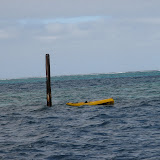
cockpit so he can see our position on the chart at all times. The only problem is that the electronic charts are not always correct. I remember as we entered Neifu in Tonga that the electonic chart showed us on land . You always have to cross reference with paper charts to be safe, but for today the electronic charts were correct. We made it through Sulphur Pass unscathed and we made it into the Astrolabe Reef through Herald Pass just fine as well. At least Herald Pass had a stick as a marker.
That helps things considerably. As we entered and saw the islands inside, we could tell this was going to be a fantastic place. Bright sunshine and blue skies helped that image.
Safina and Ranger were already at anchor when we arrived at 1530. In fact, Safina had already been to the village and stopped by to say hello and give us arrival information on their way back to their boat. We then got the dinghy in the water and we went over to say hello to Ranger. They had not been in to the village yet, so we went together. We took our yaqona or kava for sevusevu and made our way to shore. This little island is so very different from Beqa. Instead of looking like lush rain
forest, the islands within the Astrolabe Reef look sculpted, almost unreal. They are certainly lush enough, but the high peaks are grass covered, not topped with trees. The village on Dravuni is a stopping place for large cruise ships. Yes, these cruise ships come through those reef passes! In our reading about it, we gleaned that this is a very neat and clean village, prospering from their cruise ship visits. When we went ashore, we found that to be the case and were greeted with repeated choruses
of “bula, bula” from adults and children. We asked where we could find the village chief, and were led to him. He was sitting in the grass cross-legged ready to accept our gift. We think the village chief’s first name is Romero and he is probably around 45 to 50 years old. Another older gentleman came to say the blessing. We all sat cross-legged–it is very important not to show the soles of your feet. Some young children joined us and when the older gentleman said certain words, everyone would
clap once. This indicates a thank you. When the blessing was complete, we started to talk about life in the village and to ask for permission to snorkel, walk through the village, walk about the island, and visit the other islands inside the reef. Some islands are uninhabited, but you need permission from the Dravuni village chief in order to visit them. I also asked permission to visit the grades 1 through 4 school in the village and was invited to come tomorrow morning at 0800. As we started
to walk away, the older gentleman who had conducted the ceremony asked Mark and Paul for some help on an engine problem. Marie and I were drawn to some woman sitting on the grass, so we parted ways for a bit.
Marie and I met Marianne, the chief’s wife, and an older woman named Eleanor. Marianne was quiet and shy, but I could tell that Eleanor must be an island character. Marianne explained that the chief’s home had been burned to the ground on May 26 and we could see only the round stone foundation–the sign of a chief’s home. She explained that they have two daughters that live in Suva, and they have taken three young boys to raise. One of the young boys was killed in the fire. As we were talking,
Marianne expressed a desire to learn to bake bread. I told her that I would come tomorrow after visiting the school and we would made bread. I was surprised that she didn’t know how to make banana bread. They have soooooo many bananas, but she explained that they have no recipes. So instead of snorkeling all day tomorrow, I plan to made whole meal bread and banana bread with Marianne in the morning and she is going to show me how to weave pandanus floor mats. She is currently weaving them for
the new home they will be building. Mark and Paul will return tomorrow with some tools to help the older gentleman with his engine problem and hopefully by early afternoon, we can have the bread baked and be ready to snorkel. I can’t wait for that.
This village has generators and individual homes also have them. They have TV’s and Marianne said they really like to watch the 6 PM Fiji news to see what is happening in their country. She said the generators are not working like should right now, maybe no fuel, and they are currently using keronsene lanterns for light at night. While writing this log, we heard drumming beginning at 6:45 PM. The drumming continued for a short while. We will ask tomorrow what this signifies. It is now after
7 PM and we are listening to singing, probably from the village church. There are so many things to learn and so many questions we don’t even know to ask. Tomorrow will be another day of discovery.
by Judy Handley | Jun 5, 2007 | Fiji, Sailing Logs Year 2 |
Day 43, Year 2: From Vaga Bay to Maluma Bay
Date: Tuesday, June 5, 2007
Weather: Who knows?????
Location: Maluma Bay, Beqa Island, Fiji
We finally made the move. We pulled up anchor in Vaga bay just before noon and motored around the west side Beqa Island and across the north to Maluma Bay. All of this was done in the lagooninside the outer reef and with winds against us most of the time. As we left Vaga Bay and headed north along the west coast of Beqa Island, we could see Rukua village. We also could see Stewart Island to our south. This is the home of a resort and we saw boats transiting tourists from the mainland. We also
saw beautiful silver fish, about three feet long, jumping out of the water and begging to be caught. But we have not gotten the fishing gear out yet, so we missed our opportunity. We will work on getting things out and ready tomorrow.
It took us about two and half hours to move around to Maluma Bay and get anchored. The cruising guides for Fiji are almost 15 years old, so we really don’t have good information. The charts are okay, but any navigation marks that are indicated are probably not there. Navigation here is most interesting. Basically, you stand on the foredeck and look for coral heads with fairly good information from the electronic charts. It is a bit harrowing, but we did make it in here. As we entered Maluma
Bay we saw a big ketch at anchor along with a couple of large aluminum fishing boats. As we drew closer, we saw they were anchored off a beach with a very up-scale dock and very fancy housing on shore hidden amongst the trees. We decided that it looked like a resort and since the sailboat was flying no flags, we thought maybe it belonged to whomever had this fancy complex in the bay. We decided to anchor here instead of going further into the bay to village of Labuti. Since we are hoping to leave
early in the AM for Astrolabe Reef, it seemed silly to dig ourselves deeper into the bay. We successfully anchored on the first try and had a late lunch and read for a bit. We thought we would go exploring, but before we got that far, a fishing boat came up to us. There were two young men and an older gentleman. His name was Sele and he wanted to see our cruising permit. We got that for him and he was satisfied. He said he was from the village of Labuti. He asked if we had any 4-stroke, 2-cycle
oil aboard that we could spare. We did, so we gave that to them and he invited us to visit the village tomorrow if weather does not permit our passage to Kadavu. He told us that the fancy complex on shore is owned by an American and no one is there this week. They will return next week with tourists. I am assuming that the big ketch anchored here belongs to the owners. Since it is possible for foreigners to purchase free-hold land here, I am assuming that someone sailed here from the US and
decided to set up residency. It is beautiful and if I had unlimited money to fly back and forth between here and the US to visit family at will, I might do the same. But we don’t have that kind of money, and the distance would probably keep me from doing it even if I did have the money.
The weather just really isn’t cooperating. It is again windy and rainy, so we are only a little hopeful that we will be able to exit the reef in the AM and head for Kadavu. Keep your fingers crossed for us as we are really ready to move on.
by Judy Handley | Jun 3, 2007 | Fiji, Sailing Logs Year 2 |
Day 41, Year 2: Still in Vaga Bay with Improving Weather
Date: Monday, June 4, 2007
Weather: Improving–Still Overcast with Rain; Winds Lessening
Location: Vaga Bay, Beqa Island, Fiji
We are still here in Vaqa Bay. The weather has improved considerably, but the reports we are receiving tell us that it is still windy in the pass between here and Kandavu Island and the Astrolabe Reef. So we are staying put. Tomorrow we might move around to a bay on the northeast side of this island. If we do that, it will get us closer to our destination in the Astrolabe Reef on the next day. But we can only make the move if it is clear enough for us to be able to see any coral heads in our
path. Today that would not have been possible until almost noon. We will just have to see how tomorrow’s weather plays out.
We spent our day doing our rainy day projects. We cracked open the coconuts given to us by the people in the village of Naiseuseu. We scraped the coconut out the shells and have it set to dry. We have not been given coconuts by locals in the past, so this is a new experience for us. We are eating more papaya than we ever wanted, but we are getting used to the taste. With enough lime, it is okay. We don’t love it, but it is what is here so we are adjusting. My rule is that we are not allowed
to drink any of the purchased juice onboard as long as we have local fruit. Mark is especially unhappy with this rule, but he is trying to learn to love pawpaw. We continued working on computer projects. We completed meshing our Outlook contacts and wrote a few emails to friends. I made “crunch coleslaw” that doesn’t have to be refrigerated, and checked all of our fruits and vegetables that we are storing to make sure all is well. I had to peel a couple of mandarin oranges and put them in the
refrigerator, but other than that, everything is holding fine. Yesterday we ate our last New Zealand kiwis and our last New Zealand new potatoes. It is amazing to me that those things lasted this long, but now we are now relying on our Fiji fruits and vegies. Let’s hope they have the same longievity.
Yesterday we were blown about by the relentless strong winds. Today, we have had a few gusts and some rain, but basically the weather is moderating. Our weather reports today indicate that we should wait until Wednesday (it is Monday evening here) to travel across the Kadavu Pass, but we will rise early in the morning and check the latest weather to see if we might be able to do this tomorrow. We are not anxious to get out in angry seas, so we will only go if the reports are very favorable. Otherwise,
we will move around the island to the northeast side tomorrow, and then leave early the next day for Kadavu.
Since we had put our dinghy on deck last evening, we didn’t bother to put it back in the water today. That meant that we didin’t visit the village. I know it must be hard to imagine what I mean when I talk about a village. There are about 90 people living in Neiseuseu. Each family lives in a concrete block or corregated iron home. There are uncovered windows and doors, and the concrete floors are covered with mats. There are mattresses in the partitioned bedrooms and stuffed furniture in the
living area. There are outdoor shared showers between the houses that appear to have pressure water. I know the water comes from the mountain springs, but I actually don’t know what the people do about sewage. I have not seen bathrooms of any sort, so I’m just not sure. This village has a generator and there is a centrally located tv. I think I mentioned this in an earlier log. The only store is over the mountain, so any purchased goods come from there. Clothes obviously come from Western
sources–t-shirts and jeans for the guys, and dresses for the woman. There are tennis shoes to be worn when walking on the mud flats and reefs, but otherwise people wear thongs or go barefooted. In the little village of Naiseuseau, the church is central. It is the largest building in the center of the village. Everyone speaks English, although the children speak less than the adults. The children tell me that they are taught in Fijian, so I am not exactly sure when and where they learn the English.
I know we will learn more about village life as we continue our trek, so I report in when I know more.