by Judy Handley | Aug 12, 2008 | Indonesia Alor to Flores, Sailing Logs Year 3 |
Day 95, Year 3: Teluk Lewaling to Kroko Atoll
Date: Hari Selasa (Tuesday), Bulan Agustus 12, Pada Tahan 2008
Weather: Sunny Skies with a Few Puffy White Clouds; No Wind When Needed
Latitude: 08 degrees 14.598 minutes S
Longitude: 123 degrees 19.464 minutes E
Location: Kroko Atoll, Adunara Island, Nusa Tengarra Province, Indonesia
We traveled from Lembata Island to Adunara Island today and our “new” Yanmar engine hit 3,000 engine hours. I call it new because it was new when we started this circumnavigation. But we aren’t even half-way home and 3,000 engine hours is a lot of motoring. But it has brought us to beautiful places to meet beautiful people. Tonight we are anchored near Kroko Atoll behind a little sand islet. It is a beautiful spot with active volcanoes looming up in every direction on the horizon. We have made
the decision to stay out here and live the good life while most of the other rally boats are just about seven miles away in the anchorage at Lewoleba, Lembata. When the seventy plus boats leave there, they will come here and there is really only room for about five boats, so we just wanted to beat the crowd to this little piece of paradise.
We went snorkeling this morning on the reefs under the awe-inspiring Ili Api volcano before leaving Teluk Lewaling. It was not the most beautiful snorkeling spot, but it was wonderful to get in the water again. It’s been a long dry spell since Lizard Island on the Great Barrier Reef. Even though I would not rate today’s snorkeling spot very high on a scale of one to ten, I always find it fascinating to search for new fish and delight in seeing old friends. Today there were lots of the ever present
bright blue starfish, but I also saw the brown and tan sea star with the scientific name of Nardo tuberculata. I first saw this specimen on the reef at East Hope Island in Australia. Today this guy was in a seagrass bed along with the blue starfish. Something new to us today that was in abundance was a soft pink plant-like animal that looked like a feather duster. The branches were in one plane like a feather and they swayed so beautifully in the water. But when I got back and tried to identify
the new citing it appears that it is a hydroid which strings humans with quite a punch. The string evidently produces a sharp pain something like an electric shock. Even in these warm waters, we wear our dive skins and gloves, so we are protected, but I will know not to dive down and touch this enticing creature. The fish life today was not so prolific, but the bright blue chromis and yellow-tailed fusiliers known as pisang pisang in Indonesia brightened up the grassy seabed. I saw two fish I
had not seen before. One was a small filefish with furry skin. At first I thought it had algae growing all over it, but then I could see it was part of the fish. A much larger new fish that was seen today looked like the other juvenile batfish that were swimming around, but this one was totally black with neon orange tips on its long, fluttery fins. I even thought I saw a bright blue vertical stripe on its nose, but I cannot find a fish that looks like this in any of my identification books.
I’ll keep looking.
When we reached our new anchorage, there was only one other boat here. It was CanKata from Canada. Shirena and Scot Free II had sailed here with us and CanKata called and invited all of us to come over for sundowners. We had met Darrel and Loretta on one of our inland tours while in Kupang, but it was so nice to spend the evening with them and with Tina and Robert on Shirena and Gerry, Donna, and Klinton on Scot Free II. CanKata has been here for a couple of days and they were able to report
to us the fantastic snorkeling opportunities here. Evidently I am going to see lots of little Nemos in the next couple of days. I can’t wait to dive in early tomorrow morning.
by Judy Handley | Aug 11, 2008 | Indonesia Alor to Flores, Sailing Logs Year 3 |
Day 94, Year 3: Villages and Volcanoes
Date: Hari Senin (Monday), Bulan Agustus 11, Pada Tahan 2008
Weather: Sunny Skies and No Wind
Latitude:08 degrees 17.560 minutes S
Longitude: 123 degrees 37.893 minutes E
Location: Teluk Lewaling, Lembata Island, Nusa Tengarra Province, Indonesia
Today was V Day-vistas of villages and volcanoes . . . and at the end of the day a very special visit to the village of Dikasare in Teluk (Bay of) Lewaling. We started our day motor sailing west across the top of Pantar Island and then hopped across Selut Alor to the north shore of Lembata island. Lembata is named Kawula on most charts and Lomblen on others. Everyone today refers to it as Lembata, so that is what is used here. Whatever the name, our trip across the top of the island was fascinating.
The land drops sharply into the sea from the top of Mt. Kedang towering 5,000 feet high. There are no places to anchor on this north coast as it is much too deep right up to shore, but obviously supply ships get in and out of each of the little seaside villages. Actually, they weren’t so little. It is amazing how many homes are in these “middle of no-where” villages. We could see the perfect volcanic cone of Ili Api, also known as Mt. Warian, as we sailed along. Ili Api is just shy of 5,000
feet and it dominated the view most of the day as we puttered along the north coast. Just before the mountain, we hung a left and went into a huge bay that juts inland. Sailing in under the smoking cone of Ili Api was quite dramatic. The larger and deeper bay is Teluk Welenga but we turned to the east and entered Teluk Lewaling. The only information we had about this area was a handwritten note scribbled on one of the copied charts we bought in Darwin. For one anchorage area it said “pretty
coral, no people, lots of bommies” and for the other it said “a few houses, mangroves, and sandflies.” Well, we chose the latter for tonight, but that was because our friends Jean-Pierre and Colette on Safina were there and radioed to us saying it was a good anchorage and a nice village. We needed to see Safina to loan them our back-up camera. They bought a new camera in Darwin but the battery charger doesn’t work and without that they can’t use it. Anyway, we got the camera to Safina and then
went to shore to see the village.
As it turns out, the village where we are anchored is the village that rally participants will be visiting on Wednesday. Dikasare has 100 houses. Ninety homes are Catholic and ten are Muslim. A young man who could speak English met us at the beach. He learned English while working on a project in Malaysia and he took us to meet the head of the village. So we got a head start on the rally with a personalized tour and a wonderful weaving demonstration. The head of the village told us that they
would exercise for us. We finally figured out that meant “practice.” Cruisers who were here this morning got to see the cotton being picked, but we got to see it combed and spun by hand. We actually got to see the women build a loom from sticks and string and then we watched a woman as she threaded the loom. The process of dying the thread was explained and we got to see the plants that are used for dying. We also got to see how they tie the plastic string around the threads before it is dipped
in the dye to make the designs. This is one process where a picture is worth a thousand words. If I ever get to a high speed internet location, I’ll post these photos first. The ikat weaving process is absolutely fascinating.
So tomorrow we will go to the anchorage with the “pretty coral” but as much as I love snorkeling, today’s accidental village visit is going to be hard to beat. But every time we think we have seen the most spectacular, there always seems to be more.
<table style=”width:194px;”><tr><td align=”center” style=”height:194px;background:url(http://picasaweb.google.com/s/c/transparent_album_background.gif) no-repeat left”><a href=”http://picasaweb.google.com/110091696418315776431/080811Day94IndonesiaPantarToLembata?authkey=Gv1sRgCLLg2qePmdDMnwE&feat=embedwebsite”><img src=”http://lh3.ggpht.com/_WzplUbkWh1c/TTSTCzy0c0E/AAAAAAABLrw/OFzdVOUs01U/s160-c/080811Day94IndonesiaPantarToLembata.jpg” width=”160″ height=”160″ style=”margin:1px 0 0 4px;”></a></td></tr><tr><td style=”text-align:center;font-family:arial,sans-serif;font-size:11px”><a href=”http://picasaweb.google.com/110091696418315776431/080811Day94IndonesiaPantarToLembata?authkey=Gv1sRgCLLg2qePmdDMnwE&feat=embedwebsite” style=”color:#4D4D4D;font-weight:bold;text-decoration:none;”>080811 Day 94 Indonesia–Pantar to Lembata</a></td></tr></table>
<table style=”width:194px;”><tr><td align=”center” style=”height:194px;background:url(http://picasaweb.google.com/s/c/transparent_album_background.gif) no-repeat left”><a href=”http://picasaweb.google.com/110091696418315776431/080811Day94LembataIndonesiaDikasareVillage?authkey=Gv1sRgCOPmh9z5ivTwdg&feat=embedwebsite”><img src=”http://lh5.ggpht.com/_WzplUbkWh1c/TTSVHjYbFDE/AAAAAAABLog/XU9K_wJFKb4/s160-c/080811Day94LembataIndonesiaDikasareVillage.jpg” width=”160″ height=”160″ style=”margin:1px 0 0 4px;”></a></td></tr><tr><td style=”text-align:center;font-family:arial,sans-serif;font-size:11px”><a href=”http://picasaweb.google.com/110091696418315776431/080811Day94LembataIndonesiaDikasareVillage?authkey=Gv1sRgCOPmh9z5ivTwdg&feat=embedwebsite” style=”color:#4D4D4D;font-weight:bold;text-decoration:none;”>080811 Day 94 Lembata, Indonesia–Dikasare Village</a></td></tr></table>
by Judy Handley | Aug 10, 2008 | Indonesia Alor to Flores, Sailing Logs Year 3 |
Day 93, Year 3: Leaving Alor and Heading West
Date: Hari Minggu (Sunday), Bulan Agustus 10, Pada Tahan 2008 Weather: More Sunshine and Fluky Winds
Latitude: 08 degrees 21.816 minutes S
Longitude: 124 degrees 05.778 minutes E
Location: Blangmerang, Panta Island, Nusa Tengarra Province, Indonesia
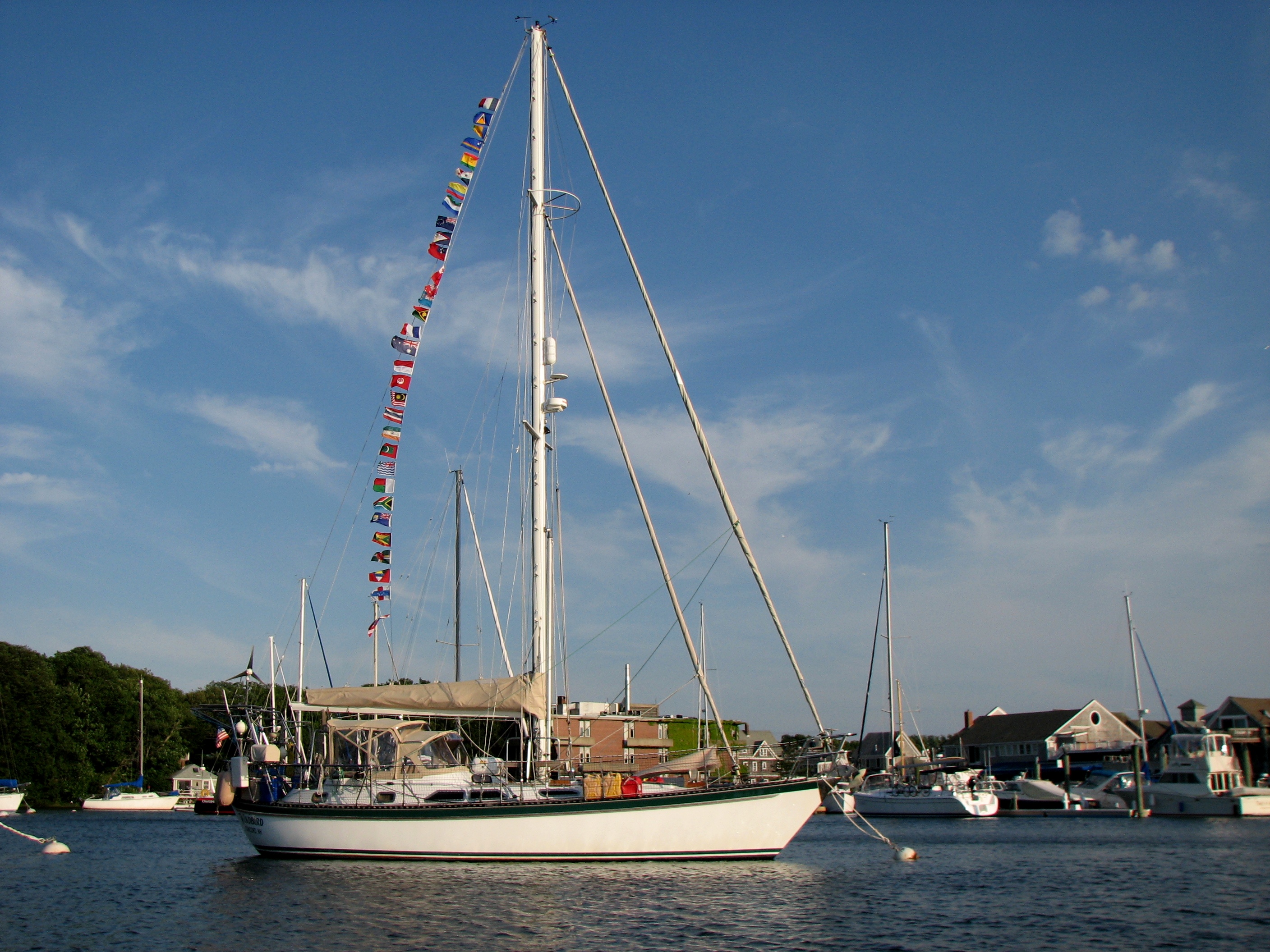
There was once again a mass exodus early this morning of rally boats leaving Kalabahi. I think there were about 40 boats in the anchorage, and the only one that stayed behind was Mike on Good News. He was visiting an orphanage today and delivering clothes and school supplies. I gave him some of the little practice books that I had to give to children and I think some other cruisers did the same. It took about an hour and a half to get out of the long, thin bay leading out of Kalabahi and back into the main pass. We are getting a little better at timing our passages and had less current against us today. But there was almost no wind. I heard a cruiser say yesterday, “If thou art sailing then thy wind and thy current will surely be against thee.” I might have my ‘thous’ and ‘thys’ and ‘thees’ in the wrong places, but you get the idea. So Windbird, the motor sailor, decided to go the 36 nautical miles to Blangmerang instead of head on and yet into the further anchorage after dark. Only Shirena and Scot Free came to the same anchorage with us. A whole slew of boats had planned to anchor just north of where we are on the southern tip of a small island. But when they got there it was totally untenable so they went on but were going to have to sail through night. Shortly after we arrived here, Tina of Shirena, Gerry and Donna of Scot Free II, and Mark and I got in our dinghy and went over to the village. It was a huge village with hundreds of people. This side of Pantar is very dry, so there is not one blade of grass. The village was laid out in a rectangular grid with semi-paved narrow streets and concrete sidewalks. The homes were all single-story concrete block or brick and mortar, with lots of people in each tiny little home. Most roofs were corrugated iron, but the homes did not look like there was any furniture inside. There were at least four mosques in the village and most people we met appeared to be Muslim as the women were all wearing a head covering. No one could speak English and none of us speak very much bahasa Indonesian, but we walked and took pictures to the delight of the people. They love having their pictures taken and looking at the images. At one point, I had stopped to take a picture of a mother and her baby in a doorway, and when I went back to the sidewalk, I was met by a parade of Muslim women all carrying beautifully wrapped bowls of food on their heads and the men carrying live ducks, chickens, and goats. They motioned for us to join them and Mark really wanted to go. But this time I was hesitant. I’m sure it would have been an interesting feast, but since the animals were still alive, it was obviously going to be a long time before dinner. If we joined them we would have had to eat and drink whatever they offered. The food would have been fine, but the drink could definitely cause a problem. Beer and Coke are the only things we can have when ashore, and I am absolutely positive that neither was going to be served. And we didn’t bring any mosquito repellent and it was getting late in the day. So we continued our walk but did not follow the parade. We made our way back out to the sailboats and Tina invited us all aboard Shirena for sundowners. Robert had stayed on the boat to work on their autopilot which is misbehaving. Shirena seems to be plagued with electrical problems and this time there is bad connection somewhere and he just can’t find it. But regardless, we all enjoyed our time together and we headed back to Windbird just in time for evening prayers being blared from the speakers on the roof of the mosque by the harbor. It is a new experience for us to measure the time of day by the call to prayer, but that is a fact of life in Indonesia. I think we are starting to come down from the fast pace of life we experienced in Kupang and will move at a slightly slower pace until we reach Bali.
by Judy Handley | Aug 9, 2008 | Indonesia Alor to Flores, Sailing Logs Year 3 |
Day 92, Year 3: A Quiet Day in Kalabahi
Date: Hari Sabtu (Saturday), Bulan Agustus 9, Pada Tahan 2008
Weather: Perpetual Sunshine with No Clouds
Location: Kalabahi, Alor Island, Nusa Tengarra Province, Indonesia
We really needed a day of rest and we got that today, but we are going to pay the price. We have been so much on the move that we had not done much forward planning. So when we did our planning today, we realized that we cannot reach our next rally location in time for the welcoming ceremony. And, of course, the welcoming ceremony is the highlight of each venue. So we will leave early in the morning and see how things go. We’ve run the upper and lower transits of the moon for tomorrow and this
tells us we should not leave here before 8 am, but there is no way to make the destination for tomorrow night if we don’t leave here earlier. So we are going to go for it. We will probably be met with a strong current that just won’t let us move north, but we shall see. We have never cruised where you have to run these moon transits in order to predict the current, but we are learning lots of new things here in Indonesia. The worst case scenario is that we will just skip the Lembata venue, but
that might not be such a bad thing. There is a wonderful little atoll close to Lembata with good snorkeling and beautiful views of the volcanoes. We will just enjoy that and work our way to the next celebration on Flores Island.
Late in the afternoon today we went ashore to do some basic shopping-Coke, eggs, bread, bananas, and a few veggies. Notice that beer was not on that list. That’s not because it isn’t a “basic” on Windbird, it is just that it is an item doesn’t exist here. There are lots of shops that sell the other basics, but there are no grocery stores as we know them. Fruits and vegetables are sold on the side of the streets and in alley ways that wind between the streets. Everything in Kalabahi is a little
worn by time and lack of money. We have been many places in our travels where the people have had very little, but somehow when you got to know them, they were a proud people who didn’t seem poor. Here we are finding the poorest conditions that we have seen since parts of the Caribbean and Panama. The people here are certainly very friendly but they seem beaten down by years of struggling.
by Judy Handley | Aug 8, 2008 | Indonesia Alor to Flores, Sailing Logs Year 3 |
Day 91, Year 3: Another Wonderful Inland Tour
Date: Hari Jumat (Friday), Bulan Agustus 8, Pada Tahan 2008
Weather: Perpetual Sunshine with No Clouds; Winds in the Anchorage
Location: Kalabahi, Alor Island, Nusa Tengarra Province, Indonesia
Today we visited the local museum here in Kalabahi. We saw ikat weaving in progress and some beautiful examples of the weaving from different geographic areas. We learned that there is ikat weaving and sonkat weaving. The ikat weaving process is amazing. The design of the final product are died into the thread. The designs are tied off with plastic string to keep the dyes from penetrating. It takes more than a week to prepare the threads, and then the weaving commences. The actual weaving takes only two or three days. The sonkat weaving is more like weaving with which we are familiar. There is no preparation of the threads. Different colors of thread are woven in and out to create the pattern. Both processes produce beautiful cloth. The weaving was in one museum building and the moko drums were in another. The value of these drums in this country is amazing. Sonny, one of our guides and truly “modern” in every sense, is getting married in November. His bride price is one moko drum and two cows. In Alor, a bride price is still paid for every marriage and moko drums are almost always involved. These bronze drums are traced back to what is now known as Vietnam . They reached this island through trade and have remained here ever since. They are not found on other Indonesian islands. In the past, the people here thought they were a gift from the gods. Today they are just an accepted part of the economy with a very high value. The drums are about two feet tall and have the shape of an hour glass.
After the museum we headed to the north coast to the village of Takpala. This is a traditional village and we were greeted by traditional dancers. The men were dressed as warriors and the women all wore then hair down loose and danced with abandon. The women wore brass rings around their ankles that made a lovely jingling sound as they danced. The view of the Flores Sea from the village was phenomenal and the people were most gracious. After Takpala, we went to the village of Mali to have lunch and watch a group of elementary school children perform. This venue was on the ocean were the surf was constantly rolling in towards shore, and it was truly a spectacular beach. The elementary children performed for us in traditional dress and it was just great. We ate lunch and watched the dancing and the sea. And before we knew it we were off to the low mountain forest to plant a sandalwood tree in remembrance of our visit here. It was another spectacular day.
When we reached the harbor, the harbor master was there doing the final steps to check us in to this island. Mark did check in and out with the harbor master while I visited with other cruisers. Just before sundown we headed back to Windbird. We plan to do nothing tomorrow as we need a day of rest before moving on. The rally pace is fast and we need a little break before the next “expo.”
by Judy Handley | Aug 7, 2008 | Indonesia Alor to Flores, Sailing Logs Year 3 |
Day 90, Year 3: Dorothy, This Is Not Kansas
Date: Hari Kamis (Thursday), Bulan Agustus 7, Pada Tahan 2008
Weather: Perpetual Sunshine with No Clouds
Location: Kalabahi, Alor Island, Nusa Tengarra Province, Indonesia
Once again we were given a welcome fit for royalty. We went ashore this morning at 9 am following a long boat which picked up the first Sail Indonesia cruiser to arrive here to be our leader. We were met by drumming and gamelan music and lots of dancers dressed in traditional ikat woven sarongs and scarves. The official greeting was made by the head of tourism and then we were treated to traditional song and dance provided by the elementary children. They danced beautifully and the music was great. We were all provided with a boxed breakfast of local pastries and water and were all given an ikat woven scarf. A young woman who is serving as one of our guides asked us if we would do a greeting like this in our country. We had to reply that we have no “traditional” dance that would be performed. I guess this is what happens when you are a melting pot, but it did make me wonder what kind of greeting we would give to world cruisers arriving in the US.
This afternoon we all hopped on a local bus and went to a special market place set up for this Alor festival. The event was called Friendship Shopping and every little village and surrounding island had a booth there. It was sort of like a science fair. We went from booth to booth learning about the arts and crafts of various villages and islands. There were some things for sale but it was mostly an information fair. Mark was particularly curious about some of the traditional tools. There were things hanging on the walls of one of the booths that looked a little like a bow with no arrows. It was actually a mouse trap and of course, Mark had to set it off and then have them reset it so he could see how it worked. In the next booth, there was a similar contraption, but instead of mouse trap that kills the mouse, it was a trap to catch the mouse. It was a traditional Indonesian Hav-a-Heart trap. I couldn’t believe it. We learned all about the seaweed industry they have here where they build special shelters on the water to encourage the growth of seaweed that is then dried and marketed. We had a sweet bread made of ground seaweed and it was very good. And then there were the weaving demonstrations. The ikat weaving is very intricate and fascinating to watch. I bought a few beautifully woven baskets, a wonderful tray made of bamboo, and a couple of wooden writing pens . . . all for a total of $10US. We are told we should bargain, but the prices on some of these things are so low it seems a sin to offer less. Mark and I decided to walk back to the harbor. Walking through the local neighborhoods is always one of our favorite things to do. The children here yell “Mister” as we pass, and some little ones have learned to ask, “How are you?” We actually walked past the turn to the harbor and found ourselves in a Muslim neighborhood of very friendly people. No one could speak English, but one young man knew we were lost before we did. He helped give us directions back to the harbor and sent an older man along with us just in case we might get lost again. We love getting “lost” in places like this. This is when we have some of our best experiences. But after today’s walk, all I could think is, “Dorothy, this is not Kansas.”
We will be going back to shore this evening for a welcome dinner. The graciousness of these people just never ends. Tomorrow we are going on a tour that will take us to the local museum, the traditional village of Takpala, to a beach, and then to a memorial forest. We had thought of trying to do this on our own without going with the organized tour, but in the end that just proved to be too difficult. The language issues do make striking out on your own problematic.