by Judy Handley | Apr 14, 2010 | Chagos, Sailing Logs Year 5 |
Day 170, Year 5: The BIOT Boat
Date: Wednesday, April 14, 2010
Weather: Partly Sunny with Rain Off and On; Winds Variable
Location: Ile du Coin, Peros Banhos Atoll, Chagos
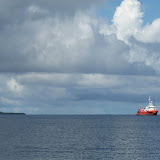
Last night just after Mark sent the log, he went outside to take a look around. He was a bit surprised to see ship lights coming our way as that is not something we normally see here in the atoll. We figured it had to be the BIOT boat, the Pacific Marlin, but there was no way to tell that at night. We watched it until it anchored and checked in by radio with Constance to tell them we had company in the anchorage. They had been watching the lights as well and had tracked it on radar. They agreed that it must be the Pacific Marlin. It was a coincidence that when we sent the log we received an email from our son-in-law Jed that included an article about Chagos that mentioned the Pacific Marlin. The article from the Times of London Online announced that on April 1 Britain announced the creation of the world’s largest marine nature reserve in Chagos-all 250,000 square miles of ocean in and around the atolls here. The article said that the ocean here is some of the “best preserved seas on the planet.” I can certainly believe that and we believe that the presence of the Pacific Marlin has something to do with this. Again, quoting the Times of London article, “The area is patrolled by the Pacific Marlin, a small vessel that costs £1.7 million a year to operate. Until now licenses sold to French, Spanish, Korean and Taiwanese tuna-fishing vessels contributed about £1 million a year to the cost. A faster patrol ship will probably be necessary to prevent illegal fishing in the new reserve, but there are hopes that the US military base will assist enforcement by sharing information from existing intelligence networks on activity in the area.” Making this area a reserve has doubled the global coverage of the world’s oceans under protection. Those that used to live here oppose this move because it means that they can never return to live here. They had hoped that once the US is no longer leasing Diego Garcia that they might return. But on the positive side, because this area is literally unpolluted, making it a reserve assures “a valuable scientific baseline against which to judge human impacts to other areas of ocean.” The Pacific Marlin is a bright red vessel and she spent her day here at anchor. The large dinghy went far out into the atoll, probably gathering scientific data, and then at sunset, she pulled up anchor and went back out of the atoll the way she came in last night. We saw camera flashes as she left, so maybe there will be a photo of Windbird and Constance in Chagos recorded somewhere in the history books.
We had a bit of a rocky start to our morning. We had our granola and checked for email and then I went to the forward head to get some cleaning agents. I have been smelling this sweet smell every time I open the door to that head and this morning I discovered what it was. A big bag of dry Tide detergent was stored on the sink counter and it had somehow torn open and there was a huge pile of Tide on and in the sink. It is amazing how sweet it smelled. An hour later that was cleaned up and Mark found the next problem. He was turning the eggs when he saw something dripping-a broken egg. So we had to take the egg palates apart and check and clean each egg. We found five bad ones, so it was a good exercise. But when we finished it was 10:30 and we were just starting our day. I cleaned the wooden louvered cabinets in the galley and then applied lemon oil to them while Mark worked on the electrical connections of the solar panels. The connections to the fuses were corroded and needed to be cleaned and fuses changed. We kept thinking the solar panels weren’t clean enough and that was the reason we weren’t getting a charge from them, but now we know it was the connections. In the afternoon, I wrote emails and Mark went to Constance to help Lynne organize the files on her computer and ran software to eliminate viruses that may have gotten on her computer when she was connected to the internet in Gan. She has been getting warnings since then but hopefully today’s work eliminated the problem. Later, Mark went to shore with Ed to burn garbage and get more water. We had dinner on Constance tonight. It was a squid pasta and was delicious. Lynne caught the squid and Ed fixed the pasta-a perfect combination.
I can’t believe it, but the calendar tells me it has been two months since my brother Dickie died. Today would have been his 75th birthday, so I know this is a particularly hard day for my sister-in-law. Conda, we just want you to know that we are thinking of you.
by Judy Handley | Apr 13, 2010 | Chagos, Sailing Logs Year 5 |
Day 169, Year 5: Another Explore on Ile du Coin
Date: Tuesday, April 13, 2010
Weather: Beautiful Day; Winds S-SE 5-8
Location: Ile du Coin, Peros Banhos Atoll, Chagos
The anchorage here is almost empty. Mirage left yesterday and Nepenthe left early this morning. So that leaves just Windbird and Constance here at Ile du Coin. The winds are backing to the SE and soon we will have to move back to Ile Fouquet on the SE side of the atoll where the reef protects us from the swell caused by the east winds. We are now on the west side of the atoll and the winds blowing across the waters of the atoll cause a bit of a roll here. It is not bad yet, but I expect we could have to move tomorrow or maybe the next day. In the meantime, we continue to enjoy our time here. Mark visited with Ed and Lynne this morning, but I stayed home baking bread and doing boat chores that take time but I can never pinpoint exactly what it was that I did. The boat looks cleaner and neater inside, so that is what I did. When Mark came home he tried once again to catch squid but they are being very tricky. They are always around the boat but they just aren’t biting. Lynne caught five today, so she may have to come give us lessons.
In the afternoon, Mark and I took off in the dinghy with empty water jugs, the FAD that needed to be taken back to shore, and a fishing rod. We were headed about two-thirds of the way down the island to the cemetery in the dinghy. When we reached the coconut trees with white painted trunks, we took the dinghy ashore and could see the grave markers from the shore. Nepenthe saw the resident donkey there last week and we were hoping for the same, but no luck. But we did wander through the cemetery. It looks so very old, but many of the graves are from the 1900’s. Most everything is covered with green moss and crumbling stones in one part of the cemetery, but in the other half many of the graves look new. Many of the graves have raised stone monuments about two feet high covering the entire grave. In the one section, it looks like the old stone monuments have recently been covered with new concrete. It was very sad to see how many of the graves were small indicating that they were the graves of very young children. Either life here was very tough on the young ones or there was some sort of disease that swept through and killed them. We left the cemetery and headed back to the area to the west of the old pier where dinghies go ashore. I hopped off with all the water jugs and a bucket of laundry that I was going to do close to the well so we didn’t have to carry water for that. Mark went out to see if Ed wanted to come ashore to get water, but he was way too involved in a boat project today that took much longer than he expected. While Mark was gone, I walked back to the area where the well is and proceeded to get the laundry in to soak while filling one water jug. Five gallons of water weighs something like 60 pounds, so the jaunt back to the beach seems very long when carrying the full jugs. I carried the one jug back to the shore and Mark had just arrived, so we carried two more empty jugs back to the well to fill. He filled those while I washed and rinsed the laundry, and then it was back to Windbird.
Tomorrow could be a quiet day working on editing photos and reading. We’ll see what the morning brings.
by Judy Handley | Apr 12, 2010 | Chagos, Sailing Logs Year 5 |
Day 168, Year 5: Snorkeling the Morning Away
Date: Monday, April 12, 2010
Weather: Beautiful Day; Winds SW 5-8
Location: Ile du Coin, Peros Banhos Atoll, Chagos
This morning we got in the water at 8:30 am and didn’t get out until 11. Carol of Nepenthe, Ed and Lynne of Constance, and Mark and I took our dinghies halfway down the island and then pulled them along with us as we snorkeled our way back toward the pier. It was a long snorkel, and not the most dramatic, but we did see a couple of things that were really fantastic-both right at the end of our morning. One was a hawksbill turtle that decided to hide from us by throwing sand on his back and just sitting quietly on the bottom. Carol of Nepenthe and Lynne of Constance had been following him as he swam to the sand patch, but by the time I arrived he had settled in. Two bright blue and yellow-striped Regal Angelfish were swimming around the turtle, as well as a beautiful blue fish with blue fins and yellowish-orange circles all over it. I saw a number of these today and have no idea what they are, so I’ll have to research that one. We had just put the camera in the dinghy so I asked Mark to go get it as it was such a perfect picture. But, of course, by the time Mark got back with the camera, the fish were gone. He did get photos of the turtle, however. As we headed to deeper water we saw the next incredible sight. There were parrotfish, probably two hundred of them, just swimming together in a cluster. There were purple ones, blue ones, and red ones, with yellow, orange, and pink splashes here and there. It was quite amazing and the perfect end to a peaceful morning in the water.
In the afternoon, Carol, Lynne, and I had a little book exchange aboard Windbird while Mark and Ed went out fishing and exploring. They came back with two red snappers and what looked like a big blue buoy. Actually it was a FAD, a Fish Attraction Device, or at least part of one. It had washed up on the shore and will be taken back there, but Mark and Ed thought we would like to see it. A FAD is a satellite transmitter that’s hooked up to a net (maybe with bait fish) that attracts and traps fish. The signal emitted from the transmitter gives the location to the fishing boat so they can find it later. I think there is more to the structure than the transmitter and net, but this is the extent of our knowledge. Cruisers here find them all the time here, so this must be the end of the line for FAD’s.
Jeff and Cathy of Mirage headed north to Ile Diamant this morning and have reported that it is a bit bouncy up there. They got a squall this afternoon that we didn’t get. Carol and Jim on Nepenthe are thinking of leaving tomorrow morning and heading over to the Salomon atoll. The GRIBS are showing that the SE winds are starting to set in and Salomon is protected from the East. But we have more exploring to do here and will probably move back to Ile Fouquet before the light E winds arrive in three or four days. If it looks like stronger E winds are coming, then we will make our move, but for now the address for Constance and Windbird is Ile du Coin.
by Judy Handley | Apr 11, 2010 | Chagos, Sailing Logs Year 5 |
Day 167, Year 5: Rainy Day in Paradise
Date: Sunday, April 11, 2010
Weather: Cloudy and Rainy; Winds NW to W to SW
Location: Ile du Coin, Peros Banhos Atoll, Chagos
Raindrops were falling on my head at 6:30 this morning. Mark quickly shut the hatch overhead and then we rushed to get everything secured. It was a pouring rain and we were able to catch lots of rain water in buckets to help fill the water tanks. I had put a wash in the shower stall last night to soak, so I hurriedly wrung it all out and hung it outside to rinse in the rain. Once all this was done, we had a special breakfast of bacon, eggs over easy (the first time since Thailand), and toast, and then sat in the cockpit to watch it rain while reading. Mark is reading The Looming Tower: Al-Qaeda and the Road to 9/11 by Lawrence Wright and I am reading a novel by Chimamanda Ngozi Adichie, Half of a Yellow Sun. This novel takes place in the 1960’s in Nigeria and then in the newly formed country of Biafra. Both books are gripping, so it was easy to spend a rainy morning reading. Mark took time out to try his hand at catching squid and he was finally successful. I heard him calling, “Bucket.” So I went running with the bucket to put under the squid to catch the ink he was squirting. We don’t want to have to clean that off the boat. So now we had a squid but we didn’t know what to do with him. I love calamari, but the sight of this beautiful creature in a bucket made me think I might just have to change my tastes, but this one needed to be put out of his misery, so we called Ed on Constance. While he was giving us detailed directions, we saw Carol of Nepenthe headed our way. She is a master squid catcher, so we took advantage of her timely visit to have her show us how to deal with squid. She brought us a couple of pieces of upside down cake for lunch dessert and we gave her the last of our very over-ripe bananas. The rain subsided in the afternoon and the clothes on the life lines began to dry. We had happy hour on Constance with Jim and Carol of Nepenthe and Cathy and Jeff of Mirage. There are just the four boats here right now and it was great to get together.
If you are interested in seeing where we are located, evidently you can do that by going to Google Maps. Our friend Alan Kanegsberg in Concord, New Hampshire, wrote today, “We are following you on Google Maps. It is hard to locate the particular atoll you are on, but once you find it you can zoom in very close and read the names. You can see that there is virtually nothing but trees. You can see the buildings you are describing and the remnants of the old pier. To find it, you follow a line from India to Mauritius. Halfway there is a lighter blue area. Zooming in on the big one and then moving a little north
shows the necklaces of surface land that surround each lagoon. If you move south to Diego Garcia, you can see the military ships anchored inside the reef.” The next time you have a rainy day, maybe you can see if you can find our little paradise.
It is Sunday evening here, but Sunday morning in New Hampshire. Probably all of my teacher friends in Concord will be gathering this morning for a memorial service honoring a teacher and a friend who died suddenly this week and my thoughts are certainly with them. They are gathered to honor Sue Ann Martin, one of the best teachers I have ever known. She could help kids reach deep inside themselves and bring forth their best. She was a wonderful mother, teacher, and friend and it seems so unfair that she should die so young. At 50, Sue Ann was still running five miles every morning before breakfast. She was as fit as a 50 year-old woman could be, but a strep infection went into her blood system and spine and took her quickly. She was teaching on Monday and was gone by the end of the week. The Concord Monitor reported that only 1 in 100,000 die of this type of infection. Our thoughts are with her family and all of our mutual friends. Life is so precious and we must all remember to live each day to its fullest.
by Judy Handley | Apr 10, 2010 | Chagos, Sailing Logs Year 5 |
Day 166, Year 5: Exploring Ile du Coin
Date: Saturday, April 10, 2010
Weather: Very Little Wind from the North
Location: Ile du Coin, Peros Banhos Atoll, Chagos
Latitude: 05 degrees 26.579 S
Longitide: 071 degrees 45.541 E
The weather was just right for our move back to Ile du Coin. The GRIB file says we should have very little wind for three days, so we got up early, checked to make sure the GRIB file was correct, and made the move. I really wanted to explore Ile du Coin, but we also needed water and there is a good well here. Most people don’t drink the water, but use it for washing clothes and dishes, and for showers. I know I have not explained the Chagos water system that we learned from Constance and used the whole time we were in India. It was a lifesaver there as we could not run our water maker and we would have run out of drinking water in the six weeks that we were there. So here’s a description of the system. We bought extra five gallon water jugs in India. We sit one on the top of the cabin and run a short hose through the galley hatch into the galley. It hangs down from a ceiling hook over the galley sink and we attached a shower nozzle that we also bought in India. It is the type of shower nozzle that you have to squeeze the handle to get water and we use this for all dish washing. We have a five gallon solar shower bag that we now hang just above the port in our shower stall. We fill up the bag from the water jugs we get on shore and simply pull the solar shower nozzle into the shower stall through the port. We save all shower water by not pumping out the shower right away and use this for washing clothes. I then take them on deck and use the water from the jugs for rinsing in buckets. The rinse water is then used to wash down the deck. Today we filled all four of our water jugs, so tonight we’ll save the shower water and tomorrow will be laundry day. So for now, we use our water tanks only for drinking water. We can make water here, but that takes power, and power takes diesel fuel. We probably have plenty, but we are trying to be as conservative as possible so we will have all the fuel needed for the 1,500 mile trip to Madagascar.
Before I can describe the island walkabout I think I need to give a brief history. According to the history books, there were no indigenous peoples living here when the Portuguese, the French, and then the English sailed here. The Portuguese came in the 1500’s. Later on the French camped out here, left, and then returned and started exporting coconut oil and copra. This required people and suddenly Diego Garcia, Salomon, and Peros Banhos Atolls in Chagos were populated. The population came in the form of lepers from Mauritius and slaves from Mozambique and Madagascar, but in whatever form, the islands were populated and the copra and coconut oil business flourished. In the late 1700’s the English arrived. Once Napoleon was defeated, the Treaty of Paris in 1814 gave Mauritius, and Chagos as a dependency of Mauritius, to the English. Sometime around 1834 “human rights” was a term being used to force the Brits to start paying their workers, so very slowly the slaves became apprentices and were paid a penny a month for their labors. Hardly freedom, but it was a bit of a step forward. By the late 1800’s palm oil mills were operating in Salomon Atoll on Boddum Island and in Peros Banhos Atoll on Ile du Coin Island. Diego Garcia Atoll was used as a “coaling station” for passing steamships. The hardwood Takamaka trees were also exported. There were few women but regardless, by the 1930’s, about 60 per cent of the islanders were born and bred in Chagos and were known as ‘Ilois’ or ‘children of the islands.’ During World Wars I and II there were some passing ships but it was not until the 1950’s during the height of the Cold War that Chagos was considered as a possible military base. At the same time, the independence of Mauritius was becoming a sure thing and the English didn’t want Chagos to go with it. So in 1965 they separated Chagos from Mauritius and called it BIOT-a British Indian Ocean Territory. Then in 1966 the Americans convinced the Brits to lease Chagos to them for use as a military base. This initial rental agreement was for 50 years and the Americans didn’t want the people to stay, so the English found some obscure clause in the history books that would declare the residents as temporary visitors so that the people could be removed. Lawsuits followed, but the agreement still stands and there are no people other than visiting cruisiers at Peros Banhos and Salomon Atolls and military personnel at Diego Garcia. That is a brief, and possibly not completely accurate history of Chagos, but it is the best I can do from the resources at hand.
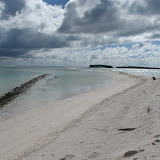
So when you anchor close to Ile du Coin the remnants of a large concrete pier greet you. When we took the dinghy ashore next to the old pier, we could immediately see what little is left of a once thriving community. The buildings were roofed with tin and all of the tin has blown off, but the buildings themselves were built of coral blocks and mortar and are quite substantial. We walked down a path with huge elephant leaf plants on both sides and then saw the remnants of what was once the center of the community. The building was two stories with a waist-high coral block wall surrounding it with little pillars at the entrance. The well that cruisers use is on the back side of the house and is covered with tin. It is about twelve feet deep and you just throw a bucket on a line down, fill it with water, and pull it up. The water is crystal clear and cool. We wanted to fill our water jugs, but Jeff and Cathy of Mirage and Ed of Constance were onshore and had already filled their jugs by the time we arrived. They were getting ready to walk around the island, and since they have been here before and know their way around, we decided to follow. There are old orange and lemon trees, bilimbi trees that have fruit that looks like little cucumbers growing on the trunk, guava trees, and some sort of nut tree. There are huge plots of taro growing in the wet areas and a few bread fruit trees scattered here and there. Everything is overgrown, but not so much that you can’t see the remnants of homes and the railway track that carried the processed coconuts from parts of the island to the pier to be shipped. We walked all the way to the back side of the island and were amazed by the amount of coral that has been swept inland during storms. Mark and I also saw the biggest coconut crabs that we have ever seen. Where coconut trees have blown over in storms, there are huge holes where the roots once were. When we would peek into any of these holes, we would see the crabs with their most impressive pincers. We certainly didn’t get too close. By the time we got back to the pier, filled our water jugs and lugged those out to the beach, and got back to Windbird it was almost 5 pm and we were exhausted. Exploring the underwater world here will be tomorrow’s job.
by Judy Handley | Apr 9, 2010 | Chagos, Sailing Logs Year 5 |
Day 165, Year 5: More Banana Bread and Granola, But No Fish
Date: Friday, April 9, 2010
Weather: Weather Unsettled; Squalls Passing to the South
Location: Ile Fouquet, Peros Banhos Atoll, Chagos
Things have been a bit bouncier today than normal. There has been a little more wind than the past few days and sometimes it comes from the NE, sometimes from the E, and sometimes from the SE. And squalls have been passing just south of us all day. We’re hoping whatever is going on will settle by in the morning so we can go back to Ile du Coin, but we’ll have to wait to get a GRIB file and then see how things look in the morning before making the move. Jim and Carol of Napenthe, a couple from Michigan, are the only ones left at Ile du Coin. Carol called today and offered to show us the hiking trails on the island, so I am anxious to get there before she leaves. The bouncy waters also caused our early morning fishermen some problems. Ed, Jeff, and Mark headed out of the atoll at 7:30 am, but by 9 am they were back with no fish and two lost lures. It was a little bouncy for Mark’s lower back, so I don’t think he’ll be heading out again until we have smoother waters.
I spent my day baking more granola and more banana bread. We are all sick of bananas, but we hate to waste what we have. They are getting over ripe and must be used, but without a freezer, two people can only eat so much banana bread. We won’t have bananas again until we get to Madagascar and I’m only assuming they have them there. But we’re getting our fill now, that’s for sure. And since I had to turn the oven on, I decided to do a double batch of granola. I shouldn’t have to make granola again until it is almost time to leave here. I also spent time editing the underwater photos from our snorkeling adventures this week. Instead of zooming in while underwater, Mark just takes all the pictures with a wide angle and we crop them later using the computer. It does take time, but his camera takes such high definition photos that we don’t lose much by cropping, so that is good.
Mid-afternoon, Ed of Constance, Cathy of Mirage, and Mark and I went to shore for a walk around the little island. It is tiny, but somehow we managed to spend two hours walking and talking and looking at all the little wonders on the beach. The sand crabs here are huge and dig holes big enough to lose your foot in, so you have to watch where you step. There are not many shells, but there is a lot of red coral that washes up both on the north and south side of the island. And today there were a number of perfect sea urchin shells on the south side. As I mentioned from our island visit two days ago, there are lots of shells, but they all have legs. Hermit crabs of every size and shape are crawling everywhere. We can look but not touch and are not allowed to take anything from our beach walks. We must leave only footprints, but it is a joy just to walk and see all the sand critters.