by Judy Handley | Jun 6, 2010 | Passage to Madagascar, Sailing Logs Year 5 |
Day 223, Year 5 Passage to Madagascar, Day 4
Date: Sunday, June 6, 2010
Weather: Sunny Day; SSE Winds 12-16 Knots
Latitude: 08 degrees 18.381 minutes S
Longitude: 064 degrees 16.696 minutes E
Miles to Go: 940
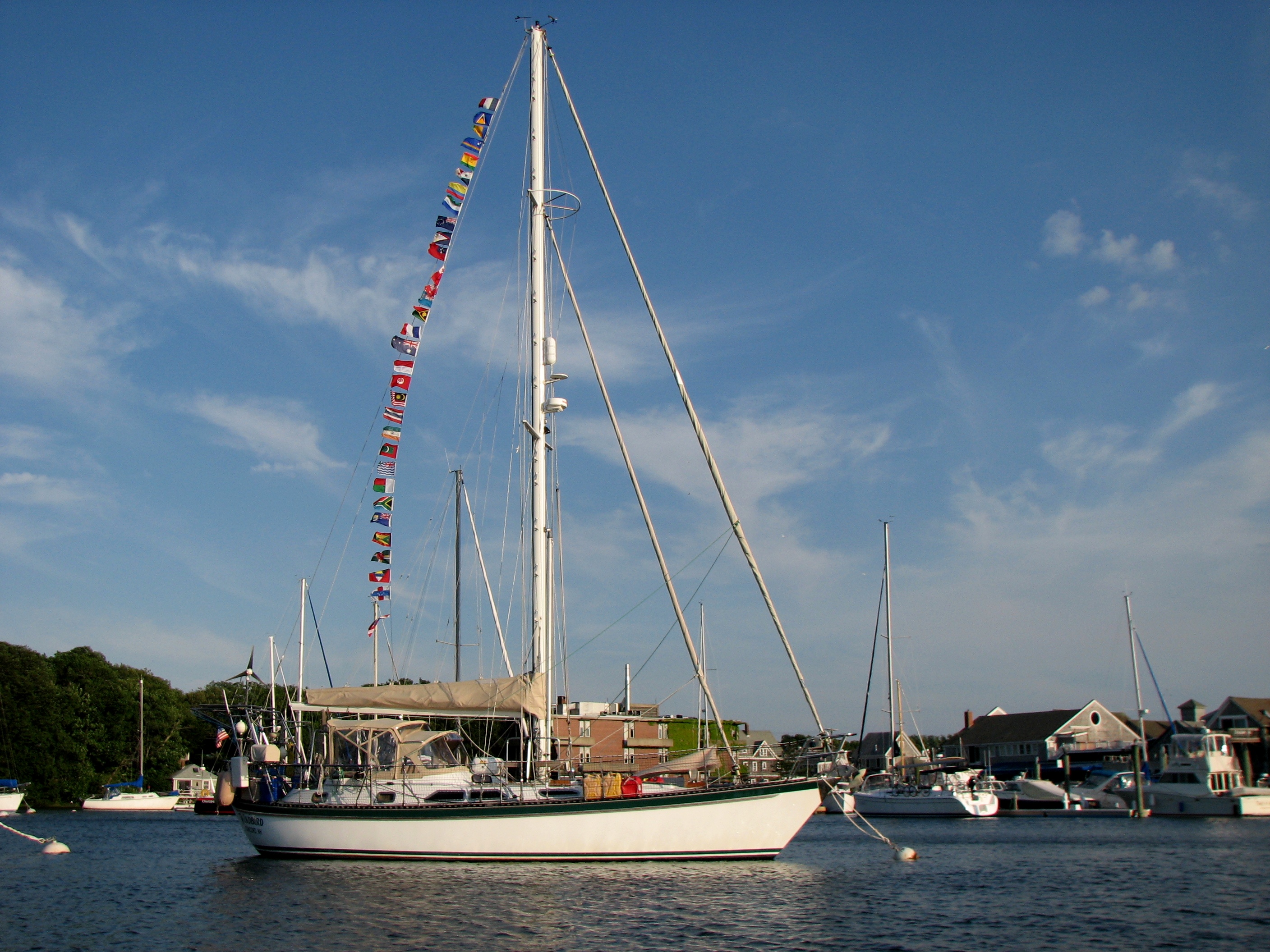
One-third of the way there, but things do happen. Both Windbird and Constance were sailing along on a fast track to Madagascar when Ed noticed that the headstay on Constance had broken at the top. The headstay is the heavy wire around which the roller furler and head sail are attached. The halyard holding up the headsail was holding up the whole mechanism, so thankfully nothing came down. He and Lynne were able to roll in the sail and reinforce the halyard with the spinnaker halyards that are not in use. For those of you who are not sailors, the halyards are the lines that pull sails up and down and in this case are being used like a wire stay. Constance is a cutter rig, so there is an inner staysail which helps support the mast, but the sail itself is very tiny. But they rolled that sail out and are sailing along about a knot to a knot and half slower than they were. Not wanting to leave them behind, we rolled in our headsail and put out the staysail. It was then that we noticed that the stay that holds our staysail roller furler and sail has somehow gotten very loose. So we rolled that in and went back to a double-reefed headsail. All of this happened about four hours ago and we are still about the same distance from Constance, so it looks like we have found a way to stay with them. They insist that we fly on, but we’ll continue like this through the night and make a final decision tomorrow on whether or not to go on or stay behind. We are still moving at 5.8 knots which is as fast as we normally go. This trip is faster because the winds are just right and we have a half to a knot of current going with us. The winds are less today, down to 12 to 16 knots, but they are a bit more southerly which puts us on a broad reach. So all is well and Ed thinks once he gets to a quiet anchorage in Madagascar that he can repair the damages. That’s good because there are basically no marine services in Madagascar and you don’t want to head to South Africa without strong rigging. Our friends Peppe and Bob on Far Niente have been in Madagascar for a few days now and they have found the northern anchorages to be VERY windy. So Ed might have to wait until we get down the coast a bit before attempting the repairs.
Another cargo ship passed about six miles in front of us early this morning, but we have seen no other fishing boats, cargo ships, or even birds today. During the night, I used my watch time to read a Bradt Visitor’s Guide to Madagascar Wildlife and the hours passed so quickly. I’ve always known that Madagascar is home to unique plants and animals that exist no where on earth, but I really didn’t know why until last night. If you feel a lesson in evolutionary biology coming, you are right. I’m no biologist, but I just have to share what I learned. We just left the atolls in Chagos which in their current form are very young, only thousands of years. For Madagascar, we have to go back MYA’s (millions of years ago). The Bradt Guide (the only one I have) uses the MYA abbreviation, so I will use that as well. If we go back 200mya to the days when dinosaurs roamed the earth, the huge land mass of Gondwana was just starting to break apart. This land mass broke apart to form South America, Africa, Antarctica, and Australia. Fast forward to 165mya and scientists say Madagascar, with India still attached, broke away from Africa. Then a ‘mere’ 80mya, India migrated north and left Madagascar as an isolated island. It would have been populated by dinosaurs as they didn’t start to die away for another 15 million years. So Madagascar has been isolated for a very long time and in that time some of the earth’s most interesting creatures have arrived and evolved in isolation. By the way, the oldest dinosaur bones discovered to date come from southern Madagascar. They date back 230 million years, before the break-up of Gondwanaland. So that’s the science lesson for today. I’ll wait to get a correction email from our daughter who is an evolutionary biologist to see just how far off these facts gathered in my wildlife book might be.
by Judy Handley | Jun 5, 2010 | Passage to Madagascar, Sailing Logs Year 5 |
Day 222, Year 5 Passage to Madagascar, Day Three
Date: Saturday, June 5, 2010
Weather: Sunny Day; SE Winds Alternating 15-20 and 12-15 Knots
Latitude: 07 degrees 27.317 minutes S
Longitude: 066 degrees 40.345 minutes E
Miles to Go: 1,092
The Indian Ocean can be angry, but so far on this passage she has been fabulous. We continue to roll through 155 miles days averaging about 6.5 knots. This afternoon the wind has diminished but our speed is still a 6 knots due to a positive current headed our direction. The early mornings are a bit cloudy, but by 9 am the sky is a bright blue with scattered white puffy clouds. Later in the afternoon, more clouds appear and by sundown the last light of the day must peak through the clouds. Then miraculously there is a clear, starry night until after midnight when the clouds seem to return. Last night when I came on watch at 10:15 pm I was looking at the Big Dipper to starboard and the Southern Cross to port. The night sky is amazing and it makes me wish I knew more about it.
We had another big cargo ship pass in front of us this morning, but this time we saw it coming. And then in the early afternoon we spotted what looked like a fishing boat coming up from behind us. That gave us a bit of a scare as that is the technique the pirates use, but there are no pirates in this part of the ocean. We called Constance and they had another fishing boat passing in front of them. The one came within a half-mile of Windbird and it was easy to see that is was definitely a working fishing boat. In fact, it looked like it was reeling in a very long fishing net that was piled high on the aft deck. BIOT makes a bit of money each year selling permits to fishing boats from as far away as Korea, so we shouldn’t have been surprised by seeing a boat. But they are few and far between.
Mark is down at the nav station trying to listen in on a South African weather net that comes on at 4:30 pm our time. We’re just starting to try this. It is when we leave Madagascar headed for South Africa that getting these reports will be critical. For now we have Captain Jay Burgess (from New Hampshire) of the UUS Lopez stationed in Diego Garcia watching for any heavy weather for us. We made contact with him when we first arrived in Chagos and we talked to him again yesterday morning on the High Frequency radio. Thanks to Alan and Helaine Kanegsberg back in New Hampshire, we now have his email address and we can also communicate that way. We are very thankful that he will be sending us any notice of adverse weather or piracy activity during this passage.
by Judy Handley | Jun 4, 2010 | Passage to Madagascar, Sailing Logs Year 5 |
Day 221, Year 5 Passage to Madagascar, Day 2
Date: Friday, June 4, 2010
Weather: Sunny Day; Winds SE 15-20 Knots
Latitude: 06 degrees 35.059 minutes S
Longitude: 069 degrees 05.950 minutes E
Miles to Go: 1,251
Things are slowing down a bit, but we did 163 miles in our first 24 hours with an average speed of 6.8 knots. We don’t know for sure if that is a record for Windbird, but we think maybe it is. The seas are still 2-3 meters and the wind is coming from the aft quarter, so it is not a totally smooth ride. But it is certainly comfortable enough. There were clouds during the night and early this morning, but those went away and we have had another beautiful, sunny day. We thought we were all alone out here except for Constance, but about 2:30 this afternoon a huge freighter passed about two miles to starboard. We didn’t even see it until it was well behind us. We were both sitting in the cockpit working on our computers finishing up the synchronization of our address books. We won’t be doing that again as it is too easy to get engrossed in what you are doing and forget to look about. So only one person on a computer at a time!
by Judy Handley | Jun 3, 2010 | Passage to Madagascar, Sailing Logs Year 5 |
Day 220, Year 5 Passage to Madagascar, Day 1
Date: Thursday, June 3, 2010
Weather: Sunny Day; Winds SE 18-22 Knots
Water Temperature: 83 Degrees F
Latitude: 05 degrees 39.518 minutes S
Longitude: 071 degrees 36.293 minutes E
Miles to Go: 1,411
The sky is blue with puffy little white clouds, the sun is shining brightly, and the wind is strong, but no too strong. The seas are a little sloshy, probably two to three meters but coming directly at our beam about every four or five seconds. That plus the fact that the wind is slightly behind us makes it a little uncomfortable, but not too bad. We’ve traveled 47 miles in 7 hours which means we have been moving an average 6.5 knots . If we keep up like this we’ll reach Madagascar sooner than expected The prediction is for lower wind speeds for the next few days, however, so we don’t expect this to last.
We have had a surprisingly busy day. The marines who came in on the Pacific Marlin stopped by our boat first thing this morning to check our permit and invite us to a barbecue on Boddam tomorrow. We might have been able to ask them to let us extend our stay by two days so we could attend, but we had already decided that the weather looked good so it was time to go. We went over to say farewell to Kathy and Richard on Mr. Curley and get a photo of his spectacular onboard garden and then came back and raised the dinghy. We put it on the foredeck bottoms up and I scrubbed off the lovely green algae that grew on it in the past two months. We had not put the printer away for passage and before we did, we printed a batch of photos of our grandbabies to look at while on passage. They are still on the table and every time I go below, I get the greatest joy just looking at their smiling faces. By 10 am the anchor was up and we were on our way. We had a great send off. Wolfgang on Galateia blew the conch shell over and over while Elizabeth on Ventana hummed the Star Spangled Banner. She’s from Norway so I don’t know how she knows our national anthem. And then people got on the radio with verbal farewells. Constance was behind us so we looked a bit like a parade leaving Salomon Atoll. After we were out of the atoll, we raised the main and found ourselves moving along nicely at 5.5 knots. We added the staysail and the speed increased to 6.5 and when we rolled out the headsail we were speeding along at 7.5 to 8 knots. We decided to roll in the staysail and settle for 6.5+ knots as it was a little more comfortable. I didn’t get to take a shower before we left and I am sure glad we have a shower with a seat in it. Otherwise, I would have had to go without as it was just too rolly poly to stand up. I did a small laundry, made up the sea berth, used the volcano technique (vinegar and baking soda) to clean the drains in the twin galley sinks, and now it is time to fix dinner. That’s how the first few hours of passage went on Windbird.
by Judy Handley | Jun 2, 2010 | Chagos, Sailing Logs Year 5 |
Day 219, Year 5: Last Day in Chagos
Date: Wednesday, June 2, 2010
Weather: Beautiful Day, SE Winds 10 Knots
Location: Ile Fouquet, Salomon Atoll, Chagos
This is it. It is time to exit paradise. We are having a very hard time thinking about pulling ourselves away from here but our permit expires at midnight and we plan to leave by 10 am. The Pacific Marlin came in tonight, so I am sure they will be coming into the anchorage tomorrow morning to make sure we are on our way. We are bummed that we missed both of the wonderful barbecues that they have for cruisers, but that was not in the picture for us. But everything else about our visit here has been perfect, so no complaints.
We did our farewell round late this afternoon. The boats in this anchorage have become our Chagos family. Whether we have known the cruisers for three weeks or three days, we bond and feel we have known each other for a very long time. Mr. Curley and Susan Margaret are headed back to Southeast Asia, so more than likely we will not be seeing them again. Kea, Galateia, and Ventana we will probably see in Madagascar in September or later in South Africa. Aries Tor is still conflicted about which way to go. Last night they thought they were headed to Madagascar and then on to South Africa, but this morning a South African on the net strongly encouraged them not to approach the South African coast without an engine. So now they are thinking they might return to Southeast Asia or possibly head south to Mauritius and get repairs done there. If they do that, they could still be in Madagascar by September. We wish them the best in whatever decision they finally make.
We our going to miss the underwater world here, the land treks, the Brown Noddy Terns that have roosted on our bow even though they have made another mess after our clean-up yesterday, and we will miss the people we have met. But as always, we will move on and enjoy the adventures ahead.
by Judy Handley | Jun 2, 2010 | Chagos, Sailing Logs Year 5 |
June 2, 2010 Letter to Family and Friends
Dear Family and Friends,
Go back in time some twenty thousand years to the end of the last Ice Age and you see the atolls of the Chagos Archipelago thrusting out of the sea much higher than they are today. Over the years a rising sea covered more and more of the land, possibly all of it. Only 6,000 years ago did the sea levels drop a little so that the islands of the atolls could peak their heads above water again and these beautiful green isles surrounded by fine white coral sand beaches and coral reefs emerged. This is a young land with no indigenous people, but it is a land teeming with life-birds, fish, rays, turtles, and crabs. The Portuguese were the first discovers, followed by the English and French. Eventually the British won possession and these iles became the British Indian Ocean Territory. There were coconut plantations here in the 1800 and 1900’s but that stopped when the British leased one of the atolls, Diego Garcia, to the US to be used as a military base. This happened in the mid- 1960’s and as part of the agreement, the US insisted that all inhabitants in the islands be removed. So by 1973, the islands were once again growing wild with no humans except the visiting scientists and cruisers. It is truly a little paradise and we are so glad that we decided to spend two months here. But we can’t believe the two months have passed so quickly. We arrived on April 2 and will be leaving tomorrow on June 3. Our next destination is Madagascar. The passage is 1500 miles and it has the potential of being a windy one. But with or without wind, by mid-June we should be anchored on the northwest coast of Madagascar. We hope to stay there for three months before heading south through the Mozambique Channel to South Africa. So much ahead of us . . .
But now back to Chagos. How have we spent our two months here? Basically our time has been spent doing the things you do at home like cooking, cleaning, and maintenance. The only difference is that we are in a drop-dead gorgeous place to do these things. We have to work at catching rain water to supplement what we can make with our little watermaker or we go to land to get water out of the wells. This is not drinking water, but it can be used for laundry, dish washing, and showers. Mark has spent hours with Ed taking the dinghy outside the atoll to fish so we have had a good supply of Yellowfin Tuna, Wahoo, and Bonito while here. The sea became our supermarket. Fishing outside in a dinghy is a rough sport. You have to go about 15 miles an hour in order to catch the fish, so just imagine doing that in a little rubber dinghy on seas that are never totally calm. Mark does a great interpretation of the experience, but he really has become a fisherman. In addition to fishing, we go snorkeling as often as possible and we have truly enjoyed our walks around and through the islands exploring the plants and animals that live here.
There are a few animals that are found only in Chagos. The Chagos clownfish (Amphiprion chagosensis) are here and entice us into the water as they are fascinating to watch. A particular brain coral, Ctenella chagius, is also found only in Chagos. We think we have identified it, but it is most difficult to make positive identification of coral by just looking at it. If what we are seeing is Ctenella chagius it is the most perfectly round brain coral we have ever seen. We have seen and photographed one of the two endemic butterflies and have spent untold hours walking on the islands identifying the plants that are here. In the air and roosting in the trees on the islands are Red-footed Boobies, frigate birds, and a variety of terns, our favorite being the delicate and beautiful snow white Fairy Terns. Then there are the crabs. The most abundant are the hermit crabs that wear abandoned shells. These shells scurry here, there, and everywhere on the islands, climbing the bushes and scurrying over your toes. There is hardly a shell to be found here that is not alive or lived in by a hermit crab. The coconut tree (Cocos nucifera) is king of the plant community here and the coconut crabs (Birgus latro) are king of the land animals. They are related to the hermits and have borrowed the trait of living in empty shells until they are big enough to provide their own protection. Coconut crabs are giants that can be twenty inches long including their powerful claws. Their natural shells are usually a color combination of black, shades of brown, with a tad of red thrown in. But the really large ones are a beautiful blue. They live entirely on land and can be seen tucked away in every little hidey hole on the islands. Our favorite beach crab is one we call the pirate crab. This one is light yellowish-green in color, has a body about two inches across, has eyes on stalks that stick straight up and a hollow space by each eye, one that looks darker than the other giving the appearance of a pirate with an eye patch saying, “Aaargh, Matey.”
We have had wonderful outings exploring the reef flats at spring low tides following the full and new moons. On the seaward side of the islands, the reef flats extend out almost a quarter of a mile with very little coral growing on the flats. But there is a rock-hard pink algae that grows on the flats. It is this plant that looks like pinkish-red rocks that repels the constant onslaught of the sea and keeps the islands in place. The flats support a great deal of life. Turtles, triggerfish, puffers, small moray eels, sea cucumbers, and various sponges live in the shallow waters. On the lagoon side the reef flat slopes quickly and supports the growth of huge coral bommies. This is where we snorkel among the colorful reef fish and coral. Sometimes there are turtles, sometimes Eagle Rays, but always there are parrotfish that come in every color and size that you can image, loads of powderblues, a type of surgeonfish, lots of yellow, white, and black butterflyfish, and beautiful blue and yellow Regal and Emperor Angelfish the size of large dinner plates. There are often moray eels sticking their heads out of cracks and crevices trying to scare us and lurking on the bottom are huge grouper with their big, ugly mouths. There are white fish, red fish,, yellow fish, black fish, brown fish, orange fish, and fish in every possible shade of blue. There are fish decorated in shades of purple, striped fish, polka-dotted fish . . . you name it, it is here.
We are having a very hard time thinking about leaving all of this behind, but it is time to move on as we have miles, literally thousands of miles, to go. We miss our grandbabies so very much so we are on the way home going as fast as the weather will allow us to travel. But we can’t round the Cape of Good Hope in South Africa until December or January, so we will spend three months in Madagascar and then head to a place called Richards Bay in on the northwest coast of South Africa. From there we will visit the game reserves and wait for the weather to be just right to head on south. By March of next year we should be in Brazil, but even from there it is another 3,000 miles to south Florida. So we have many miles and many adventures ahead of us.
We would love to hear from you. We miss family and friends so much and hearing the details of how your lives are going helps us feel connected. But if you do reply, please remember that we are bandwidth impaired. We cannot receive attachments and make sure that you delete our message if you hit the reply button. Whether you are family, friend, or fellow cruiser, we miss you.
Affectionately,
Mark and Judy
S/V Windbird