by Judy Handley | May 11, 2007 | Fiji, Sailing Logs Year 2 |
Day 17, Year 2: Arrival in Suva, Fiji
Date: Friday, May 11, 2007
Weather Today: Clear Blue Skies, Winds NE 10-12 Knots
Temperature: Air 81 degrees F; Water 81 degrees F
Latitude: 18 degrees 07 minutes S
Longitude: 178 degrees 25 minutes E
Total Trip Miles: 1104
Location: Suva, Fiji
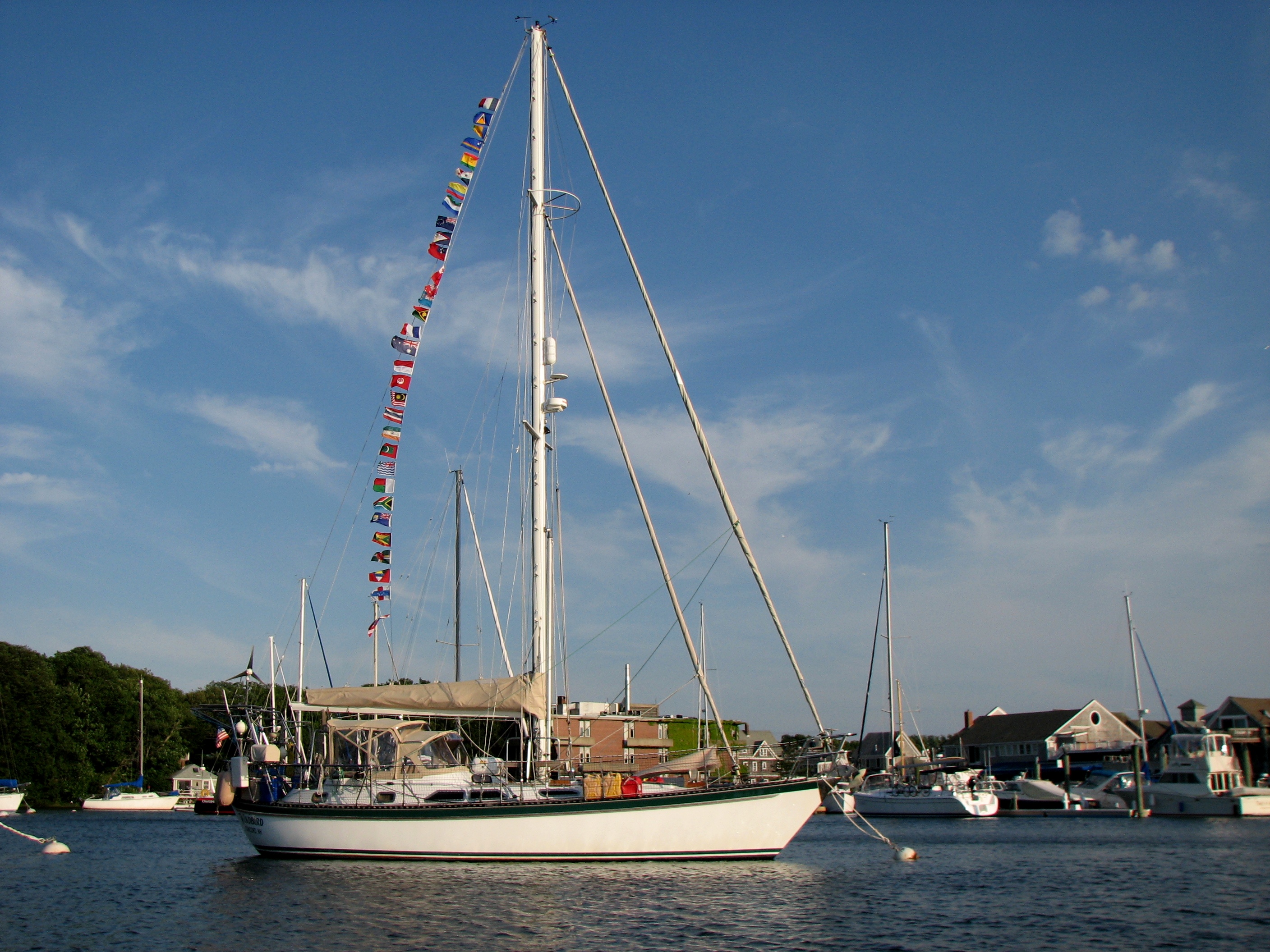
Exactly eight days to the hour. That’s how long it took for our passage from Opua, New Zealand to Suva, Fiji. The GPS reads 193 hours, but that is because Mark turned on the GPS before the trip started. Actually it took 192 hours, noon Thursday of one week to noon Friday of the next. Even with the wind against us the last day and a half, we averaged 5.7 knots overall with the GPS showing our highest speed as 9.6 knots. We were flying through that ‘squash zone’ and I’ll be just as happy if we never have to fly through one again. Customs, Immigration, Agriculture, and Health officials came out at 2:30 to inspect the boat and officially check us in to Fiji. We passed inspection, have taken down the quarantine flag, and are now ready to make our first trip to shore. We are in the Royal Suva yacht Club anchorage and hope to meet Colette and Jean-Pierre of Safina and Marie and Paul of Ranger for Happy Hour. Ohana Kai is also here, but they don’t usually come to Happy Hour since they have two young boys. We’ll have to see them tomorrow. I found it really amazing that all of us that left Opua at the same time, even a catamaran named Balsam that went past us in the Veronica Channel as we left Opua, pulled in here at about the same time. I assumed a catamaran would have beat us here, but they came in an hour after we did. All of us arrived within four hours of each other. Dave of La Vie arrived here yesterday, but he left a day before the rest of us.
Viti Levu is a mountainous island. From our anchorage we look one direction and see a busy shipping port and look the other way and see beautiful mountains. I’m anxious to start exploring, but we’ll probably take it easy this weekend and start the explorations on Monday. Today is Friday here but Thursday back in the US. Our grandbaby Sam had his first plane ride today and I can’t wait to hear how that went. Heather, Jed, and Sam flew to Washington, DC, today to spend the Mother’s Day Weekend with Jed’s parents. On Sunday, Sam will get to meet his only living great grandmother, Muriel. She is Jed’s father’s mother. When we go into town tomorrow, I’ll have to check out the phone and internet capabilities. I have already checked and there is no wireless internet here. Sure hope I can find an internet cafe where I can take in my own computer and make Skype calls. I’ll definitely have a “Gramma Attack” if I can’t talk to and see Sam.
It’s raining right now which is pretty much a daily affair here in Suva. It rains and then the sun comes out. This rain is welcome as it is helping to rinse off the salt. But it’s time to get ready to go in during the next dry period. You’re probably getting the idea that I don’t like wet, and you are right.
by Judy Handley | May 10, 2007 | Passage to Fiji, Sailing Logs Year 2 |
Day 16, Year 2: Eighth Day of Passage from New Zealand to Fiji
Date: Thursday, May 10, 2007
Weather Today: Clear Blue Skies, Winds Just E of N 12-15 Knots
Temperature: Air 81 degrees F; Water 78 degrees F
Latitude: 19 degrees 31 minutes S
Longitude: 177 degrees 25 minutes E
Miles to Go: 105
Location: Passage from New Zealand to Fiji
I entered the eighth day of passage wearing shorts and a tank top, and I’m still hot. But no complaints, mates. We are motor sailing even though we have 12 to 15 knots of wind. The problem is that it is coming directly at us, so we are using the motor to push us forward. White Swan and Scott Free II are the only boats we know that are still back in the squash zone, but they should be coming out of that soon. Scott Free II has an autopilot problem and I sure hope they don’t have to hand steer all the way to Fiji. Donna and Jerry, we are thinking about you. Ranger’s autopilot problems have settled down and they think they were caused by getting water in the autopilot computer. Ours is under our bed, so if it gets wet, we are in more trouble than not having an autopilot! The group headed to Tonga has had rough going, but Procyon will be there tomorrow. Fatty Goodlander on Wild Card is in his third day of sitting out there in 35 to 40 knot winds. As I said yesterday, he deployed a sea anchor day before yesterday and was happy that he could sit still and drink a glass of wine without spilling it. Conditions would have to a lot worse than they have had for me to sit still for three days in Windbird waiting for the weather to pass, but then I’m not familiar with his boat. Since it is smaller and an aft cockpit, and has 20 year old sails, I guess I can see the logic. Hope he has lots of wine onboard. Ohani Kai’s sails are back up after 4,000 pain staking hand stitches and their motor is running smoothly after switching to a new fuel tank and changing the fuel filter twice. Safina barely has enough fuel to make it to Suva, so Ranger is trying to close the gap between them and will follow them in–ready to transfer fuel if necessary. It looks like we are all going to make it just fine, but we have all had to battle some nasty weather on this passage. There will certainly be a celebration at the Royal Suva Yacht Club (RSYC) tomorrow night if we all make it in. Our ETA is around 1 PM in the afternoon, and after getting checked in, we’ll certainly head to the RSYC for Friday Happy Hour.
As we near Fiji, I figure it is time for a language, history, and geography lesson. We are going to the island of Viti Levu to the city of Suva as our first. Suva is the largest city in the South Pacific and some people don’t go there because of that. We enjoy visiting the cities as well as the villages, so we will start there. Half of the population of Fiji lives in Suva. The indigenous people of Fiji were the Lapita people from southeast China mixed with people who arrived from Melanesia. The people called their land Viti and were known as Vitians. That is, until Captain Cook asked the Tongans what the name of the islands to their west were called. The Tongan pronunciation of Viti sounded like “Feegee” to Cook, so Fiji was born out of a misunderstanding of pronunciation. Today Fiji is comprised of over 300 islands. Those islands are divided into nine or ten ifferent groups. We are hoping to visit all nine groups, but that will depend on getting permission while we are in Suva. Fiji’s goverment is a democratic parliament, but they have had four coups since 1987. The most recent coup was just this past November, so we will have to test the waters carefully upon arrival in the capital of Suva. As far as we can tell from our internet research, tourism has not been affected by the coup, so we should be fine. But going through the bureaucracy to get permission to take our boat into remote places might be challenging. About half of Fiji’s population is Fijian and the other half is Indo-Fijian. These are the people who originally were brought in by the British from India as indentured laborers, but these people worked hard and now almost outnumber indigenous Fijians. There is always tension between these two groups. The Indo-Fijians are mostly Hindu, some Muslims, and the Methodist Church is the most influential religious group representing the indigenous Fijians. One of the highlights of visiting Suva is attending Sunday morning church service at the Centenary Methodist Church. They say the singing is spectacular. Maybe this Sunday.
In Fiji, the greeting for hello is “Bula!” Pronouncing such a simple word becomes a trick however. Most of the English alphabet is used except for ‘x’. And ‘h’ and ‘z’ are only used for words that are borrowed from the English language. Of the remaining twenty-six letters, there are variations for eleven of them.
‘b’ is pronounced as ‘mb’
‘c’ is pronounced as ‘th’ in ‘this’
‘d’ is always proceeded with an ‘n’
‘g’ is preceeded with an ‘n’ and pronounced as in ‘sing’
‘j’ is pronounced as ‘ch’ as in ‘charm’ without the ending puff of air
‘k’ is pronounced as in ‘kick’ without the ending puff of air
‘p’ is pronounced as in ‘pip’ wihtout the ending puff of air
‘q’ is pronounced as ‘ng’ as in ‘angry’ not as in ‘sing’
‘r’ is trilled as in Scottish English
‘t’ is pronounced as in ‘tap’ without the ending puff of air, and is sometimes pronounced as ‘ch’ before an ‘i’
‘v’ is pronounced with the lower lip touching the upper lip, not the lower teeth
Wish us luck. I’m not sure we’re going to be able to pronounce much, but we can at least learn to say hello. We just have to put the ‘m’ before the ‘b’–‘mbula’. And if it is like Samoa, you also say hello when you say goodbye, so we can do that as well. Bula!
PS–Land Ho! Just as I started to close this log, I spotted land–the island of Kadavu. This island is south of Viti Levu, our destination. When we reach Kadavu, we turn east in a channel between Viti Levu and Kadavu. After our stay in Suvu, we plan to head back across the channel to visit Kadavu. The Great Astrolabe Reef is there and they say it is great snorkeling. So we are getting close.
by Judy Handley | May 9, 2007 | Passage to Fiji, Sailing Logs Year 2 |
Day 15, Year 2: Seventh Day of Passage from New Zealand to Fiji
Date: Wednesday, May 9, 2007
Weather Today: Finally Clear Blue Skies, Winds N 12 Knots
Temperature: Air 78 degrees F; Water 78 degrees F
Latitude: 21 degrees 17 minutes S
Longitude: 176 degrees 22 minutes E
Miles to Go: 222.5
Location: Passage from New Zealand to Fiji
It is close to sundown and Mark is below on the radio. By the way, he has on shorts and no shirt. The temperature is rising. There has been a 5 PM net that has been run by Paddy on Zafarse but this evening Paddy has his engine running and has interference that is keeping him from hearing most boats. He could hear us and asked Mark to take the net. So Mark is taking the check-ins to make sure we know everyone’s location in case of problems. We are all getting close to Fiji, but different boats are starting to have problems. Ohana Kai with Bruce and Lisa and their two beautiful little boys, Tristin and Matthew, are struggling a bit tonight. They have tears in both their main and headsail and their engine is giving them problems. They are working hard this evening to repair the sails in case the engine goes, but they are two days out of Fiji. We are close to them and we will check in tomorrow morning to see how things are going. I’m not sure what we can do, but I know we will think of something. Kelly and Kelly of Moorea and Ranger are also nearby, so between us all I’m sure we will be creative and find solutions to their problems. Safina is further ahead, but they are losing ground. They are short on fuel and they have only their main sail as their genoa blew out a couple of days ago. This trip has been tough on a number of boats but most of us are now above the squash zone and out of danger. White Swan and Scott Free II are still behind us, but things are starting to calm for them as well. Now we are having to contend with headwinds. At least the seas are fairly calm and the headwinds are fairly light. Windbird is barreling through. This is when Windbird’s large fuel capacity and ability to simply plow forward through wind and waves come into play. She is a good boat.
This morning’s radio net was interesting. The group of boats headed to Tonga have had to slosh through the same squash zone that we have and they are still in it. We talked briefly with Randy on Procyon and he said they are doing fine but it has been a wet trip. With their brand new bullet-proof cockpit enclosure, I was surprised to hear that. But they are an aft cockpit boat. I will have to email to find out the details. We have not heard anything about Endangered Species or Wind Pony, but I’m assuming that Procyon is in contact with them and all is well. Fatty Goodlander on Wild Card is also on the way to Tonga and he reported this morning that he put out a sea anchor last night to steady things. Winds were only in the 25 to 35 knot range, so others on the net were a little surprized at the action. We will be interested to hear tomorrow morning how things went for him. Wild Card is a smaller boat than many out here. It is either a 36 or 38 foot Sparkman-Stephens aft cockpit design. In the seas that we have had, the aft cockpits have been much wetter than our center cockpit. I’m definitely a center cockpit sailor. I often think of Tom Linskey when I talk about liking to be dry when sailing. He and his wife Harriet circumnavigated a number of years ago, and when we were having dinner and talking about our upcoming voyage, I was concerned about getting wet in our little dinghy. I wanted a bigger one (which we did buy). All Tom said to me was, “Judy, didn’t anyone tell you that sailing is a water sport?” I now know it is, but I still prefer the high and dry center cockpit on Windbird. Sorry, Tom.
by Judy Handley | May 8, 2007 | Passage to Fiji, Sailing Logs Year 2 |
Day 14, Year 2: Sixth Day of Passage from New Zealand to Fiji
Date: Tuesday, May 8, 2007
Weather Today: Mostly Overcast, Winds SSE 20 Knots
Temperature: Air 76 degrees F; Water 78 degrees F
Latitude: 23 degrees 03 minutes S
Longitude: 175 degrees 13 minutes E
Miles to Go: 374
Location: Passage from New Zealand to Fiji
After 18 hours of 30 to 40 knot winds and high seas, and then 6 hours of 25 to 30 knot winds and high seas, at about 3 PM this afternoon we came out on the other side. Whew! As I said yesterday, the sailing was challenging and Windbird is a little worse for the wear, but actually we are fine. Others have had problems as well. Ranger and Safina had water in the cockpit that went pouring down into their cabins and Safina blew out their headsail. We are minus a solar panel and only one cockpit
enclosure panel as we did a makeshift repair on the other. We did get some water in the cockpit which is very unusual on Windbird, but we are dry below. We can now see the sun and blue sky and that is comforting. We still have lots of clouds, but they are white, not gray walls. We were in a squash zone and then at about 3 PM I think we emerged on the north side of a front. We had a monster squall at about 1 PM and that started the final passage to the other side. It is nice and calm now and
all is well. If those sailors that are out in front of us are any indication, sometime during the night or early tomorrow, we will lose all wind and have to motor, but I don’t think any of us are going to be upset about that. As long as it is calm, we will be happy. Right now we are sailing along at about 6.5 knots with a double reefed main and we just rolled out the full headsail. We are back on track.
We had a number of squalls today and a couple of those ended with beautiful rainbows. That was the visual highlight of the day. My job tonight is to start seriously studying the various options for islands to visit in Fiji. When we arrive we have to hand the Customs and Immigration folks our Fiji sail plan and get permission to visit the various islands. It has been hard to think about that during the heavy weather, but I am very hopeful that those days are over for now and we can focus on our
arrival in beautiful Fiji.
by Judy Handley | May 7, 2007 | Passage to Fiji, Sailing Logs Year 2 |
Day 13, Year 2: Fifth Day of Passage from New Zealand to Fiji
Date: Monday, May 7, 2007
Weather Today: Totally Overcast, Winds SE 33 Knots
Temperature: Air 76 degrees F
Latitude: 25 degrees 36 minutes S
Longitude: 175 degrees 00 minutes E
Miles to Go: 508
Location: Passage from New Zealand to Fiji
It was a challenging day on the high seas, and I literally mean high seas. Winds during the night were 25 to 30 and during the morning they started building slowly. By 2 PM, the predicted 20 to 25 knot winds were a consistent 33 knots with gusts to 38 and the seas had built to at least 12 feet. A weather map is a little like a topographic map. On a topographic map, when the lines are close together it indicates rising heights in the land. On a weather map, when those lines or isobars are close together, it means high winds. And when you get caught between a low and a high, the lines get close together. Some call this a squash zone, and I can tell you first hand that I definitely feel squashed. When you have heavy weather like this, you just can’t afford to make mistakes, but we did just that today. We are okay, although Mark’s arm is a little bruised, but Windbird sustained a little more damage. At 10 AM this morning, we were running with the double reefed mainsail and the staysail. The winds had not started to seriously build, and we decided to put out a bit of the headsail to give us a little more speed. That was the mistake. By 2 PM, we knew we needed to bring in the headsail, usually not a problem. So without thinking through the complications in such windy conditions, we started trying to bring it in. One thing led to another, and the sheet or line to the headsail started flogging wildly. There was so much force behind it that it bent one of the stanchions or stainless steel uprights that hold the life lines in place, it shattered the solar panel on the port side, and it destroyed the plastic and zippers in two of our cockpit enclosure panels.
While all of this was happening, we were continuing to try and pull the sail in. Mark’s arm got in the way a few times and he has some pretty ugly bruises on his right forearm. In addition, he lost both of our good wench handles overboard. We only have two more, one old stainless one that doesn’t lock in place, and the one we leave on the mast to use when raising the mainsail. I was protected by the plastic enclosure, so I didn’t get the damage, they did. For about half an hour, it wasn’t a pretty picture here on Windbird. And of all the luck, at this same time, another boat was hailing us as it passed by. After our ordeal was over, we called back. The boat’s name is Halo and the captain sounds British. We will be traveling close together tonight and have promised to hail each other if we have problems. We were close to Arctic Fox last night, but they dipped out of sight by 7 AM this morning. They have tried to call us this afternoon, but they are too far away and we can’t connect. We will talk on the 5:30 radio net.
Halo called a few minutes ago to inform us of their course for the night and to tell us that they took down their staysail and were much more comfortable. We did the same, and we are riding much smoother now. We are no longer going 8 and 9 knots, but we are moving at a comfortable 6.5 knots. So we will sail through the night with just the double reefed main up. Sometime tomorrow, we should be far enough north to be out of the squash zone. At that point, the winds should subside, but we still don’t know exactly what is going to happen with the low. At worst we will have more 30 knot winds, but at best, we will be far enough north and it will pass behind us. Right now, that sounds really good.
by Judy Handley | May 6, 2007 | Passage to Fiji, Sailing Logs Year 2 |
Day 12, Year 2: Fourth Day of Passage from New Zealand to Fiji
Date: Sunday, May 6, 2007
Weather Today: Mostly cloudy, Winds SE 25 Knots
Temperature: Air 68 degrees F; Water 68 degrees F
Latitude: 28 degrees 05 minutes S
Longitude: 174 degrees 45 minutes E
Miles to Go: 648
Location: Passage from New Zealand to Fiji
Good news. That low that has had us worried is currently staying at 180 on the Dateline for now. We are between 174 and 175 E and by the time it moves to this area on Thursday, we will be well north of it. That means we shouldn’t get the heavy winds above 30 knots. However, the beautiful conditions we had yesterday were a one day affair. We are still sailing at about 6.5 knots, but with winds in the 20 to 30 knot range. That means the seas have kicked up so it is not a smooth ride, but it is certainly safe. The latest weather report tells us that we will have a thick cloud cover from here on to Fiji and will probably have rain once we get there. We got our first squall on my watch around midnight last night and will continue to get occasional squalls with rain, but nothing terrible. The water and air temperature are getting warmer, but with the cloud cover, it actually feels cooler. So far the water and air temps have increased by about two degrees per day.
Last night at about sunset, we had more unexpected bird visitors. Other boats were reporting the same. Last night’s visitors were Saddlebacks, but as dark descended, they flew away. There’s not much else to report. I’ll finish a Tom Clancy book tonight (I’m deep into the Middle East). Mark finished reading Dava Sobel’s The Planets and is now reading a Robert Ludlum book, The Ambler Warning. Clancy, Ludllum, Grisham, and DeMille books are great for passage. Alan Kanegsberg left The Planets for Mark to read and he really enjoyed it. Sobel has an interesting way of interweaving mythology, science, astrology, and current space exploration. I’ll wait until we are in Fiji to read that one as I need to start reading about Fiji.