by Judy Handley | May 26, 2010 | Chagos, Sailing Logs Year 5 |
Day 212, Year 5: Chasing Chicks and Other Things
Date: Wednesday, May 26, 2010
Weather: Sunny Day, Cloudy Evening, SE Winds 12-15
Location: Ile Fouquet, Salomon Atoll, Chagos
Mark has a brother named Steve and a nephew named Jimmy. When Jimmy was about five years old, he had gone out with Steve and when he returned he was asked where they had been. He nonchalantly said, “Chasing chicks and drinking beer.” Well, we weren’t drinking beer this afternoon but I was chasing chickens again . . . and tiny little white moths with black and red dots. When we assessed what needed to be done today, there was a long list of things like polish stainless, put AwlCare on the topsides (like waxing your boat), clean the Raycor fuel filter, finish synchronizing and updating our Outlook contacts on our two computers, and on and on. I added one more thing and that was to go to the north end of Takamaka and sit in a chair and watch for a little white moth. When Mark asked which one I wanted to do, guess which one I chose. But it takes fuel to go down to the end of Takamaka and we are really trying to conserve, so going to look for an obscure moth didn’t quite make it. We compromised and worked for the morning on cleaning the Raycor fuel filter and getting through the letters R and S in the Outlook contacts list. In the afternoon I worked on photos and Mark took a mooring ball that we found on the beach and cut in half to make two hanging pots for growing more arugula and basil. THEN we went to Takamaka to get water and look for moths. I had read that the moths live in the Beach Heliotrope, a shrub, sometimes tree height, that grows abundantly on the north end of Takamaka. While walking slowly looking for the moth, what we heard clearly were chickens on the other side of the Beach Heliotrope. This stuff grows in and amongst the Scavvy or Lettuce Shrub right at the high tide line. Behind this impenetrable shrubbery are a number of different hardwood trees and those chickens were there cackling and crowing away. I am dying to see one of them, so I walked all the way to the end of the beach shrubs and crawled behind. I could hear the chickens but see nothing. I could see lots of boobies roosting above me and worried that I would be their next target. Guano covered every leaf and branch that I was crawling through. I found my way back out to the beach and started back toward the dinghy when the call of chickens got to me. I found a low break in the hedge and crawled through again. On the other side was a lovely little meadow, but again no chickens. Richard on Mr. Curley who has been here year after year says the way to see them is to break open some green coconuts and leave them in the camp in the evening. The next morning the chickens will be there. So I’ll try that next. But I was successful in sighting and photographing the little white moth (less than an inch long and wide) with black and red speckles (Ultethesia pulchelloides), so I’ll consider my day a success.
Dinner tonight is even more of an adventure. I am using most of the little tomatoes we still have from India with a squash that has kept all this time to make a Chagos rendition of ratatouille. The moon is up and almost full. Tomorrow we have our beach Full Moon party in the evening. Life here is just full of interesting things!
by Judy Handley | May 25, 2010 | Chagos, Sailing Logs Year 5 |
Day 211, Year 5: You Can’t Take It With You
Date: Tuesday, May 25, 2010
Weather: Another Mostly Sunny Day, Cloudy Evening, SE Winds 10-12
Location: Ile Fouquet, Salomon Atoll, Chagos
One week from tomorrow, give or take a day or two for weather considerations, we will be leaving Chagos and traveling the 1500 miles to Madagascar. Our Chagos permit is up on June 2, so that is our deadline. We paid 100 British pounds or $150 US per month for our permit to stay here and it has been worth every penny. This morning when we checked our email we received a message from our son Justin. He told us about the environmental disaster happening in the Gulf of Mexico. We get no news out here and we had not heard about this. It made us so very sad to think of the damage that much crude oil can do to our oceans and it made me value the pristine nature of Chagos even more. So we rowed our dinghy to the shore closest to Windbird to conserve fuel and Mark carried the bag with our cans and bottles half the length of the island to the Fouquet camp where the recycling bins are located. I followed along slowly doing a tree and shrub “inspection.” I was amazed to find four of the six most prevalent Chagos hardwoods growing right there on the beach. I can’t take them with me, but I took more photos and collected leaves and blossoms to dry and sketch. In those trees we saw lots of Red-footed boobies just hanging out and four beautiful little fairy terns put on a show for me. These small terns are so very white with tiny almond-shaped black eyes. They appear to be mating and while I was taking photos of a tree with orange blossoms, I heard quite a commotion overhead. Two pairs were flying up in the air and coming back down to land on the dead branches of a tree over my head. Every time they went up and down they would chatter and this caused the boobies in the tree I was photographing to fuss. I was in bird heaven. On the end of the island we watched Bridled Terns putting on a different show. We have been here long enough now to recognize most of the birds, trees, and bushes. That is made possible because there are just so many plants and animals here. This would not be possible in New England where the diversity is so much greater. Hopefully the oil spill will be contained soon so that it doesn’t get into the Gulf Stream and head up the East Coast. That would be a disaster beyond comprehension. We have many months before we arrive in the waters off the East Coast of the US but it would be quite sad to return to a less diverse coast than the one we left almost six years ago.
We spent the middle part of our day rearranging things inside the boat to get ready for the Madagascar passage and we got out our Snuba dive compressor and took it apart to clean it. We will need it to clean the bottom of the boat before leaving here and we realized that we have never cleaned it. We then used our dinghy motor to take us to Takamaka island to burn trash, cut Mark’s hair, get water, and do a little island exploring. Tomorrow might end up to be a fishing day if the winds calm back down, and if not we will continue to get Windbird ready for passage and maybe do a little snorkeling in the pass at high tide again.
by Judy Handley | May 24, 2010 | Chagos, Sailing Logs Year 5 |
Day 210, Year 5: Hat Making 101
Date: Monday, May 24, 2010
Weather: Broken Record-Sunny Day, Cloudy Evening, SE Winds 5
Location: Ile Fouquet, Salomon Atoll, Chagos
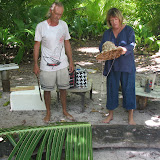
Today’s endeavor was to try and learn the art of making hats and bowls from coconut fronds. After three hours, Mark and I decided that we flunked Hat Making 101, but we had a good time and we do certainly know more than we did. I have a bowl woven from a coconut frond sitting on the table in the main salon. It has been there since Tonga in 2006 and I never dreamed that I could learn to make one. But I now look at it differently. With time and patience, I think I could make one. The key is finding a frond with long enough leaves (three feet is a good length, not shorter) and with no more than an inch-and-a-half between where the leaves come off the palm frond. You then chop out a section of the frond that has about eighteen sets of leaves. The length depends on what you are making, but for a hat this is about right. You then take a machete and split the stem right down the middle and spend about a half-an-hour trimming this down so that there is just enough stem to hold the leaves on. The stem is now pliable and you can bend it around to fit your head. You overlap the stem, cut off the excess, and then make two sets of notches on each side of where the stem overlaps. You then wrap wire ties or strips of coconut fiber around at both sets of notches. At this point you have a crown of very long palm leaves. Then the fun begins. You begin to weave the leaves together and two hours later you have a hat. Or something like that. Our products from today are pretty rough looking, but we now know how to do this. Now we just need to practice. Kathy of Mr. Curley was our teacher and the students were Mark and I, John and Sue of Susan Margaret, and Wolfgang of Galateia. John was by far the most serious student and his second creation was quite nice. While Mark and I were working on our first, Sue came over and asked if we were making a lamp shade. That’s why I say we flunked the course!
We are also indebted to Kathy and Richard on Mr. Curley for selling us 50 liters of dinghy fuel. They will be here another six weeks, but they have extra and we are so happy to get the fuel. We split the fuel between Constance and ourselves and now we can use the dinghy without worrying about running out of fuel. I traded a couple of cans of butter plus some US money for the fuel. Thank you, Mr. Curley.
by Judy Handley | May 23, 2010 | Chagos, Sailing Logs Year 5 |
Day 209, Year 5: Book Swap in Takamaka Camp
Date: Sunday, May 23, 2010
Weather: Still Beautiful, Still Cloudy Evenings, Still SE Winds 10-15
Location: Ile Fouquet, Salomon Atoll, Chagos
I don’t think you can have a bad day here in Chagos, so I must report another beautiful day. We are anchored here with a really interesting group of boats. There are seven boats now-one French (Kea), one German (Galateia), one out of Dubai with a Brit and a South African aboard (Susan Margaret), one out of Australia with an Aussie and a Brit aboard (Mr. Curley), and three from the USA (Windbird, Constance, and Ventana with a Norwegian crew member aboard). Every person is interesting and together we make a great group. Our book swap in the Takamaka camp was just an excuse for getting together, but we did swap books, eat goodies that everyone brought, and then the nature lovers (me, Sue and John of Susan Margaret, Wolfgang of Galateia, Ed of Constance, and our fearless leader, Kathy of Mr. Curley) took off down a path that follows the shore, just a bit inland. We came to a beautiful little meadow, saw some new (to me) wildflowers, and then went into the area with the well to look for palm fronds that would be just the right size for weaving hats and baskets. We found just the right fronds, sent John up a coconut tree to cut them down, and then carried them back on our heads-one person, one palm frond. I had my bush knife with me and my camera, so carrying a very long palm frond on my head while carrying a bush knife and trying to take photos at the same time was a real trick. It was great fun and I look forward to going back tomorrow to learn how to weave the fronds into hats and baskets.
While in the camp today, a butterfly flew thru and Kathy and I went running into the bush after it. It was the black and white butterfly that Kathy had told me about, the one that the dragonfly that I have a photo of tries to mimic, so I was super excited to get a photo of it. While we were on our palm frond search, I was also able to get a few more photos of blossoms and fruits that have escaped me to date. I could spend at least a year here just identifying plants and fish, but in only nine more days we move on to Madagascar. So I know I will be desperately filling my nine days with forays to shore to get just one more photo.
Ed and Lynne invited us over for sundowners this evening. Somehow it seems like ages since we have been together to catch up on family news and talk about plans for leaving for Madagascar. So it was a great evening of catch-up. We both bemoaned the fact that we have very little fuel left for our dinghies, so we really have to limit our trips. Mark and Ed will go out fishing tomorrow for probably the last time. Mark and I really want to go down to Boddam again to walk the trails, but we might have to move the big boat instead of taking the dinghy.
One last note . . . about food. It has been about two and a half months since we last visited a real supermarket (in India). We did buy limes, a few banana peppers, and eggs in Gan in the Maldives, but I’m not counting that. And even without a freezer, we are still having delicious meals. We have to be inventive, but it works. Tonight we had grilled Yellowfin tuna with a mix of pasta shells, feta cheese (preserved in olive oil), and dried green peas bought in India that you boil and simmer for ten minutes to bring them back to life. It was a gourmet meal.
by Judy Handley | May 22, 2010 | Chagos, Sailing Logs Year 5 |
Day 208, Year 5: Fantastic Drift Snorkel and Camp Clean-up
Date: Saturday, May 22, 2010
Weather: Repeat–Beautiful Day, Cloudy Evening; SE Winds 15
Location: Ile Fouquet, Salomon Atoll, Chagos
What a great way to start a day. High Tide was at 9 am, so we picked up Ed and Lynne and headed into the pass between Takamaka and Fouquet. This is a narrow pass with sandbars on both sides, and you can only go so far in even at high tide as it gets very shallow, but we went as far as we could and jumped in the water to drift with the dinghy. The current is somewhere between one to two knots 24 hours a day. It never reverses and never slows down, so the only way to see the fish and coral is to drift with the current. I took Mark’s video camera and tried to capture some of the beauty. Most of the footage is unusable as I was moving too fast, but once in a while I could grab on to a piece of coral and hold fast for a few seconds. I got so-so footage of a large and beautiful Emperor Angelfish, good footage of the little Nemos, and a short, but great clip of a turtle that was right under in front of me. He was swimming against the current, so it seemed he was not moving and that allowed me to get the video of him. We went in and out three times and just had a fabulous time. We will definitely do this a few more times before leaving here.
The good news of the day is that Ed and Lynne’s refrigerator compressor is magically working again, so they are VERY happy cruisers. But their almost new AGM batteries just don’t seem to be holding a charge like they should, so today’s project was to take one of their batteries and connect it directly to our wind generator to charge it. In order to do that we had to get under the bed in the aft cabin and that meant moving all the stuff on top that used to be stored in the v-berth. So we decided to move everything back to the v-berth and sleep once again in the aft cabin. It is cooler now, so that should be fine, and we have discovered that it is a much better mattress. All of that moving happened before the drift snorkel and then in the afternoon, Mark, Ed, and I went to the camp on Takamaka and did a major clean-up to get ready for tomorrow morning’s book exchange. Sweeping debris from a large area with a palm fond is a back breaking job, but the camp looks great now and it will be fun to get together with everyone tomorrow. We have a new boat in the anchorage, Galateia, a German boat with a young single-hander named Wolfgang. We haven’t met him yet, but hopefully we will meet him tomorrow.
The bad news of the day is that our friend Robert of Shirena has more serious heart problems than expected. He arrived in Vienna, went immediately into the hospital, and the test results are showing that part of his heart is simply not working due to a lack of blood flow over a period of time. The doctors there tell him his sailing days are over and that he needs a pacemaker and a defribulator with him all the time. So now he and Tina are flying back to their home in Sydney, Australia, to get a second opinion. Shirena seems safely tucked into the marina in Ashkelon, Israel, and they will leave it for the next six months while they are deciding what to do. Right now friends Tom and Nicolette of Katanne are in the marina with Shirena and watching over things. So our thoughts are with Robert and we are hoping that when he arrives in Australia, the doctors there might be more hopeful.