2020 Life Logs, Day 159: Switching Gears Mid-Day
Date: Monday, June 8, 2020
Weather: Mostly Sunny, Windy; High 75, Low 54 degrees F
Location: At Home in The Cottage, East Falmouth, MA
The really good news of the day is that Ollie’s fever broke during the night and he is back to feeling fine. We have various ideas of what caused the fever, but no one thinks it was coronavirus related. I started my day thinking I would not be seeing the Goldstones as a safety measure because of Ollie’s fever, but I ended my day taking Sam, Jonah, and Ollie to beach. I had just finished watching a New York Times Living Well webinar on Lowering Coronavirus Risk with Professor Erin Bromage when Jed called to explore the possibilities. Together we decided that keeping the boys active and in outdoor activities is the best for all of us. So, I volunteered to take all three to the beach this afternoon and Jed agreed.
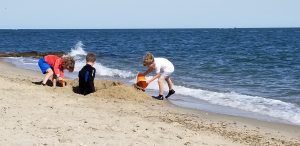
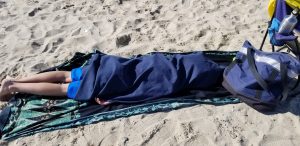
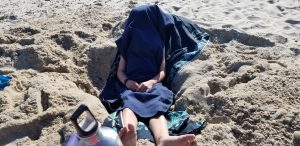 Jed delivered the boys here and then he left as he had to make a trip into Woods Hole to check on things at work. It was a beautiful afternoon with lots of sunshine, but it was windy at the beach which made it feel cooler that we expected. I was glad I had on a long sleeve beach shirt. Sam is the only one who got into the water today as he had his wet suit on. Jonah spent most of his time finding ways to hide under towels to stay out of the wind. And Ollie played on the edge of the water, just not jumping in. Just as we were getting in the car to go home, I got a call from Heather saying she was on her way to pick Jed up. He rode his bicycle into Woods Hole and had a bike accident on his way home. She didn’t know the details at that point, but said that he had called and said something about a flat tire and a wipe out, but that he sounded okay. By the time I got the boys home, Heather was pulling in with Jed. He had fallen off the bike when the tire blew and skidded on the pavement. Thankfully, nothing broken, but some areas of pavement ‘burn’. Ouch.
Now back to the webinar with Erin Bromage. He is the University of Massachusetts Dartmouth Associate Professor of Biology whose blog discussing how to lower your risk of getting the coronavirus went viral a couple of weeks ago. His appeal is the down-to-earth way he takes the current data and translates it into practical ways of protecting yourself and your family. I took some notes today and will share them with you here. He had nothing to say that I really had not already heard, but it is the way he puts it all together that is so valuable.
1. His number one recommendation is for everyone to keep track of the number of positive test results being reported by your state. If it is between 2 and 5 per cent, then your state is probably doing well. Under 2 per cent is ideal. His advice is to simply Google your state and Covid-19 to get the results for your state. The lower the percentage, the less community transmission. And that is a good thing.
2. For parents, he recommends making a pact with neighborhood parents. You need to know what each family is doing in terms of safety. Then pick a group that you feel safe with and let your children play together outside—never inside someone else’s home. Once you pick a group, stick with it and don’t mix your circles of friends.
3. Bromage feels that most park environments are fairly safe as along as you maintain that six-foot spacing and have hand sanitizer with you. When at the beach, he doesn’t think you need to worry about which way the wind is blowing as it switches too quickly. Just pick a space separate from others and stay within your space.
4. For hair cuts, he recommends finding someone who will do your whole family at once. Skip getting your hair washed or any other thing done that is not absolutely essential right now. Just go get your hair cut, no waiting in waiting rooms, and make sure only every other chair in the salon is in use.
5. Bromage is really hopeful that we are going to be able to get kids back in schools, but it is going to take a huge amount of planning. He is suggesting a pod approach of 15 to 20 students and no mixing of pods for any reason. But he admits that no matter what is done, there will be transmission. Parents just have to ask what level of risk they are willing to take.
6. On public transportation. People are walking and using their own cars, but they are not yet convinced that public transportation is safe. If you do need to take public transportation, invest in a high quality mask as those become available. Be aware of the surfaces you touch. Carry alcohol rub and use it immediately after exiting. Use an N95 mask in high risk areas and treat it as contaminated. Wear it, then store it in a closed plastic box you carry with you. When you get home, open it up to air out. Using this protocol, he thinks you can use same mask over and over without risk. He mentioned that everyone on airlines must wear a mask, but airlines are not enforcing this. If everyone is not wearing a mask, it puts everyone at risk.
7. On bathrooms—vacuum flush toilets on airlines are the safest, porta potties are okay as long you use hand sanitizer when you exit, but indoor flush toilets are the most risky because they aerosolize. Just remember that the virus hangs in the air for about eight minutes.
8. If you do find yourself in a high risk situation, like being part of a protest, just make sure you self-isolate for ten days afterwards. And get tested if that is possible.
9. Final recommendations—manage your interactions. Constantly be aware of SPACE and the LENGTH OF TIME of encounters. Keep it short. WEAR MASKS. And never gather with TOO MANY PEOPLE. The way you manage your space is up to you and doing it responsibly is the most important thing you can do.
10. Bromage ended by saying that he is optimistic about the level of cooperation between scientists and that he really believes most people are trying to do the right thing.
This New York Times webinar is called Live Well and is aired every Monday at 1 pm EDT. It is hosted by Tara Parker-Pope. To register for future webinars, go to https://timesevents.nytimes.com/