
Day 39, Year 2: Guided Tour on Beqa Island
Date: Saturday, June 2, 2007
Weather: More Wind and Rain; Clearing in Late Afternoon
Location: Vaga Bay, Beqa Island, Fiji
What an interesting day. We awoke to almost sunny skies after a night of rain. Naively, we thought maybe the weather was clearing. Until about 10 AM, it was mostly sunny, but then the rains and winds blowing down into the anchorage from the mountains on the island returned. We delayed our visit to the village of Naiseuseu, waiting for better weather. But just after noon, we realized that the off and on rain was going to be with us for the duration, so we got in the dinghy and went around the
reef and into the harbor area of the village. On the way, we saw beautiful coral and lemon fish, but soon we had to get out the dinghy and walk her through the shallow waters to shore. It was almost low tide, and at this time, there is huge mud flat in front of the village, stetching almost across to the reef. By not going in yesterday, I think I had built up a fear of experiencing the new and I was actually dreading going into the village. I have no idea what I was afraid of, but this is all
new to us. Last year, we never came into a harbor where we were the only boat, but out here, we are really on our own. After today’s experieince, however, I feel much more confidient.
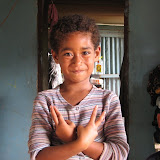
As we were pulling the dinghy through the low tide shallows, a kid about nine or ten years old came down to help us. He brought with him a couple of younger girls. The young man, Saula, went with Mark to help him move the dinghy closer to the village. I walked across the low tide flats with Maria (trill the ‘r’) and Kesaia. They spoke almost no English, but I did learn that Maria was Class One in school and the taller girl, Kesaia, was younger and was ‘kinder.’ I assumed that was kindergarten.
The only word I recognized that they were saying sounded like palagi. This is the Samoan word for ‘white man’ and later in the day Kesaia’s grandmother explained that the Fijian word for ‘white man’ is kaitani (pronounced kaitangi). It sounds amazingly similar to the Samoan ‘palagi’. After Mark and Saula (pronounced like ‘Soul-a’) got the dinghy secured, we all walked up to the village. Saula led us to his grandmother’s house which was the same house Mark visited yesterday. Toni, the young
man that had brought Mark into the village yesterday came out to greet us and invite us in. On the way, a little tyke about four years old came up and grabbed Mark’s hand. He kept saying ‘kaitani’ over and over. Mark was his ‘kaitani’ and he was not going to let go. He certainly won over Mark’s affection right away. Maria and Kesaia continued to walk with me and once in a while they would take my hand, but then they would giggle and let go. I think they were as nervous as I was.
We took off our shoes and went into Toni’s mother’s home. His sister was there and she had a one year-old that looked identical to the four year-old that was holding Mark’s hand. Four of the children present were hers. The grandmother, Kesaia, came out to greet us and we sat on the couch and talked. Toni’s sister was sitting on the floor in the living room. Four of the children belonged to her and she could not have been older than 30. She admired my earrings and I gave them to her as a gift
when we left. Toni then presented us with three huge papayas, some lemons, and two coconuts. Yesterday Mark had told him that we would give him some D-cell batteries and I think this was the payment. Unfortunately, we had given the batteries to a fishing boat last night thinking that Toni was in the boat, but he had not been the recipient. We told him we had only four more D-cells, but that we would bring those back to him once we returned to Windbird. We then expressed a desire to walk around
part of the island and we were granted permission to do so. Saula was to be our guide, so off we went.
We walked across the mud flats to a small stream that was flowing out to the sea. I had a million questions. “What kind of tree is this? What kind of fish is that that walks across the water? How do you say that in English?” I had a pen but no paper with me so I did the thing that I have always fussed at my children for doing–I Wrote notes on my hand. You will see the folly of this later on, but for now, I was asking and writing and Saula was doing his best to teach us all he knew. We found
our first butu tree. We had seen this tree in American Samoa and then later in Tonga. It has an absolutely beautiful blossom and a huge seed pod. We had learned in American Samoa that the seed pod can be thrown into a small clump of fish and that it has a poison that stuns the fish long enough to let them be caught. We walked on and found a tree with purple blossoms and a green seed pod that Saula said could be eaten. We don’t know the name of that tree. Then there was the tree with hibiscus
blossoms called and vau tree. Saula invited us to walk up the muddy hillside through a stream to the garden. The garden was actually a lemon tree and a mango tree, but it was a neat side trip. I did see one of the dreaded centipedes in the stream as I was walking and since I was in sandals, I was glad I hadn’t stepped too close. These creatures have a powerful sting. We investigated the clams that are plastered to every rock, learned that the small coconut-like pods lying on the ground are called
ivi, and found another tree with a green pod that houses something like a peanut that can be eaten. I think this was called a silu. By this time we were at the point near the mouth of the bay, so we all agreed it was time to walk back to the village. As we walked back, Saula pulled up every coconut tree that had sprouted in the low tide area and whistled and sang to hermit crabs in their little shells. At one point, we got into a crab chasing game. He would stomp on the sand and the crab would
come running towards me. I would try to block its advance with my foot, but then I would back off and the crab would run forward. We were having a grand time, but then it was back to the village. We went back to Saula’s grandmother’s home and were invited to stay for tea. I know we are not supposed to drink the local water, but how can you refuse such hospitality? I guess we will learn, but for now we drank the tea and enjoyed the children. The grandmother Saula asked if we had any fishing
line that we could spare and we told her we would check. Toni was there and he quietly talked to Mark about coming out to see our boat. I didn’t hear this part of the conversation, but when we left, Saula and Toni went with us. Maria and Kesaia also followed but Toni told them to go back and they obeyed.
We got back to Windbird and I offered Toni and Saula a Coke. I had to get ice out of the freezer as I had no cold drinks and in doing so, I washed my hands and lost all of my precious notes from the walk with Saula. I couldn’t believe it. As soon as Mark took Toni and Saula back to the island, I tried to remember as many names as possible from our walk, but next time I will be sure to take a journal to record the information. The writing on the hand method obviously doesn’t work for me. Either
that, or I have the wrong kind of writing pen.
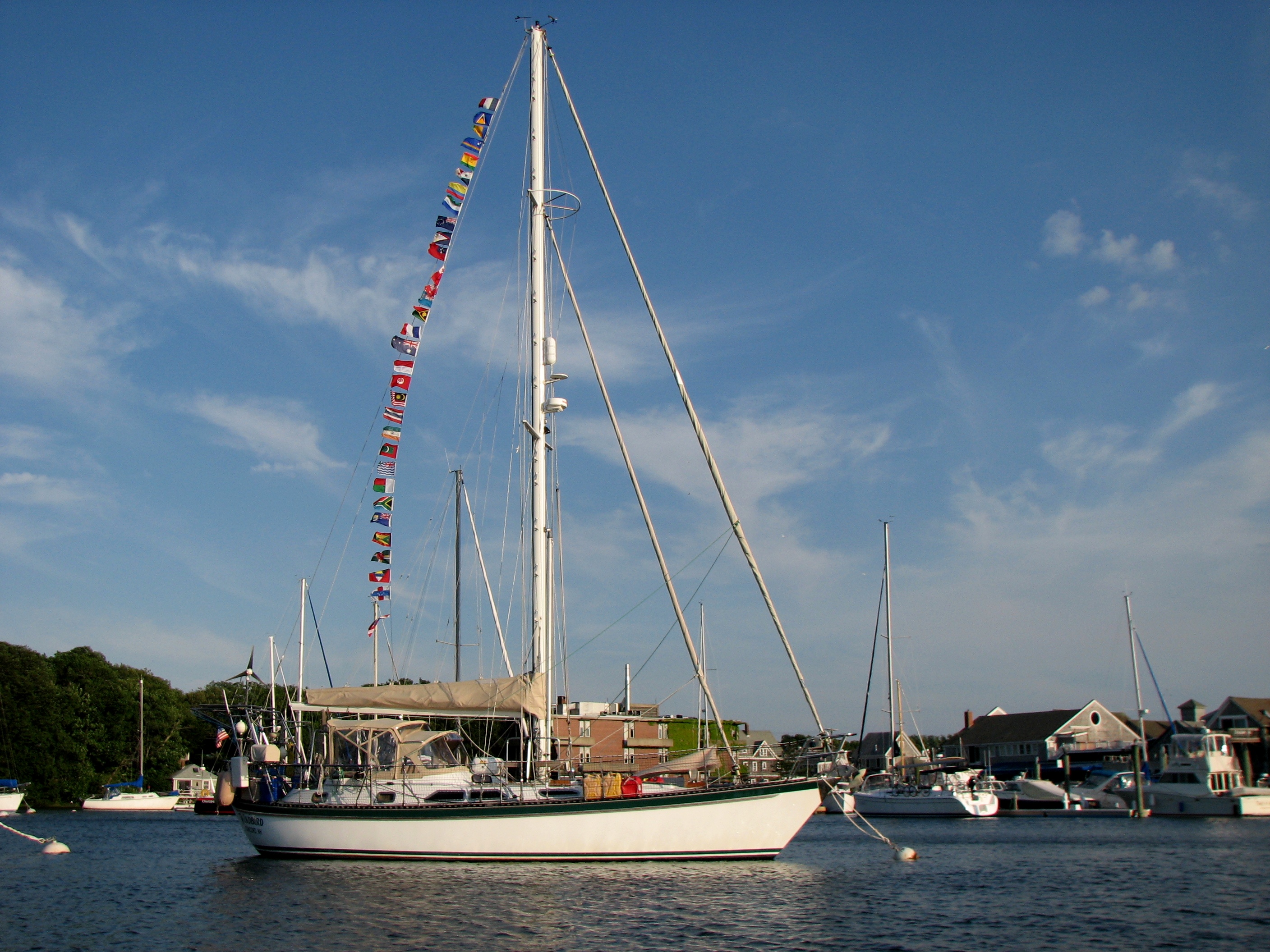
I could tell by today’s visit that it is going to be hard for us not to give more than we have to the island people. They have so little and you want to give them what you can. We don’t have much on board, but we will give what we can. We might have little left by the time we reach Australia, but we will have rich memories.
Not sure what we are going to do about leaving here for Kadavu. Kesaia, the grandmother, told us today that this same weather will probably be around for the next week or two. We had hoped to leave here tomorrow or Monday at the latest, but we certainly don’t want to try and enter the Astrolabe reef in these windy conditions. There is a pattern to this weather–rain, rain, rain, sun, rain, rain, rain, sun. The early mornings are calm, late morning is windy and rainy, early afternoon is sunny
and calm, and then in late afternoon, the rain and wind comes back full force. Right now it is blowing 20 t0 25 knots and actually causing the boat to heel. We will check the Fiji weather when we get on the radio to send this email and hope the report has some hope for a break. We now know that the weather rules, so we will just have to wait and see.
 |
| 070602 Day 39 Beqa Island, Fiji–Guided Tour on Beqa Island |
Dear Judy and Mark,
Now this is some interesting cruising! After the rough trip over to the island and the harrowing anchoring session, I’m glad to hear that the people have accepted your kava root offering and befriended you. Sounds like the little ones have definitely taken a shine to you. Maybe you’ll have to go back to Suva before you continue on, to stock up on batteries and fishing line for gifts! I think you did a great job, Judy, of remembering all those things after you washed the notes off your hand. Hope you’re taking lots of pictures.
Wishing you smooth sailing ahead.
Cheryl in Maine